
Resources
Explore a wide range of valuable resources on GCED to deepen your understanding and enhance your research, advocacy, teaching, and learning.
3,376 Results found
 Teaching and Learning Transformative Engagement Year of publication: 2019 Corporate author: UNESCO While there is a large body of literature on citizenship and civic education, there is less clarity about the meaning of ‘responsible transformative engagement’ for young learners in relation to GCED and ESD – notably, the types of transformative engagement and the meaning of ‘responsible’. Understanding better the connection between learners’ engagement and education can clarify the knowledge, skills and competencies that schools may provide, as well as how the role of education can vary depending on context. In this light, this paper explores the meaning of ‘responsible transformative engagement’ with a view to clarifying the role of education in ways that may be reflected by UNESCO and other education stakeholders. Enseigner et apprendre l'engagement transformatif Year of publication: 2019 Corporate author: Organisation des Nations Unies pour l'éducation, la science et la culture (UNESCO) Si les ouvrages consacrés à la citoyenneté et à l’éducation civique foisonnent, le sens d’un « engagement transformatif responsable » pour de jeunes apprenants dans le contexte de l’ECM et de l’EDD est moins clairement défini, notamment les types d’engagement transformatif et la notion de « responsabilité ». Mieux comprendre le lien entre l’engagement des apprenants et l’éducation permet de clarifier les connaissances, aptitudes et compétences que l’école peut enseigner, ainsi que le rôle variable que peut jouer l’éducation selon le contexte. Dans cette optique, le présent document s’interroge sur le sens d’un « engagement transformatif responsable » en vue d’apporter des éclaircissements sur le rôle de l’éducation qui peuvent être pris en compte par l’UNESCO et d’autres acteurs de l’éducation. Enseñando y aprendiendo para una participación transformadora Year of publication: 2019 Corporate author: Organización de las Naciones Unidas para la Educación, la Ciencia y la Cultura (UNESCO) Si bien existe una extensa bibliografía sobre educación cívica y ciudadana, hay menos claridad acerca del significado del concepto de una "participación transformadora responsable" de jóvenes estudiantes en relación con la ECM y la EDS, en particular, los tipos de participación transformadora y la definición del término "responsable". Comprender mejor la relación entre la participación de los estudiantes y la educación puede contribuir a mejorar la definición de los conocimientos, aptitudes y competencias que las escuelas pueden enseñar, así como las maneras en que el papel de la educación puede variar según el contexto. En este sentido, el presente documento explora el significado de una "participación transformadora responsable", con miras a explicar el papel de la educación de formas que puedan reflejar la UNESCO y otros actores de la educación
 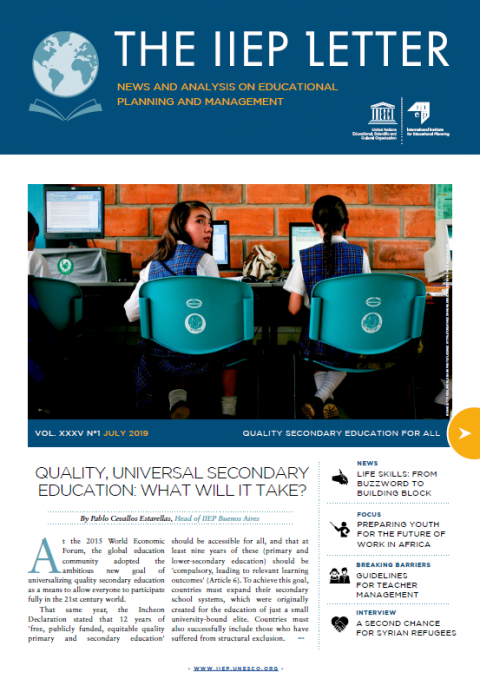 The IIEP letter: news and analysis on educational planning and management, vol. 35, no. 1 Year of publication: 2019 Corporate author: UNESCO This issue is dedicated to addressing the challenges and opportunities for quality secondary education for all. It addresses the necessary structural and curricular changes secondary education must undergo in order to address long histories of segregation and inequality. Experiences from Latin America illustrate some key takeaways on how to match commitment with meaningful change.
  Her education, our future: snapshots of UNESCO's work Year of publication: 2019 Corporate author: UNESCO This collection provides snapshots of some of UNESCO’s efforts to empower women and girls through education. It highlights core areas of work undertaken, as profiled on the next page. The aim is to give the reader a flavour of what it is that UNESCO, including its 53 field offices and specialized institutes, is doing to transform her education and our future.
 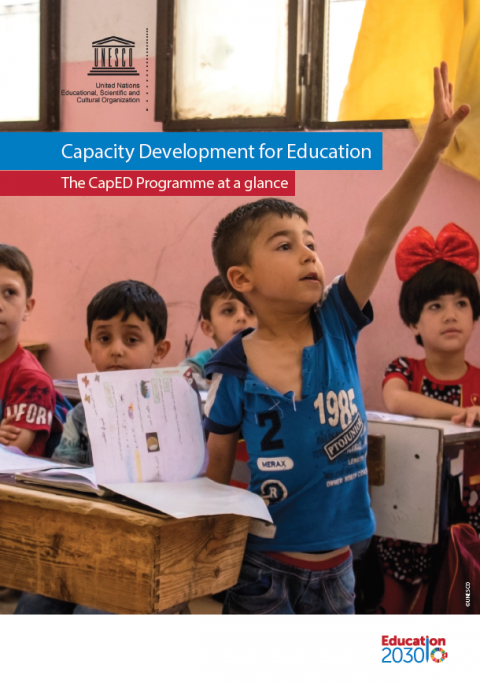 Capacity Develoment for Education: the CapED Programme at a glance Year of publication: 2019 Corporate author: UNESCO Education has the power to transform lives and is at the heart of UNESCO’s mission to build peace, eradicate poverty and drive sustainable development. Right now, 750 million adults – two-thirds women – still lack basic literacy skills. Around 264 million children and youth are out of school and the international community must have almost 69 million new teachers to reach the 2030 education goals. These challenges can be tackled effectively through education reforms. However, these can only take place when countries have the capacities to put this change into action. As well as trained staff, countries need efficient organizational processes, functioning institutions and the tools and resources to design, implement and manage tailored education policies and plans. This is where the CapED Programme steps in. By mobilizing UNESCO’s global network, the Programme provides selected countries with a cohesive package of support. It works alongside stakeholders to reinforce national capacities to undertake evidence-based education reforms that fit into their national priorities and respond to SDG4 commitments, in order to offer quality education opportunities to all.
 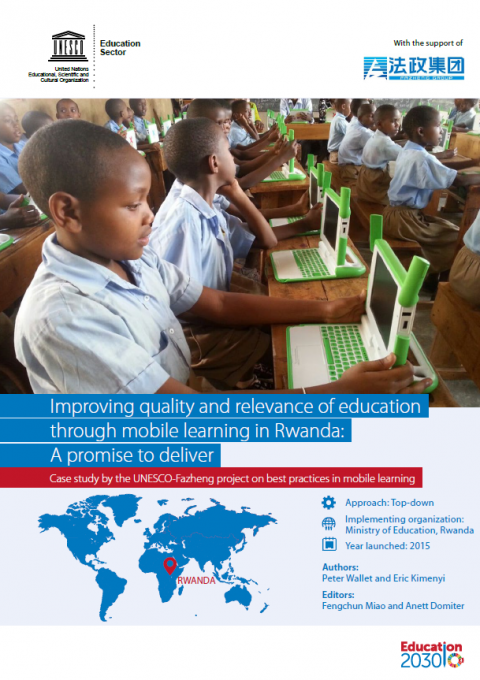 Improving quality and relevance of education through mobile learning in Rwanda: a promise to deliver: case study by the UNESCO-Fazheng project on best practices in mobile learning Year of publication: 2019 Author: Wallet, Peter | Kimenyi, Eric | Miao, Fengchun | Domiter, Anett Corporate author: UNESCO Rwanda’s education sector is evolving through the adoption of information and communication technology (ICT ). Whereas the focus was previously on the extensive deployment of laptop devices, it is shifting towards advancing adaptive child-centred learning and the use of ICT augmented environments to enrich teaching and learning. In developing countries, however, an orientation frequently remains to select strategies which have previously shown to be successful in developed contexts without taking into account the full range of elements required for effective implementation including a comprehensive assessment of the financial implications required to ensure longer term sustainability. This case study aims to showcase Rwanda’s customised approach to the integration of ICT in classrooms adapted to meet the particular needs of the Rwandan education system. The SMARTRwanda Master Plan lays out a vision to transform Rwanda’s economy by leveraging the use of ICT. Aligned to SMART Rwanda, the Ministry of Education (MINEDUC) is implementing the SMARTClassroominitiative under its ICT in Education Master Plan to reach all schools by 2020. Although there have been several challenges encountered during the various phases of implementation, more than half of all schools across the country are now equipped with ICT devices and many teachers have undergone various capacity-building initiatives to make better use of ICT in teaching and learning. More work is required in order to develop a fully functioning ICT in education ecosystem in Rwanda; nevertheless, this case study demonstrates progress made thus far and describes the various system stakeholders, their roles, responsibilities and contributions to date to improve access, quality and relevance of education through ICT adoption.
  The Big conversation: handbook to address violence against women in and through the media Year of publication: 2019 Corporate author: UNESCO This handbook provides guidance, tools and promising practices from countries across the globe for those working with and within media. It is our intention that this handbook provides entry points for accelerating progress towards gender equality in the systems and structures of organizations. We hope that it leverages what we know works in order to promote the values of diversity, equality and non-violence in the content that media produces.
  LES OUTILS DU PLURALISME CULTUREL Year of publication: 2015 Corporate author: UNESCO Face aux formes persistantes de xénophobie et d’exclusion sociale, face aux actes spectaculaires d’intolérance dont nos sociétés peuvent être le théâtre, la Convention de l’UNESCO de 2005, par laquelle les États parties s’engagent à développer des politiques publiques pour la promotion et la protection de la diversité des expressions culturelles, s’avère plus que jamais actuelle : elle incite à mieux prendre en compte le rôle de la culture au profit du partage, du respect et de la reconnaissance de l’autre, au-delà des appartenances sociales et culturelles.A l’occasion du 10e anniversaire de la Convention de 2005 de l’UNESCO, désormais ratifiée par 138 États et l’Union européenne et dans le cadre de la Décennie internationale du rapprochement des cultures (2013-2022, ONU), la Commission nationale française pour l’UNESCO, en partenariat avec le Secrétariat de l’Organisation et avec le soutien du ministère français de la Culture et de la Communication, a organisé deux conférences internationales au siège de l’UNESCO.Première de ces deux conférences internationales, Les outils du pluralisme culturel, le vendredi 2 octobre 2015 à l’UNESCO, pendant la Semaine des Cultures Étrangères organisée par le Forum des Instituts Culturels Étrangers à Paris, a offert un état des lieux, à un niveau européen élargi, des initiatives de promotion de la diversité des expressions culturelles comme outils du vivre-ensemble.
  Indigenous peoples’ right to education Year of publication: 2019 Corporate author: UNESCO This document follows a previous series of thematic mappings on the implementation of the right to education regarding specifically Girls’ and Women’s Right to Education, the Right to Education for Persons with Disabilities, and the Right to Education and the Teaching Profession. It compiles practical examples related to indigenous people’s right to education, extracted from reports submitted by Member States within the framework of the Ninth Consultation on the implementation of the 1960 Convention and Recommendation against Discrimination in Education. It is intended to serve as a practical tool for both information sharingandadvocacy.