
Resources
Explore a wide range of valuable resources on GCED to deepen your understanding and enhance your research, advocacy, teaching, and learning.
3,438 Results found
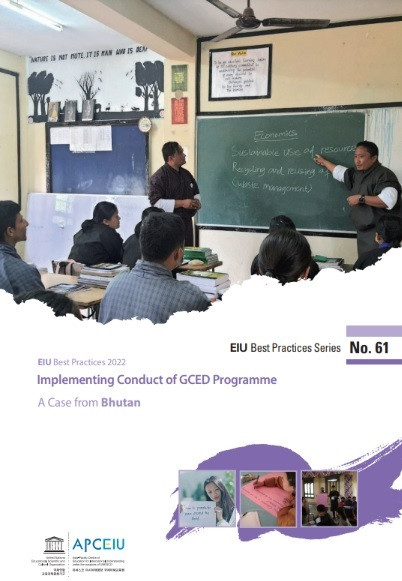 EIU Best Practices 2022: Implementing Conduct of GCED Programme; A Case from Bhutan (EIU Best Practices Series; no.61) Year of publication: 2022 Author: Santosh Kumar Biswa Corporate author: Centre Asie-Pacifique d'éducation pour la compréhension internationale (APCEIU) This monograph is one of APCEIU's EIU Best Practices Series, which aims to encourage educators, scholars, and activists to implement and share local initiatives on EIU. The Series No.61 is focusing on equipping youths, teachers and people around the world with the concept of GCED through his capacity-building and familiarization programme in schools and communities.
 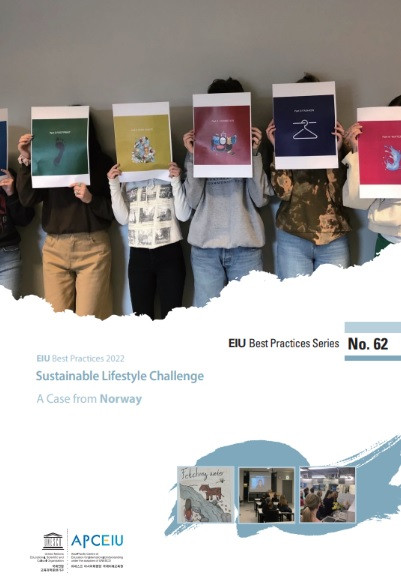 EIU Best Practices 2022: Sustainable Lifestyle Challenge; A Case from Norway (EIU Best Practices Series; no.62) Year of publication: 2022 Author: Barbara Anna Zielonka Corporate author: APCEIU This monograph is one of APCEIU's EIU Best Practices Series, which aims to encourage educators, scholars, and activists to implement and share local initiatives on EIU. The Series No.61 is focusing on providing opportunity for teachers and students worldwide to learn about environmentally friendly alternatives by changing their lifestyles and engaging with the world through the lens of sustainability.
  다문화가정대상국가와의 교육교류사업 후속활동 길라잡이 Year of publication: 2023 Corporate author: APCEIU The Asia-Pacific Teacher Exchange for Global Education(APTE) is a bilateral teacher exchange programme between the Republic of Korea and Asia-Pacific countries, hosted by the Ministry of Education of the Republic of Korea (MOE ROK) and implemented by the Asia-Pacific Centre of Education for International Understanding under the auspices of UNESCO (APCEIU), in collaboration with the Ministries of Education of the partner countries. Since 2012, the Office of International Teacher Exchange of APCEIU has been playing a pivotal role in implementing APTE. APCEIU prepared this book in the hope of spreading the fruits of teachers’ efforts and the seeds of peace in them, which were nurtured on the ground of APTE, to a broader world. <Contents>IntroductionI. Understanding follow-up activitiesII. Types of follow-up activities and model examples1. Types of follow-up activities2. Model examples of follow-up activities- [Real-Time Online Video Class] Starting online international education exchange- [Visiting / Invitational Program] An insight into international exchange programme- [Club-Oriented Inter-School Exchange] Follow-up exchange with invention club activity- [Inter-School Cooperative Agreement] Precious ties- [Participation In Various Support Programs] Heart of Korea, multicultural values: overcoming the limits of the classroomIII. Follow-up activity operation1. The nine-step preparation process for independent operation of educational exchange2. Procedures for independent operation of international exchangeIV. Annex1. Asia-Pacific Teacher Exchange for Global Education2. UNESCO APCEIU: Asia-Pacific Centre of Education for International Understanding under the auspices of UNESCO3. Reference programs for follow-up activities 다문화가정대상국가와의 교육교류사업 후속활동 길라잡이 Year of publication: 2023 Corporate author: 유네스코 아시아태평양 국제이해교육원 다문화가정대상국가와의 교육교류사업(APTE: Asia-Pacific Teacher Exchange for Global Education)은 대한민국 교육부가 주최하고 유네스코 아시아태평양 국제이해교육원이 주관하며, 교류 대상국 교육부가 현지 협력주체로서 함께하는 한국 아태지역 국가 양자 간 교육교류사업입니다. 아태교육원 국제교사교류실은 2012년부터 2022년 현재까지 10년간 APTE 사업 시행을 담당하고 있습니다. 지난 10년간 APTE 사업이라는 터전에서 선생님들께서 맺으신 열매와 그 속에 담긴 평화의 씨앗이 더 널리 퍼지길 기대하며 이 책자를 제작합니다. 목차:머리말I. 후속활동의 이해II. 후속활동 유형 및 우수 사례1. 후속활동 유형 소개2. 후속활동 우수 사례 - [온라인 실시간 화상수업 사례] 온라인 국제교육교류 시작하기 - [방문 및 초청 프로그램 운영 사례] 국제교류프로그램에 대한 고찰 - [동아리 중심 학교 간 교류 사례] 발명 동아리 활동과 함께한 후속교류사업 - [학교 간 협약 체결 사례] 소중한 인연들 - [각종 지원사업 참가 사례] 한마음, 다가치 교실의 경계를 넘다III. 후속활동 운영 방법1. 교육교류 자체 운영을 위한 9단계 준비 과정2. 국제교류 자체 운영의 절차IV. 붙임1. 다문화가정대상국가와의 교육교류사업 소개2. 유네스코아시아태평양국제이해교육원 소개3. 후속교류 시 참고 프로그램
  다문화가정대상국가와의 교육교류사업 참가 우수사례 모음집 Year of publication: 2023 Corporate author: APCEIU A carefully curated collection of best practices is presented as part of the 10th-anniversary celebrations of the Asia Pacific Teacher Exchange for Global Education (APTE). Over 30 teachers share their honest and vivid experiences, as well as outstanding follow-up activities. Each story aims to inspire teachers who are interested in the APTE Programme, and to serve as a valuable resource for future participants. 다문화가정대상국가와의 교육교류사업 참가 우수사례 모음집 Year of publication: 2023 Corporate author: 유네스코 아시아태평양 국제이해교육원 다문화가정 대상국가와의 교육교류사업의 10주년을 맞아 우수사례를 선별한 모음집을 선보인다. 국경을 넘어 마음을 나누는 교사들의 솔직하고 생생한 경험과 후속활동 사례가 수록되어 있다. 교사들의 생동감 있는 이야기가 향후 참가 교사들에게 긍정적인 영향과 소중한 자산이 되길 바란다.
  ACER-APCEIU 세계시민교육 모니터링 가이드: 교사, 학교 관리자, 교육행정가를 위한 안내서 Year of publication: 2025 Author: Rachel Parker | Amy Berry | Payal Goundar | Karena Menzie-Ballantyne Corporate author: 호주교육연구위원회 | 유네스코 아시아태평양 국제이해교육원 『ACER-APCEIU 세계시민교육 모니터링 가이드: 교사, 학교 관리자, 교육행정가를 위한 안내서』는 APCEIU와 ACER가 2022년부터 2024년까지 3년에 걸쳐 호주, 라오스, 필리핀, 한국의 파트너들과 함께 수행한 공동연구의 결과물인 『ACER-APCEIU Global Citizenship Education Monitoring Toolkit for Teachers, Schools and System Leaders』를 한국의 맥락에 맞게 번역한 국문판이다.이 가이드는 다양한 수준의 교육 이해관계자가 세계시민교육에서 자신의 위치를 진단하고 목표와 계획을 수립하며, 실행과 평가를 지속적으로 이어가도록 설계된 탐구 순환 모형을 제시하며, 이를 각자의 맥락에 맞게 실천할 수 있도록 구체적인 지침과 방법을 안내한다.이 가이드의 주요 활용자는 정책 입안자, 교육부 및 교육청 등 유관 기관의 교육행정가, 학교장과 학교감 등 교육 리더십을 가진 이들뿐 아니라 정규·비정규 교육 전반에서 세계시민교육을 실천하는 모든 교사를 포함한다.
  APCEIU-MNUAC Joint Research on Establishing the Foundation for Promoting Global Citizenship Education in Higher Education Institutions in Mongolia Year of publication: 2025 Author: Daehoon Jho | Jihyang Lee | Odsuren Dagmid | Mandukhai Baldandorj | Tumennast Dashtsenden | Amartuvshin Myagmarsuren | Delgertsetseg Choijilsuren | Punsaldulam Binderiya Corporate author: APCEIU | Mongolia National University of Arts and Culture (MNUAC) This report reviews the integration of global citizenship education (GCED) in higher education and examines various approaches to establishing a foundation for promoting GCED in Mongolian HEIs. To this end, the study conducted a situational analysis on the current status of GCED at MNUAC. Based on this analysis, the report proposes a GCED integration roadmap for MNAUC, outlining a sequenced pathway that begins with achievable initiatives while also offering insights for other HEIs in Mongolia. The report is available in both English and Mongolian.
  Supporting Change in Practice: Case Studies on the Use of the ACER-APCEIU Global Citizenship Education Monitoring Toolkit: Country Case-Republic of Korea Year of publication: 2025 Author: Suyeon Park | Sunmi Ji | Yoonyoung Lee Corporate author: APCEIU APCEIU is pleased to announce the release of its new publications, Supporting Change in Practice: Case Studies on the Use of the ACER-APCEIU Global Citizenship Education Monitoring Toolkit, which shares key findings from the research conducted in Australia and the Republic of Korea. The two reports, based on case studies from two countries, build upon the three-phase Asia-Pacific GCED Monitoring Project (2022–2024) jointly undertaken by ACER and APCEIU to strengthen monitoring and evaluation of GCED and support progress toward SDG 4.7 across the region. The three phases of the initiative identified enabling conditions for GCED, validated the regional GCED Monitoring Framework, and developed the ACER-APCEIU GCED Monitoring Toolkit. The reports for each phase can be found here: Phase I, Phase II, and Phase III. The newly released reports move the project forward by examining how the Toolkit can be practically applied in real educational settings. The study aimed to examine how the Toolkit could be used to support collaboration among key education stakeholders—teachers, school leaders, and education supervisors—in 1) goal setting, 2) planning, 3) implementing, and 4) reflecting on GCED practices. Through this process, the research sought to understand how the Toolkit could help strengthen the connection between policy commitments and everyday educational practice, supporting teachers, school leaders, and system leaders to embed GCED more systematically and sustainably within their existing framework. Both studies conducted in Australia and the Republic of Korea have been guided by the following research questions: 1. How does the GCED Monitoring Toolkit support key stakeholder groups to collaboratively embed GCED in policy and practice? a. What aspects of the Toolkit enable or challenge stakeholders to achieve their GCED goals and objectives? b. How do key stakeholders perceive its usefulness? 2. Are there any aspects of the Toolkit that stakeholders would change to improve its usefulness in supporting the implementation and contextualisation of GCED in policy and practice?The reports demonstrate how a GCED Monitoring Toolkit can be translated into actionable processes within real educational settings. It offers valuable insights for policymakers, school leaders, teachers, and researchers aiming to monitor and strengthen GCED implementation and systematically embed GCED within their educational ecosystems.
  Supporting Change in Practice: Case Studies on the Use of the ACER-APCEIU Global Citizenship Education Monitoring Toolkit; Country Case-Australia Year of publication: 2025 Author: Rachel Parker | Karena Menzie-Ballantyne Corporate author: APCEIU APCEIU published Supporting Change in Practice: Case Studies on the Use of the ACER-APCEIU Global Citizenship Education Monitoring Toolkit, which shares key findings from the research conducted in Australia and the Republic of Korea. The two reports, based on case studies from two countries, build upon the three-phase Asia-Pacific GCED Monitoring Project (2022–2024) jointly undertaken by ACER and APCEIU to strengthen monitoring and evaluation of GCED and support progress toward SDG 4.7 across the region. The three phases of the initiative identified enabling conditions for GCED, validated the regional GCED Monitoring Framework, and developed the ACER-APCEIU GCED Monitoring Toolkit. The reports for each phase can be found here: Phase I, Phase II, and Phase III.The reports move the project forward by examining how the Toolkit can be practically applied in real educational settings. The study aimed to examine how the Toolkit could be used to support collaboration among key education stakeholders—teachers, school leaders, and education supervisors—in 1) goal setting, 2) planning, 3) implementing, and 4) reflecting on GCED practices. Through this process, the research sought to understand how the Toolkit could help strengthen the connection between policy commitments and everyday educational practice, supporting teachers, school leaders, and system leaders to embed GCED more systematically and sustainably within their existing framework. Both studies conducted in Australia and the Republic of Korea have been guided by the following research questions: How does the GCED Monitoring Toolkit support key stakeholder groups to collaboratively embed GCED in policy and practice? a. What aspects of the Toolkit enable or challenge stakeholders to achieve their GCED goals and objectives? b. How do key stakeholders perceive its usefulness?Are there any aspects of the Toolkit that stakeholders would change to improve its usefulness in supporting the implementation and contextualisation of GCED in policy and practice?The reports demonstrate how a GCED Monitoring Toolkit can be translated into actionable processes within real educational settings. It offers valuable insights for policymakers, school leaders, teachers, and researchers aiming to monitor and strengthen GCED implementation and systematically embed GCED within their educational ecosystems.