
Resources
Explore a wide range of valuable resources on GCED to deepen your understanding and enhance your research, advocacy, teaching, and learning.
3,436 Results found
 APCEIU-MNUAC Joint Research on Establishing the Foundation for Promoting Global Citizenship Education in Higher Education Institutions in Mongolia Year of publication: 2025 Author: Daehoon Jho | Jihyang Lee | Odsuren Dagmid | Mandukhai Baldandorj | Tumennast Dashtsenden | Amartuvshin Myagmarsuren | Delgertsetseg Choijilsuren | Punsaldulam Binderiya Corporate author: APCEIU | Mongolia National University of Arts and Culture (MNUAC) This report reviews the integration of global citizenship education (GCED) in higher education and examines various approaches to establishing a foundation for promoting GCED in Mongolian HEIs. To this end, the study conducted a situational analysis on the current status of GCED at MNUAC. Based on this analysis, the report proposes a GCED integration roadmap for MNAUC, outlining a sequenced pathway that begins with achievable initiatives while also offering insights for other HEIs in Mongolia. The report is available in both English and Mongolian.
  Supporting Change in Practice: Case Studies on the Use of the ACER-APCEIU Global Citizenship Education Monitoring Toolkit: Country Case-Republic of Korea Year of publication: 2025 Author: Suyeon Park | Sunmi Ji | Yoonyoung Lee Corporate author: APCEIU APCEIU is pleased to announce the release of its new publications, Supporting Change in Practice: Case Studies on the Use of the ACER-APCEIU Global Citizenship Education Monitoring Toolkit, which shares key findings from the research conducted in Australia and the Republic of Korea. The two reports, based on case studies from two countries, build upon the three-phase Asia-Pacific GCED Monitoring Project (2022–2024) jointly undertaken by ACER and APCEIU to strengthen monitoring and evaluation of GCED and support progress toward SDG 4.7 across the region. The three phases of the initiative identified enabling conditions for GCED, validated the regional GCED Monitoring Framework, and developed the ACER-APCEIU GCED Monitoring Toolkit. The reports for each phase can be found here: Phase I, Phase II, and Phase III. The newly released reports move the project forward by examining how the Toolkit can be practically applied in real educational settings. The study aimed to examine how the Toolkit could be used to support collaboration among key education stakeholders—teachers, school leaders, and education supervisors—in 1) goal setting, 2) planning, 3) implementing, and 4) reflecting on GCED practices. Through this process, the research sought to understand how the Toolkit could help strengthen the connection between policy commitments and everyday educational practice, supporting teachers, school leaders, and system leaders to embed GCED more systematically and sustainably within their existing framework. Both studies conducted in Australia and the Republic of Korea have been guided by the following research questions: 1. How does the GCED Monitoring Toolkit support key stakeholder groups to collaboratively embed GCED in policy and practice? a. What aspects of the Toolkit enable or challenge stakeholders to achieve their GCED goals and objectives? b. How do key stakeholders perceive its usefulness? 2. Are there any aspects of the Toolkit that stakeholders would change to improve its usefulness in supporting the implementation and contextualisation of GCED in policy and practice?The reports demonstrate how a GCED Monitoring Toolkit can be translated into actionable processes within real educational settings. It offers valuable insights for policymakers, school leaders, teachers, and researchers aiming to monitor and strengthen GCED implementation and systematically embed GCED within their educational ecosystems.
  Supporting Change in Practice: Case Studies on the Use of the ACER-APCEIU Global Citizenship Education Monitoring Toolkit; Country Case-Australia Year of publication: 2025 Author: Rachel Parker | Karena Menzie-Ballantyne Corporate author: APCEIU APCEIU published Supporting Change in Practice: Case Studies on the Use of the ACER-APCEIU Global Citizenship Education Monitoring Toolkit, which shares key findings from the research conducted in Australia and the Republic of Korea. The two reports, based on case studies from two countries, build upon the three-phase Asia-Pacific GCED Monitoring Project (2022–2024) jointly undertaken by ACER and APCEIU to strengthen monitoring and evaluation of GCED and support progress toward SDG 4.7 across the region. The three phases of the initiative identified enabling conditions for GCED, validated the regional GCED Monitoring Framework, and developed the ACER-APCEIU GCED Monitoring Toolkit. The reports for each phase can be found here: Phase I, Phase II, and Phase III.The reports move the project forward by examining how the Toolkit can be practically applied in real educational settings. The study aimed to examine how the Toolkit could be used to support collaboration among key education stakeholders—teachers, school leaders, and education supervisors—in 1) goal setting, 2) planning, 3) implementing, and 4) reflecting on GCED practices. Through this process, the research sought to understand how the Toolkit could help strengthen the connection between policy commitments and everyday educational practice, supporting teachers, school leaders, and system leaders to embed GCED more systematically and sustainably within their existing framework. Both studies conducted in Australia and the Republic of Korea have been guided by the following research questions: How does the GCED Monitoring Toolkit support key stakeholder groups to collaboratively embed GCED in policy and practice? a. What aspects of the Toolkit enable or challenge stakeholders to achieve their GCED goals and objectives? b. How do key stakeholders perceive its usefulness?Are there any aspects of the Toolkit that stakeholders would change to improve its usefulness in supporting the implementation and contextualisation of GCED in policy and practice?The reports demonstrate how a GCED Monitoring Toolkit can be translated into actionable processes within real educational settings. It offers valuable insights for policymakers, school leaders, teachers, and researchers aiming to monitor and strengthen GCED implementation and systematically embed GCED within their educational ecosystems.
  2021 다문화가정 대상국가와의 교육교류사업 성과분석: 글로벌 역량과 디지털 리터러시 역량을 중심으로 Year of publication: 2021 Author: 박주형 | 문찬주 Corporate author: 유네스코 아시아태평양 국제이해교육원 본 보고서는 2021년 온라인으로 시행한 「다문화가정 대상국가와의 교육교류사업」의 참가자를 대상으로 교육교류사업의 핵심성과인 글로벌 역량과 디지털 리터러시 역량의 향상도를 측정하여 제시하고 있다.
  2021 다문화가정 대상국가와의 교육교류사업 성과분석: 성과측정도구 개발 Year of publication: 2021 Author: 박현정 | 박민호 | 권현주 Corporate author: 유네스코 아시아태평양 국제이해교육원 이 보고서는 유네스코 아태교육원이 시행하는 「다문화가정 대상국가와의 교육교류사업」의 성과를 측정하는데 있어 보다 적합한 ‘글로벌 역량’ 측정 도구를 개발하고자 진행된 연구 내용을 담고 있다.
  2021 다문화가정 대상국가와의 교육교류사업 성과분석: 온라인 교육교류 참가학교 학생 및 교사의 다문화 수용성 개선도 측정을 중심으로 Year of publication: 2021 Author: 한유경 Corporate author: 유네스코 아시아태평양 국제이해교육원 유네스코 아태교육원은 「다문화가정 대상국가와의 교육교류사업」의 일환으로 외국(말레이시아, 몽골, 베트남, 인도네시아, 캄보디아, 태국, 필리핀)교사를 초청하여 교육활동을 수행한 국내 학교의 교사 및 학생의 다문화 수용성 향상도를 측정·분석해왔다. 본 보고서는 21년도 온라인 교육교류사업을 통한 참가자의 다문화 수용성 개선 정도를 측정하여 제시하고 있다.
 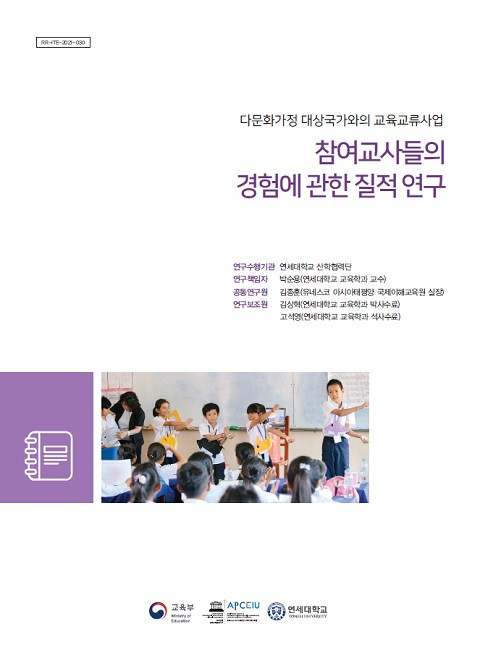 2021 다문화가정 대상국가와의 교육교류사업 성과분석: 참여교사들의 경험에 관한 질적 연구 Year of publication: 2021 Author: 박순용 | 김종훈 | 김상혁 | 고석영 Corporate author: 연세대학교 산학협력단 | 유네스코 아시아태평양 국제이해교육원 유네스코 아태교육원이 시행하는 「다문화가정 대상국가와의 교육교류사업」의 성과분석과 개선을 위한 정책연구에 대한 보고서이다. 본 연구는 여러 나라에 걸쳐 다른 경험을 한 참여교사들을 다층위의 질적 연구를 통해 상호주관적 맥락성을 살펴보고 프로그램의 과정과 전후에 참여하는 여러 주체들의 주관적 경험을 들여다봄으로써 그로부터 의미와 시사점 및 향후의 과제들을 성찰해보기 위한 것이다.
 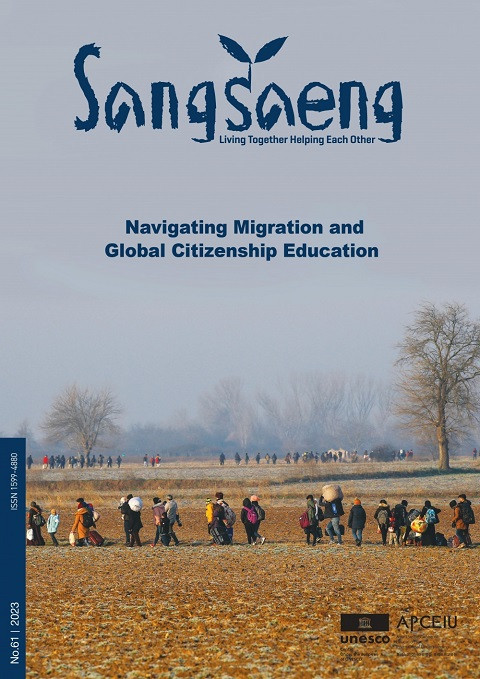 Navigating Migration and Global Citizenship Education (SangSaeng no. 61, 2023) Year of publication: 2023 Corporate author: APCEIU Migration is reshaping our societies and challenging traditional notions of identity, belonging, and cultural diversity. Global Citizenship Education, with its emphasis on fostering an understanding of global interconnectedness, human rights, social justice, and intercultural competence, is uniquely positioned to address the complex issues arising from migration. In this context, SangSaeng No. 61 explores the multifaceted relationship between migration and GCED to inspire innovative approaches to education and advocacy that address the challenges and opportunities presented by migration. Contents 03 Editor's Note 04 Special Column Renewing Our Commitment — Global Citizenship Education Should Address International Migration / Geon-soo Han 08 FOCUS: Navigating Migration and Global Citizenship EducationAfrican Migration Narratives — Mozambican Migrants in Southern Africa and Trends of African International Migration in Contemporary Africa / Joel das Neves TembeReimagining Thai Society — Burmese Migrant Children and Their Education in Thailand / Nongyao NawaratFortress Europe’s Educational Obstructions — Accessing Education for Refugees and Asylum Seekers in Europe / Prem Kumar RajaramCost of Invasion and Colonial War — Russian Invasion of Ukrainian, Refugees and Migration Governance / Franck DüvellPathway to Empowerment — Self-Reliance: A New Vision Toward Sustainable Solutions for Refugees / Kari Diener 24 Special ReportExploring Transformative Learning for Critical Empowerment through GCED / APCEIU IGCED and RND 26 Best PracticesTaking It Local — Using a Collaborative Approach to Contextualise an International Global Competence Framework / Karena Menzie-BallantyneHarmonizing the Streets for Youth — Jelajah Harmoni: Exploring the Meaning of Harmony through Community-Based Learning / Anna TanTeach to Transform — Creating Empowering Learning Spaces and Building Community of Changemakers / Rajvi Trivedi 35 Story TimeUnparalleled Look into Lives of Migrants / Virginia Pittaro 38 Peace in My MemoryCultivating Tranquillity: Thoughts on Peace / Wisdom Addo 42 GCED YOUTH NETWORKMigration and Global Citizenship Education — Youth Voices from the Ground / Oshan M. GunathilakeEducation without Borders — Empowering Displaced Children and Youth through Global Citizenship Education / Victoria Ibiwoye 48 LetterFacilitating Connections through My Experience with APCEIU / Lorena Gamerra 50 APCEIU in Action
 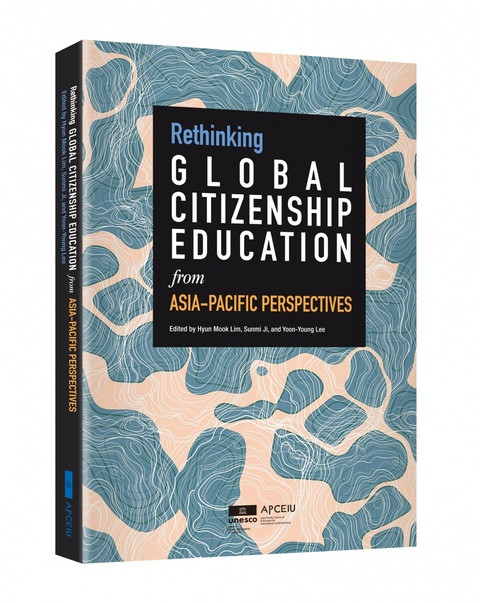 Rethinking Global Citizenship Education: From Asia-Pacific Perspectives Year of publication: 2024 Author: Sicong Chen | Suzanne S. Choo | Thippapan Chuosavasdi | Aigul Kulnazarova | Mousumi Mukherjee | Tania Saeed | Tanya Wendt Samu | Kyujoo Seol | Jun Teng Corporate author: APCEIU Rethinking Global Citizenship Education from Asia-Pacific Perspectives aims to rethink and reinterpret global citizenship and GCED in light of the cultural and historical contexts and political and economic conditions of the Asia-Pacific region. The edited volume offers an in-depth exploration of global citizenship and GCED through the contributions of nine scholars who examine the subject from a range of cultural, historical, and theoretical perspectives. Each chapter brings to light the complexities involved in fostering global citizenship in an era defined by both growing interconnectedness and intensifying political, social, and economic divides.This book is structured into three parts. The first part examines how various philosophical traditions from the Asia-Pacific region, such as Confucian cosmopolitanism, Tagore’s mindset, Pacific indigenous wisdom, and the Tianxia system, can inform and enrich the concept of GCED. The second part delves into the foundational ideas of global citizenship embedded within Asian religious and spiritual traditions, including Buddhist and Sufi perspectives. The third part provides case studies from Central and East Asia, highlighting the practical application of GCED in local contexts such as Kazakhstan, China, Japan, and South Korea. Together, these chapters offer a comprehensive analysis of the evolving challenges, opportunities, and innovations within GCED from Asia-Pacific viewpoints, emphasising the need for education systems to adapt and respond to the multifaceted nature of global citizenship.
 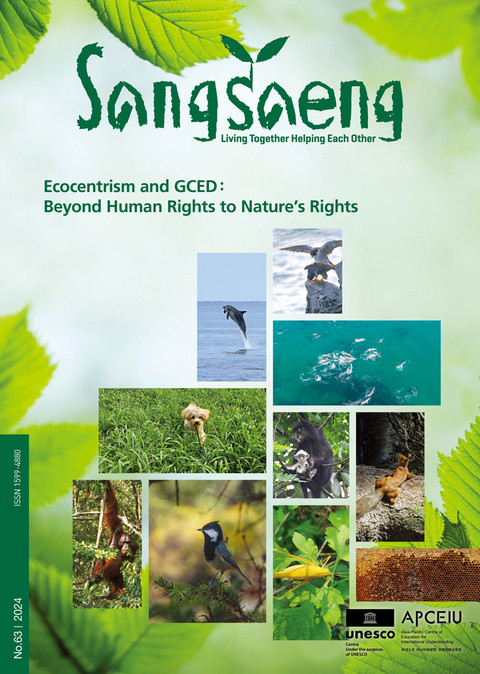 Ecocentrism and GCED : Beyond Human Rights to Nature’s Rights (SangSaeng; No.63, 2024) Year of publication: 2024 Corporate author: APCEIU In the context of Sustainable Development Goal (SDG) 4, global citizenship and sustainability are spotlighted through SDG Target 4.7, which underscores the importance of harmonising cultural and biological diversity.To address the urgent need for harmony between humanity and the nature, ecocentrism needs to be explored as a guiding principle for fostering ethical and sustainable coexistence.In this light, Issue 63 of SangSaeng delves into Ecocentrism—a perspective advocating for the ethical treatment of all beings and recognising their intrinsic value—alongside Global Citizenship Education (GCED). Contents 03 Editor's Note 04 Special Column- Creating Respectful, Valued Society — Strengthening Global Citizenship Education (GCED) to Combat Hate, Racism, and Discrimination Worldwide / Peter K. Ngure 08 FOCUS Ecocentrism and GCED: Beyond Human Rights to Nature’s Rights- Getting Over Ourselves — Ecocentrism: The Importance of Earth Jurisprudence, Compassionate Conservation, and Personal Rewilding / Marc Bekoff- Combating Decline of Nature’s Diversity — Global Citizenship Education for Geodiversity, Biodiversity Conservation / Eunhee Lee- Ecocentrism and Global Citizenship Education — Fostering Coexistence with Critically Endangered Primates through Citizen Science / Andie Ang- Dolphins Dream of Peace: Beyond Human Rights to Nature’s Rights / Interview with Seungmok Oh 23 Special Report- Small Actions, Global Ripples — How GCED is Revitalizing Peace / Micha Aime 26 Best Practices- What’s Good for the Community — GCED in Action Fosters Culture of Bulungi Bwansi in Uganda / Barbara Nakijoba- Sharing Emotional Sensibility in Education — Practicing Arts Opens up the Spirit of Global Citizenship / Seoyoung Bae - Teaching GCED through Liberation History — Working to Eradicate Entrenched Racism, Intolerance, Xenophobia / Charles Chikunda 36 GCED YOUTH NETWORK- How Youth Leaders Redefine Advocacy, Leading Global Change to Shape our Future — Deep Dive into South Asian Youth Declaration on GCED, Facilitation Techniques for Empowered Youth / Noora Elkenawi 39 Peace in My Memory- Pathway to Inner Peace — Journey is Interconnected with Relationships and Environment / Itseng Kwelagobe 42 Story Time- From Drops to Waves — Power of Poetry-telling in Times of Crisis / Kalpani Dambagolla & Alessia Marzano 45 Understanding the Asia Pacific Region- Central Asian Heart of Culture — Legacy of Horsemanship from Tradition to Modernity / Gulzhan Kabysheva 48 Letter- Raising a Global Citizen / Nelly Aluanga Omino 50 APCEIU in Action