
Resources
Explore a wide range of valuable resources on GCED to deepen your understanding and enhance your research, advocacy, teaching, and learning.
3,224 Results found
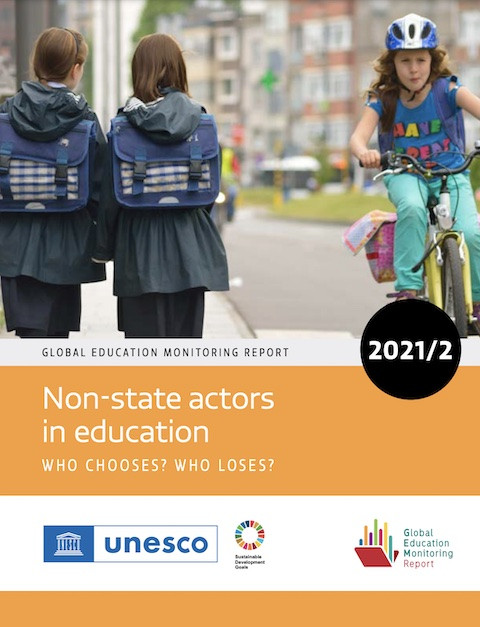 Global Education Monitoring Report 2021/2: Non-state Actors in Education; Who Chooses? Who Loses? Year of publication: 2021 Corporate author: UNESCO Non-state actors’ role extends beyond provision of schooling to interventions at various education levels and influence spheres. Alongside its review of progress towards SDG 4, including emerging evidence on the COVID-19 pandemic’s impact, the 2021/2 Global Education Monitoring Report urges governments to see all institutions, students and teachers as part of a single system. Standards, information, incentives and accountability should help governments protect, respect and fulfill the right to education of all, without turning their eyes away from privilege or exploitation. Publicly funded education does not have to be publicly provided but disparity in education processes, student outcomes and teacher working conditions must be addressed. Efficiency and innovation, rather than being commercial secrets, should be diffused and practiced by all. To that end, transparency and integrity in the public education policy process need to be maintained to block vested interests. The report’s rallying call – Who chooses? Who loses? – invites policymakers to question relationships with non-state actors in terms of fundamental choices: between equity and freedom of choice; between encouraging initiative and setting standards; between groups of varying means and needs; between immediate commitments under SDG 4 and those to be progressively realized (e.g. post-secondary education); and between education and other social sectors. 全球教育监测报告摘要, 2021/2年: 教育领域的非国家行为体:谁能主动选择?谁将错失机会? Year of publication: 2021 Corporate author: 联合国教科文组织 (UNESCO) 本文件是2021/2022年全球教育检测报告的摘要,主要聚焦教育领域的非国家行为体,包括私人办学、宗教办学等力量,并探讨了与非国家行为体对教育的影响与存在问题。
 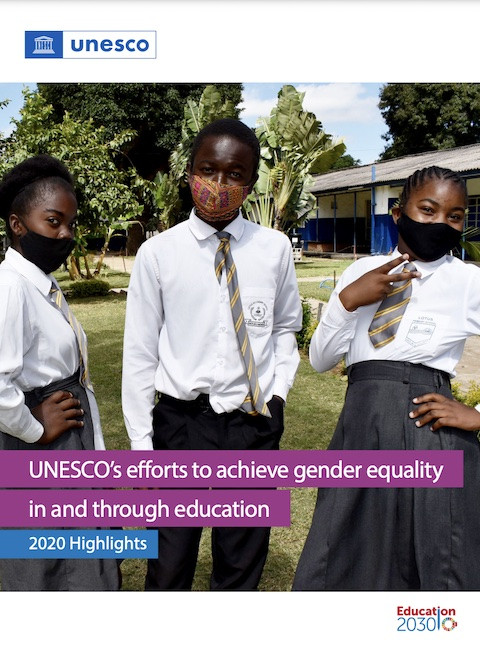 L’action de l’UNESCO en faveur de l’égalité des genres dans et par l’éducation: Points majeurs de l’année 2020 Year of publication: 2022 Corporate author: UNESCO Ce rapport présente les points majeurs de l’action menée en 2020 par l’UNESCO pour faire progresser l’égalité des genres dans et par l’éducation.L’action menée par l’UNESCO dans le domaine de l’éducation et du genre est ancrée dans la stratégie de l’UNESCO pour l’égalité des genres dans et par l’éducation 2019-2025. Cette stratégie repose aussi sur l’initiative Son éducation, notre avenir, lancée en parallèle afin de mobiliser les engagements politiques et financiers et de faciliterla coopération et l’action conjointe en faveur de l’éducation des filles et des femmes.
  Water Education for Climate Resilience in Asia and the Pacific: A Regional Curriculum Year of publication: 2021 Corporate author: UNESCO A fundamental element towards attaining water security, water education has been at the heart of UNESCO’s Intergovernmental Hydrological Programme since its establishment in 1975.However, in much of Asia and the Pacific, water security remains elusive. Ensuring a water secure future for the region will require the unlocking of broader appreciation, acceptance and internalization of basic water science principles and concepts among experts and communities alike. For this, broader and more effective water education is required.For this potential to be fulfilled, reinforced human, financial and technical resources are required to deliver education, training and capacity development across large segments of society. Not only does this require the mobilization of a much larger contingent of trainers, instructors and conveners—it requires the development of new teaching and learning approaches, methodologies and curricula.This curriculum represents an invitation to tertiary-level educators as well as water managers and decision-makers to redouble efforts towards water security in Asia and the Pacific – and invitation grounded in a process that lies at the heart of UNESCO’s mission: the sharing of knowledge, experience and technologies – in this case among scientific, educational and water management communities across the region.
 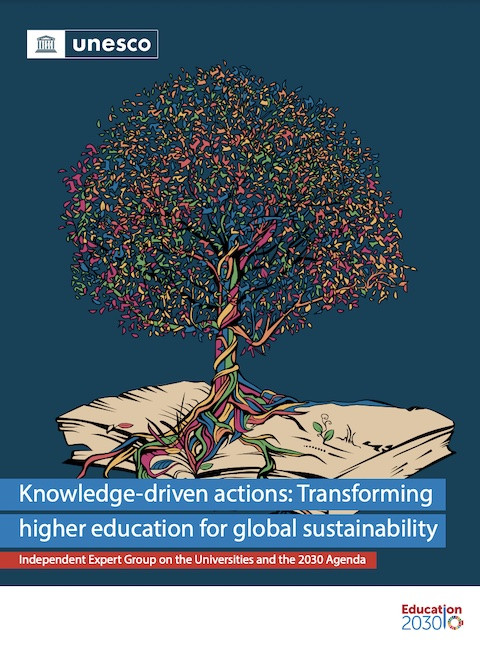 Knowledge-Driven Actions: Transforming Higher Education for Global Sustainability; Independent Expert Group on the Universities and the 2030 Agenda Year of publication: 2022 Author: Adrian Parr | Agnes Binagwaho | Andy Stirling | Anna Davies | Cheikh Mbow | Dag Olav Hessen | Helena Bonciani Nader | Jamil Salmi | Melody Brown Burkins | Seeram Ramakrishna | Sol Serrano | Sylvia Schmelkes | Tong Shijun | Tristan McCowan Corporate author: UNESCO With 2030 less than a decade away, it is paramount to think critically and act urgently if we are to achieve the Sustainable Development Goals.Higher education institutions are uniquely positioned to contribute to the social, economic and environmental transformations that are required to tackle the world’s most pressing issues.This report thoroughly discusses the role of higher education institutions in contributing to the 2030 Agenda, through a focus on three interrelated themes: the need to move towards inter- and transdisciplinary modes of producing and circulating knowledge; the imperative of becoming open institutions, fostering epistemic dialogue and integrating diverse ways of knowing; and the demand for a stronger presence in society through proactive engagement and partnering with other societal actors. The report directs attention to the systemic barriers that have inhibited transformations in these three areas so far, and provides advice and examples on how to achieve this. The report calls on higher education leaders and actors to push for transformations within their institutions, using the report’s recommendations to critically reflect and act on their role for achieving the 2030 Agenda.
 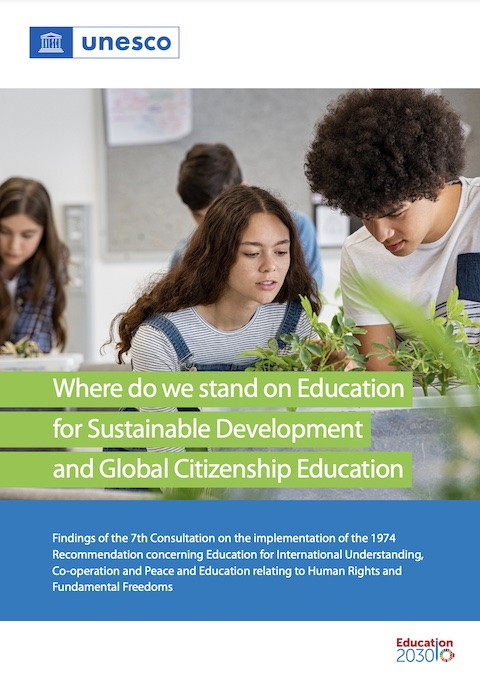 Where Do We Stand on Education for Sustainable Development and Global Citizenship Education: Findings of the 7th Consultation on the Implementation of the 1974 Recommendation Concerning Education for International Understanding, Co-operation and Peace and Education Relating to Human Rights and Fundamental Freedoms Year of publication: 2022 Corporate author: UNESCO The Recommendation concerning Education for International Understanding, Co-operation and Peace and Education relating to Human Rights and Fundamental Freedoms was adopted by the 18th session of UNESCO’s General Conference in November 1974. Every four years, Member States are invited to report on the measures they have taken to implement the Recommendation in all levels and types of education from pre-primary to tertiary, formal, non-formal and adult education. This document summarizes the results of the 7th consultation on the implementation of the 1974 Recommendation, covering the period 2017-2020. It also contains, for the first time, data for the global indicator adopted by the UN Statistical Commission and the UN General Assembly for the monitoring of Target 4.7 of Sustainable Development Goal for Education.
 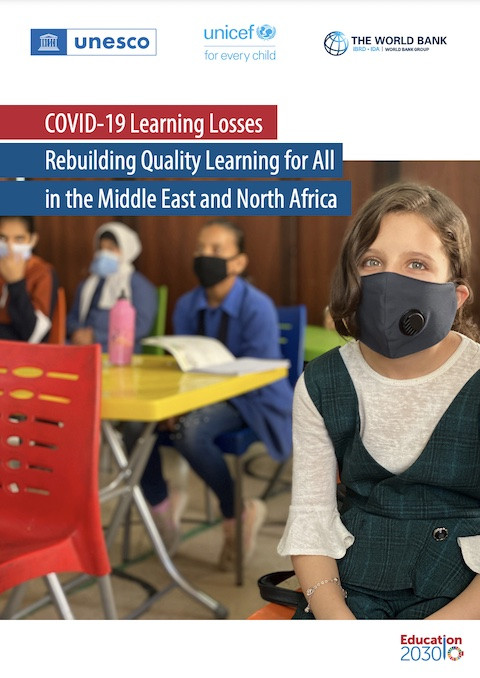 COVID-19 Learning Losses: Rebuilding Quality Learning for All in the Middle East and North Africa Year of publication: 2021 Author: Hana Yoshimoto | Jeannette Vogelaar | Brenda Haiplik Corporate author: UNESCO | United Nations Children's Fund (UNICEF) | World Bank An entire generation of children in the Middle East and North Africa (MENA) is estimated to be affected by the education crisis determined by the COVID-19 pandemic, with potential impacts that are going beyond the immediate/short term and also well beyond the education domain itself, with consequences on children’s socialisation, mental well-being, and future perspective of being active members of their society, including in the labor market. More information on the impact of the crisis would help countries to put in place strategies to mitigate the impacts. Timely investment and action to prevent extreme impacts of this crisis on education are of paramount importance in MENA, which already tackling a learning crisis before the COVID-19 outbreak.This publication delineates the overall education status in MENA after the breakout of COVID-19 pandemic, by presenting the education responses in MENA, and assessing the potential learning loss through a simulation analysis, recommendations are provided on how to build back better and enhance access and quality learning for all.
  The General History of Africa: A UNESCO Flagship Programme for Operational Strategy Priority Africa Year of publication: 2024 Corporate author: UNESCO As part of UNESCO’s Operational Strategy for Priority Africa (2022 – 2029), the General History of Africa (GHA) Flagship Programme responds to the challenge of reconstructing Africa and its diaspora historical memory and conscience by revisiting Eurocentric and colonial biases in the representation of their history and societies. It aims to advance a common identity and pride in Africa’s heritage, progress towards greater justice and an inclusive and fair future through the reappropriation and production of knowledge on Africa and its diaspora history in a manner that could contribute to the transformation of education in Africa and beyond. The GHA is aligned with the African Union Agenda 2063, The Africa We Want, the Charter for African Cultural Renaissance, and the United Nations 2030 Agenda for Sustainable Development.
  Climate Change and Sustainability in Science and Social Science Secondary School Curricula Year of publication: 2024 Author: Marcia McKenzie | Aaron Benavot Corporate author: UNESCO There is an urgent need to transform the way climate change and sustainability are taught in classrooms and at schools. Learners must grasp the environmental impacts of climate change, how climate change relates to their own context and what actions can be undertaken and contribute to making societies more sustainable, equitable, just and climate-resilient. The findings presented in this publication indicate that accelerated efforts are needed. In a study of over 530 Grade 9 science and social science curricula from 85 countries worldwide, we found that 69 per cent of curricula contained no references to climate change, while 66 per cent had no references to sustainability. Furthermore, while 69 per cent of surveyed teachers from eight of the countries studied reported that environment, sustainability and climate change topics were included in the science and social science curricula in their schools only 50 per cent included them in their teaching. While there is a notable inclusion of environment, sustainability and climate change in science and social science curricula across countries, the depth of focus of this inclusion varies widely. Cognitive learning prevails over social and emotional or action-oriented learning. Climate change and sustainability in school practices must be strengthened, with teachers playing a key role in enhancing integration through teaching methods and materials.
  Science, Technology and Innovation Policy Instruments for the Sustainable Development Goals: A Global Outlook Year of publication: 2024 Author: Galindo Moreno | Manuel Ricardo Corporate author: UNESCO This publication explores the design, implementation and impact of science, technology and innovation (STI) policy instruments across regions, revealing diverse policy priorities and support strategies. Data from the UNESCO Global Observatory of Science, Technology and Innovation Policy Instruments (GO-SPIN) platform shows that STI policy instruments are closely linked to the SDGs, particularly with SDG 9 (industry, innovation and infrastructure), SDG 8 (decent work and economic growth) and SDG 4 (quality education). Over three-quarters of these policy instruments target these goals. This publication advocates for the use of evidence in designing policies and policy instruments and underscores the importance of continuous monitoring of their implementation. Additionally, it recommends diversifying funding sources, enhancing program management, fostering communication with stakeholders, and applying policy instruments to promote transformative learning.