
Resources
Explore a wide range of valuable resources on GCED to deepen your understanding and enhance your research, advocacy, teaching, and learning.
518 Results found
 Promouvoir le développement durable au Nigéria: via l'éducation civique (Revue d'éducation et de pratique, vol. 5, n ° 34) Year of publication: 2014 Author: Ajibola A. Lukman | Habida Audu Corporate author: International Institute for Science, Technology and Education Rien dans ce monde n'est aussi puissant qu'une idée dont le temps est venu. Face à la connaissance éthique, la disposition des compétences et le développement durable au Nigeria, l'éducation civique a pris une position centrale. Idée de l'éducation civique dans le curriculum nigérian est si puissant dans la mesure où chaque jeune nigérian mérite ses connaissances. Sur cette base, cet article décrit l'éducation civique comme un facteur de base pour le développement individuel et social de notre nation. Le papier analyse le tissu entre l'éducation civique et le développement social vers le mélange et l'interfaçage de la sagesse locale avec le monde des connaissances, des valeurs et des compétences, qui développera le jeune Nigérian pour devenir un citoyen de ce pays ainsi qu'un citoyen du village global. Le document souligne que l'éducation civique est essentielle pour façonner les attitudes et les interactions sociales et que les deux sont essentiels pour aborder les questions entourant le développement durable. À cette fin, le document conclut que le développement durable exige des connaissances civiques, des compétences civiques et une disposition civique. Il est donc recommandé que l'éducation civique soit considérée comme un moteur du développement dans lequel les États, les individus, les collectivités et les entreprises participent au développement durable.
  Reimagining Life Skills and Citizenship Education in the Middle East and North Africa: A Four-Dimensional and Systems Approach to 21st Century Skills; Conceptual and Programmatic Framework Year of publication: 2017 Corporate author: UNICEF Middle East and North Africa The situation of learning in MENA calls for a holistic, lifelong and rights-based vision of education that maximizes the potential of all children and youth in the region and better equips them to create meaning out of knowledge and to face the transitions from childhood to adulthood, from education to work, and from unreflective development to responsible and active citizenship. This is what drives the MENA Life Skills and Citizenship Education (LSCE) Initiative, kicked off in 2015 with the aim of supporting the countries of the region – conceptually, programmatically and technically – to improve learning and to better invest such learning in individual, social and economic development.The LSCE Conceptual and Programmatic Framework (CPF) puts forth a roadmap to guide policies, strategies and programmes on life skills and citizenship education supporting the region-wide efforts to provide children and youth with opportunities to learn, transition from childhood to adulthood, move from school to work settings, and become responsible and active citizens of their communities.A set of twelve core life skills for MENA has been identified using the four-dimensional learning model: ‘Learning to Know’ (Cognitive Dimension), ‘Learning to Do’ (Instrumental Dimension), ‘Learning to Be’ (Individual Dimension), and ‘Learning to Live Together’ (Social Dimension). The twelve core life skills are life-long, and they build on evidence that underlines the importance of skills acquisition from an early age. Furthermore, the twelve core life skills are acquired and sustained through all forms of learning in a systems approach that recognizes multiple pathways of learning, formal, non-formal and informal. Réimaginer l’éducation aux compétences de vie et à la citoyenneté au Moyen-Orient et en Afrique du Nord : Une approche à quatre dimensions et systémique des compétences pour le XXIe siècle ; Cadre programmatique et conceptuel Year of publication: 2017 Corporate author: UNICEF Middle East and North Africa L’Initiative pour l’éducation aux compétences de vie et à la citoyenneté de la région MENA (LSCE) représente un effort de collaboration étatique et régional en faveur de la réalisation de l’objectif de développement durable (ODD) 4 – Assurer l’accès de tous à une éducation de qualité, sur un pied d’égalité, et promouvoir les possibilités d’apprentissage tout au long de la vie. Elle cherche à reformuler la compréhension traditionnelle de l’éducation aux compétences de vie et à la citoyenneté dans la région, tout en rappelant les questions fondamentales au sujet du but et du rôle de l’éducation dans le développement sociétal qui sont pertinentes dans le contexte actuel.L’Initiative LSCE se concentre sur trois défis interdépendants :Une société du savoir inaccessible, résultat de la mauvaise qualité de l’éducation, du bas niveau des résultats scolaires et d’une équité et inclusion limitées.Une croissance économique en déclin, résultat d’un manque d’aptitudes à l’employabilité, du haut taux de chômage chez les jeunes, de l’inégalité des sexes face à l’accès au marché du travail, du manque de création d’emplois, et d’un environnement économique faible.Une faible cohésion sociale, résultat de l’escalade de la violence et de la radicalisation tout autant que d’un faible engagement civique.
  Analytical Mapping of Life Skills and Citizenship Education in the Middle East and North Africa Year of publication: 2017 Corporate author: UNICEF Middle East and North Africa The Analytical Mapping of the Life Skills and Citizenship Education in MENA, published in October 2017, provides a multi-stakeholder view of the status of life skills and citizenship education in MENA and the corresponding vision for the region. It does not evaluate existing interventions, nor is it meant to generate an exhaustive list of all existing life skills programmes in MENA. It rather aims to provide an analytical overview of Life Skills and Citizenship Education (LSCE) related intervention in the region. Through analyzation, it also attempts to highlight general challenges encountered in the programming of LSCE, as well as focus on opportunities for LSCE in MENA national education systems.
 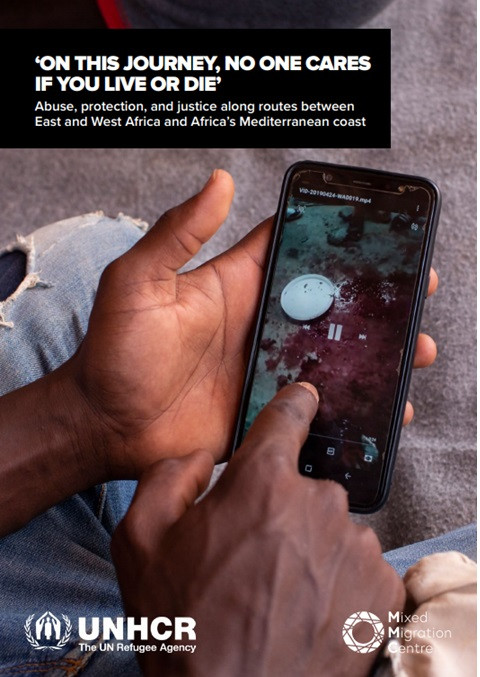 On This Journey, No One Cares If You Live or Die: Abuse, Protection, and Justice Along Routes Between East and West Africa and Africa’s Mediterranean Coast Year of publication: 2020 Corporate author: UN. Office of the United Nations High Commissioner for Refugees (UNHCR) | Mixed Migration Centre This report draws on data collected by the Mixed Migration Centre’s 4Mi monitors along the route to map the places where refugees interviewed in 2018 and 2019 most frequently reported deaths, sexual and gender-based violence (SGBV), physical violence, and kidnappings occurred. It illustrates how refugees and migrants using the route face a series of risks including as they cross into eastern Sudan, and when crossing the Sahara Desert, and then again in multiple places in Libya. Similarly, those traveling through West Africa reported multiple incidents of physical violence, SGBV, as well as deaths at various points. Refugees and migrants have reported being subjected to brutal violence, including being burnt with hot oil, melted plastic, or heated metal objects, being electrocuted, tied in stress positions, and experiencing and witnessing repeated sexual violence, often in the context of ransom demands. UNHCR staff and partners continue to witness the severe impact these abuses have had on the mental health of many men, women, and children.
 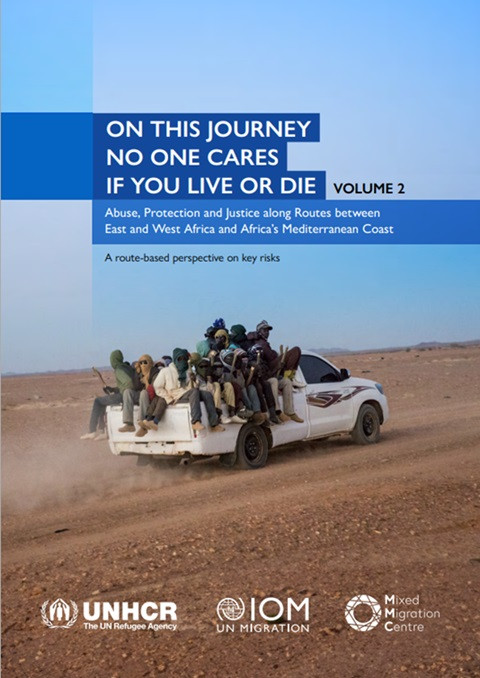 On This Journey No One Cares If You Live or Die, Volume 2: Abuse, Protection and Justice Along Routes Between East and West Africa and Africa's Mediterranean Coast Year of publication: 2024 Corporate author: International Organization for Migration (IOM) | Mixed Migration Centre | UN. Office of the United Nations High Commissioner for Refugees (UNHCR) In the complex landscape of migration, this second volume of the report, On This Journey, No One Cares if You Live or Die, emerges as a crucial body of work that sheds light on the stark realities faced by refugees and migrants traversing the perilous Central Mediterranean route all the way from East and Horn of Africa and West Africa to the North African coast of the Mediterranean and across the sea. Jointly published by IOM, MMC and UNHCR, this report delves into the protection risks faced by refugees and migrants during these journeys. It aims to inform increased and concrete routes-based protection responses to reduce the suffering associated with the desperate journeys refugees and migrants undertake, and to serve as a call to action in addressing the root causes of displacement and drivers of irregular migration through positive action on peace, climate change, governance, inequality and social cohesion, as well as the creation of safe migration pathways.
  [Technical Report] Climate Change and Girls' Education: Barriers, Gender Norms and Pathways to Resilience Year of publication: 2023 Corporate author: Plan International This is the technical report of the Climate Change and Girls' Education: Barriers, Gender Norms and Pathways to Resilience for further detail on the findings and research itself. [Rapport technique] Changement climatique et éducation des filles: entraves, normes sexistes et chemins vers la resilience Year of publication: 2023 Corporate author: Plan International This is the technical report of the Climate Change and Girls' Education: Barriers, Gender Norms and Pathways to Resilience for further detail on the findings and research itself. [Reporte técnico] Cambio climático y educación de las niñas: barreras, normas de género, y rutas hacia la resiliencia Year of publication: 2023 Corporate author: Plan International This is the technical report of the Climate Change and Girls' Education: Barriers, Gender Norms and Pathways to Resilience for further detail on the findings and research itself.
  Gender-Based Violence in Education Year of publication: 2015 Author: Jenny Perkes This paper examines how policies and strategies to address school-related gender-based violence have evolved since 2000, when gender-based violence within education was largely invisible. It traces remarkable progress in research, policy and programmes, particularly since the mid-2000s when evidence around the globe exposed high levels of many forms of violence. However, there is still insufficient knowledge about what works to reduce violence, and weaknesses in processes of policy enactment which inhibit effective action. Through four country case studies, in South Africa, Brazil, India and Liberia, this paper explores how different forms of violence are being addressed in varying contexts. It concludes that more attention is needed to the space between national and local policy enactments, and to tackling at national, district, school and community levels the norms and inequalities at the heart of gender-based violence.