
Resources
Explore a wide range of valuable resources on GCED to deepen your understanding and enhance your research, advocacy, teaching, and learning.
3,436 Results found
 A study of the middle school social studies and moral education curriculum to foster global citizenship Year of publication: 2009 Author: Geunho Lee | Deokgeun Kim | Byungsu Min | Hyunjeong Oh | Hyojeong Kim | Junsik Park | Jeongmin Eom Corporate author: Korea Institute for Curriculum and Evaluation (KICE) This study was conducted to analyze the determinants (i.e. multicultural acceptability, national identity, and moral values) influencing global citizenship in order to examine the construct of global citizenship as well as to find the moral education about global citizenship for teacher education. Hierarchical regression was used to analyze the survey of 116 college students in university of education. The results are following. Firstly, The hierarchical regression analysis of ModelⅢ with influencing three factors to global citizenship explained 25% of the variance in student’s global citizenship, and it was found common good among moral values and experience of living a life in the foreign countries as important factors in the model. Second, They regressed into the variance of moral values even though a few ones of multi-cultural acceptability and national identity were influential factors before modelⅢ. Contrary to theoretical expectations, they are turned into be a half of influential factors to global citizenship. Based on the results, we suggested that to solve the global problems need to be strengthen in the developing the education curriculum for global citizenship. Furthermore, future research with stratified sampling will be conducting to generalize the result of this study. L’Étude sur l'Éducation à la Citoyenneté Mondiale dans l'enseignement de premier cycle Year of publication: 2009 Author: Geunho Lee | Deokgeun Kim | Byungsu Min | Hyunjeong Oh | Hyojeong Kim | Junsik Park | Jeongmin Eom Corporate author: Korea Institute for Curriculum and Evaluation (KICE) Cette étude a été menée pour analyser les déterminants (à savoir d'aceptabilité multiculturelle, identité nationale, et les valeurs morales) qui influent sur la citoyenneté mondiale en vue d'examiner la construction de la citoyenneté mondiale, ainsi que de trouver l'éducation morale de la citoyenneté mondiale pour la formation des enseignants. Régression hiérarchique a été utilisé pour analyser le sondage auprès des 116 étudiants de niveau collégial à l'université de l'éducation. Les résultats suivent. Tout d'abord, l'analyse de régression hiérarchique des ModelⅢ d'influencer trois facteurs à la citoyenneté mondiale explique 25% de la variance de la citoyenneté mondiale de l'étudiant, et il a été trouvé bien commun entre les valeurs morales et de l'expérience d'une vie dans les pays étrangers comme des facteurs importants dans la modèle. Deuxièmement, ils ont régressé dans la variance des valeurs morales, même si quelques uns d'aCECptabilité multi-culturelle et l'identité nationale sont des facteurs influents avant modelⅢ. Contrairement aux attentes théoriques, ils sont transformés en une moitié de facteurs influents à la citoyenneté mondiale. D'après les résultats, nous avons proposé que pour résoudre les problèmes mondiaux doivent être renforcer dans le développement du programme d'éducation à la citoyenneté mondiale. En outre, les recherches futures avec échantillonnage stratifié sera conduit à généraliser le résultat de cette étude. 세계시민의식 고취를 위한 중학교 사회과ㆍ도덕과 교육과정 선진화 연구 Year of publication: 2009 Author: 이근호 | 김덕근 | 민병수 | 오현정 | 엄정민 | 김효정 | 박준식 | 김종람 Corporate author: 한국교육과정평가원 This study was conducted to analyze the determinants (i.e. multicultural acceptability, national identity, and moral values) influencing global citizenship in order to examine the construct of global citizenship as well as to find the moral education about global citizenship for teacher education. Hierarchical regression was used to analyze the survey of 116 college students in university of education. The results are following. Firstly, The hierarchical regression analysis of ModelⅢ with influencing three factors to global citizenship explained 25% of the variance in student’s global citizenship, and it was found common good among moral values and experience of living a life in the foreign countries as important factors in the model. Second, They regressed into the variance of moral values even though a few ones of multi-cultural acceptability and national identity were influential factors before modelⅢ. Contrary to theoretical expectations, they are turned into be a half of influential factors to global citizenship. Based on the results, we suggested that to solve the global problems need to be strengthen in the developing the education curriculum for global citizenship. Furthermore, future research with stratified sampling will be conducting to generalize the result of this study.
  세계시민교육의 측정 지표 개발 및 국제적 확산 지원 방안 탐색 Year of publication: 2016 Author: 조지민 | 곽영순, 이혜원, 이정우, 서민희 Corporate author: 한국교육과정평가원 본 연구의 목적은 UNESCO의 ‘교육 2030’에서 공동 지표로 채택하고 있는 세계시민교육(Global Citizenship Education)에 대한 측정 가능한 지표를 개발하고, 세계시민교육 측정 지표의 국제적 확산 방안을 모색하는 것이다. 본 연구에서는 UNESCO(2015c)에 제시된 학습 영역, 주제 등을 기반으로 하여 현재 활용되고 있는 국제수준의 다양한 세계시민교육 관련 개념과 측정 요소들을 비교하고 세계시민교육을 위한 종합적이고 명확한 측정 가능한 지표를 개발하고자 하였다. 일차적으로 UNESCO(2015c)의 틀에 맞추어 OECD의 글로벌 역량(OECD, 2015, 2016), IEA의 ICCS(Shulz, et al, 2016), 미국 CCSSO의 글로벌 역량(CCSSO, 2011), NGO인 Oxfam(Oxfam, 2015)의 세계시민교육의 측정 요소를 재분류하여 1차, 2차 지표(안)을 산출하였다. 그리고 3차 지표(안)을 산출하여 델파이 조사지로 활용하였다. 세계시민교육 관련 전문가 12명이 델파이 조사의 패널로 참여하였다. 델파이 조사 결과를 분석, 수렴하여, 본 연구의 목적인 측정 가능한 지표(안)을 제시하였다. 이러한 세계시민교육 지표의 활용방안과 관련하여 긍정적 효과로는 기존 다문화교육이나 국제이해교육과의 차이점 이해 및 세계시민교육에 대한 관심과 이해 제고를 통한 지구촌 사회의 공동책임감 개선에 기한다는 등을 제시하였다. 반면에 전문가들이 제안한 주요 부정적 영향으로 첫째, 세계시민성에 대한 의미 통일이 이루어지지 않으면, 혼란을 초래할 수 있으며; 둘째, 지도하는 교사의 전문성 신장 방안과 구체적인 교육 방법 등을 먼저 제시해야 한고; 셋째, 계시민만을 강조하다보면 국가차원의 시민성에 대한 논의가 제외되거나 축소될 수 있으며 세계화 등과 같은 논쟁적 개념 정의를 토대로 특정한 인간상을 구현하려고 할 경우 이데올로기적 논쟁에서 자유롭지 않을 수 있다는 점이 제기되었다. 따라서 이에 대한 연구진의 집중 논의를 통해 본 연구의 취지와 내용 등을 반영하여 우리나라의 중학교학생을 대상으로 하는 측정 지표를 산출하였다.본 연구에서는 연구 요약과 함께 본 연구에서 개발된 세계시민교육 측정 지표의 확산을 위한 방안을 세 가지로 정리하여 제시하였다. 첫째는 세계시민교육 측정 지표의 국내 및 국외적 적용, 개선 및 활용도 제고이며, 둘째는 세계시민교육 측정 지표 적용 관련 경험적 연구 수행 및 적절성, 효과성 점검이고, 세계시민교육의 내실화를 위한 선도적 역할 및 국제 협력 강화를 위한 국가차원의 지원이다. 따라서 세계시민교육의 측정 가능한 지표 개발을 토대로 세계시민교육을 활성화 및 내실화하는 데 기여할 수 있는 기반이 마련 될 것으로 기대된다.
  세계시민교육 수업 사례집: 한국, 인도네시아, 태국의 중등학교 사회과 수업 Year of publication: 2016 Author: 이정우 | 박주현 | 최정순 | 성경희 | 송성민 | 김태환 | 주귀옥 | Jaengsawang, Sureeporn Salim, Satriwan, S.Pd, M.Si Corporate author: 한국교육과정평가원 이 사례집은 ‘한-아세안 세계시민교육 국제 비교 연구’의 일환으로 이루어진 한국, 인도 네시아, 태국에서의 세계시민교육 수업 실행 사례를 담은 것이다. ‘한-아세안 세계시민교육 국제 비교 연구’는 세계시민교육 실행에서 지역적 특수성이 중요하다는 문제의식 하에 한 국과 아세안에서 이루어지고 있는 세계시민교육의 현황과 학생들의 세계시민성을 파악하 는 것을 주요 내용으로 한 3개년(2013년-2015년) 프로젝트로 기획된 것이다.각 국의 세계시민교육 사례는 모두 다섯 가지 측면에서 재구성하였다. 첫째, 각국에서 세계시민교육이 실행된 맥락에 대한 이해를 돕기 위하여 ‘수업 환경’을 소개하였다. 이 부분 은 본 사례집에 제시된 세계시민교육의 사례가 특정 국가를 전형적으로 대표하는 사례가 아님을 보여주기 위한 것이다. 즉, 본 사례집에 제시된 사례를 이해하기 위해서는 해당 학교와 학급의 특성에 대한 이해가 필요하다. 둘째, 교사가 3차시 수업을 어떻게 구성하였 는지를 보여주는 ‘수업 계획’을 제시하였다. 평소대로 사회과 수업을 진행하면서도 세계시 민교육의 주제를 결합하는 것이 가능한지, 어떠한 주제와 사회과의 수업을 연관 지을 수 있는지 등에 대한 아이디어를 얻을 수 있을 것이다. 셋째, 실제로 이루어진 교수학습 과정 의 개요를 소개하였다. 교사가 원래 의도하였던 바는 무엇이며, 이를 실제로 어떻게 수업 속에서 구현하였는지를 소개하였다. 넷째, 수업이 끝난 후 교사의 반성을 소개하였다. 본인 의 수업이 원래 의도했던 대로 잘 구현되었는지, 구현되었다면 어떤 부분이 잘 구현되었으 며, 구현되지 못했다면 그 원인이 무엇이었는지를 반성적으로 성찰한 내용을 소개하여 세 계시민교육을 교과 교육과정에서 실행할 때 발생할 수 있는 제약점은 무엇이며, 이를 어떻 게 극복하는 것이 가능한지에 대해 살펴보고자 하였다. 다섯째, 실제 수업에서 교사가 사용 하였던 수업 자료나 학생의 반응, 수업의 일면을 엿볼 수 있는 사진 자료 등을 ‘수업 사례’로 제시하였다.
  장애청소년 친화적 청소년정책 추진방안 연구 Year of publication: 2021 Author: 김지연 | 김승경 | 오욱찬 | 정소연 Corporate author: 한국청소년정책연구원 2021년 현재 24세 이하 장애청소년은 약 10만 명으로 우리나라 전체 청소년 인구 대비 약 1% 수준이다. 그러나 이는 ‘등록 장애청소년’만 해당하며, ‘미등록 장애청소년, 법정 장애 유형에 해당하지 않는 장애를 가진 청소년, 신체건강 및 정신건강 문제로 비장애청소년에 비해 일상생활 전반에서 현저한 제약이 있는 청소년’이 제외된 규모다. 우리나라는 장애 유형의 범위가 협소하여 주요국 대비 장애인 출현율이 현저히 낮으며, 아동·청소년기에 장애 등록을 꺼리는 경향 등을 고려하면 잠재적인 정책대상의 명확한 규모는 커질 수밖에 없다.이에 본 연구는 ‘포용국가 청소년정책’의 일환으로 그간 청소년정책의 대상으로 인식하지 못했던 장애청소년을 비장애청소년과 통합적으로 지원하기 위한 방안을 다각적으로 모색하였다.
  미디어 속 학교폭력 양상 분석을 통한 학교폭력 예방 및 대응 방안 도출 Year of publication: 2023 Author: 배상률 Corporate author: 한국청소년정책연구원 정부 부처와 연구기관에서 발행한 학교폭력의 현황 및 추세를 살폈다. 관련 분야의 대표적인 조사로 교육부의 학교폭력 실태조사를 들 수 있다. 초등학교 4학년생부터 고등학교 3학년생을 대상으로 매년 2회에 걸쳐 이뤄지는 조사로 온오프라인에서 발생하는 학교폭력의 실태를 조사하고 있다. 방송통신위원회와 한국지능정보사회진흥원은 사이버폭력 실태조사를 통해 학교폭력 중 온라인상에서 이뤄지는 각종 폭력들의 추이를 파악하고 있다. 푸른나무재단(청소년폭력예방재단)이 매년 실시하는 ‘전국학교폭력실태조사’는 설문과 인터뷰를 통해 학교폭력의 실태뿐만 아니라 예방 및 대응 방안을 위한 청소년과 현장전문가의 의견을 수렴하는 시도를 하고 있다. 우리 사회와 언론은 청소년이 반사회적 행동을 할 때 종종 그 원인을 미디어에 돌리는 경향이 있다. 물론, 미디어가 이러한 문제에 일정 부분 영향을 미친다는 것은 부인할 수 없다. 하지만 관련 이론과 연구 결과들은 미디어의 영향이 일관되고 강력하며 즉시 나타나지 않는다는 것을 보여준다. 미디어 사용 패턴, 인구 사회학적 배경, 부모와 자녀 간의 관계 등 다양한 요인에 따라 미디어의 영향력은 다르게 나타난다. 본 보고서는 학교폭력 현황 및 추세 분석에 이어서, 수용자의 인지, 태도, 행동에 영향을 미치는 미디어 효과를 설명한 주요 이론을 고찰하고 미디어 폭력이 청소년에게 미치는 영향력을 측정한 선행연구를 살폈다. 중고등학생 연령대 청소년을 대상으로 온라인 설문조사를 하였다. 미디어가 전달하는 폭력적 콘텐츠의 소비 실태를 파악하고, 폭력적 콘텐츠 소비가 청소년의 폭력성 및 폭력 허용도에 미치는 영향력을 분석하였다. 본 연구가 학교폭력 감소와 청소년의 건강한 미디어 이용을 위한 정책 마련을 위한 기초자료와 시사점을 제공할 것으로 기대된다. * 한국청소년정책연구원이 2023년 작성한 '미디어 속 학교폭력 양상 분석을 통한 학교폭력 예방 및 대응 방안 도출(작성자: 배상률)'은 "공공누리의 제 4유형" 출처표시-상업적 이용금지-변경금지 조건에 따라 이용할 수 있으며, 해당 저작물은 '한국청소년정책연구원, https://www.nypi.re.kr/'에서 무료로 다운받으실 수 있습니다.
  제22회 한국국제이해교육학회 국제학술대회: 미래형 교육과정과 세계시민교육: 도전과 과제 Year of publication: 2021 Corporate author: 한국국제이해교육학회 2021년 11월 13일에 개최되었던 제22회 한국국제이해교육학회 국제학술대회 자료집으로 '미래형 교육과정과 세계시민교육: 도전과 과제'라는 주제로 세계시민교육의 역할과 가능성을 어떻게 학교교실 안으로 가져올지에 대한 토론과 발표내용을 담고 있습니다. 본 자료집에는 기조강연/패널부터 자유 발표 등에 이르기까지 모든 발표자들의 자료가 포함되어 있으며 기조강연 및 패널, 패널4(이기 프로젝트)의 경우 일본어 번역자료도 함께 수록되어 있습니다.
 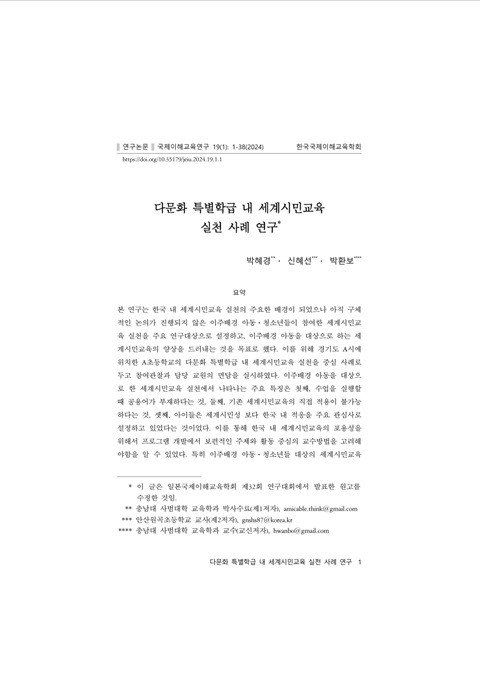 다문화 특별학급 내 세계시민교육 Year of publication: 2024 Author: 박혜경 | 신혜선 | 박환보 Corporate author: 한국국제이해교육학회 본 연구는 한국 내 세계시민교육 실천의 주요한 배경이 되었으나 아직 구체적인 논의가 진행되지 않은 이주배경 아동, 청소년들이 참여한 세계시민교육 실천을 주요 연구대상으로 설정하고, 이주배경 아동을 대상으로 하는 세계시민교육의 양상을 드러내는 것을 목표로 했다. 이를 위해 경기도 A시에 위치한 A초등학교의 다문화 특별학급 내 세계시민교육 실천을 중심 사례로 두고 참여관찰과 담당 교원의 면담을 실시하였다. 이주배경 아동을 대상으로 한 세계시민교육 실천에서 나타나는 주요 특징은 첫째, 수업을 실행할 때 공용어가 부재하다는 것, 둘째, 기존 세계시민교육의 직접 적용이 불가능하다는 것, 셋째, 아이들은 세계시민성 보다 한국 내 적응을 주요 관심사로 설정하고 있었다는 것이었다. 이를 통해 한국 내 세계시민교육의 포용성을 위해서 프로그램 개발에서 보편적인 주제와 활동 중심의 교수방법을 고려해야함을 알 수 있었다. 특히 이주배경 아동, 청소년들 대상의 세계시민교육은 각 문화마다 그 논의점이 다를 수 있으므로 교사들의 시행착오 경험을 누적할 장이 마련되어야 함을 제안하였다.
 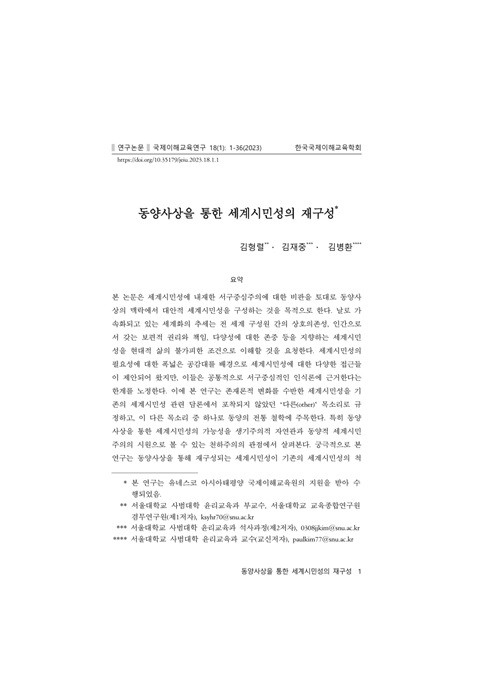 동양사상을 통한 세계시민성의 재구성 (국제이해교육연구; Vol. 18, No. 1) Year of publication: 2023 Author: 김형렬 | 김재중 | 김병환 Corporate author: 한국국제이해교육학회 본 논문은 세계시민성에 내재한 서구중심주의에 대한 비판을 토대로 동양사상의 맥락에서 대안적 세계시민성을 구성하는 것을 목적으로 한다. 날로 가속화되고 있는 세계화의 추세는 전 세계 구성원 간의 상호의존성, 인간으로서 갖는 보편적 권리와 책임, 다양성에 대한 존중 등을 지향하는 세계시민성을 현대적 삶의 불가피한 조건으로 이해할 것을 요청한다. 세계시민성의 필요성에 대한 폭넓은 공감대를 배경으로 세계시민성에 대한 다양한 접근들이 제안되어 왔지만, 이들은 공통적으로 서구중심적인 인식론에 근거한다는 한계를 노정한다. 이에 본 연구는 존재론적 변화를 수반한 세계시민성을 기존의 세계시민성 관련 담론에서 포착되지 않았던 ‘다른(other)’ 목소리로 규정하고, 이 다른 목소리 중 하나로 동양의 전통 철학에 주목한다. 특히 동양사상을 통한 세계시민성의 가능성을 생기주의적 자연관과 동양적 세계시민주의의 시원으로 볼 수 있는 천하주의의 관점에서 살펴본다. 궁극적으로 본 연구는 동양사상을 통해 재구성되는 세계시민성이 기존의 세계시민성의 척도를 대체하는 다른 척도가 되기를 주장하는 것이 아니라, 삶의 터전과 역사에 뿌리를 내린 맥락화된 많은 세계시민성 중의 하나가 될 수 있음을 논한다.