
Resources
Explore a wide range of valuable resources on GCED to deepen your understanding and enhance your research, advocacy, teaching, and learning.
684 Results found
 L’Éducation aux médias en 12 questions Year of publication: 2019 Author: Olivier Gobert | Philippe Delmotte | Catherine Soudon | Corine Dufour | Laurent Abraham | Aurore Leprêtre Corporate author: Conseil supérieur de l’éducation aux médias (CSEM) La brochure "L'éducation aux médias en 12 questions" a pour objectif de vous aider à mieux appréhender l’éducation aux médias dans divers contextes. Les 12 questions et leurs réponses sont accompagnées d’activités qui, bien qu’elles ne soient pas forcément liées aux questions qui les précèdent, servent à illustrer le champ de l’éducation aux médias.
 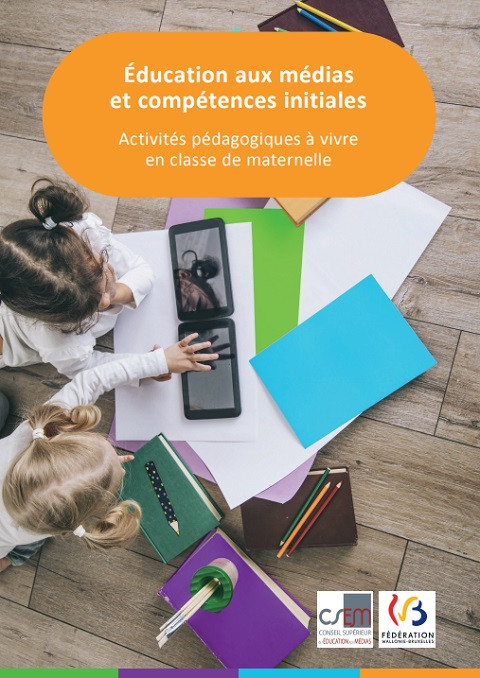 Éducation aux médias et compétences initiales: Activités pédagogiques à vivre en classe de maternelle Year of publication: 2020 Corporate author: Conseil supérieur de l’éducation aux médias (CSEM) Cet outil du Conseil supérieur de l’éducation aux médias propose aux enseignant.e.s, une série d’activités pédagogiques directement reliées aux visées transversales.Souple et modulable, ce recueil de quinze activités d’analyse et de production médiatiques complètera le panel d’activités déjà menées en classe. Chaque fiche proposée est adaptable en fonction des objectifs poursuivis, des moyens et du temps disponibles.
 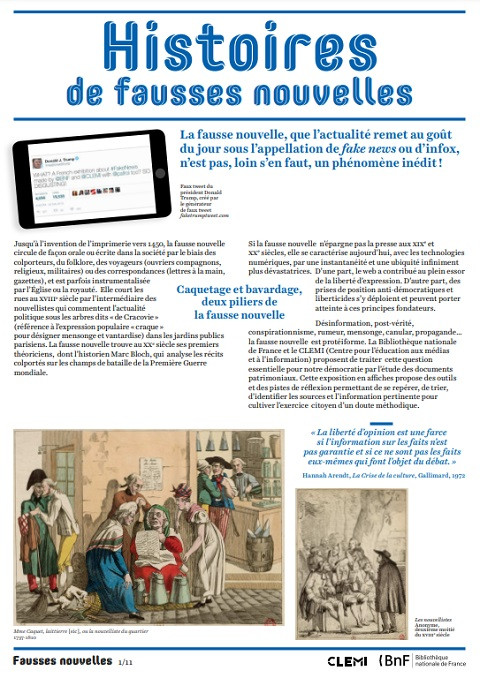 Histoires de fausses nouvelles Corporate author: Centre pour l’éducation aux médias et à l’information (CLEMI) | Bibliothèque nationale de France (BnF) Désinformation, mensonge, canular, propagande, la « fausse nouvelle » a été remise au goût du jour sous l’appellation de « fake news » puis de« infox ». Mais elle ne date pourtant pas d'hier. Le CLEMI s’est associé a Bibliothèque nationale de France pour traiter cette question essentielle pour notre démocratie par l’étude des documents patrimoniaux. Cette exposition pédagogique en affiches propose des outils et des pistes de réflexion permettant de se repérer, de trier, d’identifier les sources et l’information pertinente pour cultiver l’exercice citoyen d’un doute méthodique.
 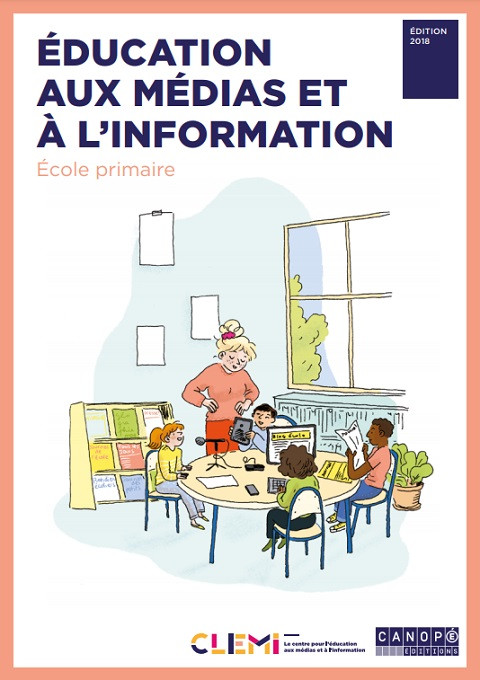 Éducation aux médias et à l’information: École primaire Year of publication: 2018 Corporate author: Centre pour l’éducation aux médias et à l’information (CLEMI) | Réseau Canopé Dans un monde complexe où l’information est surabondante, instantanée et en flux continu, l’éducation aux médias et à l’information (EMI) est devenue une priorité. À l’école primaire, elle peut s'intégrer à tous les enseignements. Son objectif est de favoriser la compréhension et un usage raisonné des médias, notamment numériques.Avec cette brochure, nous souhaitons encourager les professeurs des écoles à mettre en œuvre des activités en EMI, tout en répondant à leurs besoins spécifiques. Chaque fiche pédagogique propose des références aux programmes, un déroulement avec des activités concrètes, une durée indicative, des repères pour l’évaluation, des suggestions de traces écrites et des ressources. Ces fiches ont été validées et enrichies par un comité pédagogique, garant de la qualité et de la pertinence du contenu. Nous remercions les membres de ce comité pour leur implication active et leur engagement dans ce projet collectif.Cette brochure présente également une diversité de témoignages et d’entretiens qui démontrent que l’éducation aux médias et à l’information est une priorité éducative partagée. Apprendre à chercher, vérifier et publier l’information de manière responsable est essentiel au développement de l’esprit critique des élèves. Pensée comme outil de formation et support pour l’action, nous espérons vivement que cette brochure saura répondre efficacement aux besoins des enseignements.
  2020년 국가수준 초·중학생 디지털 리터러시 수준 측정 연구 Year of publication: 2021 Author: 정진명 | 이현숙 | 김주환 | 이운지 | 류기곤 | 김경아 | 조규복 | 구찬동 Corporate author: 한국교육학술정보원 2020년 국가수준 초중등학생의 디지털 리터러시 수준 측정 연구는 우리나라 초·중학생의 디지털 리터러시를 측정하고, 초·중학생의 디지털 리터러시 수준에 영향을 미치는 학교 환경과 관련 수업 및 교사 인식 등을 비교분석하여 주요 특징과 과제 및 개선방안을 제시하는 것이라고 할 수 있다. 또한 2020년 코로나19로 인하여 전면적인 원격교육이 일정기간 동안 시행되는 등 교육 환경에 기존과 다른 특수한 환경적 변수가 있었던 만큼 그로 인하여 학생의 디지털 리터러시와 교수학습 및 교사 인식에 어떠한 변화가 있었는지를 조사 분석하여 포스트 코로나19 교육 환경 변화에 대응하고자 하는 목적이 있다. 본 저작물은 한국교육학술정보원에서 2021년 작성하여 공공누리 제 4유형으로 개방한 ‘2020년 국가수준 초·중학생 디지털 리터러시 수준 측정 연구(정진명 외)’를 이용하였으며 해당 저작물은 한국교육학술정보원(www.keris.or.kr)에서 무료로 다운받으실 수 있습니다.
 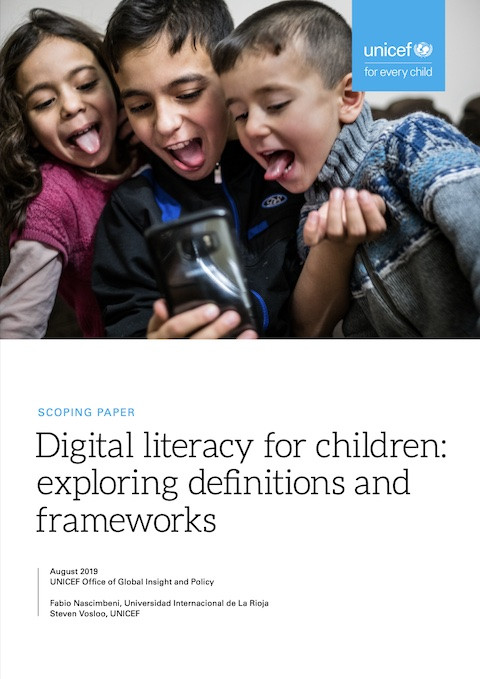 Digital Literacy for Children: Exploring Definitions and Frameworks Year of publication: 2019 Author: Fabio Nascimbeni Corporate author: United Nations Children's Fund (UNICEF) This paper presents the results of a scoping exercise on children’s digital literacy that has been undertaken with the following objectives:To understand the current digital literacy policy and practice landscape;To highlight existing competence frameworks and how they can be adapted to UNICEF’s needs;To analyze the needs and efforts of UNICEF country offices; andTo reflect on policy and programme recommendations, including a definition of digital literacy for UNICEF
  Critical Media Literacy and Popular Culture in ELA Classrooms Year of publication: 2021 Author: Jamila Lyiscott | Nicole Mirra | Antero Garcia Corporate author: National Council of Teachers of English (NCTE) This publication explores key issues on the Media Literacy impacting literacy educators and their students and articulate student-centered policy recommendations.
 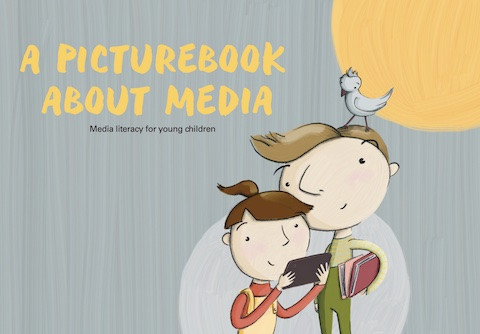 A Picture Book About Media: Media Literacy For Young Children Year of publication: 2018 Author: Alma Čakmazović Corporate author: United Nations Children's Fund (UNICEF) Media literacy helps to form the habit of appraising media contents and to develop the skills of expression necessary for critical thinking. Today, it represents education for life, human values, active citizenship and responsible media practices.This picturebook is devoted to children, parents, foster parents and educators. Its purpose is to give the youngest children the chance to understand media through one of the first lessons in media literacy, one about the difference between the media world and the real world.
 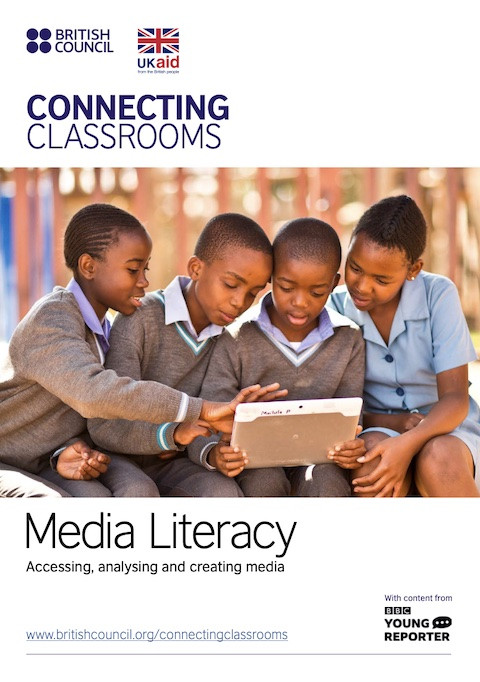 Connecting Classrooms: Media Literacy; Accessing, Analysing and Creating Media Year of publication: 2019 Corporate author: British Council | UK aid This resource aims to help young people develop and use a number of skills and approaches to analyse and critically examine information received through a range of channels and sources, such as the internet, social media, newspapers and TV.
  Human Rights Storytelling: Manual For the Educators Year of publication: 2018 Corporate author: Huristo Project Consortium Huristo project developed a methodology about awareness and advocacy about the European Human Rights Charter as a part of global citizenship education with low skilled adult learners (refugees and migrants living in the city and natives living in rural places). This methodology is based on digital storytelling: participants work on personal narratives illustrating different topics of the charter.The main result for the adult learners are increased digital skills, reading and writing skills, awareness about the Human Rights Charter and European citizenship. The work on the Charter and the personal narratives also improve participants’ analytic media literacy, interpersonal and intercultural skills, but also core skills for employability, such as teamwork, problem solving, learning to learn and communication. Additionally, the adult trainers who are involved increase their teaching skills using digital media and the methodology of digital storytelling in particular.