
Resources
Explore a wide range of valuable resources on GCED to deepen your understanding and enhance your research, advocacy, teaching, and learning.
3,378 Results found
 Élimination de la discrimination raciale, de la haine raciale et des crimes motivés par la haine raciale dans le monde (Conférence générale; 40e session) Year of publication: 2019 Corporate author: Organisation des Nations Unies pour l'éducation, la science et la culture (UNESCO) À sa 207e session, par sa décision 207 EX/49, le Conseil exécutif a décidé d’inscrire ce point à l’ordre du jour de la 40e session de la Conférence générale. Le document souligne le fait que la discrimination raciale, l’incitation à la haine raciale et les crimes motivés par la haine raciale constituent une menace pour tous les peuples et pour la communauté internationale. Dans cette perspective, la Directrice générale est appelée à renforcer la contribution réelle de l’UNESCO à la lutte contre le racisme, la discrimination raciale, la xénophobie et l’intolérance qui y est associée, et de faire rapport au Conseil exécutif, à sa 210e session, des progrès accomplis à cet égard.
  Global Guidance on Reopening Early Childhood Education Settings Year of publication: 2020 Corporate author: United Nations Children's Fund (UNICEF) | World Bank | UNESCO This guidance note outlines key principles and practical measures for decision-makers to consider before, during and after the transition from closure to reopening. It focuses on safe operations in ECE settings, staff training and support, child well-being and development, and parental communication and support.
 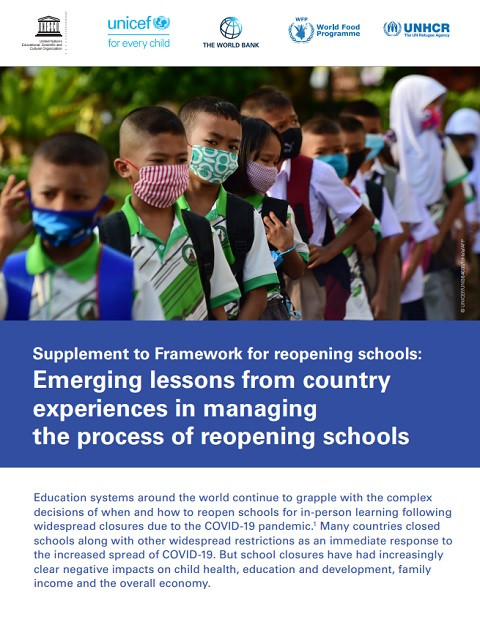 Supplement to Framework for Reopening Schools: Emerging Lessons From Country Experiences in Managing the Process of Reopening Schools Year of publication: 2020 Corporate author: UNESCO | United Nations Children's Fund (UNICEF) | World Bank | World Food Programme | UN. Office of the United Nations High Commissioner for Refugees (UNHCR) Education systems around the world continue to grapple with the complex decisions of when and how to reopen schools for in-person learning following widespread closures due to the COVID 19 pandemic. This supplement to the Framework for reopening schools, originally published jointly by UNICEF, UNESCO, the World Bank, the World Food Programme, and the UN Refugee Agency (UNHCR) in April 2020, summarizes emerging lessons learnt over the past months.The supplement follows the four main dimensions of the Framework (safe operations, focus on learning, wellbeing & protection, and reaching the most marginalized) and highlighting a number of country examples.
 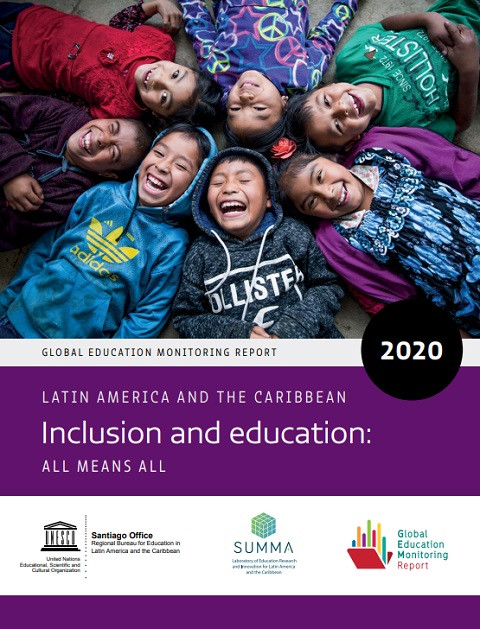 Latin America and the Caribbean 2020: Inclusion and Education; All Means All (Global Education Monitoring Report) Year of publication: 2020 Corporate author: Global Education Monitoring Report Team | UNESCO | Laboratory of Education Research and Innovation for Latin America and the Caribbean (SUMMA) Latin America and the Caribbean has the largest and most challenging socio-economic inequalities in the world, which have shaped its education systems over the decades. This report looks at everyone both in and excluded from education in the region, pinpointing barriers facing learners, especially when multiple disadvantages intersect. The report also explores challenges in education posed by COVID-19 and the need for urgent action to prevent an exacerbation of inequalities. Produced by the Global Education Monitoring (GEM) Report team, in partnership with the UNESCO Regional Bureau for Education in Latin America and the Caribbean (OREALC) and the Laboratory of Education Research and Innovation for Latin America and the Caribbean (SUMMA), the report assesses key solutions for greater inclusion through several case studies from the region. It provides in-depth analysis on challenges to inclusion in education arising from migration and displacement in Colombia and Costa Rica; remoteness in Brazil and Suriname; disability in Cuba and Nicaragua; gender in Peru and Jamaica; sexual orientation, gender identity and expression in Chile and Mexico; poverty in the Dominican Republic and Honduras; ethnicity in Bolivia and Ecuador; and incarceration in El Salvador and Uruguay. Building on the 2020 Global Education Monitoring Report, this regional edition concludes that strong laws and policies in Latin America and the Caribbean demonstrate a commitment to inclusion, but that the daily realities faced by learners suggest implementation is lagging. Recommendations are aimed at promoting more inclusive education systems to benefit all children and youth, no matter their background, identity or ability. The recommendations provide a systematic framework for identifying and dismantling barriers for vulnerable populations, according to the principle that ‘every learner matters and matters equally’. América Latina y el Caribe 2020: Inclusión y educación; Todos y todas sin excepción (Informe de seguimiento de la educación en el mundo) Year of publication: 2020 Corporate author: Global Education Monitoring Report Team | UNESCO | Laboratory of Education Research and Innovation for Latin America and the Caribbean (SUMMA) América Latina y el Caribe es la región con las mayores y más tenaces desigualdades socioeconómicas del mundo. Durante decenios estas desigualdades se han reflejado en sus sistemas educativos. El presente informe examina a quiénes incluyen y a quiénes excluyen estos sistemas y llama la atención sobre las barreras que enfrentan los educandos, especialmente cuando están expuestos a múltiples desventajas. El informe también explora los nuevos retos educativos que plantea la pandemia de la Covid-19 y la necesidad de actuar sin dilación para evitar que se agraven las desigualdades. El informe, elaborado por el equipo del Informe de Seguimiento de la Educación en el Mundo (Informe GEM), en colaboración con la Oficina Regional de Educación para América Latina y el Caribe (OREALC/ UNESCO Santiago) y el Laboratorio de Investigación e Innovación en Educación para América Latina y el Caribe -SUMMA, evalúa algunas de las principales iniciativas emprendidas para mejorar la inclusión, basándose en varios estudios de casos de la región. Analiza en profundidad algunos ejemplos de los grandes desafíos que amenazan la inclusión en la educación: migración y desplazamiento en Colombia y Costa Rica; aislamiento rural en el Brasil y Suriname; discapacidad en Cuba y Nicaragua; discriminación de género en el Perú y Jamaica; orientación sexual e identidad y expresión de género en Chile y México; pobreza en la República Dominicana y Honduras; etnicidad en Bolivia y el Ecuador; y jóvenes en situación de privación de libertad en El Salvador y el Uruguay. Esta edición regional del Informe de Seguimiento de la Educación en el Mundo 2020 concluye que, si bien las leyes y políticas de América Latina y el Caribe demuestran la firme determinación de promover la inclusión, la realidad cotidiana de los alumnos y las alumnas sugiere que la aplicación práctica lleva retraso. Se formulan recomendaciones con el objeto de promover sistemas de educación más inclusivos en beneficio de todos los niños, niñas y jóvenes, sin distinción de origen, identidad o capacidad. Las recomendaciones brindan un marco sistemático que permite identificar y eliminar barreras para las poblaciones marginadas, conforme al principio de que “cada alumno es importante y todos los alumnos importan por igual”.
 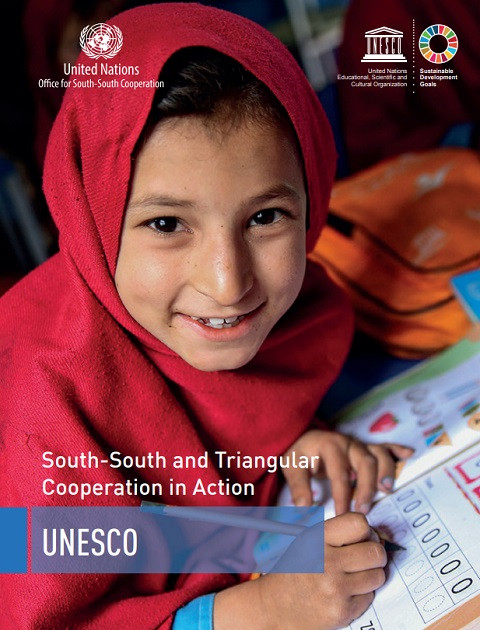 La cooperación Sur-Sur y la cooperación triangular en acción Year of publication: 2018 Corporate author: UNESCO | UN. Office for South-South Cooperation (UNOSSC) Esta publicación es el primer informe específico de la UNESCO sobre la cooperación Sur-Sur y la cooperación triangular. Se presenta un panorama general de los avances en la cooperación técnica, la creación de capacidades y el intercambio de conocimientos mediante la cooperación SurSur y la cooperación triangular en las esferas de competencia de la UNESCO y se mencionan ejemplos concretos. Se allana el camino para profundizar la cooperación en este ámbito en el futuro. La coopération Sud-Sud et triangulaire en action Year of publication: 2018 Corporate author: UNESCO | UN. Office for South-South Cooperation (UNOSSC) La présente publication est le premier rapport de l’UNESCO qui traite de la coopération SudSud et de la coopération triangulaire. Elle brosse un tableau d’ensemble, illustré par des exemples particuliers, des progrès que ces modalités de coopération ont permis d’accomplir pour faciliter la coopération technique, le renforcement des capacités et le partage des connaissances dans les domaines de compétence de l’UNESCO, et ouvre la voie à de plus amples efforts en la matière.
 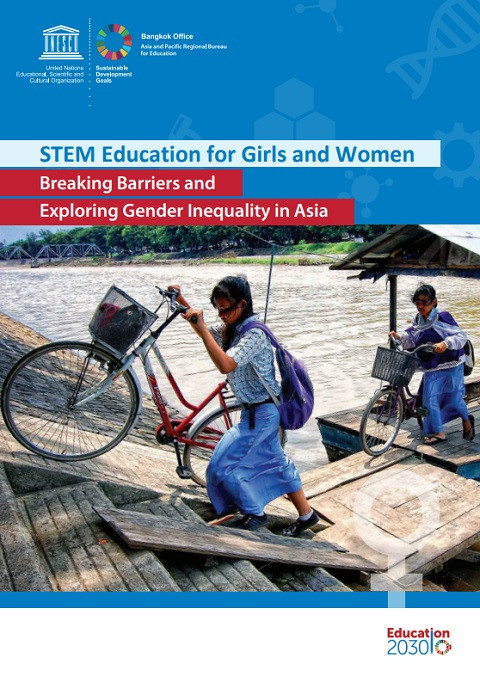 STEM Education for Girls and Women: Breaking Barriers and Exploring Gender Inequality in Asia Year of publication: 2020 Corporate author: UNESCO Bangkok | UNESCO Science, Technology, Engineering and Mathematics (STEM) fields are considered catalysts for the achievement of the 2030 Agenda for Sustainable Development. Yet, particularly for STEM fields, girls and women, for a multitude of social, cultural and psychological reasons, engage and participate at a lower rate than boys and men. This research collection aims to highlight the contextual barriers that girls and women face in STEM education and careers and offer concrete examples of interventions that successfully encourage participation of girls and women in STEM. These eight case studies from across Asia explore both the barriers and the achievements in SDG 4 and SDG 5, and give context-specific analysis of different aspects of gender disparities in the respective countries.
 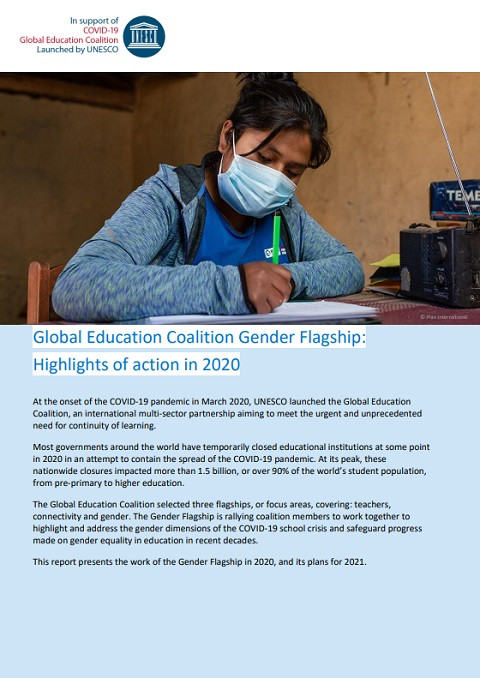 Global Education Coalition Gender Flagship: Highlights of Action in 2020 Year of publication: 2021 Corporate author: UNESCO | Global Education Coalition At the onset of the COVID-19 pandemic in March 2020, UNESCO launched the Global Education Coalition, an international multi-sector partnership aiming to meet the urgent and unprecedented need for continuity of learning.Most governments around the world have temporarily closed educational institutions at some point in 2020 in an attempt to contain the spread of the COVID-19 pandemic. At its peak, these nationwide closures impacted more than 1.5 billion, or over 90% of the world’s student population, from pre-primary to higher education. The Global Education Coalition selected three flagships, or focus areas, covering: teachers, connectivity and gender.The Gender Flagship is rallying coalition members to work together to highlight and address the gender dimensions of the COVID-19 school crisis and safeguard progress made on gender equality in education in recent decades.This report presents the work of the Gender Flagship in 2020, and its plans for 2021.
 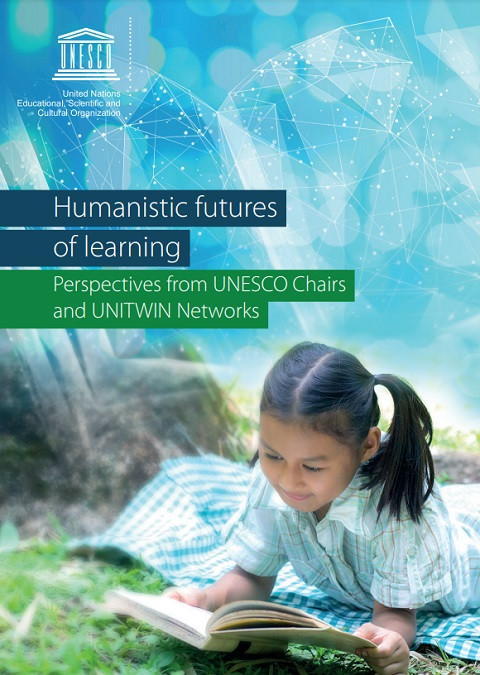 Humanistic Futures of Learning: Perspectives from UNESCO Chairs and UNITWIN Networks Year of publication: 2020 Corporate author: UNESCO UNESCO’s Futures of Education initiative aims to rethink education and shape the future. The initiative is catalyzing a global debate on how knowledge, education and learning need to be reimagined in a world of increasing complexity, uncertainty and precarity. This publication presents the first curated input to the Futures of Education initiative from the UNITWIN/UNESCO Chairs Programme, which now represents an extensive global network of more than 800 higher education institutions in over 115 countries. It features think pieces that highlight key dimensions to be considered in re-visioning and re-purposing education for the future of humanity and the planet. The collection of the pieces calls for greater focus on a number of critical areas such as: The role of culture in strengthening social and environmental sustainability; the values and attitudes that are needed to shape future generations; the importance of both robust public education, as well as of other learning spaces; the need to strengthen human creativity and capability in the digital era, as well as the role of higher education in generating the knowledge and driving the innovation required to transform our world.