
Resources
Explore a wide range of valuable resources on GCED to deepen your understanding and enhance your research, advocacy, teaching, and learning.
884 Results found
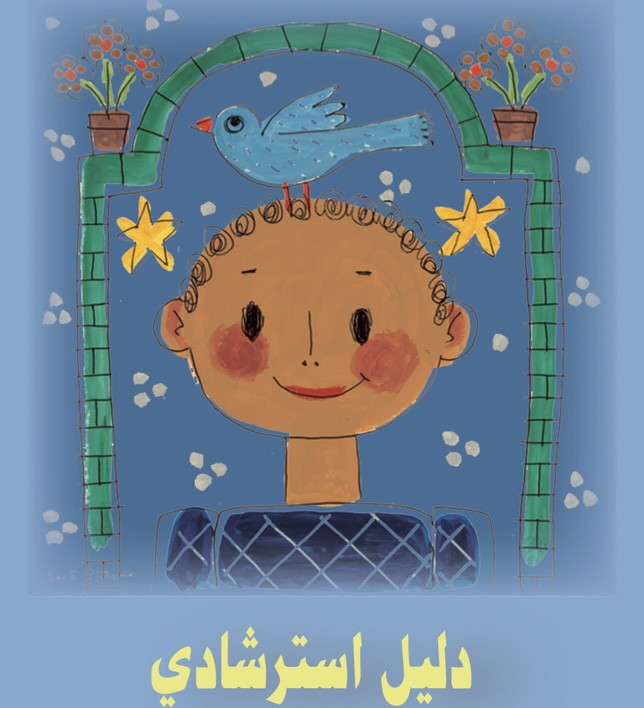 دليل استرشادي لصياغة سياسات حماية حقوق الطفل في المنطقة العربية وفق النهج الحقوقي Year of publication: 2015 Author: Adel Azar | Ahmed Abd al manaem | Abdul Latif Mahmoud | Ibtisam Al-Jafarawi | Mahmoud Bastami Corporate author: Arab Council for Childhood and Development (ACCD) هذا العمل يهدف إلى بناء دليل استرشادي لسياسات الحماية في إطار تعزيز الانتقال من نهج النموذج التجزيئي الذي يتعامل مع احتياجات الطفل في إطار الأوضاع القائمة بل وإعادة إنتاجها، أي باعتبار ما يحتاجه الطفل من خدمات، للانتقال من هذا النهج، إلى نهج النموذج العلمي الذي يتطلع إلى التغيير الشامل. اهتم هذا الدليل بتوفير رؤية شاملة ومتكاملة لسياسات حقوق الطفل، وصياغة معايير ودلالات هذه الحقوق وبرمجتها لضمان إنفاذها، وبناء سياسات فاعلة تكفل حقوق ورفاه الطفل في المنطقة العربية. A Guideline for Formulating Child Rights Protection Policies in the Arab Region according to the Human Rights Approach Year of publication: 2015 Author: Adel Azar | Ahmed Abd al manaem | Abdul Latif Mahmoud | Ibtisam Al-Jafarawi | Mahmoud Bastami Corporate author: Arab Council for Childhood and Development (ACCD) This work aims to build an indicative guide for children protection policies in the context of promoting the transition from the approach of the fragmented model that deals with the needs of the child within the framework of the existing conditions and even its reproduction. It also considers the services that the child needs, to move from this approach, to the approach of the scientific model that aspires to comprehensive change. This guide is concerned with providing a comprehensive and integrated vision of children's rights policies, formulating standards and implications for these rights and programming them to ensure their enforcement, and building effective policies that guarantee the rights and well-being of children in the Arab region.
 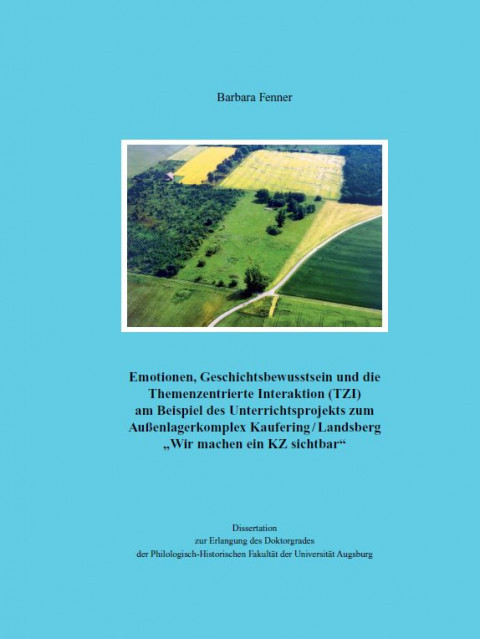 Emotionen, Geschichtsbewusstsein und die Themenzentrierte Interaktion (TZI) am Beispiel des Unterrichtsprojekts zum Außenlagerkomplex Kaufering/Landsberg: “Wir machen ein KZ sichtbar” Year of publication: 2012 Author: B. Fenner Corporate author: University of Ausgsburg Based on theme-centred interaction theory, the authors analyse a project in which a group of German 9th and 10th grade students participate in a project, “We make a Concentration Camp visible,” aimed at recreating the history of the so called Lager XI, one of the eleven satellite camp complexes of Dachau concentration camp, and make an exhibition about the camp. The above abstract is taken from the International Holocaust Remembrance Alliance Education Research Project. Please also consult the full list of abstracts in 15 languages and the accompanying publication Research in Teaching and Learning about the Holocaust: A Dialogue Beyond Borders. Ed: IHRA, Monique Eckmann, Doyle Stevick, Jolanta Ambrosewicz-Jacobs, 2017, Metropol Verlag at http://www.holocaustremembrance.com/publications.
  Jugendliche aus Einwandererfamilien und die Geschichte des Nationalsozialismus Year of publication: 2003 Author: V. B. Georgi Based on 55 interviews with young Germans with immigrant family background from the age of 15–20, Giorgi constructs a typology of how they position themesleves to the German Nazi past.
  Nationalsozialismus im Geschichtsunterricht: Beobachtungen unterrichtlicher Kommunikation Year of publication: 2002 Corporate author: Johann Wolfgang Goethe University This is a pilot study about the potential of history education about Nazism and the Holocaust. The aim is, 1) to establish whether it is possible to conduct empirical analysis about “Education after Auschwitz,” and 2) based on empircal observation improve the theoretical assumptions about the relationship between education and the specific theme of Nazism and the Holocaust. The empirical part consists of five case studies about different aspects of “Holocaust education” in two Upper Secondary schools in Frankfurt.The above abstract is taken from the International Holocaust Remembrance Alliance Education Research Project. Please also consult the full list of abstracts in 15 languages and the accompanying publication Research in Teaching and Learning about the Holocaust: A Dialogue Beyond Borders.Ed: IHRA, Monique Eckmann, Doyle Stevick, Jolanta Ambrosewicz-Jacobs, 2017, Metropol Verlag at http://www.holocaustremembrance.com/publications.
 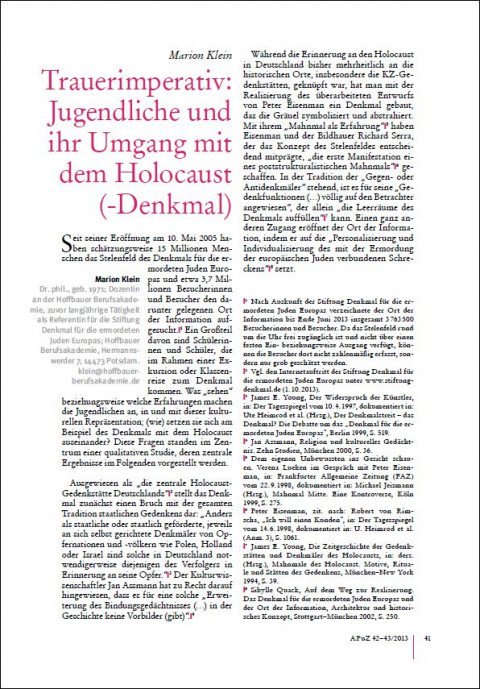 Trauerimperativ: Jugendliche und ihr Umgang mit dem Holocaust (-Denkmal) Year of publication: 2013 Author: M. Klein Corporate author: Bundeszentrale für politische Bildung The author analyzes German student’s visit at the memorial for the murdered Jews in Berlin. Empirical qualitative study.The above abstract is taken from the International Holocaust Remembrance Alliance Education Research Project. Please also consult the full list of abstracts in 15 languages and the accompanying publication Research in Teaching and Learning about the Holocaust: A Dialogue Beyond Borders.Ed: IHRA, Monique Eckmann, Doyle Stevick, Jolanta Ambrosewicz-Jacobs, 2017, Metropol Verlag at http://www.holocaustremembrance.com/publications.
  Zwischen Vermittlungsanspruch und emotionaler Wahrnehmung: Die Gestaltung neuer Dauerausstellungen in Gedenkstätten für NS-Opfer in Deutschland und deren Bildungsanspruch Year of publication: 2009 Author: Thomas Lutz Over the last decade, as part of the federal concept for memorial sites, twenty new permanent exhibitions were developed. This dissertation undertakes to examine exhibitions created at memorial sites for victims of the Nazi regime from an educational and museological viewpoint. Expert interviews with exhibition curators serve as the basis for the empirical study. The author has worked for many years in the field of memorial museums education. He applied “action research,” developed in German-speaking countries under the term “Handlungsforschung.” The study analyzes the specific characteristics of the work conducted in museums, memorial sites and educational centres and also addresses the strained connection between commemoration and learning in the educational work of the memorial museums for the Nazi victims. The study also evaluates the practical impact of these aims. The very intense form of commemorative work that is conducted in Germany is justified by the nature of its subject matter: the stigmatization of specific victim groups during the Nazi era according to a system of political, racist-biological and social characteristics and the vast dimensions of the genocide. The socially and politically explosive nature of this task is manifested by the commemoration of the “other” victims as well as by the responsibility that Germany bears for addressing its “own” perpetrators in society. The central findings of the study show that the new exhibitions embrace a much more comprehensive foundation of historical material (historical knowledge, building history and archeological significance of the crime sites, written and audio-visual survival testimony and artifacts) as was previously the case. The professionalization of the “field of memorial museums” has led to a more intensively reflected and sensitive approach to handling documents, illustrations and objects on display in a museum. In particular, the significance of the relationship between the artifacts and their location, their sources, an appreciation for their origins and a critical reflection of what it is they convey is achieved. This also applies to photography. (Written by author) The above abstract is taken from the International Holocaust Remembrance Alliance Education Research Project. Please also consult the full list of abstracts in 15 languages and the accompanying publication Research in Teaching and Learning about the Holocaust: A Dialogue Beyond Borders.Ed: IHRA, Monique Eckmann, Doyle Stevick, Jolanta Ambrosewicz-Jacobs, 2017, Metropol Verlag at http://www.holocaustremembrance.com/publications.
  Die “Erziehung nach Auschwitz” und das kulturelle Gedächtnis in der Schule: Eine qualitative Studie zur Rekonstruktion von Geschichtsbildern und didaktisch-methodischen Konzepten exemplarischer Gymnasialgeschichtslehrer der zweiten und dritten Generation in Baden-Württemberg Year of publication: 2014 Author: Bertram Noback This is a qualitative study based on interviews with 56 German history teachers working in different upper secondary schools in Baden-Württemberg. The author asks whether the theme of National Socialism is considered to be a normal topic in history teaching for contemporary German teachers or if they view it as key problem for education in schools. He therefore tries to reconstruct teachers’ images of history and their subjective theories concerning the treatment of National Socialism in history education. Among history teachers of the third generation the author distinguishes between three ideal types which he believes reflect different attitudes to society’s and the schools’ treatment of the Nazi period. He also identifies six different ideal types in terms of educational concepts concerning teaching about the Holocaust. The above abstract is taken from the International Holocaust Remembrance Alliance Education Research Project. Please also consult the full list of abstracts in 15 languages and the accompanying publication Research in Teaching and Learning about the Holocaust: A Dialogue Beyond Borders.Ed: IHRA, Monique Eckmann, Doyle Stevick, Jolanta Ambrosewicz-Jacobs, 2017, Metropol Verlag at http://www.holocaustremembrance.com/publications.
  Holocaust Education: Lehrplanrecherche, TV-Recherche und Untersuchungen Year of publication: 2011 Author: U. Schmidt-Denter | S. Stubig Corporate author: Universität zu Köln This research report contains a) a review of the conclusions of earlier research on Holocaust education as well as a review of German school curricula, b) an empirical quantitative study of the presence of the Nazi period in German television programmes 1 January 2010 – 31 March 2010, c) a group interview with a history teacher and 28 students from the 10th grade of an Upper Secondary school in Nordrhein-Westfalen. The above abstract is taken from the International Holocaust Remembrance Alliance Education Research Project. Please also consult the full list of abstracts in 15 languages and the accompanying publication Research in Teaching and Learning about the Holocaust: A Dialogue Beyond Borders.Ed: IHRA, Monique Eckmann, Doyle Stevick, Jolanta Ambrosewicz-Jacobs, 2017, Metropol Verlag at http://www.holocaustremembrance.com/publications.
 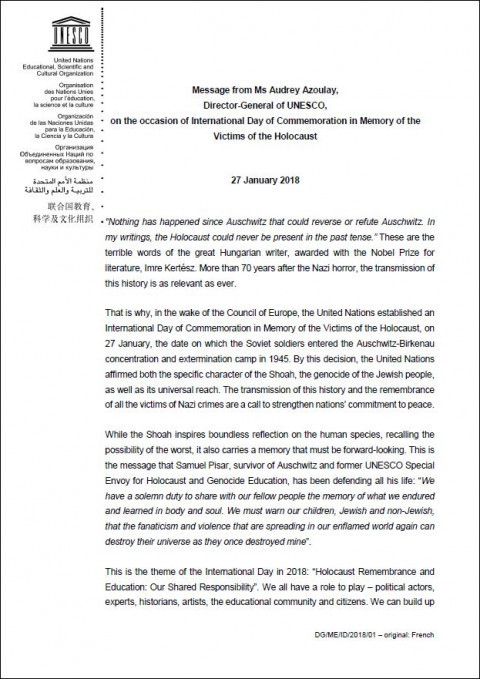 Message from Ms Audrey Azoulay, Director-General of UNESCO, on the occasion of International Day of Commemoration in Memory of the Victims of the Holocaust Year of publication: 2018 Corporate author: UNESCO. Director-General, 2009-2017 (Bokova, I.G.) This message was delivered by Audrey Azoulay, Director-General of UNESCO, on the occasion of International Day of Commemoration in Memory of the Victims of the Holocaust, on 27 January 2018.