
Resources
Explore a wide range of valuable resources on GCED to deepen your understanding and enhance your research, advocacy, teaching, and learning.
874 Results found
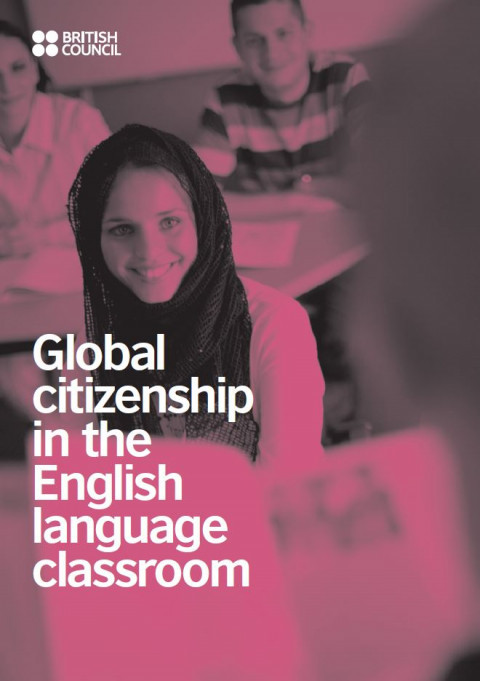 Global Citizenship in the English Language Classroom Year of publication: 2008 Author: Susan Hillyard | Elena Tarasheva | Clarissa Jordão | Francisco Fogaça | Esperanza Revelo Jiménez | Sabiha Khuram | Telma Gimenez | Vanessa Andeotti Corporate author: British Council This booklet contains a collection of papers on global citizenship in language education around the world. It provides theoretical frameworks and practical applications in different contexts.Following on from Audrey Osler and Hugh Starkey’s 'Citizenship and Language Learning: international perspectives', published in 2005, this collection aims at offering ideas and practical suggestions on how teachers around the world have tackled the teaching of English within a citizenship education perspective. There are seven chapters, from authors working in different parts of the world, such as Argentina, Bulgaria, Brazil, Colombia, and Pakistan.There are five report style chapters that deal with courses, teaching materials, research and curriculum innovation. The two remaining contributions can be seen as proposals for implementation of a global citizenship perspective in English language classrooms.The diverse interpretations teachers of English around the world have been giving to the task of promoting global citizenship in their classrooms are reflected in this collection with understandings that range from a more prescriptive approach to a transformational one. They bring the potential for new approaches to be tried out in different contexts. The aim is to inspire teachers to experiment and evaluate the results.
  Alternative bilingual Miskito-Spanish intercultural literacy education linked to the exercise of citizenship and community production Year of publication: 2008 Corporate author: Regional Literacy and CONFINTEA VI Preparatory Conference in Latin America and the Caribbean: From Literacy to Lifelong Learning: Towards the Challenges of the 21st Century, Mexico City, 2008 The Alternative Bilingual Intercultural Literacy Education project is carried out in five rural indigenous communities and eleven urban neighbourhoods of Bilwi (Puerto Cabezas) in the North Atlantic Autonomous Region (RAAN) of Nicaragua. In this region, illiteracy is the result of poverty, historical social exclusion and the lack of any official or State programme of adult literacy education in the Miskito language. This constitutes a negation of the right to bilingual intercultural education of the young and adult indigenous population and an obstacle to individual, social and regional development. The project provides literacy classes for young people and adults in their mother tongue Miskito and in Spanish, and deals with intercultural themes of their world view, the environment and indigenous rights. In Nicaragua, this experiment is a unique and alternative model of literacy provision in Miskito, with a Miskito-Spanish bilingual intercultural curriculum of its own. The texts have been produced by authors from the Miskito ethnic group, with contents determined on the basis of a needs analysis and the identification of fundamental features of the Miskito world view. Éducation Interculturelle bilingue Miskito-Espagnol liée à l'exercice de la citoyenneté et de la communauté production Year of publication: 2008 Corporate author: Regional Literacy and CONFINTEA VI Preparatory Conference in Latin America and the Caribbean: From Literacy to Lifelong Learning: Towards the Challenges of the 21st Century, Mexico City, 2008 Le projet de l'éducation interculturelle bilingue est réalisée dans cinq communautés autochtones rurales et onze quartiers urbains de Bilwi (Puerto Cabezas) dans la région de l'Atlantique Nord autonome (RAAN) du Nicaragua. Dans cette région, l'analphabétisme est le résultat de la pauvreté, l'exclusion sociale historique et l'absence de tout programme officiel ou de l'Etat de l'alphabétisation des adultes dans la langue Miskito. Ceci constitue une négation du droit à l'éducation interculturelle bilingue des jeunes et des adultes population indigène et un obstacle au développement individuel, social et régional. Le projet offre des cours d'alphabétisation pour les jeunes et les adultes dans leur Miskito langue maternelle et en espagnol, et traite des thèmes interculturels de leur vision du monde, l'environnement et les droits des autochtones. Au Nicaragua, cette expérience est un modèle unique et alternatif de la prestation de l'alphabétisation en Miskito, avec un bilingue Miskito-espagnol curriculum interculturel propre. Les textes ont été rédigés par des auteurs du groupe ethnique Miskito, avec des contenus déterminés sur la base d'une analyse des besoins et l'identification des caractéristiques fondamentales de la vision du monde Miskito.
 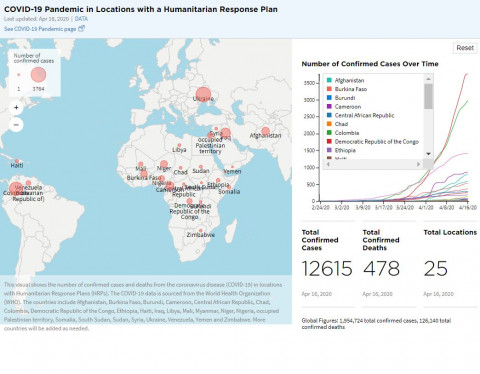 COVID-19 Pandemic in Locations with a Humanitarian Response Plans Year of publication: 2020 Corporate author: United Nations Office for the Coordination of Humanitarian Affairs (OCHA) This visual shows the number of confirmed cases and deaths from the coronavirus disease (COVID-19) in locations with Humanitarian Response Plans (HRPs). The COVID-19 data is sourced from the World Health Organization (WHO). The countries include Afghanistan, Burkina Faso, Burundi, Cameroon, Сentral African Republic, Chad, Colombia, Democratic Republic of the Congo, Ethiopia, Haiti, Iraq, Libya, Mali, Myanmar, Niger, Nigeria, occupied Palestinian territory, Somalia, South Sudan, Sudan, Syria, Ukraine, Venezuela, Yemen and Zimbabwe. More countries will be added as needed.
  Education for Global Citizenship: Meanings and Practices for a Transformative Cosmopolitism Year of publication: 2017 Author: Alejandra Boni Aristizabal According to the author: "The article aims to analyze in depth the meanings of global citizenships in order to characterize the pedagogical practices of what is known as education for global citizenship. After a brief analysis of the different stages that education for development has gone through, from the assistencialist approach of the 50s to education for global citizenship, we study different perspectives of cosmopolitanism: a vision from the field of ethics, mainly from Martha Nussbaum's perspective that talks about cosmopolitan abilities, from politics, that has democratic proposals such as David Held's, critical perspectives as Boaventura de Souza Santos' ones, and the sociological perspective that allows us to identify intercultural communicative processes where the cosmopolitan view is produced, according to Ulrick Beck's or Gerald Delanty's words. After this, we conclude with a discussion about how to encourage education for develpment spaces that foster global citizenship." Educación para la Ciudadanía Global: Significados y espacios para un cosmopolitismo transformado Year of publication: 2017 Author: Alejandra Boni Aristizabal Según la autora: "El presente artículo tiene como objetivo profundizar en los significados de la ciudadanía global con el fin de caracterizar las prácticas pedagógicas de lo que se conoce como educación para la ciudadanía global. Tras una breve análisis de las distintas etapas por las que ha pasado la educación para el desarrollo, desde el planteamiento asistencialista de los años 50 hasta la educación para la ciudadanía global, nos detenemos en diferentes perspectivas del cosmopolitismo: la visión desde la ética, fundamentalmente a través de la obra de Martha Nussbaum que nos habla de las habilidades cosmopolitas, desde la política, que contiene propuestas de democracia como las de David Held y perspectivas más críticas como las de Boaventura de Sousa Santos, y la perspectiva sociológica que nos permite identificar los procesos de comunicación intercultural donde se produce la mirada cosmopolita, según palabras de Ulrick Beck o Gerard Delanty. Tras ello, concluiremos con una discusión sobre cómo potenciar espacios de educación para el desarrollo desde donde contribuir a la formación de ciudadanos globales"
 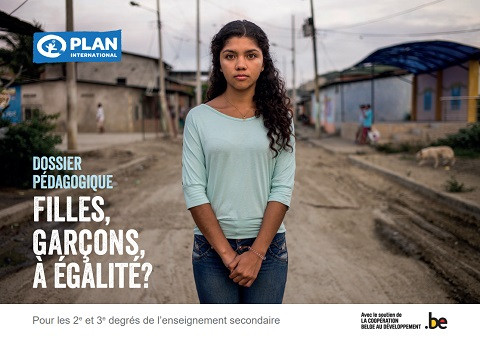 Filles, garçons, à égalité?: Dossier pédagogique Year of publication: 2017 Corporate author: Plan International Belgique | La coopération belge au développement Ce dossier pédagogique vise à sensibiliser les adolescent-e-s à propos des inégalités entre garçons et filles et à les faire réfléchir aux conséquences.Prendre conscience du poids des stéréotypes et les questionner constamment en les observant à travers le prisme du genre sont des étapes décisives sur la voie de l’égalité. En utilisant les différentes fiches de ce dossier, les enseignants peuvent aider leur élèves à développer des lunettes ‘genre’ et à mieux comprendre ce qui les entoure.
  The Regional Conference on Higher Education of Córdoba Argentina (CRES2018): Voices That Question Year of publication: 2018 Author: Luis Bonilla-Molina The report is about the Regional Conference on Higher Education (CRES2018), where the Universidad Nacional de Córdoba partnered with the Intenational Institute for Higher Education in Latin America and the Caribbean (IESALC) from the UNESCO. During the event seven main areas concerning Higher Education in Latin America were debated from a critical perspective. Regarding globalization, according to the author, during the event "the effects of the cultural 'worldization'" were analyzed, and it was stated that "planetary citizenship is a blurred topic" that can promote cultural homogenization, and that therefore, there was a need of the promotion of a critical intercultural approach. La Conferencia Regional de Educación Superior de Córdoba Argentina (CRES2018): Voces que interrogan Year of publication: 2018 Author: Luis Bonilla-Molina El reporte habla de la celebración de la Tercera Reunión Regional de Educación Superior (CRES2018) donde la Univ. Nacional de Córdoba se alió con el Instituto de Ed. Superior para América Latina y el Caribe (IESALC) de la UNESCO. Durante ese evento hubieron siete ejes de debates que analizaban la Ed. Superior en América Latina desde una perspectiva crítica. En cuanto a la globalización, según el autor, durante el encuentro se problematizaron "los efectos de la mundializaciòn cultural", y se aseguró que la "ciudadanía planetaria aparece como un tema difuso" que puede promover homogeneización cultural por lo que se planteó la necesidad de un enfoque basado en un interculturalismo crítico.
  Programming with Adolescent Boys to Promote Gender-Equitable Masculinities: A Rigorous Review Year of publication: 2018 Author: Rachel Marcus | Maria Stavropoulou | Nandini Archer-Gupta Corporate author: Gender and Adolescence: Global Evidence (GAGE) | UK aid This review brings evidence from 36 studies of 34 programmes working with adolescent boys and young men to promote more gender-equitable masculinities. It draws on studies with a range of evaluation designs; the key requirements were adequate description of methodology and a valid comparison between participants and non-participants, or of attitudes and behaviour before and after participation.