
Resources
Explore a wide range of valuable resources on GCED to deepen your understanding and enhance your research, advocacy, teaching, and learning.
1,187 Results found
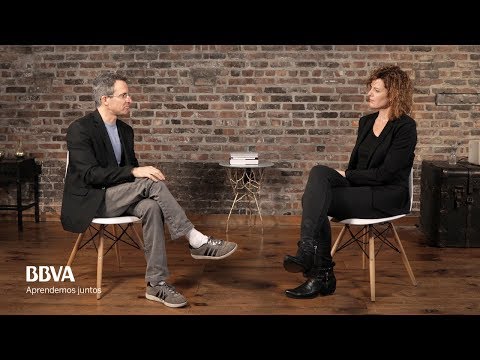 The Science of Happiness Year of publication: 2018 Corporate author: BBVA Aprendemos Juntos Tal Ben-Shahar is the happiness scientist of the 21st century. In this video he talks about the need to teach with positive emotions to increase the happiness and creativity of students. Doctor in psychology and philosophy, Tal Ben-Shahar's Positive Psychology course at Harvard holds the record for the subject with the largest number of students in the history (1400 per semester) of Harvard University, earning the nickname "professor of the happiness". Ben-Shahar is the author of books such as "Choose the life you want" or "Practice happiness", among others, in which he talks about the emotions that improve learning, creativity, the capacity for innovation, and ultimately, people's daily life. La ciencia de la felicidad Year of publication: 2018 Corporate author: BBVA Aprendemos Juntos Tal Ben-Shahar es el científico de la felicidad del siglo XXI. En este vídeo nos habla sobre la necesidad de enseñar con emociones positivas para aumentar la felicidad y la creatividad de los estudiantes. Doctor en psicología y filosofía, El curso de Psicología Positiva de Tal Ben-Shahar en Harvard posee el récord de la asignatura con mayor número de alumnos de la historia (1400 por semestre) de la Universidad de Harvard ganándose el sobrenombre de “profesor de la felicidad”. Ben-Shahar es autor de libros como "Elige la vida que quieres” o "Practicar la felicidad”, entre otros, en los que nos habla sobre las emociones que mejoran el aprendizaje, la creatividad, la capacidad de innovación, y en definitiva, la vida diaria de las personas.
 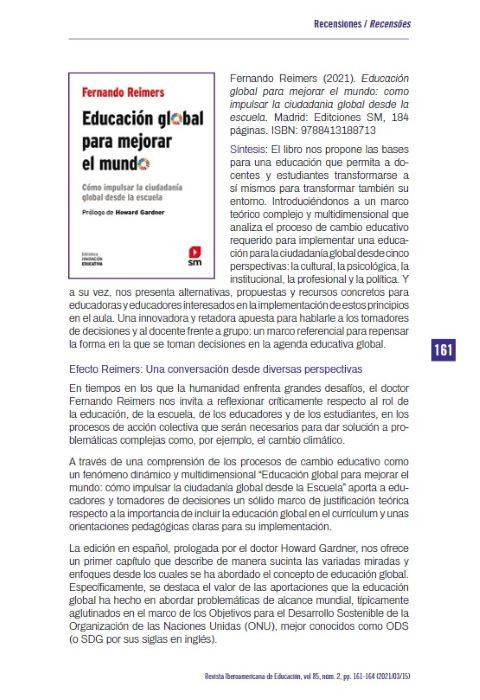 [Book Review] Global Education for a Better World (Ibero-American Journal of Education; vol. 85, no.2) Year of publication: 2021 Author: Patricia Vasquez | Gustavo Rojas Review of the book "Global education to improve the world: how to promote global citizenship from the School" in which Dr. Fernando Reimers proposes the bases for an education that allows teachers and students to transform themselves to also transform their environment. In this work, a complex and multidimensional theoretical framework is presented that analyzes the process of educational change required to implement an education for global citizenship from five perspectives: cultural, psychological, institutional, professional and political. [Reseña de libro] Educación global para mejorar el mundo (Revista Iberoamericana De Educación; vol. 85, no.2) Year of publication: 2021 Author: Patricia Vasquez | Gustavo Rojas Reseña del libro "Educación global para mejorar el mundo: cómo impulsar la ciudadanía global desde la Escuela" en el que el doctor Fernando Reimers propone las bases para una educación que permita a docentes y estudiantes transformarse a sí mismos para transformar también su entorno. En esta obra, se presenta un marco teórico complejo y multidimensional que analiza el proceso de cambio educativo requerido para implementar una educación para la ciudadanía global desde cinco perspectivas: la cultural, la psicológica, la institucional, la profesional y la política.
 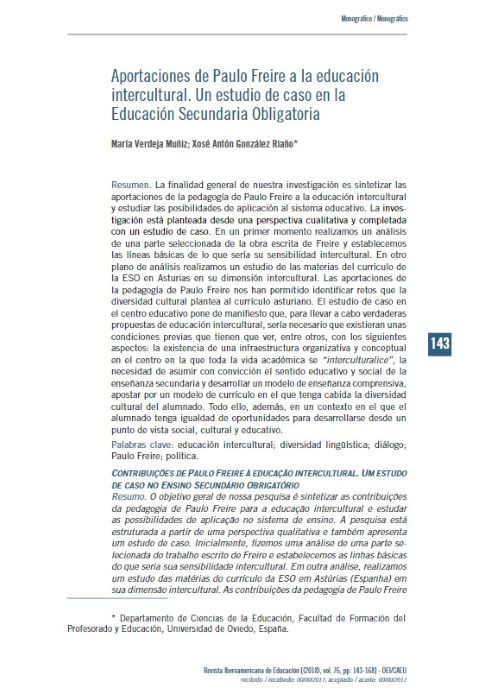 Paulo Freire's Contributions to Intercultural Education: A Case Study in Compulsory Secondary Education (Ibero-American Journal of Education; vol.76) Year of publication: 2018 Author: Maria Verdeja Muniz | Xose Anton Gonzalez Riano The general purpose of this research is to synthesize the contributions of Paulo Freire's pedagogy to intercultural education and study the possibilities of application to the educational system. The research is raised from a qualitative perspective and completed with a case study. At first, an analysis of a selected part of Freire's written work was carried out and the basic lines of what his intercultural sensitivity would be established. In another level of analysis, a study of the subjects of the ESO curriculum in Asturias in its intercultural dimension is carried out. The case study in the educational center shows that, in order to carry out true intercultural education proposals, it would be necessary for there to be some previous conditions that are described in the article. Aportaciones de Paulo Freire a la educación intercultural: Un estudio de caso en la Educación Secundaria Obligatoria (Revista Iberoamericana De Educación; vol.76) Year of publication: 2018 Author: Maria Verdeja Muniz | Xose Anton Gonzalez Riano La finalidad general de esta investigación es sintetizar las aportaciones de la pedagogía de Paulo Freire a la educación intercultural y estudiar las posibilidades de aplicación al sistema educativo. La investigación está planteada desde una perspectiva cualitativa y completada con un estudio de caso. En un primer momento se realizó un análisis de una parte seleccionada de la obra escrita de Freire y se establecen las líneas básicas de lo que sería su sensibilidad intercultural. En otro plano de análisis se realiza un estudio de las materias del currículo de la ESO en Asturias en su dimensión intercultural. El estudio de caso en el centro educativo pone de manifiesto que, para llevar a cabo verdaderas propuestas de educación intercultural, sería necesario que existieran unas condiciones previas que se describen en el artículo.
  Citizenship and Civics: Learn From These Young Senegalese Leaders Year of publication: 2020 Corporate author: Vibe Radio Senegal This is a video of young Senegalese leaders presenting on Citizenship and civics. La citoyenneté et le civisme: Apprenez de ces jeunes leaders sénégalais Year of publication: 2020 Corporate author: Vibe Radio Senegal C'est une vidéo de jeunes leaders sénégalais présentant sur Citoyenneté et civisme.
 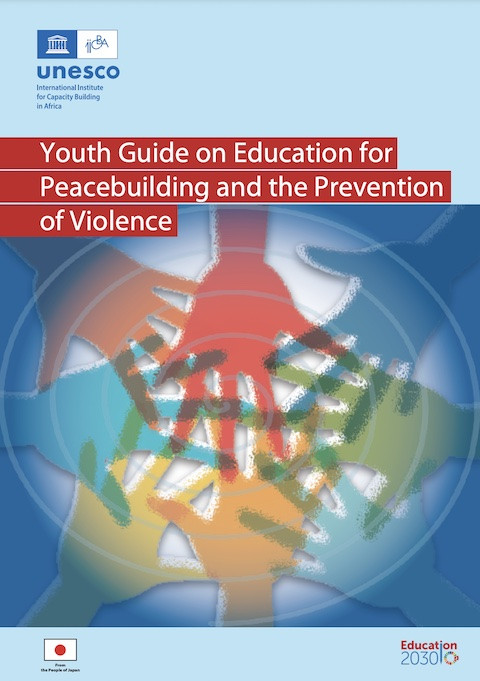 Youth Guide on Education for Peacebuilding and the Prevention of Violence Year of publication: 2022 Corporate author: UNESCO International Institute for Capacity-Building in Africa (IICBA) This publication is a training guide for the youth in both formal or non-formal education. It is a resource to work with children and young people in various settings, including schools, non-formal educational program, community activities and other settings. The goal of the training guide is therefore the youth to become a facilitator with the disposition, knowledge, skills and commitment to support other youth in developing their full potential as peace-builders. It provides a foundation of conflict analysis, peacebuilding and describes a learner centered approach to peace education and community engagement. Guide jeunesse sur l’éducation pour la consolidation de la paix et de la prévention de la violence Year of publication: 2022 Corporate author: UNESCO International Institute for Capacity-Building in Africa (IICBA) Cette publication est un guide de formation pour les jeunes de l’éducation formelle ou non formelle. Il s’agit d’une ressource pour travailler avec les enfants et les jeunes dans différents contextes, notamment dans les écoles, les programmes d’éducation non formelle, les activités communautaires et autres. L’objectif de ce guide de formation est donc de permettre aux jeunes de devenir des animateurs dotés de la disposition, des connaissances, des compétences et de l’engagement nécessaires pour aider d’autres jeunes à développer pleinement leur potentiel de bâtisseurs de paix. Il fournit les bases de l’analyse des conflits et de la construction de la paix et décrit une approache de l’éducation à la paix et de l’engagement communautaire centrée sur l’apprenant.