
Resources
Explore a wide range of valuable resources on GCED to deepen your understanding and enhance your research, advocacy, teaching, and learning.
3,777 Results found
 [摘要] 一起重新构想我们的未来:为教育打造新的社会契约 Year of publication: 2021 Corporate author: International Commission on the Futures of Education | 联合国教科文组织 (UNESCO) 人类和地球正受到威胁。我们需要共同采取紧急行动,改变发展方向,重新构 想我们的未来。长期以来,教育都被认为是促进积极变革的强大力量,而现在教育 面临着全新的、紧迫的和重要的任务。“教育的未来”国际委员会的这份报告在约 百万人参与的全球协商进程的基础上,邀请世界各地的政府、机构、组织和公民出 谋划策,为教育缔结一项新的社会契约,齐心协力地建设一个面向所有人的和平、 公正和可持续的未来。 报告深入探讨了数字技术、气候变化、民主滑坡、社会两极分化以及不确定的 工作前景等问题,其目的不仅仅是让每个人参与教育对话,引发思考,而且要鞭策 我们每个人都采取行动。报告认为,只有通过数以百万计的个人和集体,凭借行动 力、领导力、抗压力、创造力和关爱力,我们才能改变发展方向,实现教育转型, 最终建设一个公正、公平和可持续的未来。
 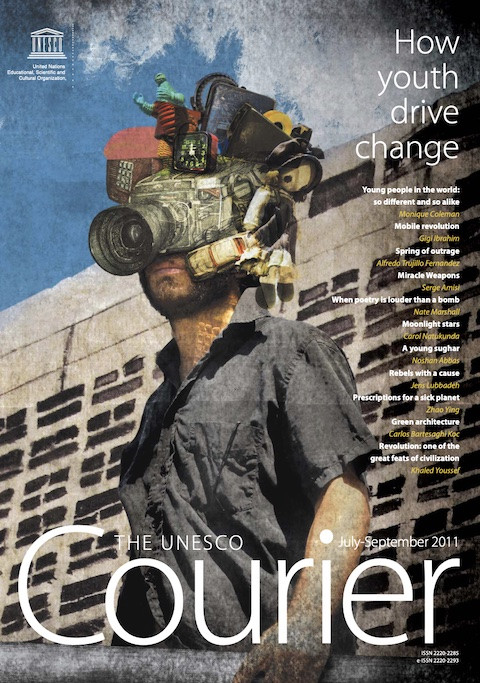 How Youth Drive Change (The UNESCO Courier no. 3; July-September 2011) Year of publication: 2011 Corporate author: UNESCO Considering school history as a place of confrontation of discourse and knowledge from competing socialization spaces (school, family, media), we are interested in citizenship education work and challenges posed by these plural socializations. In an important context media coverage of debates on the recognition of minority memories in France and their entry into the school programs of the college in 2008, how do students appropriate the ""socially vivid issues"" of immigration, colonization, and decolonization? Fromcontent analysis of a corpus made up of around a hundred interviews semi-structured conducted between 2007 and 2010 with 3rd year college students (end of lower secondary and compulsory education), we analyze and highlight contrasting interpretations of these heritages by majority students and minority students, respectively supplied by categories of public debate and family narratives. We show, following work relating to the sociology of school curricula, which learning citizenship in the light of these historical legacies results from the confrontation of the pupils with the discourses and knowledge different spaces in which they take part. But it is above all the product oftheir position in the face of these historical legacies, according to their experiences social and the role they give to these stories in building a common identity and belonging. Changer le monde: Comment s'y prennent les jeunes (Le Courrier de l'UNESCO no. 3; Juillet-Septembre 2011) Year of publication: 2011 Corporate author: Organisation des Nations Unies pour l'éducation, la science et la culture (UNESCO) Considérant l’histoire scolaire comme un lieu de confrontation de discours et savoirs issus d’espaces de socialisation en concurrence (l’école, la famille, les médias), nous nous intéressons au travail d’éducation à la citoyenneté et aux défis que lui posent ces socialisations plurielles. Dans un contexte d’importante médiatisation des débats sur la reconnaissance des mémoires de minorités en France et de leur entrée dans les programmes scolaires du collège en 2008, comment les élèves s’approprient-ils les « questions socialement vives » de l’immigration, la colonisation, et la décolonisation ? En outre, comment s’effectue dans ce contexte l’apprentissage de la citoyenneté et du principe politique qui la fonde dans la tradition scolaire républicaine ? À partir de l’analyse de contenu d’un corpus composé d’une centaine d’entretiens semi-directifs menés entre 2007 et 2010 auprès de collégiens de 3e(fin du premier cycle du secondaire et de la scolarisation obligatoire), nous analysons et mettons en évidence des interprétations contrastées de ces héritages par les élèves majoritaires et les élèves minoritaires, respectivement alimentées par les catégories du débat public et les récits familiaux. Nous montrons, à la suite des travaux relevant de la sociologie des programmes scolaires, que l’apprentissage de la citoyenneté à la lumière de ces héritages historiquesrésulte de la confrontation des élèves aux discours et savoirs issus des différents espaces auxquels ils prennent part. Mais il est surtout le produit de leur prise de position face à ces héritages historiques, selon leurs expériences sociales et le rôle qu’ils confèrent à ces histoires dans la construction d’une identité et une appartenance communes.
 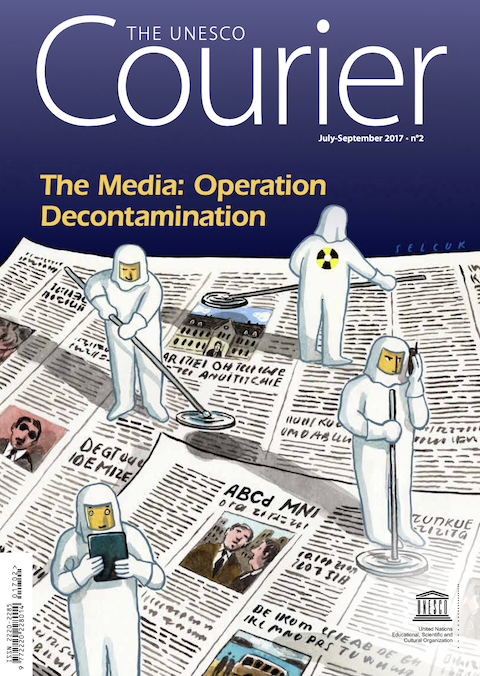 The Media: Operation Decontamination (The UNESCO Courier no. 2; July-September 2017) Year of publication: 2017 Corporate author: UNESCO The plurality of enlightened opinions is a prerequisite of the democratic development of our societies. The quality of the information disseminated by the media – traditional or new – is decisive when it comes to shaping public opinion. This is why UNESCO puts special emphasis on education about media and information, which it considers a fundamental skill for citizens in the twenty-first century.Freedom of expression and the free movement of ideas by words and images are among the constitutive principles of UNESCO and at the core of the 2030 Agenda for Sustainable Development. UNESCO supports the work of dedicated journalists and activists who defend fundamental freedoms, like the journalist Dawit Isaak, winner of the 2017 UNESCO/ Guillermo Cano World Press Freedom Prize, whose story appears in this issue of the UNESCO Courier.Over the last decade, more than 800 journalists have been victims of crimes aimed at muzzling freedom of expression. Only one murder out of ten ended with a conviction. This impunity is unacceptable and further fuels the spiral of violence in the future. This is why UNESCO is committed to putting an end to these crimes against the press, on all continents, as an indispensable condition for peaceful societies that are all the more robust for being better informed.In this “post-truth” era, the role of UNESCO is more important than ever, and this issue of the Courier is a wonderful opportunity to renew our founding commitment to support information and communication to build peace in the minds of men and women. Médias: Opération décontamination (Le Courrier de l'UNESCO no. 2; Juillet-Septembre 2017) Year of publication: 2017 Corporate author: Organisation des Nations Unies pour l'éducation, la science et la culture (UNESCO) La pluralité d’opinions éclairées est une condition sine qua non du développement démocratique de nos sociétés. La qualité des informations diffusées par les médias – traditionnels et nouveaux – est déterminante dans la formation de l’opinion publique. C’est pourquoi l’UNESCO met un accent tout particulier à l’éducation aux médias et à l’information qu’elle considère comme une compétence citoyenne fondamentale du XXIe siècle.La liberté d’expression et la libre circulation des idées par les mots et l’image font partie des principes constitutifs de l’UNESCO et sont au cœur de l’Agenda 2030 pour le développement durable. L’UNESCO soutient le travail des journalistes et militants déterminés qui défendent ces libertés fondamentales, comme le journaliste Dawit Isaak, lauréat du Prix mondial de la liberté de la presse UNESCO/Guillermo Cano 2017, dont on peut découvrir le portrait dans ce numéro du Courrier de l’UNESCO.Au cours de cette dernière décennie, plus de 800 professionnels des médias ont été victimes de crimes visant à museler la libre expression. Seul un meurtre sur dix a donné lieu à un jugement. Cette impunité est inacceptable et alimente encore la spirale de la violence dans le futur. C’est pourquoi l’UNESCO s’engage de toutes ses forces pour y mettre un terme, sur tous les continents, comme une condition indispensable de sociétés pacifiques et d’autant plus robustes qu’elles sont mieux informées.À l’ère de la « post-vérité », le rôle de l’UNESCO est plus important que jamais, et ce nouveau numéro du Courrier est une belle occasion de renouveler notre engagement fondateur à soutenir l’information et la communication pour construire la paix dans l’esprit des hommes et des femmes.
 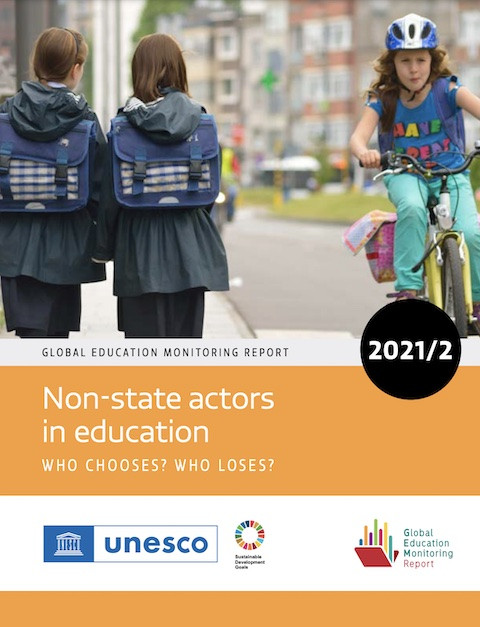 Global Education Monitoring Report 2021/2: Non-state Actors in Education; Who Chooses? Who Loses? Year of publication: 2021 Corporate author: UNESCO Non-state actors’ role extends beyond provision of schooling to interventions at various education levels and influence spheres. Alongside its review of progress towards SDG 4, including emerging evidence on the COVID-19 pandemic’s impact, the 2021/2 Global Education Monitoring Report urges governments to see all institutions, students and teachers as part of a single system. Standards, information, incentives and accountability should help governments protect, respect and fulfill the right to education of all, without turning their eyes away from privilege or exploitation. Publicly funded education does not have to be publicly provided but disparity in education processes, student outcomes and teacher working conditions must be addressed. Efficiency and innovation, rather than being commercial secrets, should be diffused and practiced by all. To that end, transparency and integrity in the public education policy process need to be maintained to block vested interests. The report’s rallying call – Who chooses? Who loses? – invites policymakers to question relationships with non-state actors in terms of fundamental choices: between equity and freedom of choice; between encouraging initiative and setting standards; between groups of varying means and needs; between immediate commitments under SDG 4 and those to be progressively realized (e.g. post-secondary education); and between education and other social sectors. 全球教育监测报告摘要, 2021/2年: 教育领域的非国家行为体:谁能主动选择?谁将错失机会? Year of publication: 2021 Corporate author: 联合国教科文组织 (UNESCO) 本文件是2021/2022年全球教育检测报告的摘要,主要聚焦教育领域的非国家行为体,包括私人办学、宗教办学等力量,并探讨了与非国家行为体对教育的影响与存在问题。