
Resources
Explore a wide range of valuable resources on GCED to deepen your understanding and enhance your research, advocacy, teaching, and learning.
124 Results found
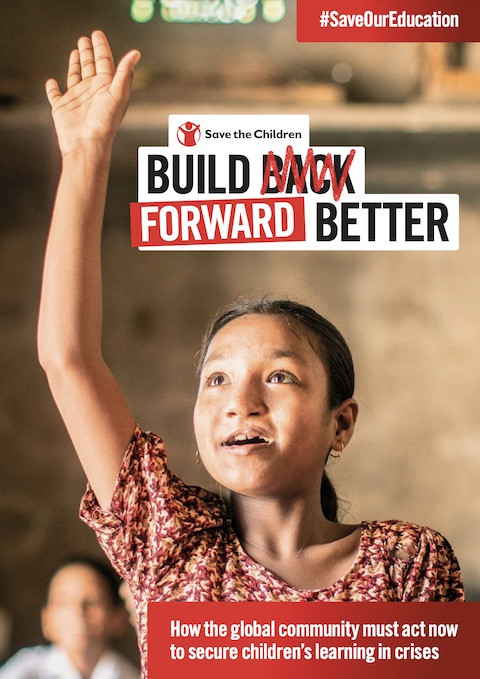 Build Forward Better: How the Global Community Must Act Now to Secure Children’s Learning in Crises Year of publication: 2021 Author: Emma Wagner Corporate author: Save the Children ‘Build back better’ has long been a rallying cry of crisis responses – and is being used frequently today. However, given the scale of the global learning crisis even before the Covid-19 pandemic – with one child in six denied their right to education – it’s vital we don’t limit our ambition to building ‘back’ to how things were. Now it’s imperative we build forward better – and differently.There’s no denying the scale of the challenge. But there’s also cause for hope. The global reach of the Covid-19 crisis has generated a shared understanding of the impact of crisis on children’s right to education. This understanding can be used to build forward better – and radically transform children’s chances.Build Forward Better presents new analysis on which countries’ school systems are most vulnerable to existing risks and future crises. And it sets out what the global community needs to do to support ministries of education in those countries to prepare now. So that, even during emergencies, education systems can provide all children with good-quality, safe and inclusive opportunities to learn.
 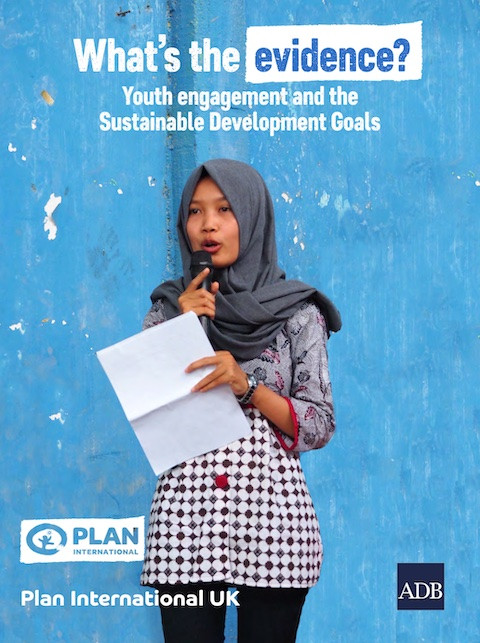 What’s the Evidence?: Youth Engagement and the Sustainable Development Goals Year of publication: 2018 Corporate author: Asian Development Bank (ADB) | Plan International UK This study represents an encouraging body of evidence, both primary and secondary, which will inform future practice and policymaking with regard to young women and men’s contributions towards the Sustainable Development Goals (SDGs). The learnings from this study provide important insight that will support the design and implementation of youth programming. It examines five programs across three youth-focused or youth-led organisations: Plan International UK, the Asian Development Bank (ADB), and AIESEC.
 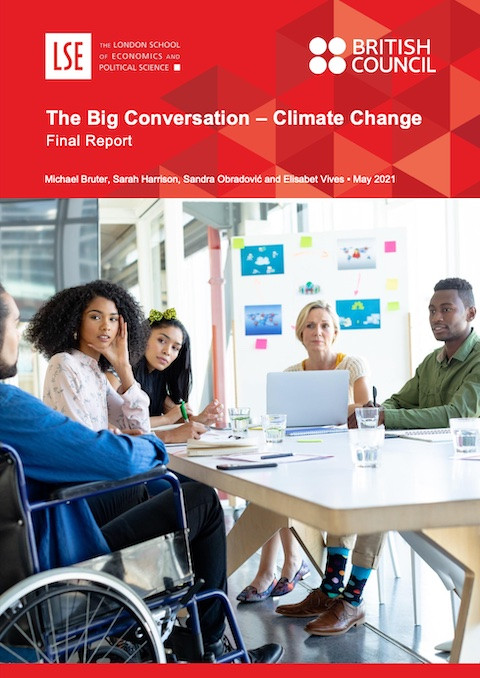 The Big Conversation: Climate Change; Final Report Year of publication: 2021 Author: Michael Bruter | Sarah Harrison | Sandra Obradović | Elisabet Vives Corporate author: British Council | London School of Economics and Political Science This research draws on experience from the field of international cultural relations as well as the latest academic research on values, behaviours and norms to understand more about how we can create the conditions for co-operation on shared global challenges.It delivers new insight on values and attitudes towards climate change among the populations of China, India, Japan and Mexico – selected to represent a diverse range of major world economies who are also important players in the global climate change debate.The research also draws on the experience of international cultural relations experts to provide new insight on how to strengthen international cooperation on climate change and the important role that cultural relations can play in supporting that.
  Experiences of Education for Sustainable Development in the Further Education and Training Sector Year of publication: 2021 Corporate author: Education and Training Foundation The Education and Training Foundation (ETF) recognises the vital role the further education and training (FE) sector has to play in combating climate change and achieving sustainability and social justice, both nationally and globally. Not only does our sector provide the technical and vocation skills required to help transition to a sustainable future, it also reaches millions of learners from all walks of life, spread across diverse communities.This report provides the results and an analytical narrative of findings from a survey carried out among the FE and training sector workforce about their experiences of education for sustainable development (ESD).
 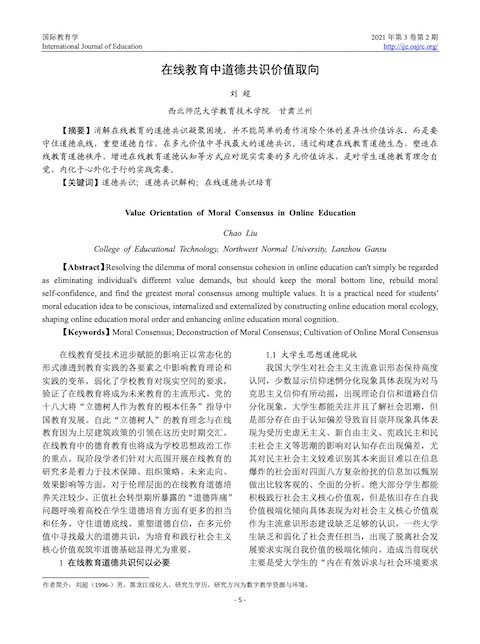 Value Orientation of Moral Consensus in Online Education (International Journal of Education; vol. 3, no. 2) Year of publication: 2021 Author: Chao Liu This paper discusses moral philosophy of. online education, and explores how to achieve moral consensus in online education. 在线教育中道德共识价值取向 (国际教育学; vol. 3, no. 2) Year of publication: 2021 Author: Chao Liu 本文探讨了在线教育道德哲学,并讨论了如何实现在线教育的道德共识。
  Handbook on Media Advocacy for Marginalized Groups Presented to Stakeholders in China Year of publication: 2019 Author: Mike Jempson Corporate author: Media Diversity Institute This guideline uses practical cases to introduce how NGOs can work better with media in China to achieve organisational goals. 发出你的声音,传播你的想法:民间社会组织指南 Year of publication: 2019 Author: Mike Jempson Corporate author: Media Diversity Institute 这份报告结合案例,详细地介绍了民间组织在中国与媒体协作的策略,以更好地实现组织的社会目标。
  Educating Against Hate Year of publication: 2016 Corporate author: United Kingdom. Department of Education, United Kingdom. Home Office As children grow and become more independent, it is not unusual for them to take risks, explore new things and push boundaries. This can mean that they are particularly vulnerable to extremist groups, who may claim to offer answers, as well as identity and a strong social network. And because they know young people are vulnerable, extremist groups often target them using the internet and social media to spread their ideology. The purpose of this website is to provide practical advice and support to help all individuals with an interest in keeping children safe from the dangers of extremism. Educating Against Hate Year of publication: 2016 Corporate author: United Kingdom. Department of Education, United Kingdom. Home Office Lorsque les enfants grandissent et deviennent plus indépendants, ils prennent des risques, explorent l’inconnu et repoussent les limites. Ils sont alors particulièrement vulnérables aux groupes extrémistes, qui prétendent détenir les réponses à leurs questions et pouvoir leur offrir une identité, ainsi qu’un important réseau social. Et parce qu’ils savent que les jeunes sont vulnérables, les groupes extrémistes utilisent internet et les réseaux sociaux pour répandre leur idéologie et atteindre les jeunes. L’objectif de ce site web est d’apporter des conseils pratiques et un soutien pour tous les individus, afin d’éloigner les enfants des dangers de l’extrémisme.