
Resources
Explore a wide range of valuable resources on GCED to deepen your understanding and enhance your research, advocacy, teaching, and learning.
126 Results found
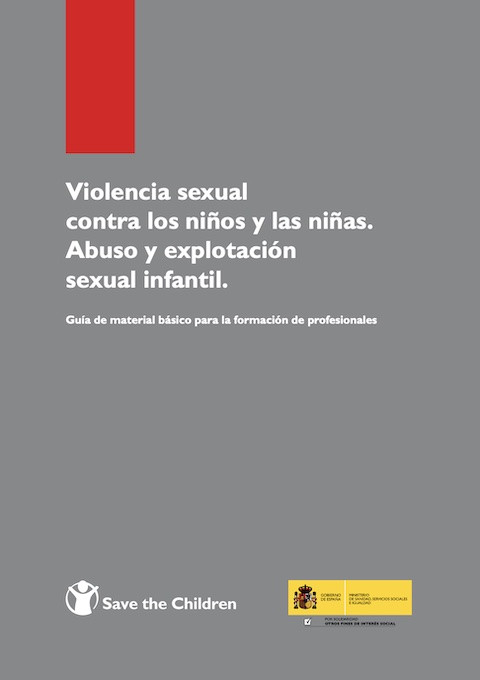 Sexual Violence Against Boys and Girls: Child Sexual Abuse and Exploitation; Guide to Basic Material for the Training of Professionals Year of publication: 2012 Author: Liliana Orjuela López | Virginia Rodríguez Bartolomé Corporate author: Save the Children This document highlights the importance of protecting children from sexual violence, such as abuse, sexual exploitation, child pornography and human trafficking. It presents the ways in which you can intervene with regard to child abuse and exploitation. Violencia sexual contra los niños y las niñas: Abuso y explotación sexual infantil; Guía de material básico para la formación de profesionales Year of publication: 2012 Author: Liliana Orjuela López | Virginia Rodríguez Bartolomé Corporate author: Save the Children Este documento pone de manifiesto la importancia de proteger a los niños y niñas de violencias sexuales, como el abuso, la explotación sexual, la pornografía infantil así como la trata de seres humanos. Posteriormente señala las maneras en las que se puede intervenir con respecto al abuso y la explotación infantil.
 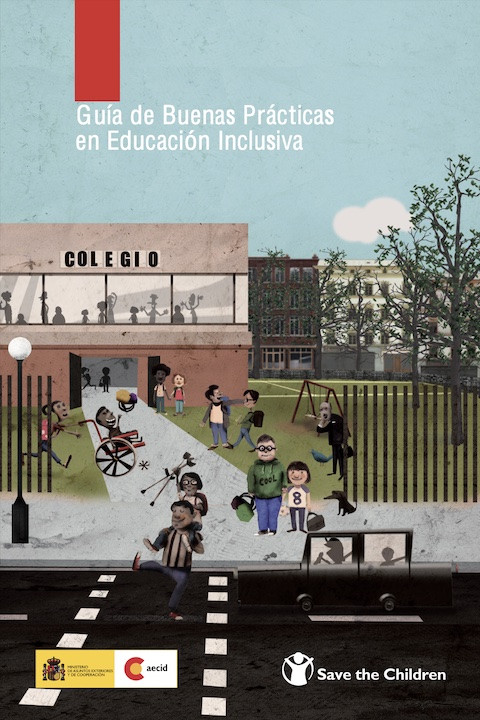 Guide of Good Practices in Inclusive Education Year of publication: 2013 Author: Carmen Solla Salvador Corporate author: Save the Children | Spanish Agency for International Development Cooperation (AECID) In this document, Save the Children expresses its commitment to an educational model in which all boys and girls learn together, regardless of their personal, social or cultural conditions; being able to opt for the same learning and development opportunities. To achieve this, the actors in the different educational fields (competent administrations, those responsible for the centers, other educational entities and the rest of the community), must establish the necessary conditions to identify the existing barriers to the participation and learning of children, girls and adolescents; and implement the necessary measures to overcome them. Guía de buenas prácticas en educación inclusiva Year of publication: 2013 Author: Carmen Solla Salvador Corporate author: Save the Children | Spanish Agency for International Development Cooperation (AECID) En este documento, Save the Children manifiesta su apuesta por un modelo educativo en el que todos los niños y las niñas aprendan juntos, independientemente de sus condiciones personales, sociales o culturales; pudiendo optar a las mismas oportunidades de aprendizaje y desarrollo. Para lograrlo, los actores en los distintos ámbitos educativos (administraciones competentes, responsables de los centros, de otras entidades educativas y resto de la comunidad), deben establecer las condiciones necesarias para identificar las barreras existentes para la participación y el aprendizaje de los niños, niñas y adolescentes; e implementar las medidas necesarias para superarlas.
 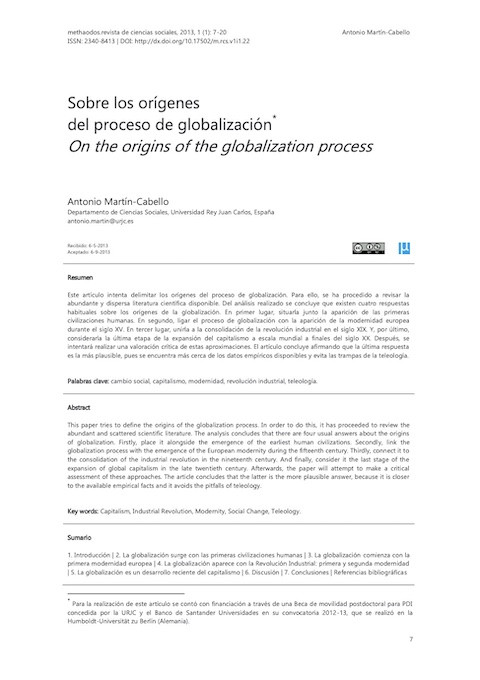 On the Origins of the Globalization Process (Methaodos.revista de ciencias sociales; vol. 1, no. 1) Year of publication: 2013 Author: Antonio Martín-Cabello Corporate author: Rey Juan Carlos University This paper tries to define the origins of the globalization process. In order to do this, it has proceeded to review the abundant and scattered scientific literature. The analysis concludes that there are four usual answers about the origins of globalization. Firstly, place it alongside the emergence of the earliest human civilizations. Secondly, link the globalization process with the emergence of the European modernity during the fifteenth century. Thirdly, connect it to the consolidation of the industrial revolution in the nineteenth century. And finally, consider it the last stage of the expansion of global capitalism in the late twentieth century. Afterwards, the paper will attempt to make a critical assessment of these approaches. The article concludes that the latter is the more plausible answer, because it is closer to the available empirical facts and it avoids the pitfalls of teleology. Sobre los orígenes del proceso de globalización (Methaodos.revista de ciencias sociales; vol. 1, no. 1) Year of publication: 2013 Author: Antonio Martín-Cabello Corporate author: Rey Juan Carlos University Este artículo intenta delimitar los orígenes del proceso de globalización. Para ello, se ha procedido a revisar la abundante y dispersa literatura científica disponible. Del análisis realizado se concluye que existen cuatro respuestas habituales sobre los orígenes de la globalización. En primer lugar, situarla junto la aparición de las primeras civilizaciones humanas. En segundo, ligar el proceso de globalización con la aparición de la modernidad europea durante el siglo XV. En tercer lugar, unirla a la consolidación de la revolución industrial en el siglo XIX. Y, por último, considerarla la última etapa de la expansión del capitalismo a escala mundial a finales del siglo XX. Después, se intentará realizar una valoración crítica de estas aproximaciones. El artículo concluye afirmando que la última respuesta es la más plausible, pues se encuentra más cerca de los datos empíricos disponibles y evita las trampas de la teleología.
 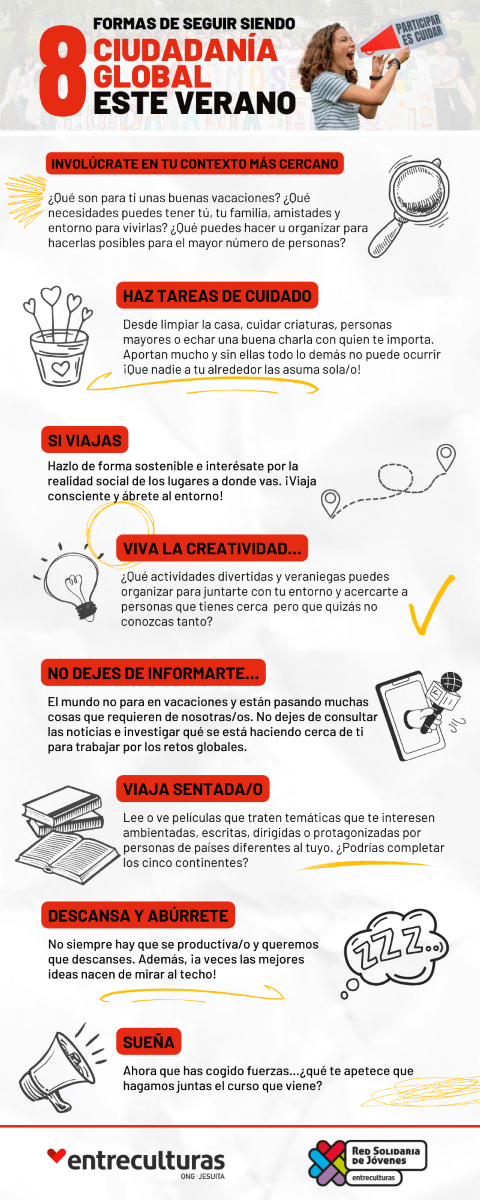 A Conscious Summer: 8 Ways to Remain a Global Citizen Year of publication: 2024 Corporate author: Entreculturas The holidays are here, and with them new ways of building global citizenship. Don't underestimate all that we can continue to do during the summer, through enjoyment, meeting and relaxation. In this infographic we present ideas to continue being global citizens. Go ahead and work on it with your groups and your environment! Un verano consciente: 8 formas de seguir siendo ciudadanía global Year of publication: 2024 Corporate author: Entreculturas Llegan las vacaciones, y con ellas nuevas maneras de construir ciudadanía global. No subestimes todo lo que, desde el disfrute, el encuentro y el descanso, podemos seguir haciendo durante el verano. En esta infografía presentamos ideas para seguir siendo ciudadanos globales. ¡Anímate a trabajarlo con tus grupos y tu entorno!
 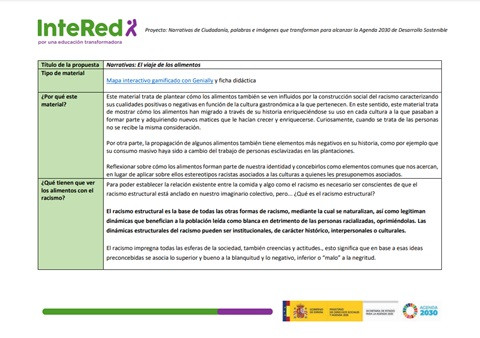 Narratives: The Journey of Food Year of publication: 2024 Corporate author: InteRed This is an interactive game that raises the question of how food is also influenced by the social construction of racism, characterising its positive or negative qualities, depending on the gastronomic culture to which it belongs. In this sense, this material tries to show how food has migrated throughout history, enriching its use in each culture it became part of and acquiring new nuances that made it grow and become richer. Curiously, when it comes to people, the same consideration is not given. On the other hand, the spread of some foods also has more negative elements in their history, such as the fact that their mass consumption has been in exchange for the work of enslaved people on plantations. Narrativas: El viaje de los alimentos Year of publication: 2024 Corporate author: InteRed Este es un juego interactivo que plantea cómo los alimentos también se ven influidos por la construcción social del racismo caracterizando sus cualidades positivas o negativas, en función de la cultura gastronómica a la que pertenecen. En este sentido, este material trata de mostrar cómo los alimentos han migrado a través de su historia enriqueciéndose su uso en cada cultura de la que pasaban a formar parte y adquiriendo nuevos matices que les hacían crecer y enriquecerse. Curiosamente, cuando se trata de las personas, no se recibe la misma consideración. Por otra parte, la propagación de algunos alimentos también tiene elementos más negativos en su historia, como por ejemplo que su consumo masivo haya sido a cambio del trabajo de personas esclavizadas en las plantaciones.