
Resources
Explore a wide range of valuable resources on GCED to deepen your understanding and enhance your research, advocacy, teaching, and learning.
124 Results found
 Religious Traditions and Models of Citizenship Education: The Legacy of a Normative Universe (Politique et Sociétés; vol. 34, no. 2) Year of publication: 2015 Author: Félix Mathieu | Guy Laforest Corporate author: Société québécoise de science politique This article analyzes the significant links between the citizenship education curricula of France, England and Quebec, as well as their respective religious traditions, which all stem from the central and common core of belonging that is christianity. More precisely, starting from the postulate according to which the religious fact, as a socio-cultural heritage, permeates in a deep and lasting way contemporary societies, the authors show that the values and the ideals resulting from the various religious paths are transposed more or less singularly through the normative and pedagogical universe of French, English and Quebec citizenship education programs. Traditions religieuses et modèles d’éducation à la citoyenneté : l’héritage d’un univers normatif (Politique et Sociétés; vol. 34, no. 2) Year of publication: 2015 Author: Félix Mathieu | Guy Laforest Corporate author: Société québécoise de science politique Cet article analyse les liens significatifs entre les curriculums d’éducation à la citoyenneté de la France, de l’Angleterre et du Québec, ainsi que leurs traditions religieuses respec-tives, lesquelles découlent toutes du noyau central et commun d’appartenance qu’est le christianisme. Plus précisément, en partant du postulat selon lequel le fait religieux, en tant qu’héritage socioculturel, imprègne de manière profonde et durable les sociétés contemporaines, les auteurs montrent que les valeurs et les idéaux issus des différents parcours religieux se transposent plus ou moins singulièrement à travers l’univers nor-matif et pédagogique des programmes français, anglais, puis québécois d’éducation à la citoyenneté.
  Analysis (Didactic) of a Historical Video Game: Democracy and Citizenship Education in Civilization VI (Revue de recherches en littératie médiatique multimodale; no. 9) Year of publication: 2019 Author: Vincent Boutonnet Corporate author: Groupe de recherche en littératie médiatique multimodale Civilization VI, published in 2016, is a turn-based strategy game allowing the player to go through historical eras by leading a civilisation toward cultural, economic, military or technological sophistication. This new entry introduces a civic tree presenting new gameplay with government systems and civics policies. This research is descriptive and aims at a formal analysis of the gameplay. We examine the various components and the principles of design as well as the conceptual and civics limits of such a game. We believe this game is an opportunity to analyse and talk about these limits with pupils to foster critical thinking about democracy and citizenship. Analyse (Didactique) d’un jeu vidéo historique: Démocratie et éducation à la citoyenneté dans civilization VI (Revue de recherches en littératie médiatique multimodale; no. 9) Year of publication: 2019 Author: Vincent Boutonnet Corporate author: Groupe de recherche en littératie médiatique multimodale Civilization VI, publié en 2016, est un jeu de stratégie tour par tour qui permet de traverser les ères historiques à la tête d’une nation grâce au développement culturel, économique, militaire et technologique. Ce nouvel opus introduit l’arbre des dogmes qui permet de nouvelles mécaniques en lien avec les modes de gouvernement et la citoyenneté. La recherche est de nature descriptive et vise une analyse formelle des mécaniques du jeu. Nous examinons les éléments constitutifs du jeu, les principes qui le régissent ainsi que les limites conceptuelles et civiques d’une telle ressource. Cependant, nous y voyons aussi une occasion de discuter de ces lacunes avec des élèves afin de les engager authentiquement dans une réflexion critique sur la démocratie et la citoyenneté.
  World Education Statistics 2024 Year of publication: 2024 Corporate author: UNESCO Institute for Statistics (UIS) The report summarizes the education data published by UIS and serves as a fundamental resource and essential guide for policy-makers, researchers and analysts, as well as anyone interested in education data and statistics. Statistics are presented in 11 thematic chapters, covering primary and secondary education; early childhood; technical, vocational and tertiary education; skills for work; parity; literacy and numeracy; sustainable development and global citizenship; learning environment; scholarships; teachers; and financing education.
  School Closures and Regional Policies to Mitigate Learning Loss due to COVID-19: A Focus on the Asia-Pacific Year of publication: 2021 Corporate author: UNESCO Institute for Statistics (UIS) Global school closures as a result of COVID-19 have caused learning losses for millions of children despite efforts to deploy remote learning options. Greater economic insecurity among families may also affect school enrolment as many struggle to pay school fees, or require children to work to supplement family income. Ultimately, this will lead to rising dropout rates, estimated to be as much as 4% in a region where 128 million children and young people were already out of school before COVID-19. The largest number of learners at risk reside in South and West Asia.Together, the education and economic fallout from the pandemic threaten progress toward the Sustainable Development Goal for education (SDG 4). Even prior to the COVID-19 disruptions, progress towards SDG 4 was lagging in many countries in the Asia-Pacific and without significant contributions to education finance, the pandemic threatens to push the region even further behind.This report breaks down the effects of school closures. It considers, for example, how many schools were closed, and when, across the Asia-Pacific, and the effects on different levels of education from early childhood education, through to primary and secondary school. The report analyses country efforts to implement remote learning, and strategies to mitigate learning losses as the proportion of students expected to fall below minimum proficiency levels is expected to rise.To achieve SDG 4, all children and young people, and especially those in marginalized groups, need support to get the education they need and deserve.
  SDG 4 Data Digest 2020: Using Household Survey Data to Monitor SDG 4 Year of publication: 2020 Corporate author: UNESCO Institute for Statistics (UIS) The 2020 edition of the SDG 4 Data Digest by the UNESCO Institute for Statistics focuses on household surveys as an important and underutilized tool to collect the data needed to track progress towards Sustainable Development Goal 4 and to ensure that no one is left behind. The Digest describes existing survey programmes and offers advice on the design and implementation of new surveys. The Digest identifies a number of advantages to using household surveys and describes the categories of indicators best suited for monitoring with survey data. Data from household surveys complement administrative data collected in schools and can be disaggregated to a greater extent than administrative data to facilitate the monitoring of exclusion in education. The definitions and calculation methods of selected indicators are laid out and the combination of household survey data with data from other sources is explained. This issue of the Digest is aimed at government officials, national planners, donors and others who make decisions about the implementation of nationally representative household surveys. It describes the requirements for conducting a household survey and the steps that must be followed from questionnaire design to data collection and analysis, and it gives advice on presentation of the findings. A section on COVID-19 summarizes the impact of the current pandemic on data collection. Additional resources, with suggested survey questions for the collection of education data through household surveys, are also included. Compendio de Datos sobre el ODS 4: Cómo utilizar datos de encuestas de hogares para monitorear el ODS 4 Year of publication: 2020 Corporate author: UNESCO Institute for Statistics (UIS) La edición 2020 del Compendio de Datos sobre el ODS 4 del Instituto de Estadística de la UNESCO se centra en las encuestas de hogares como una importante e infrautilizada herramienta para la recolección de los datos necesarios para rastrear el progreso hacia el Objetivo de Desarrollo Sustentable 4 y para garantizar que nadie quede en el camino. El Compendio describe los programas de encuestas existentes y brinda consejos para el diseño y la implementación de nuevas encuestas. El Compendio identi ca una serie de ventajas en el uso de las encuestas de hogares y describe las categorías de indicadores más adecuados para el monitoreo con datos de encuestas. Los datos de encuestas de hogares complementan los datos administrativos recolectados en las escuelas y pueden ser desglosados a un grado mayor que los datos administrativos, facilitando el monitoreo de la exclusión en la educación. Se han expuesto las de niciones y métodos de cálculo de los indicadores seleccionados y se ha explicado cómo se combinan los datos de encuestas de hogares con los datos de otras fuentes. Esta edición del Compendio está dirigida a los funcionarios de gobierno, plani cadores nacionales, contribuyentes y quienes tomen decisiones sobre la implementación de las encuestas de hogares nacionalmente representativas. Describe los requisitos para la ejecución de una encuesta de hogares y los pasos que deben seguirse desde el diseño del cuestionario hasta la recolección y análisis de datos, además de dar consejos sobre cómo presentar los hallazgos. Una sección sobre el COVID-19 resume el impacto que tiene la actual pandemia sobre la recolección de datos. También se han incluido recursos adicionales, con preguntas de encuestas sugeridas para la recolección de datos educativos mediante las encuestas de hogares. Rapport sur les données de l’ODD 4: Utiliser les données des enquêtes auprès des ménages pour le suivi de l’ODD 4 Year of publication: 2020 Corporate author: UNESCO Institute for Statistics (UIS) L’édition 2020 du Rapport sur les données de l’ODD 4 de l’Institut de statistique de l’UNESCO met l’accent sur les enquêtes auprès des ménages comme un outil important et sous-utilisé pour collecter les données nécessaires au suivi des progrès réalisés sur la voie de l’Objectif du développement durable 4 et pour s’assurer que personne n’est laissé pour compte. Le Rapport décrit les programmes d’enquêtes existants et offre des conseils sur la conception et la mise en œuvre de nouvelles enquêtes. Le Rapport identi e un certain nombre d’avantages à utiliser les enquêtes auprès des ménages et décrit les catégories d’indicateurs les mieux adaptées au suivi avec des données d’enquête. Les données issues des enquêtes auprès des ménages complètent les données administratives recueillies dans les écoles et peuvent être ventilées dans une plus large mesure que les données administratives a n de faciliter le suivi de l’exclusion dans l’éducation. Les définitions et les méthodes de calcul des indicateurs sélectionnés sont présentées et la combinaison des données des enquêtes sur les ménages avec les données provenant d’autres sources est expliquée. Ce numéro du Rapport s’adresse aux responsables gouvernementaux, aux plani cateurs nationaux, aux donateurs et aux autres personnes qui prennent des décisions concernant la mise en œuvre d’enquêtes sur les ménages représentatives au niveau national. Il décrit les conditions requises pour mener une enquête auprès des ménages et les étapes à suivre depuis la conception du questionnaire jusqu’à la collecte et l’analyse des données, et il donne des conseils sur la présentation des résultats. Une section sur le COVID-19 résume l’impact de la pandémie actuelle sur la collecte de données. Des ressources supplémentaires, avec des suggestions de questions d’enquête pour la collecte de données sur l’éducation par le biais d’enquêtes auprès des ménages, sont également incluses.
 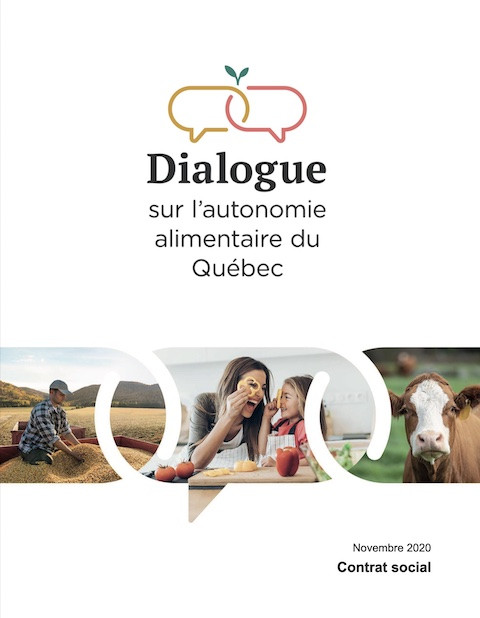 Dialogue on Quebec Food Autonomy Year of publication: 2020 Corporate author: Institut du Nouveau Monde (INM) Food autonomy is more than ever a crucial subject for Quebec society. The COVID-19 pandemic has revealed the fragility of our food system and has created a new opportunity to talk about this strategic issue. Several players are saying it: it It is time to bring agricultural producers closer to citizens, and to create new forms of solidarity between them.To do this, the Union des producteurs agricoles (UPA) wishes to set up a real opportunity for dialogue between the two ends of the production chain food, that is to say producers and citizens.The Dialogue on food autonomy is an opportunity for citizens to participate in the development of a social contract on issues related to food autonomy and to facilitate a dialogue between them and producers, who are an essential link. of this strategic issue. It provides opportunities for open and constructive exchanges between agricultural producers and citizens, first separately and then in a common group. It will then be offered to all of Quebec.