
Resources
Explore a wide range of valuable resources on GCED to deepen your understanding and enhance your research, advocacy, teaching, and learning.
62 Results found
 Policy Brief: Talking Across Generations on Education; #TAGe Bujumbura: Youth, Social and Emotional Education and the Prevention of Violent Extremism Year of publication: 2020 Corporate author: Mahatma Gandhi Institute of Education for Peace and Sustainable Development (MGIEP) With the aim to mainstream the voices of Burundi youth and include them in the policymaking process in the areas of education for peace, sustainable development and global citizenship, UNESCO MGIEP, YELI-Burundi (Youth Empowerment and Leadership Initiative Burundi) and the Government of Burundi organised a series of high-level #TAGeBujumbura dialogues. These were an integral part of the Annual Prevention of Violent Extremism (PVE) Youth Blast, which was organised by YELI-Burundi on September 16-17, 2019 in Bujumbura, Burundi. H.E Everlyne Butoyi, Minister of Youth, IT and Posts, inaugurated the event. The theme of the main TAGe plenary was The Place of the Youth and Social and Emotional Learning for the Prevention of Violent Extremism – within the broader context of United Nations Security Council Resolution 2250.This unique UNESCO MGIEP TAGe modality for actionable dialogue comprised the following components – month-long online discussions, live TAGe and actionable outputs. The preceding online discussion had over 1,000 participants, and witnessed rich discussion threads being compressed into insightful, actionable ideas. Subsequently, based on the online engagement and the on-ground work done, six representatives were chosen from these participants to represent the collective voices of the youth. They were joined by three distinguished senior decision-makers (from the Government of Burundi and civil society) in a live TAGe exchange, where they delved into issues and unearthed creative solutions in front of an audience of over 200.
  Building Kinder Brains Year of publication: 2021 Author: Nandini Chatterjee Singh | Anantha Kumar Duraiappah Corporate author: Mahatma Gandhi Institute of Education for Peace and Sustainable Development (MGIEP) This booklet is a presentation of some of the key messages from the Rethinking Learning report and is intended to be an introduction to Social and Emotional Learning and its incorporation in the classroom. The key messages presented in this toolkit provide teachers, educators, parents, and policy makers with the incredible opportunity and responsibility to build kinder brains for a resilient, peaceful and sustainable planet by training and nurturing the social and emotional development of children.
  How Mindful Compassion Practices Can Cultivate Social and Emotional Learning Year of publication: 2018 Author: Marilee Bresciani Ludvik | Tonya Lea Eberhart Corporate author: Mahatma Gandhi Institute of Education for Peace and Sustainable Development (MGIEP) A fundamental purpose of social-emotional learning (SEL) is to provide students with opportunities to develop self-awareness, self-management, and social awareness, which in turn would lead to positive goal-oriented behaviors and the cultivation of collaborative relationships. While scholarly literature lists several strategies to foster SEL skills, there is little evidence of their effectiveness. There is research to support that mindful compassion practices (MCPs) cultivate specific outcomes that align with SEL outcomes. However, questions as to how much of each of these practices and how long they need to be practiced in order to realize effective integration into school curricula remain unanswered. Nevertheless, it has been determined that in order for these approaches to have a positive effect, schools need support to define, implement, evaluate, and modify SEL curriculum according to their needs.
 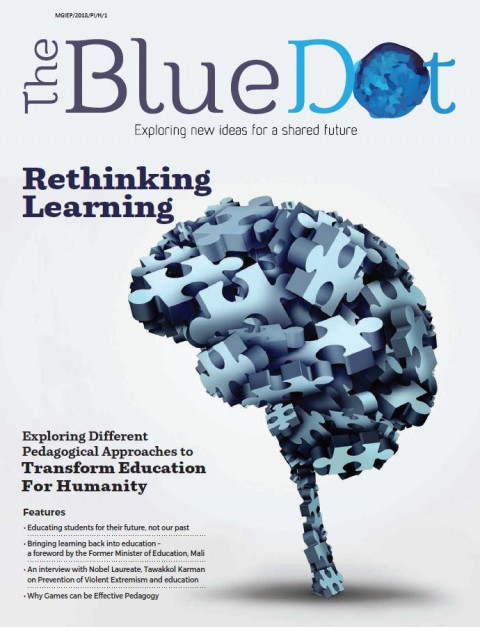 Rethinking Learning: Exploring Different Pedagogical Approaches to Transform Education for Humanity (The Blue Dot Issue 7, 2018) Year of publication: 2018 Corporate author: Mahatma Gandhi Institute of Education for Peace and Sustainable Development (MGIEP) In the seventh issue of the Blue Dot, we focus on Rethinking Learning. The Issue includes a foreword by the Former Minister of Education of Mali, H.E. Adama Samassékou on how education systems need to be re-looked at to incorporate personalised learning and technology as an enabler and our Cover Story, which focuses on the importance of socio-emotional learning.Additionally, we feature opinions by specialists from academia, research, policymaking and the industry on the need to relook at education systems for the future. Amongst various experts, we hear from Andreas Schleicher, Director of Education and Skills and Special Advisor on Education Policy to the Secretary-General at the Organisation for Economic Co-operation and Development (OECD); Anneli Rautiainen from the Finnish National Agency for Education as well as Pratik Mehta, Head of Education & Skills, Microsoft India.Further, we present short blogs from the youth about what future education systems mean to them and we hear from Nobel Laureate, Ms Tawakkol Karman on the importance of education for peace.
  Guidelines for Implementing SEL in Schools Year of publication: 2022 Corporate author: Mahatma Gandhi Institute of Education for Peace and Sustainable Development (MGIEP) Schools that promote SEL help in their students’ academic and global learning. It enables learners to live peacefully with others in heterogeneous societies and build ‘tolerance’ and ethics in behaviour in terms of universal human traits that go beyond social, cultural and gender differences. SEL cultivates children’s wellbeing, and because schools are mirrors or microcosms of our larger and dynamic societies, it is vital that personal and social learning be mainstreamed in schools. The purpose of these guidelines is to share the latest research with policymakers, school leaders, and teachers looking to integrate SEL into school practices and present scientific evidence on creating school environments and recommending practices that are key to building peaceful and sustainable societies.
  Sexual Violence and the News Media: Issues, Challenges and Guidelines for Journalists in India Year of publication: 2021 Author: Chindu Sreedharan | Einar Thorsen Corporate author: UNESCO New Delhi This report presents the findings of a multilingual national study on the news reporting of sexual violence in India. Drawing on a content analysis of 10 newspapers covering six languages, and semi-structured interviews with 257 journalists working across 14 languages, it provides comparative insights into the routines journalists follow and the challenges they face when they cover sexual violence.The report evidences how news outlets tend to disproportionately publish unusual cases, such as those involving extreme brutality; focus on rape in urban areas; and rely heavily on police sources. Journalists rarely undertake in-depth inquiries into the cases they cover. The challenges they face include safety issues while newsgathering, difficulties in accessing key sources, and distress from the requirements of their assignments. Overall, nearly 20% of our respondents experienced psychological challenges while reporting on sexual violence, and 55% of women journalists reported workplace sexual harassment or violence.Based on the evidence, the report presents seven national and 10 organisational recommendations. It concludes by offering guidelines that individual journalists and media houses can adapt to suit their news routines.
 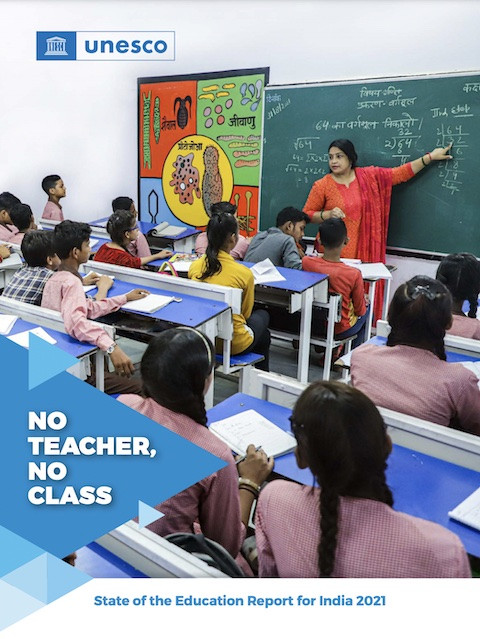 No Teacher, No Class: State of the Education Report for India, 2021 Year of publication: 2021 Author: Padma M. Sarangapani | Bindu Thirumalai | Anusha Ramanathan | Ruchi Kumar | Mythili Ramchand Corporate author: UNESCO New Delhi This report attempts to provide an understanding of key aspects of the teaching profession and workforce in India – nearly 9.7 million teachers in 2019/20 – the complex work that they do, and their professional development, through the filters of policy debates, choices, pushes and pulls. It looks at the questions that create core tensions in the sector and affect teacher quality and availability. It presents evidence wherever possible, and identifies gaps. The analytical framework of this report draws from important contextual and sectoral aspects including India’s social and political context — especially its federal structure – and social characteristics of gender, caste, rural-urban divide and the government-private divide. This report, prepared during the ongoing COVID-19 pandemic, and constrained by prevailing conditions, is primarily based on analysis of secondary data and review of policies, reports and research literature. Chapters explore specific themes and present key findings.
  Reimagining Education: The International Science and Evidence Based Education Assessment; Summary for Decision Makers (SDM) Year of publication: 2022 Author: Anantha Kumar Duraiappah | Nienke M. van Atteveldt | Joanne Marieke Buil | Kriti Singh | Rongxiu Wu Corporate author: Mahatma Gandhi Institute of Education for Peace and Sustainable Development (MGIEP) The International Science and Evidence Based Education (ISEE) Assessment is an initiative of the UNESCO Mahatma Gandhi Institute of Education for Peace and Sustainable Development (MGIEP), and is its contribution to the Futures of Education process launched by UNESCO Paris in September 2019. In order to contribute to re-envisioning the future of education with a science and evidence based report, UNESCO MGIEP embarked on the first-ever large scale assessment of knowledge of education.
  Can Education Contribute to Peace? Year of publication: 2018 Author: Krishna Kumar Corporate author: Mahatma Gandhi Institute of Education for Peace and Sustainable Development (MGIEP) The paper questions the common assumption that education promotes peace. By referring to pedagogic routines and the political culture of nationalism, the paper indicates the nature of reforms education requires for contributing to peace. The basis of discussion is the author’s own study of the role played by school education, specifically through the teaching of history, in maintaining mutual hostility between India and Pakistan. The paper is divided into four sections.The first section summarizes conceptual issues raised by philosophers and educators in the context of schooling and peace. Section II introduces the author’s Indo-Pak study in relation to the challenges that nationalism, religion and culture place before education. Section III deals with regimentation as an integral aspect of modern schooling and its implications for the role expected from education in promoting peace.The final section discusses the demands and contradictions education faces under the increasing dominance of the human capital ideology. The paper concludes by highlighting the importance of humanist goals and processes in education for serving the cause of peace.
  [Video] Socio-emotional Learning - the Key to Building Global Citizenship Year of publication: 2018 Author: Nandini Chatterjee Singh Corporate author: Mahatma Gandhi Institute of Education for Peace and Sustainable Development (MGIEP) Dr. Nandini Chatterjee Singh, Programme Specialist, UNESCO MGIEP speaks about 'Socio-emotional Learning: the Key to Building Global Citizenship' as part of Association for Childhood Education International (ACEI)'s online learning event for educators, titled 'Breakthroughs in Education: Innovations in Equity, Access & Quality.