
Resources
Explore a wide range of valuable resources on GCED to deepen your understanding and enhance your research, advocacy, teaching, and learning.
89 Results found
 Chronologie du génocide Year of publication: 2024 Corporate author: United States Holocaust Memorial Museum (USHMM) Cette chronologie proposée par le Musée du mémorial américain sur la Shoah montre les avancées conceptuelles et juridiques majeures dans l’évolution du terme « génocide » . Elle ne cherche pas à détailler tous les cas pouvant être considérés comme des génocides, mais à montrer comment le terme a intégré le vocabulaire politique, juridique et éthique de 1900 à 2016 pour exprimer les menaces de violences contre des groupes.
 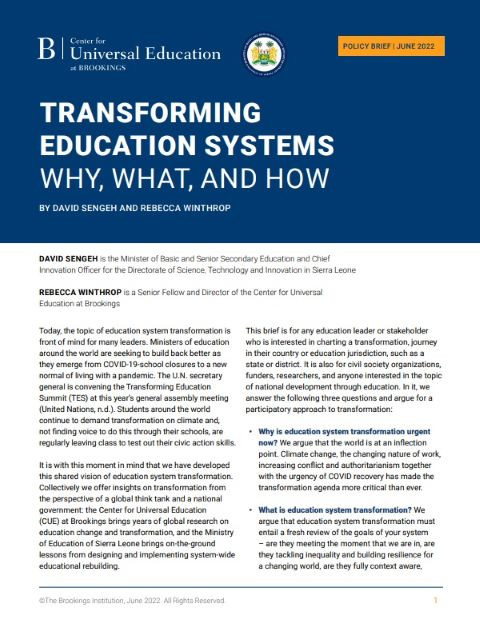 Transforming Education Systems: Why, What, and How Year of publication: 2022 Author: Rebecca Winthrop | David Sengeh Corporate author: Brookings Institution This brief is for any education leader or stakeholder who is interested in charting a transformation journey in their country or education jurisdiction such as a state or district. It is also for civil society organisations, funders, researchers, and anyone interested in the topic of national development through education. In it, the authors answer the following three questions and argue for a participatory approach to transformation: Why is education system transformation urgent now? The world is at an inflection point. Climate change, the changing nature of work, increasing conflict and authoritarianism together with the urgency of COVID recovery has made the transformation agenda more critical than ever. What is education system transformation? Education system transformation must entail a fresh review of the goals of your system – are they meeting the moment that we are in, are they tackling inequality and building resilience for a changing world, are they fully context aware, are they owned broadly across society – and then fundamentally positioning all components of your education system to coherently contribute to this shared purpose. How can education system transformation advance in your country or jurisdiction? Three steps are crucial: Purpose (developing a broadly shared vision and purpose), Pedagogy (redesigning the pedagogical core), and Position (positioning and aligning all components of the system to support the pedagogical core and purpose). Deep engagement of educators, families, communities, students, ministry staff, and partners is essential across each of these 3P steps.
 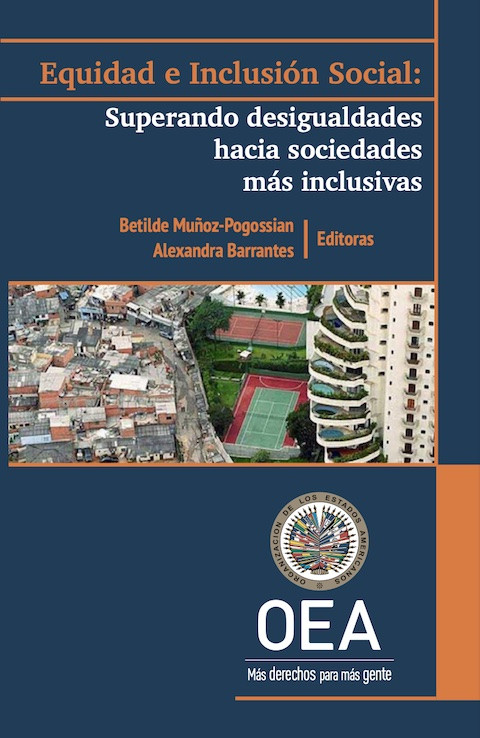 Equity and Social Inclusion: Overcoming Inequalities Towards More Inclusive Societies Year of publication: 2016 Author: Betilde Muñoz-Pogossian | Alexandra Barrantes Corporate author: Organization of American States (OAS) Inequality continues to be one of the main challenges for the countries of the Americas, and the debate about its roots and consequences has permeated all areas of public policy. The truth is that advances in civil and political rights have not been matched by advances in economic, social and cultural rights, and in this context and during the last 15 years, many of the countries of the region have taken measures of public policy to generate greater inclusion and a better redistribution of the benefits of economic growth, with the intention that this will translate into the enjoyment of more rights (in all spheres) for citizens. Equidad e inclusión social: Superando desigualdades hacía sociedades más inlcusivas Year of publication: 2016 Author: Betilde Muñoz-Pogossian | Alexandra Barrantes Corporate author: Organization of American States (OAS) La desigualdad continúa siendo uno de los principales retos de los países de las Américas, y el debate sobre sus raíces y consecuencias ha permeado todos los ámbitos de la política pública. Lo cierto es que los avances en materia de derechos civiles y políticos no se han correspondido con avances en materia de derechos económicos, sociales y culturales.En este marco y durante los últimos 15 años, muchos de los países de la región han tomado medidas de política pública para generar mayor inclusión y una mejor redistribución de los beneficios del crecimiento económico, con la intención de que esto se traduzca en el goce de más derechos (en todas sus esferas) para los ciudadanos y ciudadanas.
  School-Related Gender-Based Violence Measurement Toolkit Year of publication: 2020 Author: Dexis Consulting Group Corporate author: United States Agency for International Development (USAID) This toolkit delivers practical guidance and resources for measuring the prevalence and extent of students’ experiences of school-related gender-based violence (SRGBV), and provides methods for assessing key risk factors and drivers of SRGBV. This toolkit contains a conceptual framework for measuring SRGBV, a school- based survey for measuring experiences of SRGBV, risk factors, and drivers, as well as practical guidance for implementing the survey.
 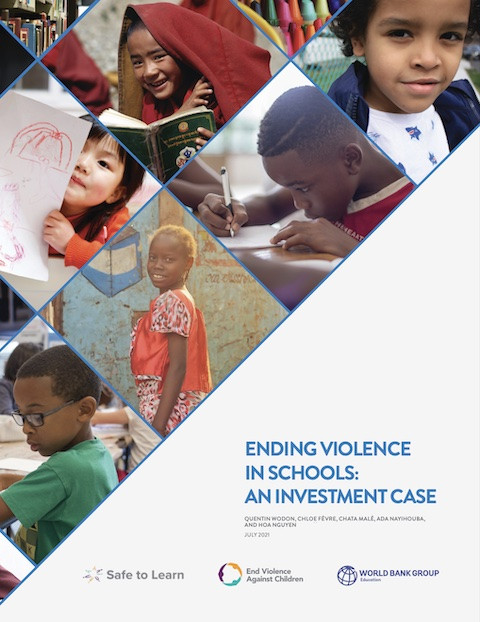 Ending Violence in Schools : An Investment Case Year of publication: 2021 Author: Quentin Wodon | Chloë Fèvre | Chata Malé | Ada Nayihouba | Hoa Nguyen Corporate author: World Bank Preventing violence in and through school is a prerequisite for girls and boys getting the education they need and deserve, and acquiring the skills, knowledge and values that provide the foundations for strong and inclusive societies. This report demonstrates that violence in and around schools negatively impacts educational outcomes, and society pays a heavy price as a result (with an estimate of $11 trillion in lost lifetime earnings). Cost-benefit analyses suggest that implementing interventions to prevent violence in and through schools from early childhood to secondary education is a smart economic investment. Rigorously evaluated programs and policies aimed at preventing violence at different levels of the education system show that action is feasible. The benefits of investing in preventing violence in and through schools is likely to far outweigh the costs.
 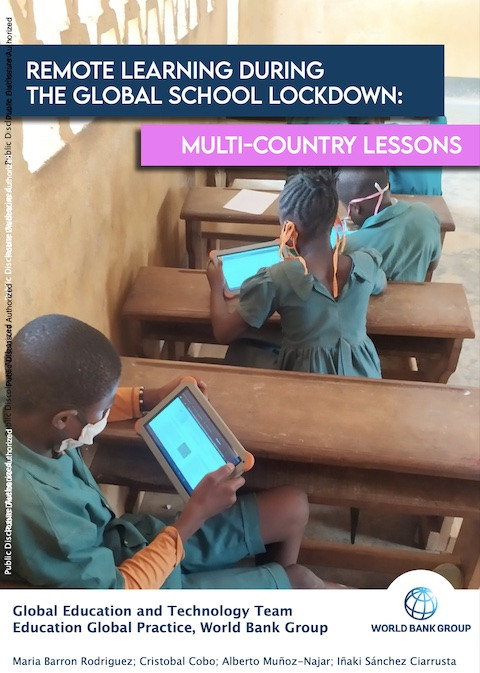 Remote Learning During the Global School Lockdown: Multi-Country Lessons Year of publication: 2020 Author: Maria Barron Rodriguez | Cristobal Cobo | Alberto Muñoz-Najar | Iñaki Sánchez Ciarrusta Corporate author: World Bank This study includes three main sections that have been organized in a chronological order within this report: the first one, “What can we learn from education emergency responses in low- and middle-income countries?” analyzes the emergency education responses to the COVID-19 pandemic of over 120 governments from April until May, 2020. The second section, “Is remote learning perceived as effective? An in-depth analysis across five countries” discusses the main national education responses deployed by Brazil, Kenya, Nigeria, Sierra Leone, and Peru, as well as the perceived effectiveness of these strategies conducted from May until August, 2020. The third section, “What works with remote and remedial strategies? an analysis across 13 countries” builds on key lessons learned during the analysis of the five multi-country experiences and presents global trends of remote learning implemented during school closures and the actions governments adopted to get ready for remedial learning, conducted from August until December 2020. The countries prioritized for the third section are IDA borrowing countries of which six are low-income countries: Afghanistan, Haiti, Malawi, Mozambique, Niger, and Rwanda; and five are lower-middle-income countries: Cambodia, Cameroon, Kenya, Nepal, and Pakistan. Additionally, two high-income countries, Estonia and Uruguay, have been included in the report. The main trends across this report are discussed below and have been grouped in five themes: (1) Adopt delivery systems with an inclusive approach; (2) Adjust the curriculum to ensure effectiveness; (3) Secure sustained teacher training and in-service support; (4) Leverage institutional capacities while ensuring sustained monitoring and evaluation; and (5) Consolidate national strategies to remediate learning losses.
  Advancing Digital Equity for All: Community-Based Recommendations for Developing Effective Digital Equity Plans to Close the Digital Divide and Enable Technology-Empowered Learning Year of publication: 2022 Corporate author: USA. Department of Education. Office of Educational Technology In spring 2022, the U.S. Department of Education’s Office of Educational Technology (OET) committed to advancing digital equity through the Digital Equity Education Roundtables (DEER) Initiative. Through DEER, OET hosted a series of national conversations with leaders from community-based organizations, as well as families and learners furthest from digital opportunities. The “Advancing Digital Equity for All” resource illuminates insights from these conversation to highlight the barriers faced by learner communities and promising solutions for increasing access to technology for learning.The historic federal investments authorized by the Infrastructure Investment and Jobs Act offer critical opportunities for broadband planning that can identify and equitably address the various availability, affordability, and adoption challenges described. Using this guidance resource as a starting point, it is essential that leaders collaborate with those most impacted by the digital divide to develop comprehensive digital equity plans that outline strategies to meet the needs of learners, their families/caregivers, and communities effectively and sustainably.
 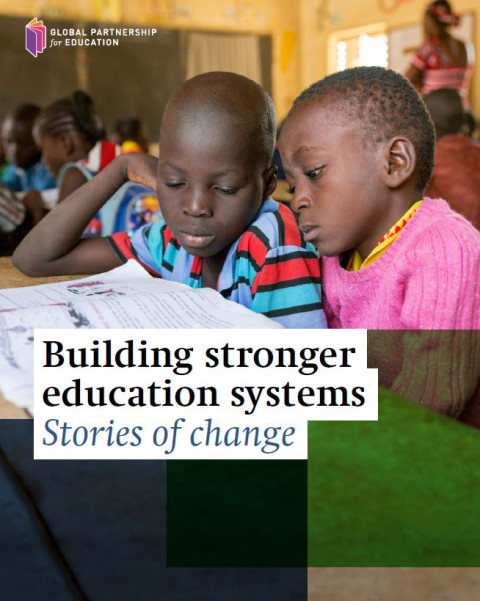 Building Stronger Education Systems: Stories of Change Year of publication: 2019 Corporate author: The Global Partnership for Education (GPE) A compilation of results stories which show the progress that GPE's developing country partners are making in getting more children, especially girls, in school and learning. The brochure includes stories from Afghanistan, Benin, Burkina Faso, Djibouti, Eritrea, Ethiopia, Guyana, Kenya, Pakistan, Papua New Guinea and Sudan. Construire des systèmes éducatifs plus performants : parcours de réussite Year of publication: 2019 Corporate author: The Global Partnership for Education (GPE) Cette brochure présente des parcours de réussite attestant des progrès accomplis par les pays en développement partenaires du PME pour que davantage d’enfants, et en particulier de filles, aillent à l’école et bénéficient d’une éducation de qualité.Elle met en évidence les cas des pays tels que l'Afghanistan, le Bénin, le Burkina Faso, Djibouti, l’Érythrée, l’Éthiopie, le Guyana, le Kenya, le Pakistan, la Papouasie-Nouvelle-Guinée et le Soudan.