
Resources
Explore a wide range of valuable resources on GCED to deepen your understanding and enhance your research, advocacy, teaching, and learning.
875 Results found
 Opening new windows to sow peace: building citizenship Year of publication: 2015 Author: Tatiana Zuluaga Zapata | Carlos Humberto Vélez Ocampo | Laura Juliana Pachón Rodríguez | María Julieta Ortiz Fernández Corporate author: Bogotá. Secretaría de Educación del Distrito (SED) This document aims to help students come with innovative ideas to generate transformations for peace and citizenship in Colombia. It is aimed at creating a conscious mobilization every April 9, during the commemoration of the victims and the missing in Colombia, and has the intention of motivating citizens to fill the streets with joy, raise their voices and commit to peace. Ouvrez de nouvelles fenêtres pour semer la paix: la construction de la citoyenneté ... Year of publication: 2015 Author: Tatiana Zuluaga Zapata | Carlos Humberto Vélez Ocampo | Laura Juliana Pachón Rodríguez | María Julieta Ortiz Fernández Corporate author: Bogotá. Secretaría de Educación del Distrito (SED) Ce document vise à aider les élèves à venir avec des idées novatrices pour générer des transformations pour la paix et la citoyenneté en Colombie. Il est destiné à créer une mobilisation consciente le 9 Avril, lors de la commémoration des victimes et des disparus en Colombie, et a l'intention des citoyens de motivation pour remplir les rues avec joie, faire entendre leur voix et engager à la paix. Abrir nuevas ventanas para sembrar la paz: una ciudadanía que construye… Year of publication: 2015 Author: Tatiana Zuluaga Zapata | Carlos Humberto Vélez Ocampo | Laura Juliana Pachón Rodríguez | María Julieta Ortiz Fernández Corporate author: Bogotá. Secretaría de Educación del Distrito (SED) This document aims to help students come with innovative ideas to generate transformations for peace and citizenship in Colombia. It is aimed at creating a conscious mobilization every April 9, during the commemoration of the victims and the missing in Colombia, and has the intention of motivating citizens to fill the streets with joy, raise their voices and commit to peace.
  School Convivencia : Reviewing the Concept (Psicoperspectivas; No. 18, Vol. 1) Year of publication: 2019 Author: Cecilia Fierro-Evans | Patricia Carbajal-Padilla Corporate author: Catholic University of Valparaíso. School of Psychology This article reports an effort to review the concept of school convivencia (peaceful coexistence, living together) in the Spanish context with the purpose of advancing into its clarification, and thus contributing to developing a common language in the Latin American region. The authors conduct a basic literature review oriented to identify the main theoretical approaches in the convivencia field. Subsequently, they analyze four studies focused in systematizing the prevailing approaches in the study of school convivencia. As a result, they propose a concept of convivencia from a social justice perspective adapted to education, and they operationalize it in three areas of school life: pedagogical-curricular, organizationaladministrative, and the socio-communitarian. This comprehensive notion of school convivencia may guide future research, educational initiatives, and school assessments in the convivencia field that may respond to the violence and pervasive social exclusion that exist in the Latin American region. Convivencia escolar: Una revisión del concepto (Psicoperspectivas; No. 18, Vol. 1) Year of publication: 2019 Author: Cecilia Fierro-Evans | Patricia Carbajal-Padilla Corporate author: Catholic University of Valparaíso. School of Psychology El presente trabajo reporta un ejercicio de revisión del concepto de convivencia escolar con vistas a apoyar su clarificación y, por tanto, contribuir al desarrollo de un lenguaje común en la región latinoamericana. Para ello las autoras conducen un trabajo documental orientado a identificar los principales enfoques teóricos en la literatura de convivencia. Posteriormente analizan cuatro estudios enfocados a sistematizar los enfoques prevalecientes en el estudio de la convivencia escolar. Como resultado, proponen un concepto de convivencia desde la perspectiva de la justicia social adaptada a la educación y lo operacionalizan en tres ámbitos de la vida escolar: pedagógico-curricular, organizativo-administrativo y socio-comunitario. Esta noción comprehensiva de la convivencia escolar podría apoyar la realización de investigaciones futuras, propuestas educativas y evaluaciones de convivencia escolar que ofrezcan una respuesta a la violencia y a la persistente exclusión social que existe en la región latinoamericana.
 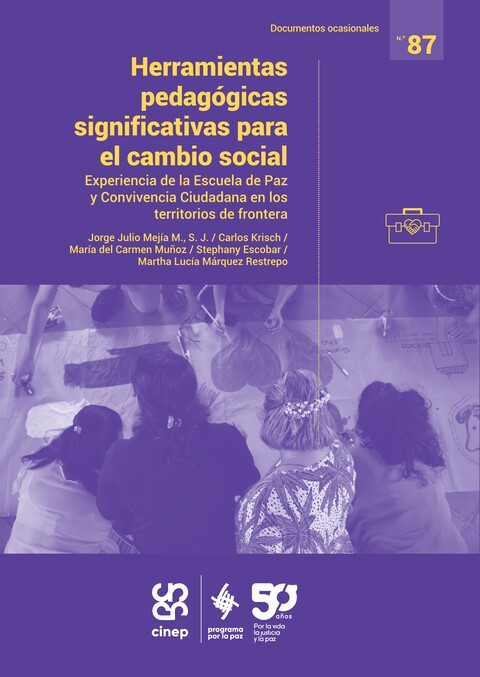 Significant Pedagogical Tools for Social Change Year of publication: 2023 Author: Jorge Julio Mejía | Carlos Krisch | Sthepany Escobar | Martha Lucía | Márquez Restrepo | María Del Carmen Muñoz Corporate author: Center for Research and Popular Education / Program for Peace (CINEP/PPP) This document includes significant pedagogical tools to promote processes of social change through training experiences for twelve years in territories on the Colombian-Venezuelan border. Through workshops and activities, participants have experienced transformations in attitudes and practices that have been useful for understanding the border as a shared space. Herramientas pedagógicas significativas para el cambio social Year of publication: 2023 Author: Jorge Julio Mejía | Carlos Krisch | Sthepany Escobar | Martha Lucía | Márquez Restrepo | María Del Carmen Muñoz Corporate author: Center for Research and Popular Education / Program for Peace (CINEP/PPP) En este documento se recogen las herramientas pedagógicas significativas para promover procesos de cambio social a través de experiencias formativas durante doce años en territorios de la frontera colombo-venezolana. Mediante talleres y actividades, los participantes han experimentado transformaciones en actitudes y prácticas que les han resultado útiles para comprender la frontera como un espacio compartido.
  Citizenship Education: Human Rights, History and Memory 50 Years After the 1973 Coup Year of publication: 2023 Corporate author: Chile. Ministry of Education Educational material that proposes a series of activities regarding the commemoration of the 50 years of the coup d'état, a topic that brings together the country through various channels and constitutes a great opportunity to contextualize the learning objectives linked to memory, democracy and human rights. Educación en ciudadanía derechos humanos historia y memoria: A 50 años del golpe de estado de 1973 Year of publication: 2023 Corporate author: Chile. Ministry of Education Material educativo que propone una serie de actividades a propósito de la conmemoración de los 50 años del golpe de Estado, tema que convoca al país a través de diversos canales y se constituye como una gran oportunidad para contextualizar los objetivos de aprendizaje vinculados a memoria, democracia y derechos humanos.
  Building Citizenship from Universities; University Social Responsibility and Challenges in the XXI century Year of publication: 2011 Author: Eduardo Gasca-Pliego | Julio César Olvera-García Corporate author: Universidad Autónoma del Estado de México The present essay contributes with a reflection on the role universities must take as agents of transformation and consolidation of the democratic model, mainly before the challenge of building full citizens, interested in the need of the physical and social environment, in collective decision making, who think of themselves as participant citizens and not only voters with their own interests in view. Distinguishable is the primordial role of university social responsibility to promote the social management of knowledge for everyone, which has as an end the construction of informed, responsible and participant citizenship, which responds to injustice, non-sustainability, violence and corruption. Rethinking the social function of the university requires defending the values proper to public education, in the sense that every citizen has equal opportunities to develop their capabilities, eliminating obstacles of social and economic nature, as well as the cultural and political that affect and hinder said development.