
Resources
Explore a wide range of valuable resources on GCED to deepen your understanding and enhance your research, advocacy, teaching, and learning.
2,772 Results found
 The Socio-Cultural Impact of COVID-19: Exploring the Role of Intercultural Dialogue in Emerging Responses Year of publication: 2020 Author: Fethi Mansouri Corporate author: UNESCO This brief illustrates, proponents and practitioners of ICD were quick to adapt to this crisis situation and shifted much of their activities online in order to mitigate the negative impacts of the pandemic. The shift has ensured that cross-cultural exchange, mutual support and intergroup solidarity, all key dimensions of the ICD approach, can be maintained in safe online contexts and thus continue to play a key role within the socio-cultural response to COVID-19.Through inductive exploration of authentic, local, community responses to the COVID-19 crisis, this brief aims to shed light on the new context in which the ICD agenda is being pursued, complementing the many existing quantitative analyses of the socio-cultural impact of the pandemic.
  Difficult Dialogue in the Classroom: Guidance and Activities to Give Teachers the Skills to Manage Difficult Dialogue Year of publication: 2017 Corporate author: Tony Blair Institute for Global Change This book builds on the core curriculum to support educators manage difficult conversations, related to challenging issues and topics. Through practical and easy to use facilitation techniques, educators are able to move young people deeper in dialogue and ensure they learn accountability for what they say. الحوار الصعب في الصف: مورد لمنح المُعلِّمي المهارات إ لدارة الحوار الصعب في الصف Year of publication: 2017 Corporate author: Tony Blair Institute for Global Change يعتمد هذا الكتاب على المنهج الأساسي لدعم المعلمين في إدارة المحادثات الصعبة المتعلقة بالقضايا والمواضيع الصعبة. من خلال تقنيات التيسير العملية وسهلة الاستخدام ، يستطيع المعلمون نقل الشباب إلى عمق أكبر في الحوار والتأكد من أنهم يتعلمون المساءلة عما يقولونه.
  Course: Dialogue and Dialogue Etiquette Year of publication: 2017 Author: Fath Omar Corporate author: Majmaah University The course includes two topics of dialogue and disagreement. It seeks to form the Muslim to be a tactful interlocutor and able to manage the conflict between him and his society and his counterparts. The course deals with one of the important pillars of global citizenship issues, which is dialogue. مقرر دراسي: الحوار وآداب الحوار Year of publication: 2017 Author: Fath Omar Corporate author: Majmaah University يتضمن المقرر موضوعي الحوار والخلاف. ويسعى لتشكيل المسلم ليكون محاوراً لبقاً، وقادراً على إدارة الخالف بينه ، وبين مجتمعه ومناظريه. المقرر يتعرض لأحد الركائز المهمة من مواضيع المواطنة العالمية وهو الحوار.
  Dialogue for Prevention Year of publication: 2025 Corporate author: UNESCO In an era where geopolitical power struggles disrupt traditional peacebuilding, where identity and misinformation fuel divisions, and where trust in institutions is eroding, UNESCO’s Intercultural Dialogue for Conflict Transformation briefs series presents an adaptable, culturally grounded, and people-centred approach to peacebuilding. With 1.5 billion people living in contexts with low intercultural dialogue where global challenges such as absolute poverty, terrorism and forced displacement are more prevalent, this four-part series draws on firsthand experience, country case studies, and expert analysis to demonstrate the transformative potential of dialogue in fragile and conflict-sensitive settings. The Dialogue for Prevention brief, developed with the Auschwitz Institute for the Prevention of Genocide and Mass Atrocities, explores the powerful role intercultural dialogue can play in preventing large-scale identity-based violence, particularly in the upstream and downstream phases of conflict. Grounded in the idea that dialogue can bridge divides and foster mutual understanding, the brief argues that enabling environments for intercultural dialogue—marked by stability, inclusive governance, freedom of expression, horizontal equality, and social cohesion—also mitigate key risk factors for atrocity violence. Drawing on diverse examples from Cambodia, Colombia, Italy, and Kenya, it showcases creative, context specific applications of dialogue. Through practical guidance, the brief equips policymakers, practitioners and civil society seeking to embed dialogue into prevention strategies.
  Dialogue for Social Cohesion Year of publication: 2025 Author: Isaure Vicarini | Euan Mackway-Jones Corporate author: UNESCO In an era where geopolitical power struggles disrupt traditional peacebuilding, where identity and misinformation fuel divisions, and where trust in institutions is eroding, UNESCO’s Intercultural Dialogue for Conflict Transformation briefs series presents an adaptable, culturally grounded, and people-centred approach to peacebuilding. With 89% of conflicts worldwide occurring in countries with limited capacity for intercultural dialogue, this four-part series draws on firsthand experience, country case studies, and expert analysis to demonstrate the transformative potential of dialogue in fragile and conflict-sensitive settings. The Dialogue for Social Cohesion brief—developed in collaboration with the Berghof Foundation and Search for Common Ground—bridges theory and practice to explore the horizontal (community-to-community) and vertical (citizen-to-state) dimensions of social cohesion and highlights how inclusive dialogue can support both. Case studies from Afghanistan, Germany, Somalia, and South Sudan illustrate how dialogue—whether through theatre, education, local governance, or environmental peacebuilding—can cultivate mutual understanding and trust, bridge identity-based divides, and restore, step by step, the social fabric in fractured societies. Through actionable recommendations, this brief equips practitioners, policymakers, and civil society with the essential guidance needed to tailor and embed dialogue in their respective contexts, helping to ensure that peace processes are inclusive, locally driven, and enduring.
 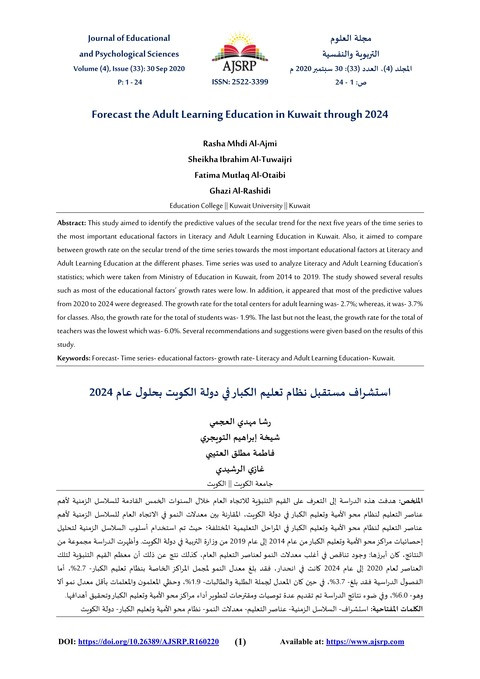 Forecast the Adult Learning Education in Kuwait Through 2024 (Journal of Educational and Psychological Sciences; vol.4, no.33) Year of publication: 2020 Author: Rasha Mhdi Al-Ajmi | Sheikha Ibrahim Al-Tuwaijri | Fatima Mutlaq Al-Otaibi | Ghazi Al-Rashidi Corporate author: Arab Institute of Science and Research Publishing (AISRP) This study aimed to identify the predictive values of the secular trend for the next five years of the time series to the most important educational factors in Literacy and Adult Learning Education in Kuwait. Also, it aimed to compare between growth rate on the secular trend of the time series towards the most important educational factors at Literacy and Adult Learning Education at the different phases. Time series was used to analyze Literacy and Adult Learning Education’s statistics; which were taken from Ministry of Education in Kuwait, from 2014 to 2019. The study showed several results such as most of the educational factors’ growth rates were low. In addition, it appeared that most of the predictive values from 2020 to 2024 were degreased. The growth rate for the total centers for adult learning was- 2.7%; whereas, it was- 3.7% for classes. Also, the growth rate for the total of students was- 1.9%. The last but not the least, the growth rate for the total of teachers was the lowest which was- 6.0%. Several recommendations and suggestions were given based on the results of this study. استشراف مستقبل نظام تعليم الكبار في دولة الكويت بحلول عام 2024 (مجلة العلوم التربوية و النفسية ;no.33, vol.4) Year of publication: 2020 Author: Rasha Mhdi Al-Ajmi | Sheikha Ibrahim Al-Tuwaijri | Fatima Mutlaq Al-Otaibi | Ghazi Al-Rashidi Corporate author: Arab Institute of Science and Research Publishing (AISRP) هدفت هذه الدراسة إلى التعرف على القيم التنبؤية للاتجاه العام خلال السنوات الخمس القادمة للسلاسل الزمنية لأهم عناصر التعليم لنظام محو الأمية وتعليم الكبار في دولة الكويت، المقارنة بين معدلات النمو في الاتجاه العام للسلاسل الزمنية لأهم عناصر التعليم لنظام محو الأمية وتعليم الكبار في المراحل التعليمية المختلفة؛ حيث تم استخدام أسلوب السلاسل الزمنية لتحليل إحصائيات مراكز محو الأمية وتعليم الكبار من عام 2014 إلى عام 2019 من وزارة التربية في دولة الكويت. وأظهرت الدراسة مجموعة من النتائج، كان أبرزها: وجود تناقص في أغلب معدلات النمو لعناصر التعليم العام، كذلك نتج عن ذلك أن معظم القيم التنبؤية لتلك العناصر لعام 2020 إلى عام 2024 كانت في انحدار، فقد بلغ معدل النمو لمجمل المراكز الخاصة بنظام تعليم الكبار- 2.7%، أما الفصول الدراسية فقد بلغ- 3.7%، في حين كان المعدل لجملة الطلبة والطالبات- 1.9%، وحظي المعلمون والمعلمات بأقل معدل نمو ألا وهو- 6.0%، وفي ضوء نتائج الدراسة تم تقديم عدة توصيات ومقترحات لتطوير أداء مراكز محو الأمية وتعليم الكبار وتحقيق أهدافها.
  The Representation of Jews, Judaism and Antisemitism in School Textbooks and Curricula in Europe Year of publication: 2025 Corporate author: UNESCO Jewish communities have been integral to Europe’s social fabric for centuries, preserving rich religious and cultural traditions while facing recurring periods of exclusion, persecution, and resilience. School textbooks are important vantage points to understand how this history and heritage is represented, (de)constructed and embedded into a shared historical and cultural memory. They are also important practical tools used daily by students, teachers, and parents.This comprehensive research, carried out by UNESCO in collaboration with the Georg-Eckert-Institute and supported by funding from the European Commission, examines the ways in which Jewish culture, history, life, and anti-Jewish prejudice are represented in secondary school materials across eight European nations.The publication highlights opportunities within curricula to address Jewish experiences and antisemitism, reviews how these themes are incorporated into textbooks, and analyzes the narratives and portrayals that arise. The study also looks at the use of visual sources and assesses whether Jewish viewpoints and agency are sufficiently reflected. The findings highlight both recurring stereotypes and promising practices. By showcasing these contrasts, the study provides targeted recommendations to guide the creation of more inclusive educational materials.