
Resources
Explore a wide range of valuable resources on GCED to deepen your understanding and enhance your research, advocacy, teaching, and learning.
1,443 Results found
 Symposium on climate change education and sustainable cities, 31 August 2009, United Nations Office at Nairobi, Kenya Year of publication: 2009 Corporate author: United Nations Environment Programme (UNEP) | United Nations Centre for Human Settlement Programme (UN Habitat) Education plays an important role in promoting knowledge, skills and values that are necessary for the realization of a sustainable society. It also assists learners to learn to cope with today's challenges such as climate change and urbanization. The overarching theme of the symposium was the critical role of education in promoting sustainable urbanization with a particular focus on climate change and its challenges. This broad theme was divided into two major sub-themes: 1. Role of education in building sustainable cities 2. Mainstreaming climate change in education for building sustainable cities. The key objective of the symposium was to raise awareness about the decade of education on sustainable development and to promote a constructive dialogue between local authorities, practitioners, academia and civil society organizations on the role of education in addressing the challenges of sustainable urbanization and climate change. A major thrust of the dialogue was “moving from rhetoric to action”. Key concepts of the Symposium Cities Half of humanity now lives in cities, and around one billion urban residents live in slums. The urbanization of poverty is therefore one of the most daunting challenges of the 21st century. Cities offer opportunities, but most urban development is largely toxic, segregated and inefficient. If cities are to come to terms with rapid levels of urbanization, they require leaders, managers and staff capable of adopting innovative and robust approaches to planning, developing, managing and financing growth for all citizens. Climate Change Globally, climate change is now recognized as one of the defining challenges of the 21st century. The future of hundreds of millions of people in urban areas across the world will be affected by the different impacts of climate change. Developing and least developed countries have higher vulnerability to climate change impacts compared to developed countries. Climate change has been identified as one of the main strategic perspectives to inform education and learning for sustainable development and by extension sustainable city development. Climate change issues need to be part of public awareness, learning and education for a sustainable future. The integrated, multifaceted vision provided by ESD is particularly well-suited to addressing climate change and city development in terms of understanding its causes, recognising its impact and effects, and preparing and implementing appropriate mitigation and adaptation responses. Symposium sur le changement climatique et l'éducation des villes durables 31 Août 2009, le Bureau des Nations Unies à Nairobi, au Kenya Year of publication: 2009 Corporate author: United Nations Environment Programme (UNEP) | United Nations Centre for Human Settlement Programme (UN Habitat) L'éducation joue un rôle important dans la promotion des connaissances, des compétences et des valeurs qui sont nécessaires à la réalisation d'une société durable. Il aide également les élèves à apprendre à faire face aux défis actuels tels que le changement climatique et l'urbanisation. Le thème général du colloque était le rôle crucial de l'éducation dans la promotion de l'urbanisation durable avec un aCECnt particulier sur le changement climatique et ses défis. Ce thème général a été divisé en deux sous-thèmes: 1. Rôle de l'éducation dans la construction de villes durables 2. Intégration du changement climatique dans l'éducation pour la construction de villes durables. L'objectif principal du colloque était de sensibiliser au sujet de la décennie de l'éducation sur le développement durable et de promouvoir un dialogue constructif entre les organisations autorités, les praticiens, les universités et la société civile locale sur le rôle de l'éducation dans la lutte contre les défis de l'urbanisation durable et le changement climatique . Un axe majeur du dialogue était «passer de la rhétorique à l'action». Les concepts clés du Symposium Villes moitié de l'humanité vit aujourd'hui dans les villes, et environ un milliard de citadins vivent dans des bidonvilles. L'urbanisation de la pauvreté est donc l'un des défis les plus redoutables du 21e siècle. Les villes offrent des possibilités, mais la plupart du développement urbain est en grande partie toxique, la ségrégation et inefficace. Si les villes doivent se réconcilier avec les niveaux rapides d'urbanisation, ils exigent des dirigeants, des gestionnaires et du personnel capables d'adopter des approches novatrices et robustes à la planification, le développement, la gestion et la croissance de financement pour tous les citoyens. À l'échelle mondiale sur les changements climatiques, le changement climatique est maintenant reconnu comme l'un des défis du 21ème siècle. L'avenir de centaines de millions de personnes dans les zones urbaines à travers le monde seront touchés par les différents impacts du changement climatique. Le développement et les pays les moins avancés ont une plus grande vulnérabilité aux impacts des changements climatiques par rapport aux pays développés. Le changement climatique a été identifié comme l'une des principales perspectives stratégiques pour informer l'éducation et l'apprentissage pour le développement durable et, par extension, le développement de la ville durable. les questions de changement climatique doivent faire partie de la sensibilisation du public, l'apprentissage et l'éducation pour un avenir durable. La vision à multiples facettes intégré fourni par EDD est particulièrement bien adapté à lutter contre le changement climatique et le développement de la ville en termes de compréhension de ses causes, en reconnaissant son impact et les effets, et la préparation et la mise en œuvre des mesures d'atténuation et d'adaptation appropriées.
  파리협정 함께 보기 Year of publication: 2022 Corporate author: 대한민국 환경부 기후변화국제협력팀 | 한국환경공단 기후정책지원부 이 책자는 ‘파리협정(Paris Agreement)’에 대한 우리 국민의 이해를 높이고, 모든 사회 주체가 함께하는 파리협정 이행 체계를 조성하는데 도움이 되고자 제작되었습니다.이 책자는 환경부와 한국환경공단이 공동으로 발간한 「파리협정 길라잡이(’16.5)」와 「파리협정 이행규칙 안내서(’19.6)」를 통합·개정·증보한 것으로, 기존 발간 자료는 환경부 누리집(me.go.kr)>발행물>환경책자>알기쉬운 소책자에서 받아볼 수 있습니다. 발행처: 환경부 기후변화국제협력팀 (044-201-6601)발행일: 2022.3.31 Предлагаемая тематическая программа по образованию в области водных ресурсов в рамках Десятилетия образования в интересах устойчивого развития ООН (ДОУР, 2005-2014 ГГ.) Year of publication: 2006 Corporate author: International Hydrological Programme (IHP) Water education is a very important component of UNESCO’s overall effort in water, including within the International Hydrological Programme. The UNESCO Executive Board has called for a UNESCO-wide strategy for water education at all levels. This document reviews the evolution of water education within UNESCO, and draws attention to the Draft Action Plan for the UN Decade on Education for Sustainable Development (DESD), which includes 12 Thematic Programmes one of which would be devoted to “Education for Sustainable Water Management”. The IHP would be expected to play an important role in such a UNESCO-wide effort for water education.
 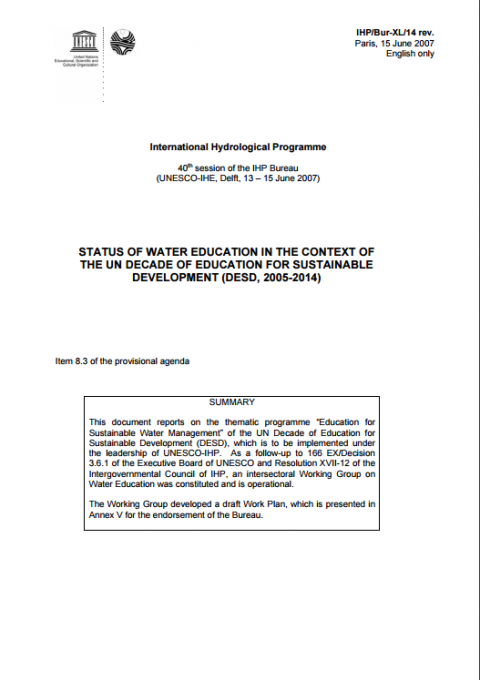 Status of water education in the context of the UN Decade of Education for Sustainable Development (DESD, 2005-2014) Year of publication: 2007 Corporate author: International Hydrological Programme (IHP) This document reports on the thematic programme “Education for Sustainable Water Management” of the UN Decade of Education for Sustainable Development (DESD), which is to be implemented under the leadership of UNESCO-IHP. As a follow-up to 166 EX/Decision 3.6.1 of the Executive Board of UNESCO and Resolution XVII-12 of the Intergovernmental Council of IHP, an intersectoral Working Group on Water Education was constituted and is operational. The Working Group developed a draft Work Plan, which is presented in Annex V for the endorsement of the Bureau. Situation de l'éducation relative à l'eau dans le contexte de la Décennie des Nations Unies pour l'éducation au service du développement durable (DEDD, 2005-2014) Year of publication: 2007 Corporate author: International Hydrological Programme (IHP) Ce document rend compte du programme thématique «Education pour une gestion durable de l'eau» de la Décennie des Nations Unies pour l'éducation au service du développement durable (DEDD), qui sera mis en œuvre sous la direction du PHI de l'UNESCO. Conformément à la décision 166 EX / 3.6.1 du Conseil exécutif de l'UNESCO et à la Résolution XVII-12 du Conseil intergouvernemental du PHI, un groupe de travail intersectoriel sur l'éducation relative à l'eau a été créé et est opérationnel. Le groupe de travail a élaboré un projet de plan de travail qui est présenté à l'annexe V pour approbation par le Bureau. Programa temático propuesto sobre la educación relativa al agua en el marco del Decenio de las Naciones Unidas de la Educación para el Desarrollo Sostenible (2005-2014) Year of publication: 2006 Corporate author: International Hydrological Programme (IHP) Water education is a very important component of UNESCO’s overall effort in water, including within the International Hydrological Programme. The UNESCO Executive Board has called for a UNESCO-wide strategy for water education at all levels. This document reviews the evolution of water education within UNESCO, and draws attention to the Draft Action Plan for the UN Decade on Education for Sustainable Development (DESD), which includes 12 Thematic Programmes one of which would be devoted to “Education for Sustainable Water Management”. The IHP would be expected to play an important role in such a UNESCO-wide effort for water education. Proposition de programme thématique sur l'éducation relative à l'eau dans le cadre de la décennie des Nations Unies pour L'Education au Service du Développement Durable (DEDD, 2005-2014) Year of publication: 2006 Corporate author: International Hydrological Programme (IHP) Water education is a very important component of UNESCO’s overall effort in water, including within the International Hydrological Programme. The UNESCO Executive Board has called for a UNESCO-wide strategy for water education at all levels. This document reviews the evolution of water education within UNESCO, and draws attention to the Draft Action Plan for the UN Decade on Education for Sustainable Development (DESD), which includes 12 Thematic Programmes one of which would be devoted to “Education for Sustainable Water Management”. The IHP would be expected to play an important role in such a UNESCO-wide effort for water education.
  Asia-Pacific Digital Transformation Report 2024: Digital Innovation for Smarter Climate Action Year of publication: 2024 Corporate author: UN. Economic and Social Commission for Asia and the Pacific (UN. ESCAP) In Asia and the Pacific, the climate crisis intersects with digital transformations through a complex mix of challenges and opportunities, creating a series of vicious but also potentially virtuous cycles. The Asia-Pacific Digital Transformation Report 2024 considers how digital transformations will structurally and irreversibly affect the trajectory of climate change. It presents a digital-growth-climate nexus to better understand the diverse and dynamic picture and considers ways in which the region can follow the most positive trajectory to avert a climate catastrophe. The Report showcases good practices and country examples of digital applications in addressing climate change, in terms of mitigation and adaptation. These can involve the use of artificial intelligence, the Internet of Things, big data, digital twins, geospatial technologies and others, which have been employed in infrastructure, government, mobility, industry and trade, digital data centres, disaster risk reduction, agriculture and biodiversity ecosystems. The Report then explores key drivers of digital transformation for climate change and outlines three future scenarios. It concludes with the key findings of the Report and proposes policy actions aligned with the five actors of the Digital Transformation Index Framework.
  Leveraging Digitalization for Productivity and Decent Employment: Asia-Pacific Countries with Special Needs Development Report 2024 Year of publication: 2024 Corporate author: UN. Economic and Social Commission for Asia and the Pacific (UN. ESCAP) The Asia-Pacific Countries with Special Needs Development Report is a recurrent ESCAP annual publication that discusses issues of interest for Asia-Pacific least developed countries (LDCs), landlocked developing countries (LLDCs) and small island developing States (SIDS), collectively referred to as countries with special needs (CSN). The Asia-Pacific Countries with Special Needs Development Report 2023: Strengthening Regional Cooperation for Seamless and Sustainable Connectivity examines how regional cooperation on seamless and sustainable connectivity can facilitate a long-term transformation towards a net zero carbon emissions future. Recognising ongoing efforts and existing initiatives and considering the large financing gaps in the countries in special situations, the Report underscores the need to seek synergies between transport, energy, and digital connectivity initiatives in the region.