
Resources
Explore a wide range of valuable resources on GCED to deepen your understanding and enhance your research, advocacy, teaching, and learning.
3,790 Results found
 Global citizenship: a high school educator's guide (grades 9-12) Year of publication: 2013 Corporate author: TeachUNICEF Global Citizenship is a unit of four lessons designed to introduce the concept of global citizenship and place it in the context of international human rights; to engage students in a guided inquiry into the meaning of global citizenship and its relationship to national citizenship; to educate about how the United Nations has framed global rights and responsibilities for the 21st century and is acting on them via the Millennium Development Goals (MDGs); and to investigate how the U.S. Fund for UNICEF has engaged individuals in support of global citizenship as well as to engage students in designing and implementing a plan to act locally in support of global issues. La citoyenneté mondiale: Guide d'un éducateur de l'école secondaire (les niveaux 9-12) Year of publication: 2013 Corporate author: TeachUNICEF La citoyenneté mondiale est une unité de quatre leçons visant à introduire le concept de la citoyenneté mondiale et le placer dans le contexte des droits de l'homme internationaux; pour engager les élèves dans une enquête guidée dans le sens de la citoyenneté mondiale et de sa relation à la citoyenneté nationale; d'éduquer sur la façon dont l'Organisation des Nations Unies a formulé des droits et des responsabilités mondiales pour le 21e siècle et est d'agir sur eux par l'intermédiaire des Objectifs du Millénaire pour le développement (OMDs); et d'enquêter sur la façon dont le Fonds américain pour l'UNICEF a engagé des individus à l'appui de la citoyenneté mondiale, ainsi que d'engager les élèves dans la conception et la mise en œuvre d'un plan d'agir localement en faveur des enjeux mondiaux.
  Global citizenship in primary and secondary education in the Netherlands Year of publication: 2012 Author: Lette Hogeling Corporate author: National Committee for International Cooperation and Sustainable Development (NCDO) NCDO has examined the opinions and methods of teachers and directors with regard to global citizenship, as well as the obstacles and opportunities they experience around global citizenship in education. More than 1,500 teachers and almost 300 directors have participated in the research. A large majority of the teachers in primary and secondary education think that global citizenship is an important subject for Dutch education. Also, the majority of the teachers are of the opinion that it is important that the lessons link up with current events. Nevertheless, only a minority of the teachers in primary and secondary education believe that global citizenship should be a compulsory part of the curriculum. It is mainly teachers of geography, economics, cultural and social subjects who are of the opinion that global citizenship is an important theme. La citoyenneté mondiale dans l'enseignement primaire et secondaire aux Pays-Bas Year of publication: 2012 Author: Lette Hogeling Corporate author: National Committee for International Cooperation and Sustainable Development (NCDO) NCDO a examiné les opinions et les méthodes des enseignants et des administrateurs à l'égard de la citoyenneté mondiale, ainsi que les obstacles et les opportunités qu'ils rencontrent autour de la citoyenneté mondiale dans l'éducation. Plus de 1.500 enseignants et près de 300 directeurs ont participé à la recherche. Une grande majorité des enseignants dans l'enseignement primaire et secondaire pensent que la citoyenneté mondiale est un sujet important pour l'éducation néerlandaise. En outre, la majorité des enseignants sont d'avis qu'il est important que les leçons de lien avec l'actualité. Néanmoins, seule une minorité des enseignants dans l'enseignement primaire et secondaire croient que la citoyenneté mondiale devrait être une partie obligatoire du programme. Il est principalement les professeurs de géographie, l'économie, la culture et les sujets sociaux qui sont d'avis que la citoyenneté mondiale est un thème important. Global citizenship: from public support to active participation Year of publication: 2012 Author: Christine Carabain | Shelena Keulemans | Marije van Gent | Gabi Spitz Corporate author: National Committee for International Cooperation and Sustainable Development (NCDO) This publication explores the concept of global citizenship by drawing on the most relevant, mainly scientific, literature. This exploration will in the coming years be the basis for NCDO’s programmes in the area of research, staff training, and knowledge sharing. NCDO has the important task of engaging people in these two major changes in perspective: what does it mean, how important is it to us, how can we contribute to it? NCDO considers it its responsibility to raise awareness amongst Dutch citizens of the growing connection and mutual dependency between people across the globe, as well as to make them aware of the opportunities they have to help tackle global issues. In other words: NCDO aims to advance the global dimension of citizenship in the Netherlands. But what exactly is that global dimension of citizenship? Despite growing awareness of the importance of global citizenship, a clear and broadly accepted definition of the concept is still lacking (Hart, 2011). To date the concept is often explained by using examples and focus areas. This publication will present the definition of global citizenship that NCDO will employ in the coming period. Global citizenship: from public support to active participation Year of publication: 2012 Author: Christine Carabain | Shelena Keulemans | Marije van Gent | Gabi Spitz Corporate author: National Committee for International Cooperation and Sustainable Development (NCDO) Cette publication explore le concept de citoyenneté mondiale en abordant essentiellement le côté scientifique, la littérature la plus pertinente,. Cette exploration dans les années à venir sera la base pour les programmes de NCDO dans le domaine de la recherche, la formation du personnel, et le partage des connaissances. NCDO a la tâche importante d'engager les gens dans ces deux grands changements en perspective: qu'est-ce que cela veut dire, combien il est important pour nous, comment pouvons-nous y contribuer? NCDO estime qu'il lui incombe de sensibiliser les citoyens néerlandais de la connexion croissante et la dépendance mutuelle entre les peuples à travers le monde, ainsi que pour leur faire connaître les possibilités qu'ils ont pour aider à résoudre les problèmes mondiaux. En d'autres termes: NCDO vise à faire progresser la dimension globale de la citoyenneté aux Pays-Bas. Mais qu'est-ce que la dimension mondiale de la citoyenneté? Malgré la prise de conscience de l'importance de la citoyenneté mondiale, une définition claire et largement acceptée du concept fait toujours défaut (Hart, 2011). À ce jour, le concept est souvent expliqué à l'aide des exemples et des domaines d'intervention. Cette publication présentera la définition de la citoyenneté mondiale qui NCDO emploiera dans la période à venir. En rejse tilbage i tiden – en lære for fremtiden Håndbog for lærere Year of publication: 2010 Corporate author: European Union Agency for Fundamental Rights What role do Holocaust-related sites play in today's societies? What do they offer young people? What should schools and teachers consider when planning a visit to such a site? And how can teachers make best use of such visits for teaching about the Holocaust and human rights? This Handbook provides a number of examples, hints and historical background information, which will help teachers and students to make visits to Holocaust-related sites and exhibitions a meaningful and enriching experience. Een stap in het verleden – een les voor de toekomst: Handboek voor leraren Year of publication: 2010 Corporate author: European Union Agency for Fundamental Rights What role do Holocaust-related sites play in today's societies? What do they offer young people? What should schools and teachers consider when planning a visit to such a site? And how can teachers make best use of such visits for teaching about the Holocaust and human rights? This Handbook provides a number of examples, hints and historical background information, which will help teachers and students to make visits to Holocaust-related sites and exhibitions a meaningful and enriching experience.
 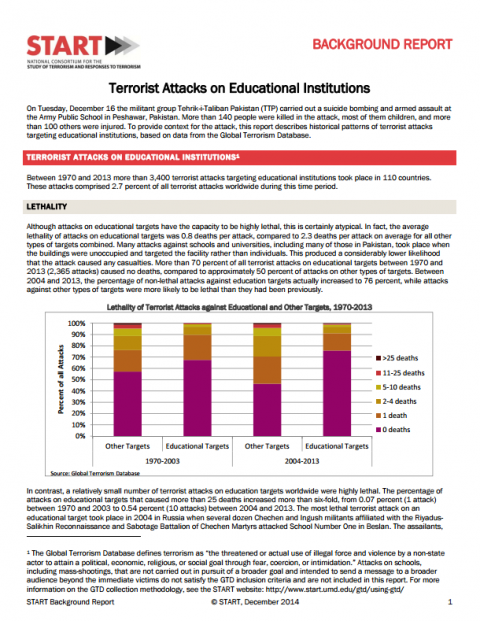 Terrorist Attacks on Educational Institutions Year of publication: 2014 Author: Erin Miller Corporate author: National Consortium for the Study of Terrorism and Responses to Terrorism (START) | Department of Homeland Security Science and Technology The report describes historical patterns of terrorist attacks targeting educations institutions dating back to 1970. Since that year, more than 3,400 terrorist attacks targeting educations institutions took place in 110 countries. These attacks comprised 2.7 percent of all terrorist attacks worldwide during this time period. Terrorist Attacks on Educational Institutions Year of publication: 2014 Author: Erin Miller Corporate author: National Consortium for the Study of Terrorism and Responses to Terrorism (START) | Department of Homeland Security Science and Technology Le rapport revient sur les attaques terroristes qui ont ciblé les institutions éducatives depuis 1970. A partir de cette année, on dénombre plus de 3.400 attaques terroristes qui avaient pour cible les institutions éducatives, dans 110 pays. Ces attaques représentent 2,7 % de l’ensemble des attaques terroristes perpétrées à travers le monde au cours de cette période.