
Resources
Explore a wide range of valuable resources on GCED to deepen your understanding and enhance your research, advocacy, teaching, and learning.
1,182 Results found
 Indicators for Monitoring the Sustainable Development Goals Year of publication: 2019 Author: Frédéric Vey | Anne-Sophie Hesse Corporate author: Université Virtuelle Environnement et Développement durable (UVED) Frédéric Vey and Anne-Sophie Hesse, from the Ministry of Ecological and Solidarity Transition, discuss in this video (12'40) the indicators for monitoring the Sustainable Development Goals (SDGs). After a theoretical approach aimed at defining and showing the limits of the indicators, they show how the "SDG" indicators are available from the international scale to the national scale. Les indicateurs de suivi des Objectifs de Développement Durable Year of publication: 2019 Author: Frédéric Vey | Anne-Sophie Hesse Corporate author: Université Virtuelle Environnement et Développement durable (UVED) Frédéric Vey et Anne-Sophie Hesse, du Ministère de la transition écologique et solidaire, discutent dans cette vidéo (12'40) des indicateurs de suivi des Objectifs de développement durable (ODD). Après une approche théorique visant à définir et à montrer les limites des indicateurs, ils montrent comment les indicateurs "ODD" se déclinent de l'échelle internationale à l'échelle nationale.
  Global Citizenship: A Path to a Better World Year of publication: 2022 Corporate author: NGO-UNESCO Liaison Committee Presentation at the Forum of NGO Liaison Committee (UNESCO) by Stefania Giannini, Deputy Secretary General, UNESCO. The need for new pedagogies and solidarity that respects diversity. Education must also aim to develop peace, gender equity, and the meaning of the ODDs, notably 4.7 in relation to Global Citizenship Education. Civil society partners are critical to fighting extremism and hate. Citoyenneté mondiale: Une voie vers un monde meilleur Year of publication: 2022 Author: Comité de Liaison ONG-UNESCO Corporate author: NGO-UNESCO Liaison Committee Presentation at the Forum of NGO Liaison Committee (UNESCO) by Stefania Giannini, Deputy Secretary General, UNESCO. The need for new pedagogies and solidarity that respects diversity. Education must also aim to develop peace, gender equity and the meaning of the SDGs, notably 4.7 in relation to Global Citizenship Education. Civil society partners are critical to fighting extremism and hate.
  State of the World's Forests 2022: Green Recovery, Creating Inclusive and Sustainable Economies Year of publication: 2022 Corporate author: Food and Agriculture Organization of the United Nations (FAO) Forests stand as a vital defense against climate change and biodiversity loss, while also providing livelihoods for millions of people across the world. But they are under threat. In the last 30 years, they’ve lost an area larger than Algeria and Libya combined. FAO’s latest State of the World’s Forests (SOFO) report identifies three pathways that can conserve forests while supporting environmental and economic recovery: halting deforestation, restoring degraded forests, and sustainably using forests to build resilient local economies. La Situation des forêts du monde 2022: Relance verte, créer des économies inclusives et durables Year of publication: 2022 Corporate author: Food and Agriculture Organization of the United Nations (FAO) Le rôle des forêts dans les écosystèmes de vie et les menaces actuelles. La perte des terres et le besoin de stopper la déforestation, de restaurer les forêts et d’intensifier l’utilisation durable.
  Annual Report 2021 Year of publication: 2021 Corporate author: University of Sherbrooke. International Cooperation Group Our main orientations in 2021: Increase the capacities of GCIUS project management, through the development of management tools standardized; Increase outreach of the GCIUS with the student community of the UdeS, as well as with the community of practice; Promote mobilization, recruitment, and implementation of strategies equity, diversity, and inclusion in the GCIUS. Rapport annuel 2021 Year of publication: 2021 Author: Groupe de Coopération Internationale de l'Université de Sherbrooke Corporate author: Université de Sherbrooke. Groupe de Coopération Internationale Nos grandes orientations en 2021: Accroître les capacités de gestion de projet du GCIUS, à travers le développement d'outils de gestion standardisés ; Accroître le rayonnement du GCIUS auprès de la communauté étudiante de l'UdeS, ainsi qu'auprès de la communauté de pratique ; Favoriser la mobilisation, le recrutement et la mise en oeuvre de stratégies en matière d'équité, de diversité et d'inclusion au GCIUS.
 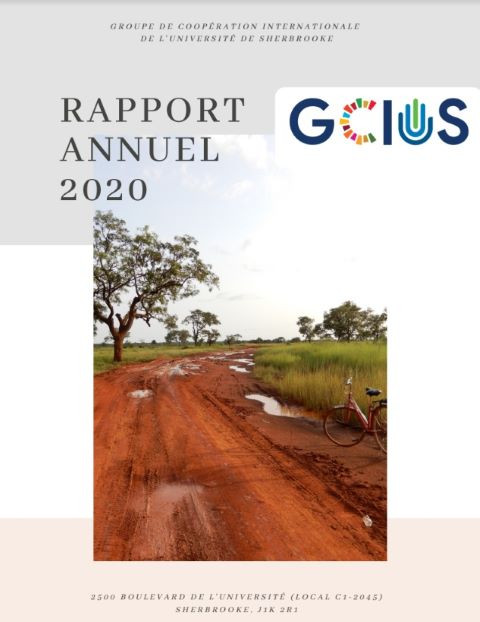 Annual Report 2020 Year of publication: 2020 Corporate author: University of Sherbrooke. International Cooperation Group The GCIUS has set itself the task of encouraging the emergence of sustainable development of local communities in the countries of intervention and UdeS students, through supportive, inclusive, and dynamic networks. The GCIUS supports students and local communities in the co-construction of multidisciplinary sustainable development projects aimed at improving living conditions for communities in need. Rapport annuel 2020 Year of publication: 2020 Corporate author: Université de Sherbrooke. Groupe de Coopération Internationale Le GCIUS s'est donné pour mission de favoriser l'émergence d'initiatives de développement durable des communautés locales dans les pays d'intervention et des étudiant.e.s de l'UdeS, via des réseaux solidaires, inclusifs et dynamiques. Le GCIUS appuie les étudiant.e.s et les communautés locales dans la coconstruction de projets multidisciplinaires de développement durable visant l'amélioration des conditions d'existence auprès des communautés dans le besoin.