
Resources
Explore a wide range of valuable resources on GCED to deepen your understanding and enhance your research, advocacy, teaching, and learning.
3,790 Results found
 Studying the Holocaust Through Film and Literature: Human Rights and Social Responsibility Through film and literature, this book shows students the moral and ethical lessons that have evolved from the Holocaust so they can connect them with the moral dilemmas they face in their own lives. The authors focus on 3 main lessons of the Holocaust ‒ thou shalt not be a victim, thou shalt not be a perpetrator and thou shalt not be a bystander ‒ and address the issues of courage, compassion, character and civility. (By the author)
  Toolkit on the Holocaust and Human Rights Education in the EU Responding to a practical need expressed by teachers and students with a view toward examining the connections between Holocaust and Human Rights Education, the Fundamental Rights Agency (FRA) and Yad Vashem have developed this Toolkit to provide first insights into Holocaust and Human Rights Education content and methodologies, which can be used for teaching about and from the Holocaust and human rights. The Toolkit is a practical guide for teachers and educators who wish to develop teaching projects, by linking Holocaust and human rights. In addition, some examples of teaching projects and learning activities of Holocaust Education and Human Rights Education are provided in the Toolkit.
  Discover the past for the future: The role of historical sites and museums in Holocaust education and human rights education in the EU The Holocaust has rightfully become an integral part of the collective cultural memory of Europe and the world. This report outlines the findings of the first EU-wide research on the role of Holocaust-related sites and exhibitions in educating young Europeans about the Holocaust and human rights. With this research, the European Union Agency for Fundamental Rights (FRA) brings the two fields of Holocaust education and human rights education together and suggests how the merging of the two could develop into a new knowledge of past and present. The report highlights that attempts to expand knowledge of human rights and to establish links between Holocaust education and human rights education need a broader focus than the memorial sites or museums can offer. Much of the work on linking Holocaust education and human rights education needs to be accomplished in schools. This requires teachers to have opportunities to gain a better understanding of human rights education, and human rights education to be better integrated into school curricula in the EU. Visits to memorial sites and museums can stimulate, support and supplement such work. (By the publisher) ‘We saw inhumanity close up’. What is gained by school students from Scotland visiting Auschwitz? As the education for citizenship agenda continues to make an impact on schools in the UK, and with the Holocaust Educational Trust (HET) in conjunction with the Scottish Government introducing its Lessons From Auschwitz (LFA) project for students and teachers in Scotland, this article focuses on the Scottish context and investigates the school processes by which students are chosen to participate in the LFA project, the impact the LFA project has on student personal growth, and the range of follow‐up activities in their schools and communities. The methodology employed online questionnaires and face‐to‐face interviews, which were designed to ascertain student perceptions of the LFA project and the impact that this project had on student participants, their schools, and their communities. Findings demonstrate that the student cohort were highly academic students who took their responsibilities on return to their schools very seriously and organized a wide range of events, both in their schools and in their communities. There was clear evidence that the LFA project had led to extra teaching and awareness of the Holocaust, racism and human rights; and that students’ citizenship values had been enhanced. (By the publisher) The Holocaust and Education for Citizenship: the teaching of history, religion and human rights in England The importance of the Holocaust is undeniable. It seems that this truism has long been accepted by teachers and education policy makers. A superficial prediction would be that the Holocaust will continue to have both a high profile and a high status in the schools and colleges of England and Wales. However, on the basis of small‐scale work using data from teachers’ perceptions, we draw attention to certain problems in learning about the Holocaust and begin to suggest issues which should be investigated further. The issues which need further investigation are related to the possibilities that there may be too little time devoted to teaching about the Holocaust; the events of the Holocaust may sometimes be used as a mere context for understanding World War Two; teachers may not perceive the Holocaust as being significantly unique; teachers may not collaborate effectively; there may be a lack of clarity about the nature of the affective and cognitive aims of such work. (By the author)
  Global Monitoring of Target 4.7: Themes in National Curriculum Frameworks; Background Paper Prepared for the 2016 Global Education Monitoring Report Year of publication: 2016 Corporate author: UNESCO International Bureau of Education (IBE) This study is an initial attempt to monitor ESD and GCED content in curricula globally. The goal here is to analyse national curriculum documents to reveal if, how, and to what extent ESD and GCED content is present across the globe. For this purpose, the research team developed a coding scheme based on key ESD and GCED knowledge, skills, behaviours and pedagogies that was used in evaluating the various national curriculum documents for evidence of ESD and GCED content. In this paper, we present the study in the following order. Further explanation of ESD and GCED, and a discussion of issues relating to their implementation and monitoring will come first. Then we will review similar studies that have also attempted to monitor GCED and ESD through content analysis. The study’s methods and findings will then be presented, followed by a discussion of the challenges addressed in developing a coding system to monitor curricula effectively. Finally, we share a series of recommendations that will focus on ways for moving forward in monitoring GCED and ESD effectively, both at a curricular level and beyond.
  The Comprehensive Learning Diagnosis: Chile’s approach to assess socio-emotional learning in schools Year of publication: 2023 Author: José Weinstein | Juan Bravo Corporate author: Center for Universal Education at Brookings Education in Chile has important challenges of quality, equity, and social integration. For decades, policies tried to respond to these concerns with a high-stakes accountability institutional framework, which has not had success. The underlying vision of educational quality was limited. The assessment system in place privileged cognitive and academic dimensions of educational results. Socio-emotional learning had been neglected or considered secondary, without an infrastructure of assessment tools that allowed teachers and principals to diagnosis students’ situations and monitor their progress. The COVID-19 crisis was an opportunity for change: Students’ socioemotional needs were a main concern for schools and society, and the regular accountability system based on standardized tests was interrupted. Subsequently, the Comprehensive Learning Diagnosis (DIA) was launched by the Education Quality Agency. The DIA is a voluntary assessment tool made available to all Chilean schools. The DIA promotes the comprehensive development of students, providing timely information and guidance to internally monitor students’ learning in the academic and socio-emotional domains at several points during the school year. Specifically, with respect to socio-emotional learning, three areas were considered: personal, community, and citizenship. In each of these areas, a set of socioemotional skills were defined, operationalized, and became possible to monitor by school communities. The DIA also collects students’ opinions of school management practices regarding socio-emotional skills. The DIA has received a wide acceptance in school communities. Despite being voluntary, an ample majority of schools decided to participate. The information collected from the DIA allows for practical use by principals and teachers. Moreover, the DIA provides the opportunity for students to inform school management. The new Chilean government has decided to strengthen DIA as an important component in a four-year national plan for reactivating academic and socio-emotional learning in schools. The previous high-stakes accountability system, which involved external assessments, has been suspended and is under discussion. The DIA experience has shown that critical social and educational situations can provide fertile ground to motivate deep and rapid transformation, if an educational actor (in this case the Education Quality Agency) is capable of enacting a pertinent, timely, and practical response to school needs. The DIA is not only an example of productive uses of students´ assessment by schools, but also a demonstration that it is possible to build an institutional arrangement among local, intermediate, and national levels of school systems, where a vertical hierarchy is changed by a collaborative relationship based on local agency, mutual trust, and differentiated technical contributions.
 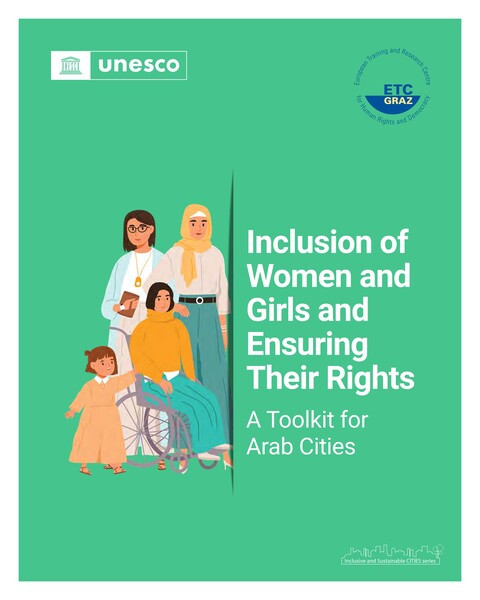 Inclusion of Women and Girls and Ensuring Their Rights: A Toolkit for Arab Cities Year of publication: 2023 Corporate author: UNESCO Cairo | European Training and Research Centre for Human Rights and Democracy (Austria) Even though women and girls represent close to or more than half of the population of most Arab cities, they are one of the groups that are historically and structurally excluded from decision-making and development planning in the cities. They face many barriers in accessing cities services, and inequality participating in cities activities. Developed on the basis of a virtual regional consultation workshop, as well as in-depth interviews with cities officials and representatives from the Coalition of Arab Cities against Racism, Discrimination, Xenophobia and Intolerance, this Toolkit provides tools and practical advice to enable Arab cities achieve a better inclusion of women and girls, and ensure their full right to benefit from local development programs. The toolkit mainly targets local authorities in Arab cities including Mayors, Members of Municipality Councils, Municipal executives, and Entities concerned with the design, implementation, follow-up, and evaluation of local projects and programs. “Since wars begin in the minds of men andwomen it is in the minds of men and womenthat the defences of peace must be constructed”Inclusion of women and girls in Arab cities: challenge or opportunity?This publication is the result of a joint effort involving the European Training and Research Centre for Human Rights and Democracy in Graz, UNESCO Coalition of Arab Cities against Racism, Discrimination, Xenophobia and Intolerance, and UNESCO Cairo Office. إدماج وضمان حقوق النساء والفتيات: دليل المدن العربية Year of publication: 2023 Corporate author: UNESCO Cairo | European Training and Research Centre for Human Rights and Democracy (Austria) إدماج النساء والفتيات في المدن العربية، تح ٍد أم فرصة؟يشكل إدماج النساء والفتيات عنصرا محوريا في مسألة الإدماج الحضري. فعلى الرغم من أن النساء والفتياتي مثلن ما يقرب من أو يزيد عن نصف السكان في أغلب المدن العربية، فإنهن من أكثرالفئات المستبعدة تاريخيا وهيكلًيا من عملية صنع القرار والتخطيط الإنمائي في المدن العربية. ويواجهن العديد من العوائقل لاستفادة من خدمات المدن ويعانين من عدم المساواة فيفرص المشاركة في أنشطتها.كان إعداد هذا الدليل على أساس ورشة عمل استشارية إقليمية افتراضية، بالإضافة إلى مقابلات متعمقة مع مسؤولي المدن وممثلي تحالف المدن العربية ضد العنصرية والتمييز وكراهية الأجانب والتعصب. ويوفر الدليل أدوات ونصائح عملية لتمكين المدن العربية من تحقيق إدماج النساء والفتيات بشكل أفضل، وضمان حقهن الكامل في الاستفادة من برامج التنمية المحلية.يستهدف هذا الدليل بشكل أساسي السلطات المحلية في المدن العربية بما في ذلك رؤساء البلديات وأعضاء المجالس البلدية والمديرين التنفيذيين في البلديات والهيئات المعنية بتصميم المشاريع والبرامج المحلية وتنفيذها ومتابعتها وتقييمها.يأتي هذا المنشور نتيجة جهد مشترك ساهم فيه كل من المركز الأوروبي للتدريب والبحوث لحقوق الإنسان والديمقراطية في جراتس، وتحالف اليونسكو للمدن العربية ضد العنصرية والتمييز وكراهية الأجانب والتعصب، ومكتب اليونسكو بالقاهرة.
  Отчёт по результатам картирования организаций гражданского общества республики Таджикистан, работающих в сферах доступа к правосудию, расширения прав и возможностей женщин и продвижения прав и возможностей лиц с инвалидностью Year of publication: 2022 Corporate author: Бюро по правам человека и соблюдению законности Картирование проведено общественной организацией «Бюро по правам человека и соблюдению законности» в рамках проекта ПРООН «Укрепление верховенства закона и прав человека с целью обеспечения возможностей для реализации прав людей в Таджикистане», финансируемого Правительством Финляндии, с целью определения ОГО, работающих в сфере продвижения прав человека, расширения прав и возможностей женщин и вопросов инвалидности», осуществленного при поддержке ПРООН в Таджикистане с целью определения ОГО, работающих в данных сферах, для доступа заинтересованных лиц и организаций к информации о деятельности данных организаций и их контактам, а также для дальнейшего повышения их потенциала.