
Resources
Explore a wide range of valuable resources on GCED to deepen your understanding and enhance your research, advocacy, teaching, and learning.
3,790 Results found
 Cultura de Paz y educación para la ciudadanía democrática Year of publication: 2006 Author: Jose Tuvilla Rayo La Cultura de Paz entendida como el concepto síntesis --suma de derechos humanos, democracia, desarme y desarrollo humano sostenible--, demanda, como respuesta humanizadora de la globalización, importantes esfuerzos de los sistemas educativos hacia la consecución de cuatro contratos sociales mundiales (Grupo de Lisboa, 1995): el contrato de las necesidades básicas destinado a suprimir las desigualdades, el contrato cultural destinado a promover la tolerancia y el diálogo entre culturas, el contrato de la democracia encaminado hacia un sistema de gobierno mundial; y, el contrato de la Tierra para promover un desarrollo humano estable y duradero. Para ello – recordando a Juan Carlos Tedesco (2001) – aprender a vivir juntos, uno de los pilares de la educación del siglo XXI, no puede ser mantenido en el terreno exclusivo de la adhesión meramente retórica.
 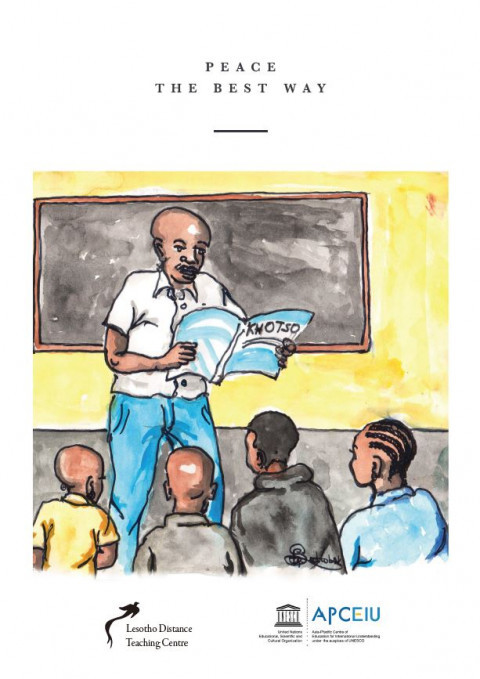 Peace the Best Way Year of publication: 2017 Corporate author: Lesotho Distance Teaching Centre (LDTC) The storybook titled “Peace, the Best Way (Ngoan’a Khotso Ha a Lebale Tsa Khotso)” is an end-product of Workshop in Lesotho on GCED: Teacher Training on Peace Education & GCED Learning Material Development held between 12 and 14 of July 2017. During the workshop, participants created learning materials on peace and conflict transformation based on what they have learned throughout the sessions.The authors share their stories of conflicts that they encounter in their everyday lives and further identify ways of managing and resolving the conflicts in a peaceful manner to let everyone live in harmony. They hope to instill the importance of peace not only to the adults reading the book, but also to the younger generation who learn from their parents and adults of the community.The book published in English as well as Sesotho, will be used as teaching and learning resources for learners and also be disseminated to public locations including schools, community centers and libraries.For more information on the Workshop, Please click here.
  Nuestra diversidad creativa: informe de la comisión mundial de cultura y desarrollo, versión resumida Year of publication: 1996 Corporate author: World Commission on Culture and Development This report is designed to address a diversified audience across the world that ranges from community activists, field workers, artists and scholars to government officials and politicians. We want it to inform the world’s opinion leaders and to guide its policy-makers. We want it to capture the attention of the world’s intellectual and artistic communities, as well as the general public. We aim to have shown them how culture shapes all our thinking, imagining and behaviour. It is the transmission of behaviour as well as a dynamic source for change, creativity, freedom and the awakening of innovative opportunities. For groups and societies, culture is energy, inspiration and empowerment, as well as the knowledge and acknowledgment of diversity: if cultural diversity is ‘behind us, around us and before us”, as Claude L&i-Strauss put it, we must learn how to let it lead not to the clash of cultures, but to their fruitful coexistence and to intercultural harmony. Just as in the tasks of building peace and consolidating democratic values, an indivisible set of goals, so too economic and political rights cannot be realized separately from social and cultural rights. The challenge to humanity is to adopt new ways of thinking, new ways of acting, new ways of organizing itself in society, in short, new ways of living. The challenge is also to promote different paths of development, informed by a recognition of how cultural factors shape the way in which societies conceive their own futures and choose the means to attain these futures. I have for some time been concerned with the “culture of peace”. There is now considerable evidence that neglect of human development has been one of the principal causes of wars and internal armed conflicts, and that these, in turn, retard human development. With government complicity and with the intention of raising export receipts, private businesses continue to sell advanced military technology, nuclear materials and equipment for the production of bacteriological and chemical warfare. The concept of state sovereignty which still prevails today has increasingly come under scrutiny. In the area of peace-keeping, the distinction between external aggression and internal oppression is often unrealistic. The predominant threat to stability are violent conflicts within countries and not between them. There is an urgent need to strengthen international human rights law. Many of the most serious troubles come from within states – either because of ethnic strife or repressive measures by governments. Conditions that lead to tyranny and large-scale violations of human rights at home sooner or later are likely to spill over into a search for enemies abroad. The temptation of repressive states to export internal difficulties is great. Consider the Soviet Union’s invasion of Hungary and Czechoslovakia after it had used domestic oppression and the persistent refusal - for many years - of the previous South African governments to grant independence to Namibia. An ounce of prevention is better than a ton of punishment. اجتماع دولي للخبراء: تعزيز الحوار بين الثقافات في الدول العربية؛ تقرير Year of publication: 2012 Corporate author: UNESCO Beirut Within the framework of the project “Fostering a Culture of Peace and Dialogue” an international meeting of experts on Fostering a Culture of Intercultural Dialogue in the Arab States took place in Beirut, Lebanon on 6 and 7 March 2012 at the Holiday Inn Hotel in Verdun. The meeting was organized by UNESCO Beirut Office in partnership with the Government of Saudi Arabia and the King Abdulaziz Center of National Dialogue and in collaboration with the Arab Thought Foundation. The 2 days event was a landmark meeting of 35 experts and professionals from more than 11 countries, representing a wide range of fields in conflict resolution, research and education, media and journalism. The meeting is the first activity of a series of regional activities and interventions to be organized within the framework of the UNESCO project “Fostering a Culture of Peace and Dialogue”.
  UNESCO international meeting of experts: fostering a culture of intercultural dialogue in the Arab States; report Year of publication: 2012 Corporate author: UNESCO Beirut Within the framework of the project “Fostering a Culture of Peace and Dialogue” an international meeting of experts on Fostering a Culture of Intercultural Dialogue in the Arab States took place in Beirut, Lebanon on 6 and 7 March 2012 at the Holiday Inn Hotel in Verdun. The meeting was organized by UNESCO Beirut Office in partnership with the Government of Saudi Arabia and the King Abdulaziz Center of National Dialogue and in collaboration with the Arab Thought Foundation. The 2 days event was a landmark meeting of 35 experts and professionals from more than 11 countries, representing a wide range of fields in conflict resolution, research and education, media and journalism. The meeting is the first activity of a series of regional activities and interventions to be organized within the framework of the UNESCO project “Fostering a Culture of Peace and Dialogue”. Réunion internationale d'experts de l'UNESCO: la promotion d'une culture du dialogue interculturel dans les États Arabes; rapport Year of publication: 2012 Corporate author: UNESCO Beirut Dans le cadre du projet «Promotion d'une culture de la paix et le dialogue » une réunion internationale d'experts sur la promotion d'une culture du dialogue interculturel dans les Etats arabes a eu lieu à Beyrouth, au Liban les 6 et 7 Mars 2012 à l'Hôtel Holiday Inn à Verdun . La réunion a été organisée par le Bureau UNESCO à Beyrouth en partenariat avec le gouvernement de l'Arabie saoudite et les Abdulaziz Centre roi de dialogue national et en collaboration avec la Fondation de la pensée arabe. L'événement de 2 jours a été une réunion historique de 35 experts et professionnels de plus de 11 pays, représentant un large éventail de domaines dans la résolution des conflits, la recherche et l'éducation, les médias et le journalisme. La réunion est la première activité d'une série d'activités et d'interventions régionales qui seront organisées dans le cadre du projet de l'UNESCO «Promotion d'une culture de la paix et le dialogue ».
  ПОЛОЖЕНИЕ С ПРАВАМИ ЧЕЛОВЕКА В МИРЕ АПРЕЛЬ 2024 Year of publication: 2024 Corporate author: Amnesty International Le Rapport d’Amnesty International décrit la situation des droits humains dans le monde en 2023 dans 155 pays différents. Les équipes de journalistes et d’enquêteurs de l'ONG peignent un portrait plutôt sombre, avec notamment un recul du droit des femmes, les conséquences dramatiques du réchauffement climatique sur les populations les plus vulnérables, le recul du droit de manifester, ou encore la prolifération de la haine en ligne dans le monde. La multiplication des conflits armés et le choc du 7 octobre ont également eu des conséquences dramatiques. Cependant, quelques bonnes nouvelles sont aussi à noter, avec des avancées pour les droits des personnes LGBTI par exemple. Amnesty International Report describes the human rights situation worldwide in 2023 in 155 different countries. TheNGO's teams of journalists and investigators paint a rather gloomy picture, with, in particular, a decline in women's rights, the dramatic consequences of global warming on the most vulnerable populations, a decline in the right to protest, and the proliferation of online hate around the world. The multiplication of armed conflicts and the shock of October 7 have also had dramatic consequences. However, there is some good news too, with advances in LGBTI rights for example. The State of the World’s Human Rights: April 2024 Year of publication: 2024 Corporate author: Amnesty International Le Rapport d’Amnesty International décrit la situation des droits humains dans le monde en 2023 dans 155 pays différents. Les équipes de journalistes et d’enquêteurs de l'ONG peignent un portrait plutôt sombre, avec notamment un recul du droit des femmes, les conséquences dramatiques du réchauffement climatique sur les populations les plus vulnérables, le recul du droit de manifester, ou encore la prolifération de la haine en ligne dans le monde. La multiplication des conflits armés et le choc du 7 octobre ont également eu des conséquences dramatiques. Cependant, quelques bonnes nouvelles sont aussi à noter, avec des avancées pour les droits des personnes LGBTI par exemple. Amnesty International Report describes the human rights situation worldwide in 2023 in 155 different countries. TheNGO's teams of journalists and investigators paint a rather gloomy picture, with, in particular, a decline in women's rights, the dramatic consequences of global warming on the most vulnerable populations, a decline in the right to protest, and the proliferation of online hate around the world. The multiplication of armed conflicts and the shock of October 7 have also had dramatic consequences. However, there is some good news too, with advances in LGBTI rights for example.
 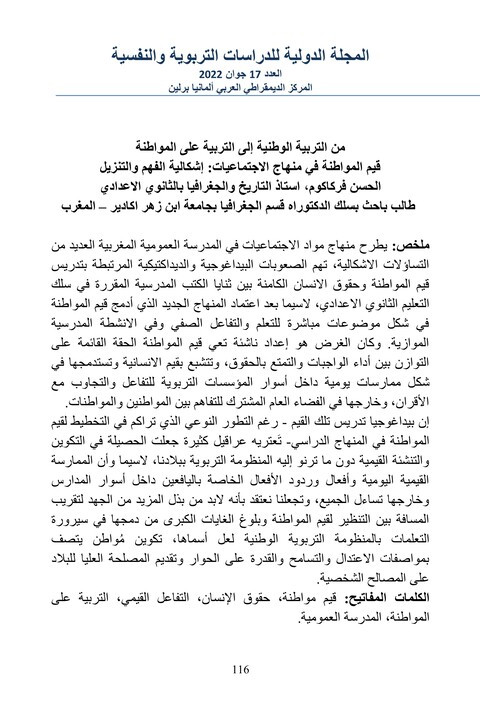 From Civic Education to Citizenship Education: Citizenship Values in the Geography Curriculum; The Problem of Understanding and Downloading (International Journal of Educational and Psychological Studies; vol. 6, no. 17) Year of publication: 2022 Author: Al-Hassan Farkakoum Corporate author: Democratic Arab Center This paper aims to contribute to revealing the extent to which the values of citizenship and human rights are present in the social studies lesson in Moroccan public schools, specifically in the middle school education curriculum. The inclusion of human rights values at this level raises several problems that lead to two complementary trends: The first is related to the didactics of human rights and citizenship education, and the second trend is related to the extent of the learner’s ability to acquire and represent the values of citizenship and transform them into automatic daily behaviors and practices in the school environment and then after that in daily public life and private transactions. من التربية الوطنية إلى التربية على المواطنة قيم المواطنة في منهاج الاجتماعيات: إشكالية الفهم والتنزيل (مجلة الدراسات التربوية والنفسية ;no.17, vol.6) Year of publication: 2022 Author: Al-Hassan Farkakoum Corporate author: Democratic Arab Center تهدف هذه الورقة الإسهام في كشف مدى حضور قيم المواطنة وحقوق اإلنسان في درس الاجتماعيات بالمدرسة العمومية المغربية، وتحديدا في منهاج التعليم الثانوي الإعدادي. إن إدراج قيم حقوق اإلنسان في هذا المستوى يطرح عدة إشكالات تصب في منحيين يكمل بعضهما البعض، الأول مرتبط بديداكتيك مادة حقوق اإلنسان والتربية على المواطنة، والمنحى الثاني له عالقة بمدى قدرة المتعلم على اكتساب قيم المواطنة وتمثلها وتحويلها إلى سلوكات وممارسات تلقائية يومية في الوسط المدرسي ثم بعد ذلك في الحياة العامة اليومية والمعاملات الخاصة.