
Resources
Explore a wide range of valuable resources on GCED to deepen your understanding and enhance your research, advocacy, teaching, and learning.
518 Results found
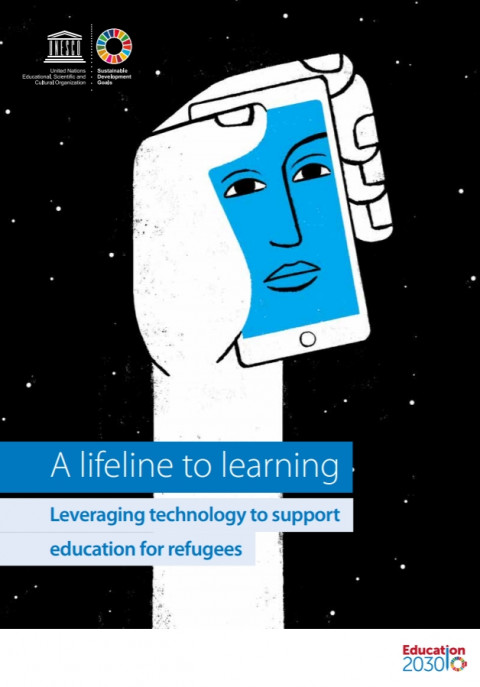 A Lifeline to Learning: Leveraging Mobile Technology to Support Education for Refugees Year of publication: 2018 Corporate author: UNESCO This publication examines the evidence base for key assumptions on using mobile technology to address individual refugees’ learning challenges, broader education system challenges, and challenges to providing refugees with specific levels and types of education. The report presents findings from a review of 117 relevant papers and reports, and lessons drawn from the implementation of 52 projects that use mobile learning for refugees and the actual use of 35 digital apps or platforms. While acknowledging a limited reach, the report identifies effective mobile solutions and organizational strategies that should be scaled up.
  Inclusive Education for Persons with Disabilities - Are We Making Progress? Year of publication: 2019 Corporate author: UNESCO | Leonard Cheshire (UK) The paper ‘Inclusive education for persons with disabilities – Are we making progress?’ has been developed as a background paper for the UNESCO International Forum on inclusion and equity in education – Every learner matters, being held in Cali, Colombia from 11-13 September 2019. The Forum is being organised in commemoration of the 25th anniversary of the passing of the Salamanca Statement and Framework for Action. The paper will explore the global progress towards inclusive education, the successes achieved and learnings observed specifically in countries of the global South. In these countries the concerns of universal access to and retention in education is still a concern for many governments, but large-scale exclusion of children with disabilities (an estimated 32 million or 1 out of 3 are out of school) remains the order of the day and is not always high on government agendas. Educación inclusiva para personas con discapacidades - ¿estamos logrando avances? Year of publication: 2019 Corporate author: Organización de las Naciones Unidas para la Educación, la Ciencia y la Cultura (UNESCO) | Leonard Cheshire (UK) El informe «Educación inclusiva para personas con discapacidades: ¿estamos logrando avances?» ha sido elaborado como documento de referencia para el Foro Internacional sobre Inclusión y Equidad en la Educación UNESCO «Todas y todos los estudiantes cuentan», que se celebrará en Cali (Colombia) del 11 al 13 de septiembre de 2019. El Foro ha sido organizado para conmemorar el 25 aniversario de la aprobación de la Declaración de Salamanca y Marco de Acción sobre Necesidades Educativas Especiales. En este informe se explora el avance mundial hacia la educación inclusiva, los éxitos logrados y las conclusiones observadas específicamente en países del hemisferio sur, donde los problemas en torno al acceso universal a la educación y la continuidad en ella siguen siendo motivo de preocupación para numerosos gobiernos y donde la exclusión a gran escala de niños con discapacidad (se estima que unos 32 millones de niños no están escolarizados, lo que supone 1 de cada 3) sigue estando a la orden del día y no siempre es una prioridad en los programas gubernamentales.
 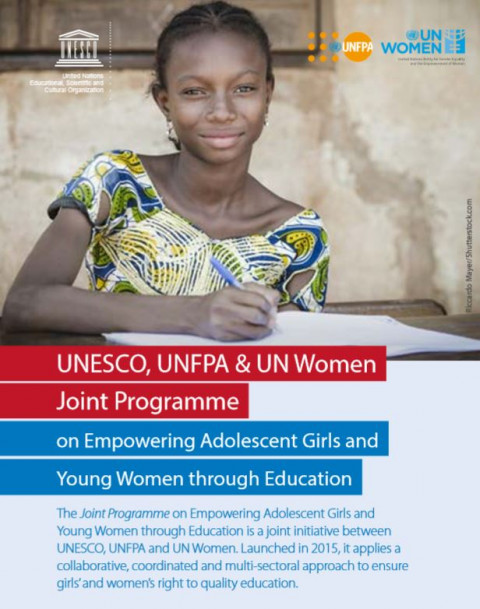 UNESCO, UNFPA & UN Women Joint Programme: on Empowering Adolescent Girls and Young Women through Education Year of publication: 2019 Corporate author: UNESCO | United Nations Population Fund (UNFPA) The Joint Programme on Empowering Adolescent Girls and Young Women through Education leverages the collective expertise, experience and networks of three United Nations agencies – UNESCO, UNFPA and UN Women.It aims to empower adolescent girls and young women aged 10 to 24 to make successful and healthy transitions into adulthood, in and through quality education.Taking a lifecycle perspective and a holistic approach, the Joint Programme strengthens the links between education, health and gender equality.
 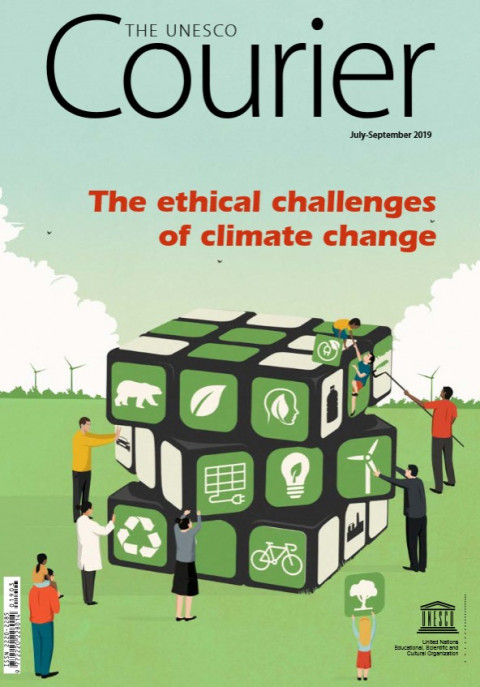 Cambio climático y desafíos éticos (El Correo de la UNESCO 3, July-September 2019) Year of publication: 2019 Corporate author: UNESCO El cambio climático no solo pone en peligro nuestros ecosistemas; también quebranta los cimientos de nuestros derechos fundamentales, agrava la desigualdad y genera nuevas injusticias. La adaptación al cambio climático y la atenuación de sus efectos no es únicamente un asunto de conocimientos científicos y voluntad política, sino que exige además una perspectiva amplia sobre una situación compleja. Con el fin de ayudar a los Estados y demás entidades pertinentes en la toma de las decisiones apropiadas y la ejecución de políticas eficaces en materia de desarrollo sostenible, adaptación al cambio climático y mitigación de sus consecuencias adversas, la UNESCO aprobó en noviembre de 2017 una Declaración de principios éticos en relación con el cambio climático.La ética determina la esencia de todo compromiso. Su capacidad de movilización permite orientar la acción, establecer arbitrajes, decidir entre intereses contradictorios y fijar prioridades. La ética facilita la articulación de la teoría con la práctica, de los principios generales con la voluntad política, y de la toma de conciencia de ámbito mundial con la aplicación de medidas a escala local.
 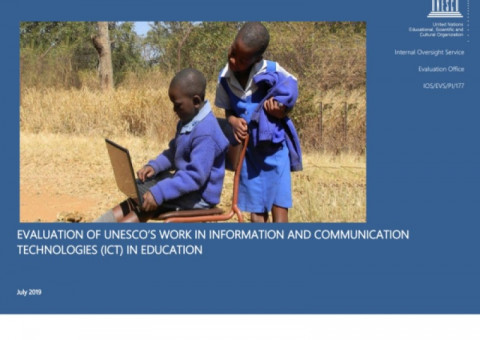 Evaluation of UNESCO's work in information and communication technologies (ICT) in education Year of publication: 2019 Author: Seán Ó Siochru and Graham Attwell Corporate author: UNESCO ICT in Education is a fast-growing area globally that offers many strategic opportunities. As the leader and coordinator of the SDG 4 – Education 2030 with the aim to “Ensure inclusive and equitable quality education and promote lifelong learning opportunities for all”, UNESCO has the mandate and expertise needed to strategically position itself as a world leader in this field. UNESCO’s work in ICT in Education aims at enhancing the quality and relevance of learning and at strengthening inclusion. While technology can facilitate wider access to education and bridge learning divides, can advance gender equality and inclusion as well as digital skills development, the rapidly changing technologies and work processes require the development of new pedagogies, both for the use of ICT for teaching and learning in the classroom and through open access and distance learning. Compared to other players, UNESCO leverages its comparative strengths in its ICT in Education interventions - especially its impartiality, convening power, and policy expertise - through an inclusive and humanistic approach to achieving quality education in coherence with Sustainable Development Agenda 2030. Its expertise across all levels of Education and its multidisciplinary potential of working across its Programme Sectors are also considered among UNESCO’s specific strengths. The evaluation revealed that UNESCO achieved important results, at the level of the learning environment, at the policy level and in institutional capacity building, but it also showed that UNESCO still needs to strengthen its positioning and visibility within the wider landscape of ICT in Education. For example, UNESCO has to continue positioning itself for producing forward-looking knowledge on ICT in Education and as a laboratory of ideas for future-oriented thinking. While the evaluation came across various specific interventions successfully addressing the needs of disadvantaged groups, the evaluation found that considerations of inclusion and gender equality were not consistently mainstreamed into policy-related and capacity building interventions. Other challenges are mainly linked to the current dispersion of resources and fragmentation of expertise across different entities within the Organization, which also leads to reduced visibility. While the key entities active in this area recognize that they are working within a common theme, collaboration and coordination still needs to be improved. The strategic measures proposed by the evaluation towards an overall organizational framework for ICT in Education aim at establishing an enabling environment for inter- and multidisciplinary approaches and greater coherence and collaboration. The ethical challenges of climate change (The UNESCO Courier no. 3, July-September 2019) Year of publication: 2019 Corporate author: UNESCO Climate change not only threatens our ecosystems, it undermines the foundation of our fundamental rights, deepens inequalities and creates new forms of injustice. Adapting to climate change and trying to mitigate its impacts are not just a matter of scientific knowledge and political will; they also demand a broader view of a complex situation. In order to help Member States and other stakeholders to make appropriate decisions and implement effective policies for sustainable development, adaptation to climate change and the mitigation of its negative effects, UNESCO adopted a Declaration of Ethical Principles in relation to Climate Change in November 2017.Ethics constitute the substantial core of any commitment. As a mobilizing force, ethics can steer action, facilitate arbitration, resolve conflicting interests, and establish priorities. Ethics have the capacity to connect theory with practice, general principles with political will, and global awareness with local actions. Défis climatiques, défis éthiques (Le Courrier de l'UNESCO 3, July-September 2019) Year of publication: 2019 Corporate author: UNESCO Le changement climatique ne met pas seulement en péril nos écosystèmes : il ébranle le socle de nos droits fondamentaux, il creuse les inégalités et crée de nouvelles injustices. S’adapter au changement climatique et tenter d’en atténuer les effets n’est pas seulement affaire de connaissance scientifique et de volonté politique; cela implique une vue d’ensemble sur une situation complexe. Afin d’aider les États et les autres acteurs concernés à prendre des décisions appropriées et à mener des politiques efficaces en matière de développement durable, d’adaptation au changement climatique et d’atténuation de ses effets néfastes, l’UNESCO a adopté, en novembre 2017, une Déclaration de principes éthiques en relation avec le changement climatique.L’éthique constitue le cœur substantiel de tout engagement. Grâce à sa force mobilisatrice, elle permet d’orienter l’action, de faire des arbitrages, de trancher entre des intérêts contradictoires, de fixer des priorités. L’éthique permet d’articuler la théorie et la pratique, les principes généraux et la volonté politique, la prise de conscience globale et les actions locales.
 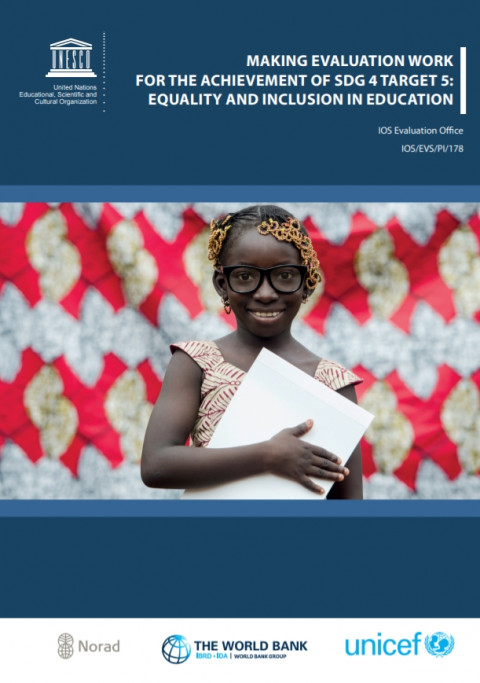 Making evaluation work for the achievement of SDG 4 target 5: equality and inclusion in Education Year of publication: 2019 Corporate author: UNESCO The adoption of the Sustainable Development Goals (SDGs) and the Education 2030 Framework for Action has placed gender parity, equality and inclusion in education at the heart of the international development agenda and is specifically formulated in SDG 4 Target 5. Now, as never before, relevant and contextualised evidence, driven in part by robust evaluation data, is needed to track and strengthen progress on educational equity. To this end, a group of international organisations, led by UNESCO, have combined efforts to explore how their education evaluations can better support Member States to strengthen progress on gender parity, equality and inclusion in education. The following report synthesises evidence from publicly available independent evaluations from 13 organisations, highlighting evidence gaps and summarising ‘what works’ for whom and in what contexts for advancing gender equality and equity for vulnerable groups. The study also reports on responses to the synthesis from national stakeholders in five countries: Ghana, Guatemala, Lebanon, Nepal and Peru. The report culminates in a discussion and recommendations, which outline the need for greater coordination and collaboration in four key areas to further enhance the contribution of evaluations to global and country level progress on SDG 4 Target 5.
 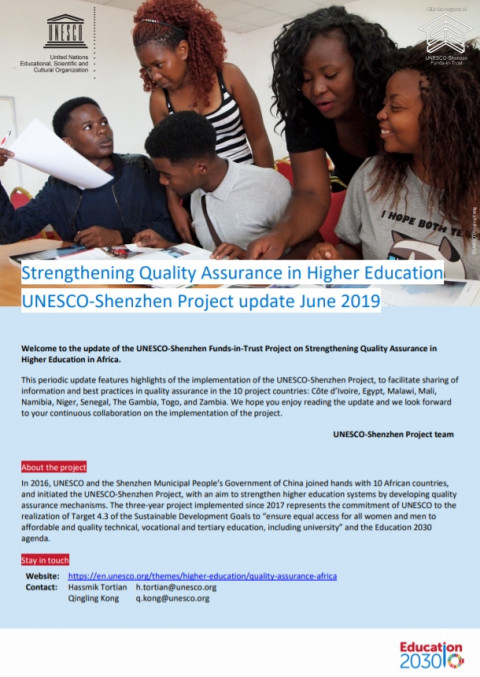 Strengthening Quality Assurance in Higher Education UNESCO-Shenzhen Project Update, June 2019 Year of publication: 2019 Corporate author: UNESCO In 2016, UNESCO and the Shenzhen Municipal People’s Government of China joined hands with 10 African countries, and initiated the UNESCO-Shenzhen Project, with an aim to strengthen higher education systems by developing quality assurance mechanisms. The three-year project implemented since 2017 represents the commitment of UNESCO to the realization of Target 4.3 of the Sustainable Development Goals to “ensure equal access for all women and men to affordable and quality technical, vocational and tertiary education, including university” and the Education 2030 agenda.