
Resources
Explore a wide range of valuable resources on GCED to deepen your understanding and enhance your research, advocacy, teaching, and learning.
1,187 Results found
 Transitions from School to Work: UNICEF Technical Note Year of publication: 2019 Corporate author: United Nations Children's Fund (UNICEF) This report provides guidance on ways that UNICEF can support governments and partners to help adolescents to make a smooth transition from school to decent work. To prepare them for life, work, citizenship and life-long learning, UNICEF encourages governments and partners to expand access to learning and skills development for all children and adolescents – from pre-primary to upper-secondary age, and particularly for the most marginalized. UNICEF further advocates strengthening systems to enable them to develop a breadth of skills across the life course and through multiple learning pathways, such as formal, non-formal, on the job and community based.
  Every Child Learns: UNICEF Education Strategy 2019–2030 Year of publication: 2019 Corporate author: United Nations Children's Fund (UNICEF) The gap between the levels of learning that education systems are providing and what children, communities and economies need, is growing. The breadth and depth of this learning crisis constitute the greatest global challenge to preparing children and adolescents for life, work and active citizenship. The lesson of the learning crisis is clear: the conventional assembly of education inputs is not improving learning outcomes. This presents a fundamental challenge to the way that governments, development partners and communities are managing and supporting education systems. A new, more radical approach that focusses on enhancing learning outcomes is long overdue and forms the basis for this strategy.The report also outlines the shift towards a greater focus on improving learning outcomes, including supporting the breadth of skills that allow young people to become agile, adaptive learners and citizens, equipped to navigate personal, social, academic, economic and environmental challenges.
  A School of Cosmopolitanism: Experiences with Global Citizenship Education in Classroom Practice Year of publication: 2019 Author: Heidi Grobbauer | Werner Wintersteiner Corporate author: Austrian Commission for UNESCO This publication focuses on examples from academic practice: this best practice collection demonstrates how young people can successfully be inspired to “think globally, act locally”. What is crucial is maintaining a view of the wider world; in particular, cooperation efforts with educational institutes outside of Europe (e.g. “élèves pour élèves” in Burkina Faso) provide a critical awareness of global connections. Learning to know/Learning to do/Learning to be/Learning to live together – these four pillars form the pedagogical foundation of the work carried out at more than 90 UNESCO schools throughout the whole of Austria. Since their founding in 1957, UNESCO schools have been considered model schools at which lessons are structured in a project-oriented, participative and even topic-specifc way. The unique ‘spirit’ of UNESCO schools often makes special projects possible. In the programme for the annual meetings of recent years, for example, Global Citizenship Education has been an ongoing topic of focus, accompanied by experts from various specialised institutions and NGOs. The pedagogical preparation of contents in a manner that ensures they are actually absorbed in the classroom presents a major challenge. Different types of schools have different educational goals, and the themes have to be made accessible for different age groups. The pedagogical finesse of each class team or individual teacher lies in finding the most motivating approaches.
  Critical Global Semiotics: Understanding Sustainable Transformational Citizenship Year of publication: 2019 Author: Maureen Eills Critical Global Semiotics: Understanding Sustainable Transformational Citizenship incorporates powerful unifying frameworks which make explicit a developing global consciousness. It explores transdisciplinary ‘common wealth’ through focus on multimodality, media, and metaphor, testing two universally applicable humanitarian frameworks: critical realism (CR) and systemic functional semiotics (SFS).Every day global citizens encounter an overwhelming host of genres and sub-genres, emergent semantic triangles, evolving semiotic trinity. Embodying philosophy, incorporating active engagement, this book addresses the political economy and cultural politics of diverse domains.Challenging daily drama and performative dharma, 24 analysts from 13 countries present current issues in Anthropology, Architecture, Dance, Feminism, Film, Health, Law, Management, Medicine, Music, Politics, Pharmaceuticals, Sociology, Sustainability Education, and Urban Development.The book’s integrative, unifying foundations will be of interest to researchers, academics, and post-graduate students in the fields of linguistics, semiotics, and critical realist philosophy, as well as to policy makers, curriculum developers, and civil society.
 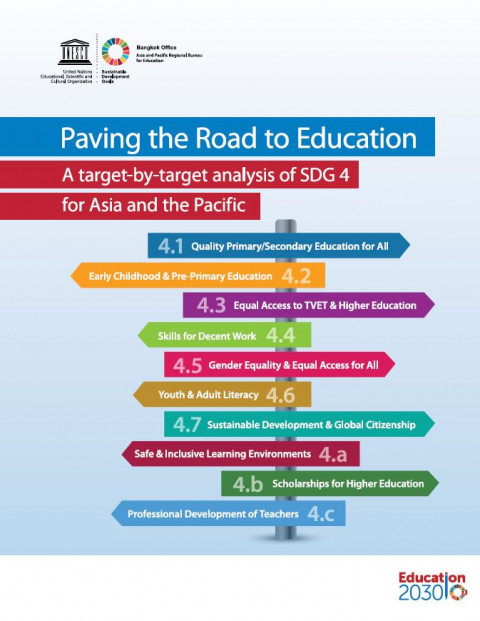 Paving the Road to Education: A Target-by-Target Analysis of SDG 4 for Asia and the Pacific Year of publication: 2018 Corporate author: UNESCO Bangkok The globally adopted development agenda “Transforming our World: the 2030 Agenda for Sustainable Development” has established ambitious intentions that build on the past Millennium Development Goals but also expand on their achievements.The Sustainable Development Goal 4 on education propels forward the vision of ensuring inclusive and equitable quality education and to promote lifelong learning opportunities for all through a holistic, aspirational and systematic education agenda. Education monitoring is an integral part in this process.This publication delivers a data-rich snapshot of Sustainable Development Goal 4, its targets and their monitoring indicators while analyzing available data through a lens of inequality.Assessing the progress which countries have made in the recent past as well as where countries currently stand, this publication sets a baseline against which Member States from Asia and the Pacic are able to monitor progress in achieving the Goal 4 over time but at latest by 2030.Finally, after discussing emerging opportunities and remaining challenges in the region, this publication seeks to assist Member States in identifying what steps can be taken to ensure that the region will achieve the new education agenda.
 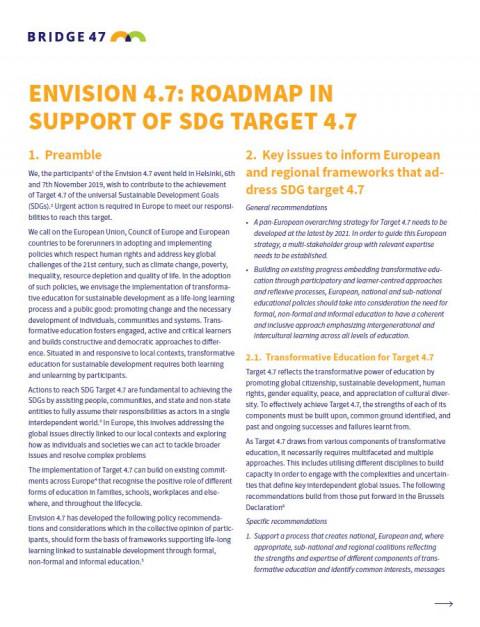 ENVISION 4.7: ROADMAP IN SUPPORT OF SDG TARGET 4.7 Year of publication: 2019 Corporate author: Bridge 47 In November 2019, 200 policy makers, civil society members and researchers from all over the world got together in Helsinki to make a roadmap for the future implementation of SDG Target 4.7 in Europe. The participants of the Envision 4.7 event held in Helsinki, 6th and 7th November 2019, made this document to contribute to the achievement of Target 4.7 of the universal Sustainable Development Goals (SDGs). This document was shaped and influenced by the expertise and insight of everyone who came to the conference. Bridge 47 is calling on this collective knowledge and community of experts to continue moving these recommendations forward as we all aim to achieve SDG Target 4.7 and use transformative education as a mechanism for achieving all of the Sustainable Development Goals.
 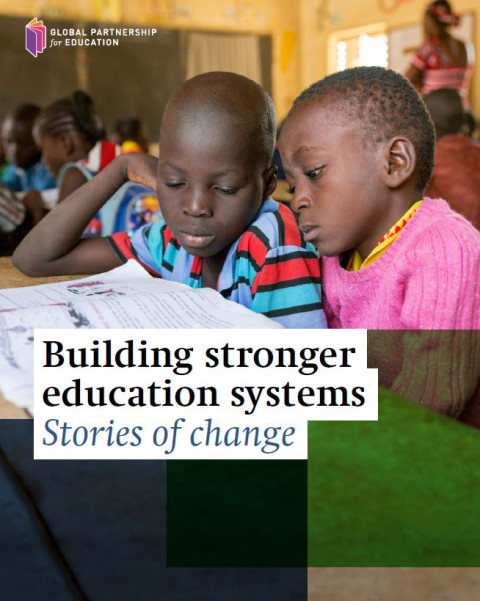 Building Stronger Education Systems: Stories of Change Year of publication: 2019 Corporate author: The Global Partnership for Education (GPE) A compilation of results stories which show the progress that GPE's developing country partners are making in getting more children, especially girls, in school and learning. The brochure includes stories from Afghanistan, Benin, Burkina Faso, Djibouti, Eritrea, Ethiopia, Guyana, Kenya, Pakistan, Papua New Guinea and Sudan. Construire des systèmes éducatifs plus performants : parcours de réussite Year of publication: 2019 Corporate author: The Global Partnership for Education (GPE) Cette brochure présente des parcours de réussite attestant des progrès accomplis par les pays en développement partenaires du PME pour que davantage d’enfants, et en particulier de filles, aillent à l’école et bénéficient d’une éducation de qualité.Elle met en évidence les cas des pays tels que l'Afghanistan, le Bénin, le Burkina Faso, Djibouti, l’Érythrée, l’Éthiopie, le Guyana, le Kenya, le Pakistan, la Papouasie-Nouvelle-Guinée et le Soudan.
  تعزيز التدريس في التعليم العالي: مقاربات جديدة لتحسين تعلم الطلاب Year of publication: 2012 Author: Peter Hartley | Amanda Woods | Martin Bell Corporate author: Al-Obeikan Publishing يضم هذا الكتاب مجموعة من الأفكار المحفزة والتقارير المتحدية المستمدة من محاضري وممارسي التعليم العالي الذين يستخدمون الأساليب البحثية والمتكررة لتحسين تعلم وتدريسه . وهو يوجز ـ حين يعرض وصفًا واقعيًا ومتاحًا للتطورات الجديدة ـ كيفية تطبيق نظرية التعلم والممارسة الفضلى في عملية التدريس اليومية ، ويقدم النصح والمشورة فيما يتعلق بمغالبة مشكلات التنفيذ والأدلة مستمدة من المشروعات المملولة والممارسين المبتكرين في سلسلة واسعة من التخصصات والخلفيات ، وتشمل مجالات تضم مقاربات للتعلم ، والعمل مع الطلاب ، وتعزيز تقدمهم وتطورهم ، ودعم ممارسات محاضرين وتنميتها . يتناول ( تعزيز التدريس في التعليم العالي ) القضايا الرئيسية المتعلقة بالتعلم والتدريس في التعليم العالي هذه الأيام ، وسيكون مصدرًا موثوقًا يعول عليه للنصح والإرشاد والأفكار للمحاضرين الجدد والمتمرسين الذين يريدون تحسين تعلم طلابهم . Strengthening Teaching in Higher Education: New Approaches to Improving Student Learning Year of publication: 2012 Author: Peter Hartley | Amanda Woods | Martin Bell Corporate author: Al-Obeikan Publishing This book includes a collection of motivational ideas and challenging reports from the lecturers and practitioners of higher education who use research methods and repeated to improve learning and teaching.In presenting a realistic and accessible description of new developments, it summarizes how to apply learning theory and best practice in the daily teaching process, and provides advice on overcoming implementation problems.