
Resources
Explore a wide range of valuable resources on GCED to deepen your understanding and enhance your research, advocacy, teaching, and learning.
3,438 Results found
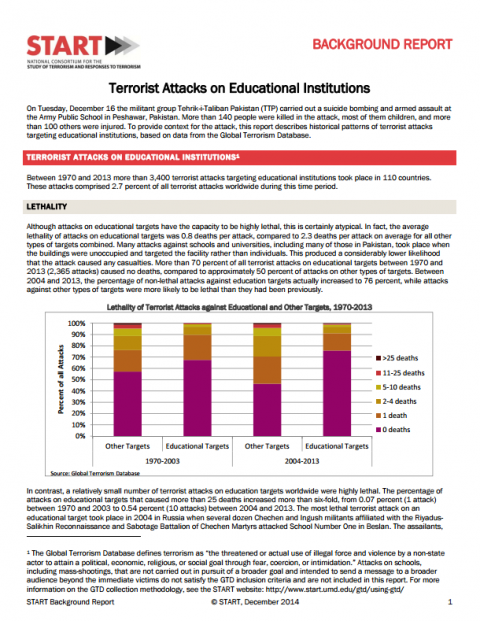 Terrorist Attacks on Educational Institutions Year of publication: 2014 Author: Erin Miller Corporate author: National Consortium for the Study of Terrorism and Responses to Terrorism (START) | Department of Homeland Security Science and Technology Le rapport revient sur les attaques terroristes qui ont ciblé les institutions éducatives depuis 1970. A partir de cette année, on dénombre plus de 3.400 attaques terroristes qui avaient pour cible les institutions éducatives, dans 110 pays. Ces attaques représentent 2,7 % de l’ensemble des attaques terroristes perpétrées à travers le monde au cours de cette période.
  Discover the past for the future: The role of historical sites and museums in Holocaust education and human rights education in the EU The Holocaust has rightfully become an integral part of the collective cultural memory of Europe and the world. This report outlines the findings of the first EU-wide research on the role of Holocaust-related sites and exhibitions in educating young Europeans about the Holocaust and human rights. With this research, the European Union Agency for Fundamental Rights (FRA) brings the two fields of Holocaust education and human rights education together and suggests how the merging of the two could develop into a new knowledge of past and present. The report highlights that attempts to expand knowledge of human rights and to establish links between Holocaust education and human rights education need a broader focus than the memorial sites or museums can offer. Much of the work on linking Holocaust education and human rights education needs to be accomplished in schools. This requires teachers to have opportunities to gain a better understanding of human rights education, and human rights education to be better integrated into school curricula in the EU. Visits to memorial sites and museums can stimulate, support and supplement such work. (By the publisher)
  An Evaluation of UNESCO Publications on Human Rights Education Year of publication: 2002 Corporate author: University of Leicester (UK) | Centre for Citizenship Studies in Education The purpose of this evaluation was to contribute to the formulation of a future strategy on Human Rights Education (HRE). The evaluation focused on nine publications commissioned by UNESCO Headquarters and field offices between 1997 and 2001.The relevance of the publications was assessed in light of UNESCO’s HRE goals and objectives. These were identified in UNESCO documents such as the 1995 Declaration and Integrated Framework of Action on Education for Peace, Human Rights and Democracy. The evaluation also included a report on the perception of users and UNESCO staff of the dissemination and impact of these publications, based on 11 staff interviews and an email questionnaire with 11 responses from 10 countries. In addition, the evaluators provided guidelines for the future development and evaluation of HRE publications.
  Global Monitoring of Target 4.7: Themes in National Curriculum Frameworks; Background Paper Prepared for the 2016 Global Education Monitoring Report Year of publication: 2016 Corporate author: UNESCO International Bureau of Education (IBE) This study is an initial attempt to monitor ESD and GCED content in curricula globally. The goal here is to analyse national curriculum documents to reveal if, how, and to what extent ESD and GCED content is present across the globe. For this purpose, the research team developed a coding scheme based on key ESD and GCED knowledge, skills, behaviours and pedagogies that was used in evaluating the various national curriculum documents for evidence of ESD and GCED content. In this paper, we present the study in the following order. Further explanation of ESD and GCED, and a discussion of issues relating to their implementation and monitoring will come first. Then we will review similar studies that have also attempted to monitor GCED and ESD through content analysis. The study’s methods and findings will then be presented, followed by a discussion of the challenges addressed in developing a coding system to monitor curricula effectively. Finally, we share a series of recommendations that will focus on ways for moving forward in monitoring GCED and ESD effectively, both at a curricular level and beyond.
  Disaster reduction and human security: education for sustainable development; case studies and best practices Year of publication: 2005 Corporate author: Kyoto University. Graduate School of Global Environmental Studies Disaster reduction, human security, education and sustainable development are the four key issues, which are considered in the current compilation. A quick glance of the case studies will tell us the varieties of focus areas. WCD R Thematic Cluster 3 (Knowledge, Innovation and Education: To Build a Culture of Safety and Resilience) identifies four themes under the cluster: Education, Research, Public Awareness and Community Empowerment. A majority of case studies focus on community activities, especially on ho w the communities were able to cope with different types of disasters in different socio-economic context. These are all learning processes for the community, especially to enhance the resilience among its members. A number of these studies include public awareness, training and capacity building programmes. Quite a number of case studies focus on professional expertise, like microzonation, mapping, planning, hazard assessment, and development of risk reduction tools. These are all related to education and research. There are some case studies, which focus on formal education at school and colleges, but are linked to practical learning exercise. Distance learning has appeared as one of the possible media to reach the global mass, and to reach the farthest and the most needy group. The link between on-site testing and on-line learning has been emphasized by several case studies. La prévention des catastrophes et de la sécurité humaine: l'éducation pour le développement durable; études de cas et les meilleures pratiques Year of publication: 2005 Corporate author: Kyoto University. Graduate School of Global Environmental Studies La prévention des catastrophes, la sécurité humaine, l'éducation et le développement durable sont les quatre questions clés, qui sont pris en compte dans la compilation actuelle. Un rapide coup d'œil des études de cas va nous dire les variétés de domaines d'intervention. WCD R thématique Cluster 3 (Connaissance, innovation et éducation: construire une culture de la sécurité et la résilience) identifie quatre thèmes du groupe: l'éducation, la recherche, la sensibilisation du public et l'autonomisation des communautés. La majorité des études de cas se concentrent sur les activités communautaires, en particulier sur ho w les communautés ont pu faire face à différents types de catastrophes dans le contexte socio-économique différent. Ce sont tous les processus d'apprentissage pour la communauté, en particulier pour améliorer la résilience parmi ses membres. Un certain nombre de ces études comprennent des programmes de sensibilisation du public, la formation et le renforcement des capacités. Un certain nombre d'études de cas se concentrer sur l'expertise professionnelle, comme microzonage, la cartographie, la planification, l'évaluation des risques, et le développement d'outils de réduction des risques. Ceux-ci sont tous liés à l'éducation et à la recherche. Il y a quelques études de cas, qui mettent l'aCECnt sur l'éducation formelle à l'école et les collèges, mais sont liés à la pratique d'exercice d'apprentissage. L'enseignement à distance est apparu comme l'un des médias possibles pour atteindre la masse globale, et d'atteindre le plus loin et le groupe le plus nécessiteux. Le lien entre les tests sur site et l'apprentissage en ligne a été soulignée par plusieurs études de cas. Human rights education in Russia: analytical report Year of publication: 2008 Author: Anatoly Azarov Corporate author: Moscow School of Human Rights The book examines the status, trends, and issues of human rights education, including HIV/AIDS prevention education in the Russian Federation. It spans the period from the early 1990s to December 2008, analyzing both positive preconditions for the spread of human rights and freedoms knowledge in Russia and obstacles encountered in the process. A special focus is on laws, regulations and standards applicable to higher education. The book describes the activities of the primary social institutions engaged in HRE: comprehensive schools and universities, human rights commissioners, NGOs. It shows examples of international humanitarian law teaching; offers an evaluation of HRE literature for Russian universities; offers a concept of Science and Discipline of Human Rights. The book also examines the condition of HIV/AIDS prevention education within the context of human rights observance. The authors’ conclusions and judgments are supported with a special opinion poll.
  How Effective Is the Role of the United Nations Human Rights Council in Protecting and Promoting Human Rights (The Arabic Journal of Human and Social Science; Vol.13, No.5) Year of publication: 2021 Author: Saffo Nardjesse Corporate author: University of Djelfa The issue of human rights remained the first in the list of human concerns and hopes, and one of the priorities that emerged on the shoulders of the United Nations within its established and difficult-to-reach programs and goals. There is no doubt that the most important causes of its emergence are attributable to those flagrant violations of human rights, especially those linked to war crimes and others against humanity, which prompted the major countries specifically to consider establishing a body concerned with the first of all the maintenance of international peace and security and the protection and promotion of human rights. , Through the Commission on Human Rights as one of the sub-committees established by the Economic and Social Council, which is tasked with preserving the sanctity of these rights. However, it soon proved ineffective due to the control of states violating human rights on the one hand and the politicization of their role on the other hand. Over the years, the committee dealt with human rights issues in ways that some commentators described as unsatisfactory and more sterile. As a result, the new body was established under the name of the "Human Rights Council" by General Assembly Resolution 60/251, and was considered the largest international body entrusted with the responsibility of promoting global respect. Human rights and fundamental freedoms for all without discrimination of any kind and in a just and equitable manner. Did the new mechanism, with its newly created composition, adequately address the weaknesses of the Commission on Human Rights? In other words, has the Human Rights Council added from its inception to today a greater value and contribution to the ؟protection and promotion of human rights? مدى فعالية دور مجلس الأمم المتحدة لحقوق الإنسان في حماية وتعزيز حقوق الانسان (دراسات وأبحاث; Vol.13, No.5) Year of publication: 2021 Author: Saffo Nardjesse Corporate author: University of Djelfa ظلت قضية حقوق الإنسان الأولى في قائمة هواجس وآمال الإنسانية وأحد الأولويات التي ترتبت على عاتق الأمم المتحدة ضمن برامجها وأهدافها المسطرة والصعبة المنال. فما من ريب من كون أهم أسباب نشأتها إنما تعزى لتلك الانتهاكات الصارخة لحقوق الإنسان لاسيما ما ارتبط منها بارتكاب جرائم حرب وأخرى ضد الإنسانية، وهو ما دفع الدول الكبرى على وجه التحديد إلى التفكير في إنشاء هيئة تُعنى ابتداءً بالمحافظة على السلم والأمن الدوليين وحماية وتعزيز حقوق الإنسان، عبر لجنة حقوق الإنسان بوصفها إحدى اللجان الفرعية التي أنشأها المجلس الاقتصادي والاجتماعي والتي أُوكلت لها مهمة الحفاظ على قدسية هذه الحقوق. غير أنه ما لبث أن ثبت عدم فعاليتها بسبب سيطرة الدول المنتهكة لحقوق الإنسان من جهة وتسييس دورها من جهة أخرى. إذ عالجت اللجنة –خلال سنوات- قضايا حقوق الإنسان بطرق وصفها بعض المعلقين بغير المرضية والأكثر عقما، على إثر ذلك تم إنشاء الهيئة الجديدة باسم "مجلس حقوق الإنسان" بقرار الجمعية العامة رقم 251/60 ، وأعتبر أكبر هيئة دولية أنيط لها مسؤولية تعزيز الاحترام العالمي لحقوق الإنسان والحريات الأساسية للجميع ودون تمييز من أي نوع وبطريقة عادلة ومنصفة. فهل عالجت الآلية الجديدة بتشكيلها المستحدث على نحو كافي نقاط ضعف لجنة حقوق الإنسان؟ وبعبارة أخرى، هل أضاف مجلس حقوق الإنسان منذ إنشائه إلى اليوم قيمة ومساهمة أكبر لحماية وتعزيز حقوق الإنسان ؟
  The rights of political women in Islam and their role in the political sphere Year of publication: 2020 Author: Hussein Zubair Thalj Al-Fahdawi | Mayada Ali Abdel Nabi Karim Praise be to God, who by His grace the righteousness is fulfilled and the pitfalls are forced and the honorees and may God’s prayers be granted to the foreboding Bashir and the enlightening OS and all his family and companions.And it was from the success of God Almighty for me to reach, through this study, some results. I summarize it as follows:Islam honored the humanity of man, so he raised it to the highest ranks and did not differentiate between it between a man and a woman. Rather, he made a man (a man and a woman) the most important thing in this universe. Human dignity, and Islam. A man and a woman are obligated to learn and understand everything and agree in religion and science, and commit them to peaceful jihad to spread the supreme belief and meanings both in the field in which he can work.It was clear from the previous presentation that the increased participation of women in political work is a pivotal factor for the advancement of gender equality and women's empowerment, as women participate in political action.And that all areas of political work are legally permissible to be assumed by whoever is her family, man or woman, just as the view of Islam for women is derived from the view of Islam for the honorable man, so there is no distinction or difference, and the provisions of the Sharia in which equality and justice are established and the origin is equal for women and men in the origin of creation and costs Legitimacy, and what is different between them is an exception to the original, and what was an exception, it is not correct to measure it.Finally, what is right in this research is from God Almighty, and all the defects and shortcomings in it are from myself and from Satan, and I cannot conclude this humble research except that Ahmed is the Most High, praise be to God, Lord of knowledge and prayer and peace be upon our Prophet Muhammad and his family and companions and from his family to the Day of Judgment.