
Resources
Explore a wide range of valuable resources on GCED to deepen your understanding and enhance your research, advocacy, teaching, and learning.
1,187 Results found
 Transforming Systems in Times of Adversity: Education and Resilience; White Paper Year of publication: 2019 Author: Ritesh Shah Corporate author: United States Agency for International Development (USAID) This white paper was commissioned to provide USAID, including Missions, Regional Bureaus, Pillar Bureaus, and the Office of U.S. Foreign Disaster Assistance (OFDA), with an overview of global and Agency thinking and practice on education and resilience and a foundation and justification for positioning USAID education efforts more concretely within a resilience frame.The white paper is organized into three key sections. The first section outlines the business case for resilience, explaining how and why resilience is an important consideration for education programs to consider in contexts of crisis and conflict and how education is well poised as a sector to contribute to strengthening resilience. The second section presents a conceptual framework for understanding how resilience operates through and within the education sector and program interventions. The third section provides a series of key considerations for developing and supporting USAID education programs with a resilience lens or focus.
  Innovative Educational Reforms in Uzbekistan Year of publication: 2019 Author: Kh. Khakimjonova The article reveals the most important stages of reforming the education system of the Republic of Uzbekistan. The structure of the education system and the basic principles on which state reforms in the educational sphere are based are revealed. Describes the changes taking place in the education system of Uzbekistan in the light of recent government decrees and the challenges facing ministries and departments whose activities are directly or partially related to the education system of the Republic of Uzbekistan. Инновационные образовательные реформы в Узбекистане Year of publication: 2019 Author: Kh. Khakimjonova В статье раскрываются важнейшие этапы реформирования системы образования Республики Узбекистан. Раскрывается структура системы образования и основные принципы, на которых основываются государственные реформы в образовательной сфере. Описываются изменения, происходящие в системе образования Узбекистана в свете последних правительственных указов и задачи, стоящие перед министерствами и ведомствами, деятельность которых связана непосредственно или частично соприкасается с системой образования Республики Узбекистан.
  National Reforms of the Higher Education in Uzbekistan Year of publication: 2019 Author: G. Burkhonova This article addresses the issues of national reform of higher education in Uzbekistan. The author of the article believes that the reforms will lead to the further development of the education system as an important factor in the country's prosperity, sustainable economic growth, and employment. Национальные реформы высшего образования Узбекистана Year of publication: 2019 Author: G. Burkhonova Данная статья рассматривает вопросы национальных реформ высшего образования Узбекистана. Автор статьи считает, что реформы приведут к дальнейшему развитию системы образования как важнейшего фактора процветания страны, устойчивого роста экономики, обеспечения занятости населения.
  Expo et outils pédagogiques Year of publication: 2015 Corporate author: La maison des solidarités locales et internationales Éduquer à la citoyenneté c’est changer les mentalités et les comportements de chacun dans le but de contribuer individuellement et collectivement à la construction, dès le plus jeune âge, d’un monde juste, solidaire et durable.Dans ce sens, le centre de ressources de la Maison propose à la location ou à la vente des outils pour donner les moyens, par l’information et la sensibilisation, de faire des choix plus responsables.
 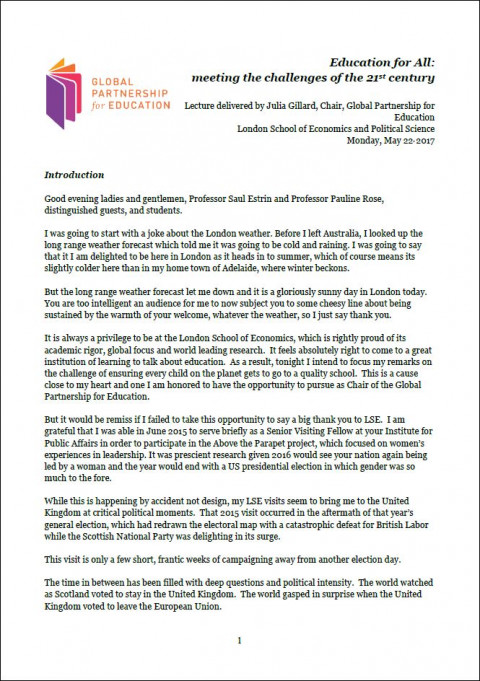 Education for All: Meeting the Challenges of the 21st Century Year of publication: 2017 Corporate author: Global Partnership for Education (GPE) In this speech at the London School of Economics on May 22 2017, Julia Gillard, Board Chair of the Global Partnership for Education, described the global education crisis that the world is facing, and how investing in inclusive, quality education is urgently needed to achieve sustainable development.
 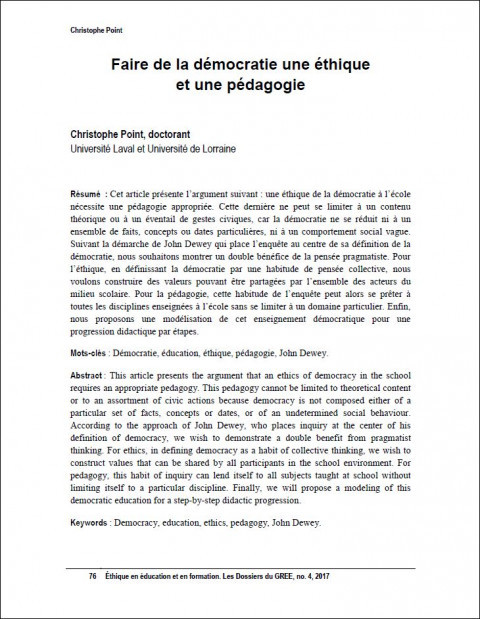 Making Democracy an Ethic and a Pedagogy Year of publication: 2017 Author: Christophe Point Corporate author: Éthique en éducation et en formation This article presents the argument that an ethics of democracy in the school requires an appropriate pedagogy. This pedagogy cannot be limited to theoretical content or to an assortment of civic actions because democracy is not composed either of a particular set of facts, concepts or dates, or of an undetermined social behaviour. According to the approach of John Dewey, who places inquiry at the center of his definition of democracy, we wish to demonstrate a double benefit from pragmatist thinking. For ethics, in defining democracy as a habit of collective thinking, we wish to construct values that can be shared by all participants in the school environment. For pedagogy, this habit of inquiry can lend itself to all subjects taught at school without limiting itself to a particular discipline. Finally, we will propose a modeling of this democratic education for a step-by-step didactic progression. Faire de la démocratie une éthique et une pédagogie Year of publication: 2017 Author: Christophe Point Corporate author: Éthique en éducation et en formation Cet article présente l’argument suivant : une éthique de la démocratie à l’école nécessite une pédagogie appropriée. Cette dernière ne peut se limiter à un contenu théorique ou à un éventail de gestes civiques, car la démocratie ne se réduit ni à un ensemble de faits, concepts ou dates particulières, ni à un comportement social vague. Suivant la démarche de John Dewey qui place l’enquête au centre de sa définition de la démocratie, nous souhaitons montrer un double bénéfice de la pensée pragmatiste. Pour l’éthique, en définissant la démocratie par une habitude de pensée collective, nous voulons construire des valeurs pouvant être partagées par l’ensemble des acteurs du milieu scolaire. Pour la pédagogie, cette habitude de l’enquête peut alors se prêter à toutes les disciplines enseignées à l’école sans se limiter à un domaine particulier. Enfin, nous proposons une modélisation de cet enseignement démocratique pour une progression didactique par étapes.
  [Video] Transforming Education for Humanity Year of publication: 2017 Corporate author: Mahatma Gandhi Institute of Education for Peace and Sustainable Development (MGIEP) UNESCO MGIEP focuses on achieving the UN Sustainable Development Goal 4.7 towards education for building peaceful and sustainable societies across the world by developing programmes that promote socio-emotional learning, innovate digital pedagogies and empower the youth.