
Resources
Explore a wide range of valuable resources on GCED to deepen your understanding and enhance your research, advocacy, teaching, and learning.
63 Results found
 Educación para la ciudadanía mundial en una nación postcolonial: lecciones de Camerún Year of publication: 2015 Author: Michael Foaleng Corporate author: Éducation des Adultes et Développement La ciudadanía mundial solo puede ejercerse allí donde las personas son capaces de participar a nivel local en la identifi cación y la solución de sus problemas básicos. El sistema postcolonial de educación de Camerún, cuyos métodos pedagógicos están obsoletos, forma estudiantes deficientes, que se identifi can con el mundo de los adultos mediante actitudes de vacilación. Aún no hemos aprendido a ser ciudadanos en este país. Por eso en la actualidad se reconoce la necesidad de impartir educación para la ciudadanía. Sin embargo, para que resulte efi caz es preciso que no solo esté orientada a los jóvenes, sino también a los adultos. Uno de los principales desafíos consiste en crear una pedagogía adecuada para alcanzar este objetivo. Éducation à la citoyenneté mondiale à l’ère postcoloniale : leçons du Cameroun Year of publication: 2015 Author: Michael Foaleng Corporate author: Éducation des Adultes et Développement Une citoyenneté mondiale n’est possible que là où localement les individus sont capables de s’engager dans l’identification et la résolution de leurs problèmes élémentaires. Le système éducatif du Cameroun postcolonial, avec ses méthodes pédagogiques désuètes, produit des déchets scolaires, qui se reconnaissent dans le monde des adultes par des attitudes attentistes. On n’a pas encore appris ici à être citoyen. C’est pourquoi l’éducation à la citoyenneté est actuellement reconnue comme une nécessité. Mais son efficacité présuppose qu’elle s’adresse non seulement aux jeunes, mais aussi adultes. L’un des défis majeurs reste alors d’imaginer une pédagogie appropriée à cet effet.
  The Migrant Community Building Active Citizenship in No Man’s Land Year of publication: 2015 Author: Elmer Romero Corporate author: Éducation des Adultes et Développement This is a story about the difficulties facing the migrant community in the United States and the potential of active citizen participation by migrants. How organisations and people work in education with the transformation of the traditional system of education into active learning that promotes critical thinking is also shown. Finally, a methodological approach which aims to create citizen transformers of reality is presented. La comunidad migrante como constructora de la ciudadanía activa en tierra de nadie Year of publication: 2015 Author: Elmer Romero Corporate author: Éducation des Adultes et Développement Esta es una historia sobre las dificultades que afronta la comunidad migrante en Estados Unidos, y el potencial de participación ciudadana activa que poseen las y los migrantes. Asimismo, en esta nota se expone el papel de las entidades y personas que trabajan en el área educativa con respecto a la transformación del tradicional sistema de educación hacia un aprendizaje activo que propicie el pensamiento crítico. Por último, se da a conocer un abordaje metodológico que tiene como fin último formar a ciudadanos transformadores de la realidad. Une communauté de migrants promotrice de la citoyenneté active dans le no man’s land Year of publication: 2015 Author: Elmer Romero Corporate author: Éducation des Adultes et Développement Cet article décrit les diffi cultés auxquelles sont confrontés les migrants aux États- Unis, et le potentiel que recèle la participation citoyenne active de cette communauté. Il montre également le travail réalisé par les organisations et les personnes impliquées dans le domaine de l’éducation pour transformer le système éducatif traditionnel en un apprentissage actif, promoteur de pensée critique. Pour fi nir, il propose une approche méthodologique visant à former des citoyens capables de changer l’ordre établi.
  UNESCO-UNEVOC Study on the Trends Shaping the Future of TVET Teaching (Trends Mapping Studies) Year of publication: 2020 Author: Gita Subrahmanyam Corporate author: UNESCO International Centre for Technical and Vocational Education and Training (UNEVOC) This report presents the results of the trends mapping study on the future of technical and vocational education and training (TVET) teaching, conducted by UNESCO-UNEVOC. The study aimed to engage the international TVET community to: (i) improve the understanding of the implications of global disruptions; (ii) gather knowledge, insights, experiences; and (iii) highlight promising practices in preparing TVET teaching staff to deliver the skills needed in the 21st century and beyond. Coordinated by UNESCO-UNEVOC, trends mapping studies aim to further the international community's understandings on contemporary key issues concerning TVET. The studies review existing literature and policies, and engage TVET stakeholders from around the world through surveys and virtual conferences.
  Advancing Innovation: UNESCO-UNEVOC in Action; Biennial Report 2018-2019 Year of publication: 2020 Corporate author: UNESCO International Centre for Technical and Vocational Education and Training (UNEVOC) In a rapidly evolving world filled with societal, environmental and economic disruptions, technical and vocational education and training (TVET) systems need to develop innovative strategies to tackle emerging challenges while simultaneously seizing the opportunities that have arisen from the advent of 21st century technology.This Biennial Report gives a comprehensive overview of UNESCO-UNEVOC's activities in technical and vocational education and training over the biennium 2018-2019.
 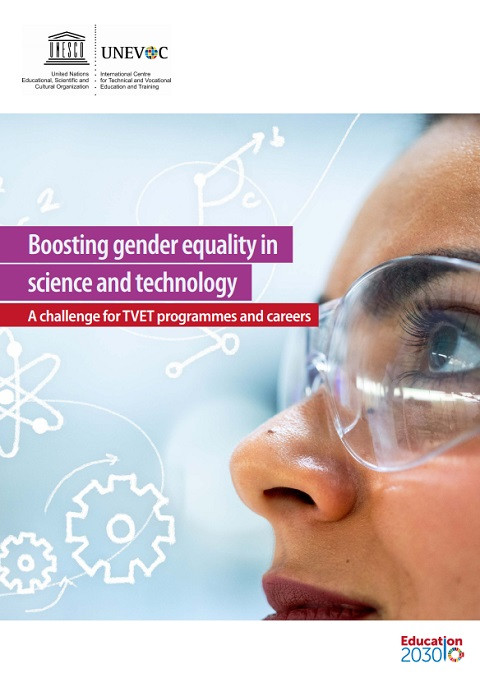 Boosting Gender Equality in Science and Technology: A Challenge for TVET Programmes and Careers Year of publication: 2020 Corporate author: UNESCO International Centre for Technical and Vocational Education and Training (UNEVOC) While technical and vocational education and training (TVET) has the potential to bolster the participation of women in the labour market, this potential is not always well understood and capitalized on. In general, female students are lowly represented in TVET compared to general programmes, and in particular girls and women tend to be under-represented in the fields that require science, technology, engineering and mathematics (STEM) skills and knowledge. In addition to being required for ‘traditional’ and ‘emerging’ occupations, STEM skills and knowledge are often needed for the so-called ‘jobs of the future’, driving innovation, inclusive growth and sustainable development. This report examines the key issues concerning girls and women’s participation and achievement in STEM-related TVET programmes and their transition STEM related careers.
  Conferencia mundial de la UNESCO sobre la educación para el desarrollo sostenible, 31 de Marzo-2 de Abril 2009, Bonn, Alemania: actas Year of publication: 2009 Corporate author: German Federal Ministry of Education and Research (BMBF) | German Commission for UNESCO As the United Nations Decade of Education for Sustainable Development (DESD) approached its midpoint, the “UNESCO World Conference on Education for Sustainable Development – Moving into the Second Half of the UN Decade” was held from 31 March to 2 April 2009 in Bonn, Germany. It brought together 900 participants from 147 countries, among them 49 Ministers and Deputy-Ministers. Participants included representatives of UNESCO Member States, UN agencies, civil society organizations, education institutions, youth, and the private sector, as well as individual experts. The Conference was organized by UNESCO and the German Federal Ministry of Education and Research, in cooperation with the German Commission for UNESCO. The programme was developed in consultation with an international advisory group. Discours de M. Koïchiro Matsuura, Directeur général de l'UNESCO, à l'occasion de la cérémonie d'ouverture de la Conférence Mondiale de l'UNESCO sur l'Education pour le Développement Durable: S'engager dans la seconde moitié de la Décennie Year of publication: 2009 Corporate author: UNESCO. Director-General, 1999-2009 (Matsuura, K.) This address by Mr Koïchiro Matsuura, Director-General of UNESCO, on the occasion of the opening ceremony of the UNESCO World Conference on Education for Sustainable Development: Moving into the Second Half of the UN Decade, was delivered on his behalf by Mr Nicholas Burnett, Assistant Director-General for Education; Bonn, Germany, 31 March 2009.