
Resources
Explore a wide range of valuable resources on GCED to deepen your understanding and enhance your research, advocacy, teaching, and learning.
134 Results found
 School and Culture: An Analysis of Justifications for Educational-Cultural Partnerships Year of publication: 2010 Author: Héloïse Côté Corporate author: Revue des sciences de l’éducation Governments legislate to favour cultural partnerships. What meaning do official texts and actors give to these partnerships ? We analysed the content of Québec official texts and of semi-structured interviews conducted with twelve actors (n = 12) from the perspective of the justifications they presented. The author found that 30,9 % of the official texts and 28,4 % of the actors’ discourse justify cultural partnerships on the basis of the exploration of networks and the elaboration of projects. Nonetheless, since other adequate justifications are also mentioned, cultural partnerships stem from a compromise between several justifications. Escuela y cultura : un análisis de las justificaciones de los colaboradores educativos con carácter cultural Year of publication: 2010 Author: Héloïse Côté Corporate author: Revue des sciences de l’éducation Los gobiernos legislan para fomentar las colaboraciones educativas con carácter cultural. ¿Qué sentido los textos oficiales y los actores otorgan a estas colaboraciones ? Hemos analizado el contenido de los textos oficiales quebequenses y de entrevistas semi-directivas realizadas con doce actores (n = 12) desde la perspectiva de las justificaciones presentadas. Unos 30,9 % de los textos oficiales y 28,4 % del discurso de los actores justifican estas colaboraciones con base a las actividades de exploración de redes y de la instauración de proyectos. Sin embargo, dado que se evocan también otras justificaciones pertinentes, las colaboraciones educativas con carácter cultural derivan de un compromiso entre justificaciones múltiples.
  The Individualization of Intervention in Community Organizations: Openings or Barriers in Relation to Democracy? Year of publication: 2009 Author: Jean-François René Corporate author: Nouvelles pratiques sociales This paper questions the fact that in some community-based organisations the level of intervention is often the individual rather than the community. This trend interferes with the internal participatory democratic practices within these organisations. To explain this relatively recent situation (beginning of the present decade) in many community-based organisations, various factors are taken into account : the large number of requests received by these groups ; the way we solve problems that people face ; the institutionalization of community intervention ; the pressure on organisations to integrate state services agendas. In this context, what actions are needed to stimulate the internal democratic practices within these groups ? L’individualisation de l’intervention dans les organismes communautaires : Levier ou barrière à la prise en charge démocratique ? Year of publication: 2009 Author: Jean-François René Corporate author: Nouvelles pratiques sociales Cet article a pour objectif de questionner la tendance à l’individualisation de l’intervention dans de nombreux organismes communautaires, et de cerner un peu mieux en quoi cela interfère sur le développement de pratiques démocratiques au sein de ces organisations. Depuis le début de la présente décennie, dans bien des organismes communautaires, il appert que peu de temps est consacré aux pratiques démocratiques et aux modes plus collectifs d’action. Différents facteurs entrent en ligne de compte : débordement des groupes face aux demandes ; lectures que l’on fait des problèmes vécus par les personnes rejointes ; formalisation de l’intervention ; accentuation de la pression étatique quant à l’intégration des services. Dans ce contexte, quelles pistes d’action faut-il explorer ? C’est à cette question que s’attarde cet article, en se centrant sur la place et le pouvoir que pourraient prendre les personnes rejointes au sein de ces organismes.
  Programme d’éducation à la citoyenneté mondiale (PÉCM) Year of publication: 2018 Corporate author: Ministère des Relations internationales et de la Francophonie La solidarité est l’un des volets prioritaires de la Politique internationale du Québec. Le PECM favorise une action cohérente et renforce le rayonnement international des actions du gouvernement du Québec en solidarité internationale.Il appuie les organismes de coopération internationale (OCI) et leurs activités d’ECM visant à sensibiliser le public québécois aux Objectifs de développement durable (ODD) et à la solidarité internationale, tout en favorisant l’acquisition de connaissances, de valeurs et de comportements qui contribuent à la mise en place d’un monde plus juste, durable et équitable.
  Understanding Policy Instrument Choice Concerning Citizenship in Education and Youth Policies: A Typology of Public Tools Year of publication: 2018 Author: Valérie Becquet Corporate author: Lien social et Politiques Whether at European or at national level, issues relating to the citizenship of young people are present in public debates and give to the implementation of specific tools. The past and the recurrence of setting up this issue on the agenda invites to reflect on the dynamics of public action. This article presents a typology of the tools gradually developed in two public sectors that concern young people: education and youth. Based on a policy instrument choice approach, it highlights that the choices made by public decision-makers to deal with citizenship issues lead to a multiplication and a diversification of the tools. This proliferation introduces suppose to reflect on the legibility of public action: if those mechanisms can be seen as complementary and as an opportunity for young people, they can also enter into tension. In a context of generational renewal of the electorate, it also calls for reflection on the consequences for young people’s practices and on the building of the perception of citizenship. Comprendre l’instrumentation des questions de citoyenneté dans les politiques d’éducation et de jeunesse : une typologie des dispositifs d’action publique Year of publication: 2018 Author: Valérie Becquet Corporate author: Lien social et Politiques Que ce soit au niveau européen qu’au niveau national, les enjeux relatifs à la citoyenneté des jeunes sont présents dans les débats publics et donnent lieu à la mise en place de dispositifs spécifiques. L’ancienneté et la récurrence de la mise à l’agenda de cette question invitent à réfléchir sur les dynamiques de l’action publique. Cet article propose une typologie des dispositifs progressivement développés dans deux secteurs publics qui interviennent auprès des jeunes : l’éducation et la jeunesse. En mobilisant une approche par les instruments d’action publique, il met en évidence que les choix opérés par les décideurs publics pour traiter des questions de citoyenneté conduisent à une multiplication et à une diversification des dispositifs. Cette prolifération interroge la lisibilité de l’action publique : si les dispositifs peuvent apparaître complémentaires et constituer une opportunité pour les jeunes, ils peuvent aussi entrer en tension. Dans un contexte de renouvellement générationnel du corps électoral, elle invite également à réfléchir sur les conséquences sur les pratiques des jeunes et sur la construction de leur représentation de la citoyenneté.
 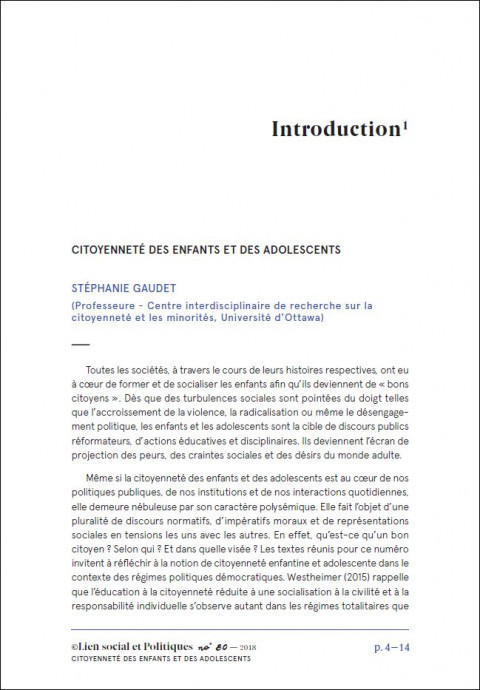 Citoyenneté des enfants et des adolescents Year of publication: 2018 Author: Stéphanie Gaudet Corporate author: Lien social et Politiques Chacune des contributions de ce numéro révèle clairement un ou plusieurs de ces défis selon différences échelles d’analyse. La première partie du numéro porte sur les normativités et les représentations sociales de la citoyenneté enfantine et adolescente véhiculées par les instruments de politiques publiques en France et au Québec. La deuxième section porte sur les institutions qui répondent directement des politiques publiques et qui ont pour mandat de socialiser et d’éduquer les enfants et les adolescents aux pratiques de citoyenneté démocratique. La troisième section de ce numéro présente deux contributions qui rendent compte de l’agencéité (agency) des jeunes et de leurs pratiques citoyennes, c’est-à-dire leur capacité à développer des intentions politiques et à les mettre en action les uns avec les autres. Ce terme se distingue de celui d’agentivité qui est utilisé davantage en sciences cognitives et s’intéresse plus spécifiquement aux mécanismes de l’action individuelle (Glossaire, 2009). Finalement, nous terminons le numéro par des analyses à l’échelle des quartiers et des organisations jeunesse. On y voit comment les intervenants de première ligne, et leurs organisations locales, négocient différentes visions de l’éducation citoyenne, allant de l’éducation à la civilité jusqu’à l’intervention démocratique. Ces échelles d’analyse nous permettent d’observer les représentations de la citoyenneté en fonction des rapports de classe et d’ethnicité.
 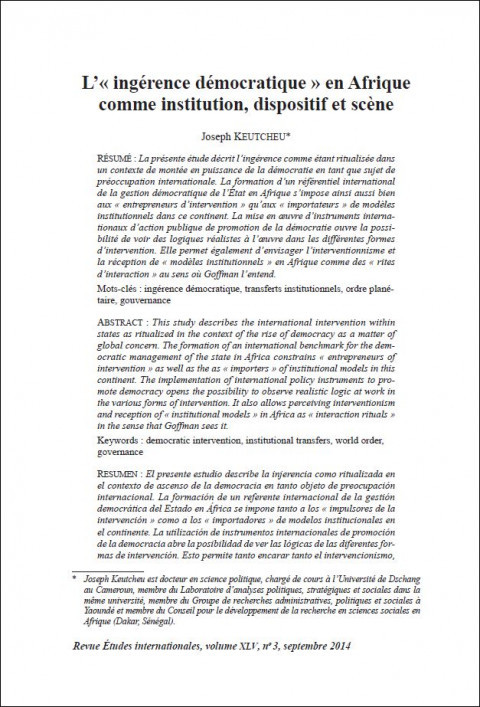 Democratic Interference in Africa as Institution and Context Year of publication: 2014 Author: Joseph Keutcheu Corporate author: Études internationales This study describes the international intervention within states as ritualized in the context of the rise of democracy as a matter of global concern. The formation of an international benchmark for the democratic management of the state in Africa constrains « entrepreneurs of intervention » as well as the as « importers » of institutional models in this continent. The implementation of international policy instruments to promote democracy opens the possibility to observe realistic logic at work in the various forms of intervention. It also allows perceiving interventionism and reception of « institutional models » in Africa as « interaction rituals » in the sense that Goffman sees it. L’« ingérence démocratique » en Afrique comme institution, dispositif et scène Year of publication: 2014 Author: Joseph Keutcheu Corporate author: Études internationales La présente étude décrit l’ingérence comme étant ritualisée dans un contexte de montée en puissance de la démocratie en tant que sujet de préoccupation internationale. La formation d’un référentiel international de la gestion démocratique de l’État en Afrique s’impose ainsi aussi bien aux « entrepreneurs d’intervention » qu’aux « importateurs » de modèles institutionnels dans ce continent. La mise en oeuvre d’instruments internationaux d’action publique de promotion de la démocratie ouvre la possibilité de voir des logiques réalistes à l’oeuvre dans les différentes formes d’intervention. Elle permet également d’envisager l’interventionnisme et la réception de « modèles institutionnels » en Afrique comme des « rites d’interaction » au sens où Goffman l’entend.