
Resources
Explore a wide range of valuable resources on GCED to deepen your understanding and enhance your research, advocacy, teaching, and learning.
88 Results found
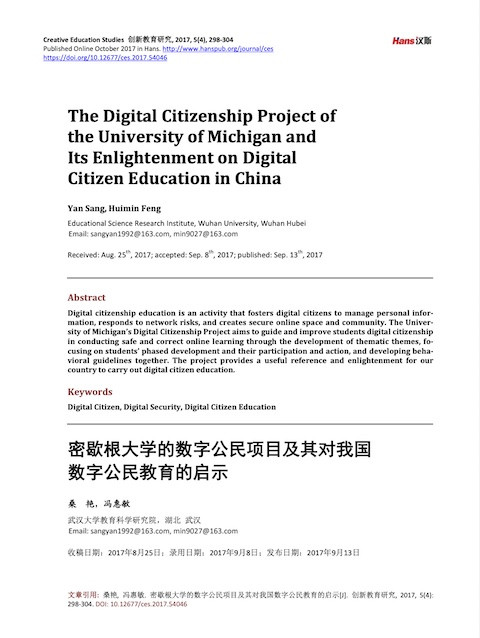 The Digital Citizenship Project of the University of Michigan and Its Enlightenment on Digital Citizen Education in China (Creative Education Studies; vol. 5, no. 4) Year of publication: 2017 Author: Yan Sang | Huimin Feng Digital citizenship education is an activity that fosters digital citizens to manage personal infor- mation, responds to network risks, and creates secure online space and community. The Univer- sity of Michigan’s Digital Citizenship Project aims to guide and improve students digital citizenship in conducting safe and correct online learning through the development of thematic themes, fo- cusing on students’ phased development and their participation and action, and developing beha- vioral guidelines together. The project provides a useful reference and enlightenment for our country to carry out digital citizen education. 密歇根大学的数字公民项目及其对我国数字公民教育的启示 (创新教育研究; vol. 5. no. 4) Year of publication: 2017 Author: Yan Sang | Huimin Feng 数字公民教育是培养数字公民管理个人信息、应对网络风险、打造安全的在线空间和社区的活动。密歇 根大学的数字公民项目,通过制定特色主题、关注学生的阶段性发展、注重学生参与和行动、共同制定 行为准则等活动,旨在引导学生进行安全的、正确的在线方式的学习,提高学生的数字公民素养。该项 目为我国开展数字公民教育提供了有益的借鉴和启示。
 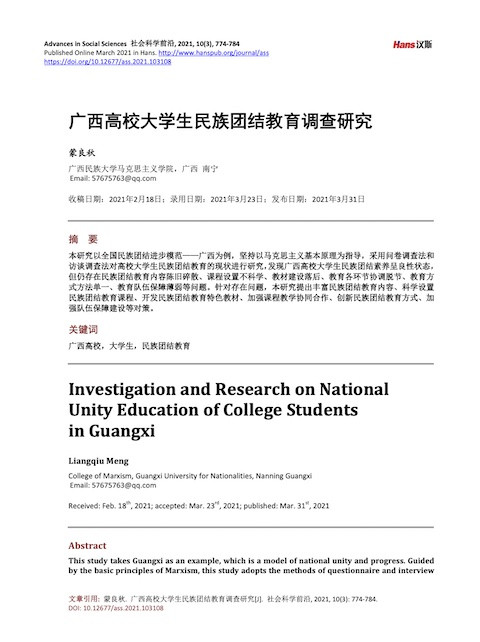 Investigation and Research on National Unity Education of College Students in Guangxi (Advances in Social Sciences; vol. 10, no. 3) Year of publication: 2021 Author: Liangqiu Meng This study takes Guangxi as an example, which is a model of national unity and progress. Guided by the basic principles of Marxism, this study adopts the methods of questionnaire and interview to study the current situation of national unity education of college students in Guangxi. It is found that the quality of national unity of college students in Guangxi is in a good state, but there are still some problems, such as the outdated and fragmented content of national unity education, un- scientific curriculum setting, the lack of quality education and the lack of quality education. There are many problems, such as backward teaching material construction, disjointed coordination of all aspects of education, single education methods, weak guarantee of education team and so on. In view of the existing problems, this study puts forward some countermeasures, such as enriching the content of national unity education, scientifically setting up the curriculum of national unity education, developing the characteristic teaching materials of national unity education, streng- thening the cooperation of curriculum teaching, innovating the mode of national unity education, and strengthening the construction of team security. 广西高校大学生民族团结教育调查研究 (社会科学前沿; vol. 10, no. 3) Year of publication: 2021 Author: Liangqiu Meng 本研究以全国民族团结进步模范——广西为例,坚持以马克思主义基本原理为指导,采用问卷调查法和 访谈调查法对高校大学生民族团结教育的现状进行研究,发现广西高校大学生民族团结素养呈良性状态, 但仍存在民族团结教育内容陈旧碎散、课程设置不科学、教材建设落后、教育各环节协调脱节、教育方 式方法单一、教育队伍保障薄弱等问题。针对存在问题,本研究提出丰富民族团结教育内容、科学设置 民族团结教育课程、开发民族团结教育特色教材、加强课程教学协同合作、创新民族团结教育方式、加 强队伍保障建设等对策。
  Review and Reflection on Special Education Act in Scotland (Creative Education Studies; vol. 7, no. 1) Year of publication: 2019 Author: Qiuhan Feng Scotland is famous for its high quality education and the development of inclusive education around the world. Education equality is a core concept to improve social justice in Scotland. The government has published many educational acts to enlarge the additional support system, protect parents’ involvement and establish teacher education system to improve the education of children in disadvantaged situations. However, problems come along with the expansion of additional support needs, such as categories and labels, stigmatization, effectiveness of education resource delivery. Education equality still remains as a big problem. 苏格兰特殊教育法案的评述及思考(创新教育研究; vol. 7, no. 1) Year of publication: 2019 Author: Qiuhan Feng 苏格兰以高水平的教育质量和融合教育发展程度闻名于世,其以教育公平促进社会公平的理念是当地教 育的特色之一。迄今为止,苏格兰已经颁布多种教育法案来扩大额外支持需要的服务范围,并保障家长 的参与权,建立完善的教师教育体系来提升各种弱势儿童群体的教育质量。然而额外支持需要带来的分 类与标签问题、污名化问题、教育资源传递有效性问题依然存在,引发学者对教育公平的思考。
 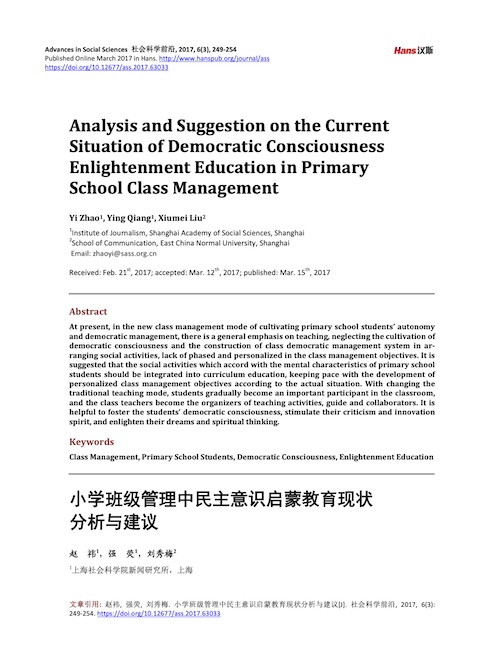 Analysis and Suggestion on the Current Situation of Democratic Consciousness Enlightenment Education in Primary School Class Management (Advances in Social Sciences; vol. 6, no. 3) Year of publication: 2017 Author: Zhao Wei | Qiang Ying | Liu Xiumei At present, in the new class management mode of cultivating primary school students’ autonomy and democratic management, there is a general emphasis on teaching, neglecting the cultivation of democratic consciousness and the construction of class democratic management system in ar- ranging social activities, lack of phased and personalized in the class management objectives. It is suggested that the social activities which accord with the mental characteristics of primary school students should be integrated into curriculum education, keeping pace with the development of personalized class management objectives according to the actual situation. With changing the traditional teaching mode, students gradually become an important participant in the classroom, and the class teachers become the organizers of teaching activities, guide and collaborators. It is helpful to foster the students’ democratic consciousness, stimulate their criticism and innovation spirit, and enlighten their dreams and spiritual thinking. 小学班级管理中民主意识启蒙教育现状分析与建议 (社会科学前沿; vol. 6; no. 3) Year of publication: 2017 Author: Zhao Wei | Qiang Ying | Liu Xiumei 目前在培养小学生自主性与民主性管理的新型班级管理模式中,普遍存在偏重教学部分,在安排社会 活动时忽视民主意识的培养,不重视班级民主化管理体制建设,班级管理目标常缺乏阶段性和个性化。 建议将符合小学生心智特点的社会活动融入课程教育;与时俱进的制定符合班级实际的阶段性和个性 化管理目标;改变传统的师生授课模式,学生逐渐变成课堂的重要参与者,班主任成为教学活动的组 织者、引导者与合作者。有利于培养小学生的民主意识,激发其批判和创新精神,启迪其梦想和灵性 思维。
 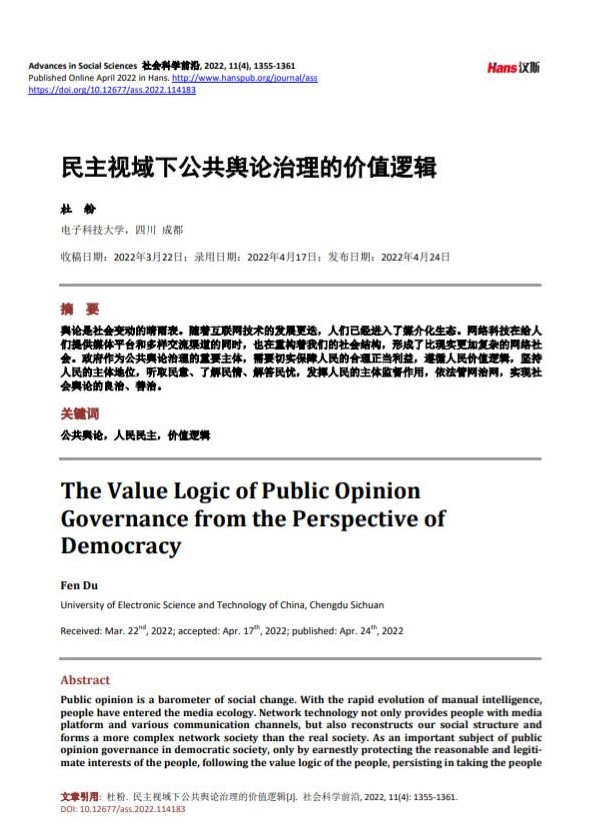 The Value Logic of Public Opinion Governance from the Perspective of Democracy Year of publication: 2022 Author: 杜粉 This article examines the governance of public opinion in the online environment from the perspective of democracy. 民主视域下公共舆论治理的价值逻辑 Year of publication: 2022 Author: 杜粉 本文从民主制度的视角出发,探讨网络环境下对公共舆论的治理问题。