
Resources
Explore a wide range of valuable resources on GCED to deepen your understanding and enhance your research, advocacy, teaching, and learning.
3,223 Results found
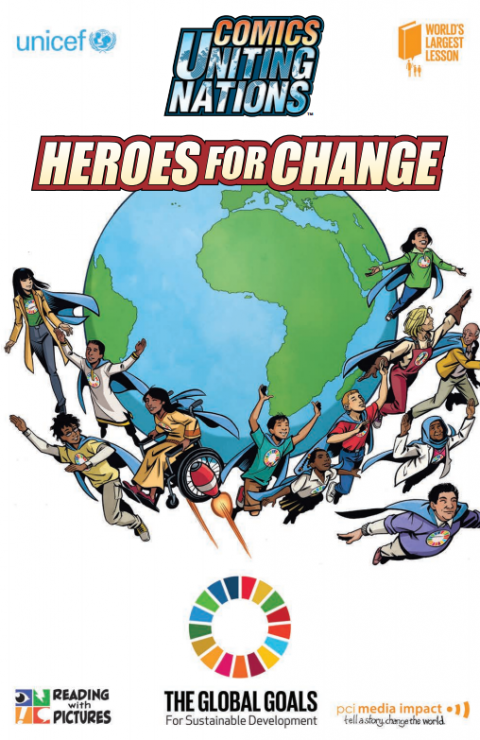 LES HÉROS DU CHANGEMENT Year of publication: 2015 Author: Josh Elder | Natabara Rollosson | Sean Southey | Grace Allison | Karl Kesel | Grace Allison Corporate author: Project Everyone | PCI Media Impact | Reading With Pictures Heroes for Change has been created for the World's Largest Lesson Initiative to share information on the global goals. héroes para el cambio Year of publication: 2015 Author: Josh Elder | Natabara Rollosson | Sean Southey | Grace Allison | Karl Kesel | Grace Allison Corporate author: Project Everyone | PCI Media Impact | Reading With Pictures Heroes for Change has been created for the World's Largest Lesson Initiative to share information on the global goals. Герои за перемены Year of publication: 2015 Author: Josh Elder | Natabara Rollosson | Sean Southey | Grace Allison | Karl Kesel | Grace Allison Corporate author: Project Everyone | PCI Media Impact | Reading With Pictures Heroes for Change has been created for the World's Largest Lesson Initiative to share information on the global goals.
  MDG #2: Education Year of publication: 2014 Corporate author: United Nations (UN) Malala Yousafzai was shot and almost killed by Taliban militants in Pakistan on her way home from school, yet her survival only made her a greater global advocate for universal education.
  Bridging the education gap in Bangladesh Year of publication: 2015 Corporate author: United Nations Children's Fund (UNICEF) “If this school didn’t exist, I wouldn’t be here… I would be forced to work,” Mohammed, 13, says. Mohammed attends an ability-based learning school in Shyamnagar, Bangladesh supported by UNICEF’s Let Us Learn initiative. Many children in Bangladesh are out of school because they never enrolled or dropped out, largely due to poverty and child labour. أبطال من أجل التغي Year of publication: 2015 Author: Josh Elder | Natabara Rollosson | Sean Southey | Grace Allison | Karl Kesel | Grace Allison Corporate author: Project Everyone | PCI Media Impact and Reading With Pictures Heroes for Change has been created for the World's Largest Lesson Initiative to share information on the global goals. 改革英雄 Year of publication: 2015 Author: Josh Elder | Natabara Rollosson | Sean Southey | Grace Allison | Karl Kesel | Grace Allison Corporate author: Project Everyone | PCI Media Impact | Reading With Pictures Heroes for Change has been created for the World's Largest Lesson Initiative to share information on the global goals.
 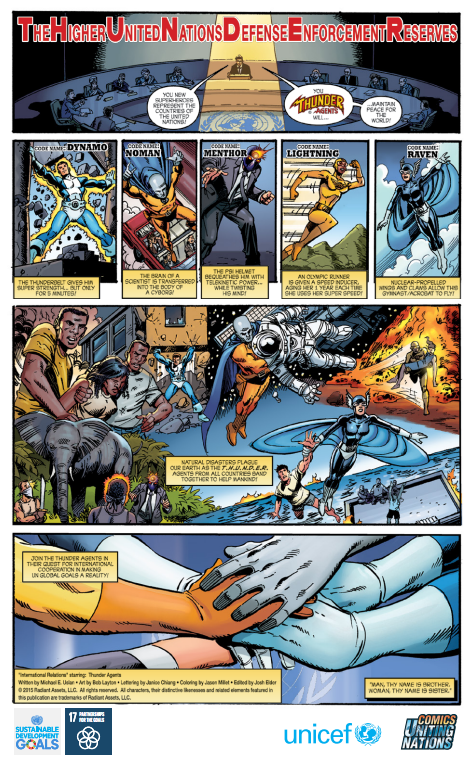 T.H.U.N.D.E.R. Agents Year of publication: 2015 Author: Michael E. Ulsan | Bob Layton | Janic Chiang | Jason Millet | Josh Elder Corporate author: Radiant Assets | LLC | United Nations Children's Fund (UNICEF) T.H.U.N.D.E.R. -- The Higher United Nations Defense Enforcement Reserves -- are UN Superheroes tasked with promoting global cooperation to make the world a better place. The T.H.U.N.D.E.R. Agentswas a comic originally created in the 1960s and is set to be made into a major motion picture in 2018.
 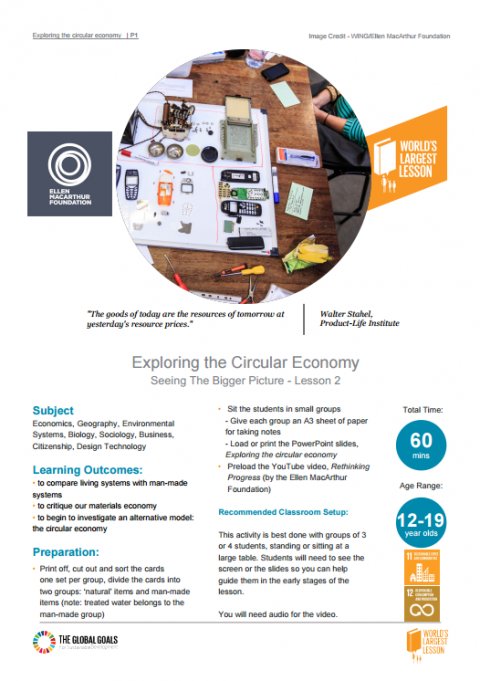 Exploring the Circular Economy: Seeing The Bigger Picture - Lesson 2 Corporate author: United Nations Children's Fund (UNICEF) World’s Largest Lesson is a collaborative education project to support the announcement of the United Nations Global Goals for Sustainable Development. Learning outcomes of the project: • to compare living systems with man-made systems • to critique our materials economy • to begin to investigate an alternative model: the circular economy
 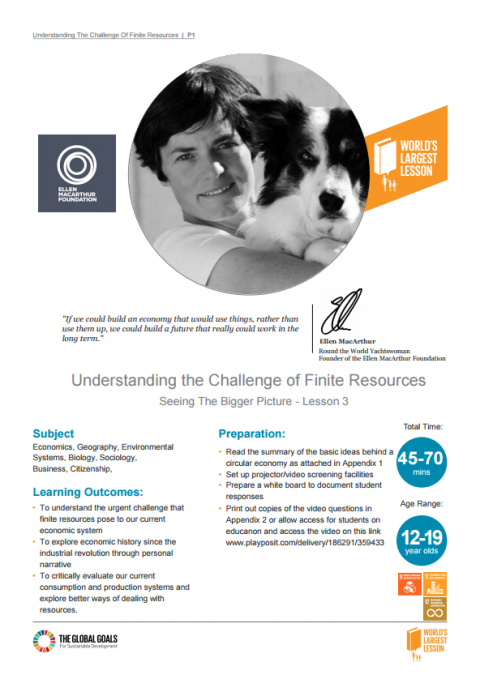 Understanding the Challenge of Finite Resources: Seeing The Bigger Picture - Lesson 3 Corporate author: United Nations Children's Fund (UNICEF) World’s Largest Lesson is a collaborative education project to support the announcement of the United Nations Global Goals for Sustainable Development. Learning outcomes of the project: • To understand and the urgent challenge that finite resources pose to our current economic system • To explore economic history since the industrial revolution through personal narrative • To critically evaluate our current consumption and production systems and explore better ways of dealing with resources.