
Resources
Explore a wide range of valuable resources on GCED to deepen your understanding and enhance your research, advocacy, teaching, and learning.
1,180 Results found
 Teaching the Holocaust at a distance : reflections from the field As technology continues to improve and online learning programs continue to proliferate each year throughout the United States, it is necessary for teachers to establish a sound understanding of proper pedagogical techniques for a digital environment. This phenomenon has ushered in a new era of education, thus bringing forth a myriad of new questions and issues that must be addressed. For instance, how should online instructors properly transfer and teach traditional core subjects in an online milieu? Social studies educators are faced with additional quandaries, such as teaching democratic processes for effective citizenship and the teaching of controversial issues/topics like the Holocaust. Undeniably, controversial topics elicit strong emotions and come with a plethora of concerns that seem only possible to address in a face-to-face classroom. This current exploration draws upon the scholarship and experience of experts in the field of social studies education, distance learning, and Holocaust Studies to provide suggestions as to how teachers should approach controversial topics in a digital learning environment. An example lesson plan is also provided to showcase a successful integration of controversial issues into an online high school social studies classroom. (By the author)
  [Vidéo] L'éducation à la citoyenneté, pourquoi ? Year of publication: 2016 Corporate author: Le Centre interdisciplinaire de recherche sur la citoyenneté et les minorités (CIRCEM) Symposium Éducation et Démocratie « Former les citoyens de demain »
  Expérience et projet : la pensée de Dewey traduite en action pédagogique Year of publication: 2016 Author: Marc Boutet Corporate author: Phronesis John Dewey parle du sujet comme d’un « agency of doing » qui, par son action, s’efforce de créer du sens. À partir de cette conception, Dewey propose de nouveaux principes d’enseignement mettant l’accent sur l’apprentissage dans un contexte d’activité libre plutôt que dans un contexte de discipline contraignante. L’apprenant n’est plus seulement invité à se représenter le phénomène à comprendre, il est en quelque sorte invité à aller à sa rencontre, à en faire l’expérience, celle-ci étant définie comme une transaction entre l’être humain et son environnement physique et social. Dewey affirmait également que l’absence d’une continuité dans l’expérience marque l’amorce de la démarche d’apprentissage, qu’il nomme démarche d’enquête (inquiry), laquelle n’est plus décrite comme essentiellement individualiste, ce qui fonde sa perception épistémique de la démocratie. Après avoir décrit brièvement notre rencontre avec la pensée éducative de Dewey, nous tenterons d’établir, à partir de sa conception de l’action, de l’enquête et de la démocratie, comment sa pensée peut être considérée comme fondatrice d’une innovation pédagogique majeure symbolisant la réforme de l’éducation au Québec des années 2000 : l’approche par projet. Experience and Project: Dewey thought Translated into Pedagogical Action Year of publication: 2016 Author: Marc Boutet Corporate author: Phronesis John Dewey talks about child as an «agency of doing» which, by its action, strives to create meaning. From this view, Dewey offers new teaching principles focusing on learning in a context of free activity rather than in a context of restrictive discipline. The child is no longer just invited to represent the phenomenon to understand, it is somehow invited to meet it, to experience it, experience being defined as a transaction between the human being and physical and social environment. Dewey also said that the lack of continuity in the experience marks the beginning of the learning process, he called inquiry, no longer described as essentially individualistic, which bases his epistemic perception of democracy. After briefly describing our meeting with Dewey’s educational thought, we will try to establish, from his conception of action, inquiry and democracy, how his thought can be considered as a foundation for a major innovation educational innovation symbolizing education reform in Quebec of the 2000s: the project approach.
  Media Education and Citizenship: An analysis of the Quebec Preschool and Elementary Education Program Year of publication: 2018 Author: Normand Landry | Chantal Roussel Corporate author: Revue Lien social et Politiques In Canada, the limited level of knowledge on media education content that is conveyed by academic curricula hinders its critical evaluation. This article presents the ways in which media education is introduced in the Quebec Education Program (QEP) at the preschool and elementary level. More specifically, it highlights the connections at work between media education, childhood and citizenship in the program. Our method tracks and extracts a set of statements related to information and communications technologies (ICTs) and the media, then conducts their automated classification into four principal categories: speech, verbs used that reflect the actions undertaken by categories of actors (school, pupils, teachers), learning objectives and suggestions. A subsequent classification allows for the emergence of verbs and learning objectives associated to the notion of citizenship. The latter are then subject to speech analysis. Our analysis intends to demonstrate the message conveyed by the QEP on media and ICTs. It highlights the roles, tasks and responsibilities of its various actors in relation to the acquisition of knowledge and skill development. In addition, it features the actions taken by these actors to operationalize the academic goals of the program. Our conclusion indicates a low subject implementation of the statements associated to media education and citizenship, relevant content, although thematically limited, along with the conception of students as capable of a reflection and critical thinking process. Articuler éducation aux médias et citoyenneté : une analyse du Programme de formation de l’école québécoise préscolaire-primaire Year of publication: 2018 Author: Normand Landry | Chantal Roussel Corporate author: Revue Lien social et Politiques Au Canada, le faible niveau de connaissance des contenus en éducation aux médias véhiculés par les curricula scolaires proscrit leur évaluation critique. Cet article présente les façons selon lesquelles l’éducation aux médias est introduite dans le Programme de formation de l’école québécoise (PFEQ) des niveaux préscolaire et primaire. Plus spécifiquement, il témoigne des articulations entre éducation aux médias, enfance et citoyenneté. La méthode utilisée procède au repérage et à l’extraction d’énoncés associés aux technologies de l’information et de la communication (TIC) et aux médias, puis à leur classement en quatre catégories principales : discours, verbes témoignant des actions de chaque catégorie d’acteurs (école, élève, enseignant), objets d’apprentissage et suggestions d’utilisation des TIC. Une classification permet de faire émerger les verbes et les objets d’apprentissage référant à la notion de citoyenneté en utilisant la définition et les composantes associées. Ces derniers sont ensuite soumis à une analyse de discours. Notre analyse fait émerger les discours véhiculés par le PFEQ sur les médias et les TIC. Elle met en exergue les rôles, les tâches et les responsabilités des différents acteurs en lien avec l’acquisition de connaissances et le développement de compétences. En outre, elle présente les actions menées par ces acteurs afin d’opérationnaliser les intentions pédagogiques du programme. La conclusion montre un faible ancrage disciplinaire des énoncés traitant de l’éducation aux médias et à la citoyenneté, des contenus pertinents, mais limités thématiquement, ainsi qu’une représentation de l’élève en tant qu’individu capable de réflexion et de pensée critique.
  Le rôle des enseignants dans l’éducation et la démocratie : impacts d’un projet de recherche sur la perception de futurs enseignants Year of publication: 2015 Author: Gina Thésée | Paul R. Carr | Franck Potwora Corporate author: McGill University. Faculty of Education Cet article étudie les réflexions suscitées par un questionnaire d’enquête portant sur les liens entre l’éducation et la démocratie. Un échantillon de 157 étudiants d’un programme de formation initiale des enseignants à Montréal a répondu à un questionnaire de suivi (seconde étude) après avoir rempli un questionnaire d’enquête (première étude) portant sur leurs perceptions et leurs expériences des liens entre l’éducation et la démocratie. La première étude révèle une expérience démocratique faible et un parcours éducatif pratiquement sans lien avec la démocratie, ce qui concorde avec les résultats d’études antérieures. Cependant, les résultats du questionnaire de suivi indiquent que la participation à l’enquête a suscité des réflexions d’ordre socioéducatif, épistémologique, pédagogique et méthodologique, qui pourraient avoir des retombées significatives sur leur perception du rôle de l’enseignant. The Role of Teachers in Education and Democracy: The Impact of a Research Project on Preservice Teacher Perceptions Year of publication: 2015 Author: Gina Thésée | Paul R. Carr | Franck Potwora Corporate author: McGill University. Faculty of Education This article presents reflections on a survey questionnaire related to the connection between education and democracy. A sample of 157 teacher-education students in Montreal completed a follow-up questionnaire after having participated in a research questionnaire (first study) concerning their perception and experience of the linkage between education and democracy. The first study underscored a weak democratic experience as well as an educational journey without a strong linkage to democracy, which concurs with our previous findings. However, the results of the follow-up survey indicate that participation in this inquiry generated socio-educational, epistemological, pedagogical, and methodological reflections, which could have significant implications for the perception of the role of educators.
 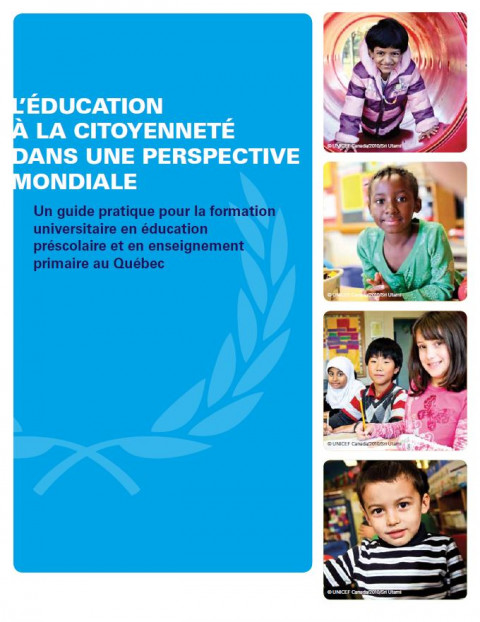 L’éducation à la citoyenneté dans une perspective mondiale : Un guide pratique pour la formation universitaire en éducation préscolaire et en enseignement primaire au Québec Year of publication: 2011 Corporate author: UNICEF Canada Ce guide permet au corps enseignant universitaire, aux étudiantes et étudiants en éducation, ainsi qu’aux enseignantes et enseignants en formation continue, d’acquérir une bonne compréhension des concepts de l’éducation à la citoyenneté dans une perspective mondiale, d’en connaître la pertinence dans tous les aspects de leur enseignement, peu importe le domaine, et ce, afin qu’ils puissent agir en enseignantes et enseignants responsables et informés, et puissent développer des compétences similaires chez leurs élèves.Le guide est divisé en trois parties. La première, intitulée Soutien à la formation initiale, permet de faire un examen des besoins pour la formation initiale et continue au sujet de l’éducation à la citoyenneté dans une perspective mondiale. C’est dans cet esprit que les compétences professionnelles ont été ciblées et que des outils pédagogiques ont été élaborés : l’outil diagnostique et de pratique réflexive. C’est dans cette partie que vous trouverez un tableau indiquant les rubriques du guide et la ou les compétences professionnelles qu’elles permettent de développer.La deuxième partie du guide présente la notion d’éducation à la citoyenneté dans une perspective mondiale. En plus de définir cette notion, elle fait des liens avec le Programme de formation de l’école québécoise. C’est aussi dans cette section que le lecteur se familiarisera avec les six concepts centraux de l’éducation à la citoyenneté dans une perspective mondiale.La troisième partie du guide est divisée en six sections; chacune d’elle présente un des six concepts centraux de l’éducation à la citoyenneté dans une perspective mondiale, soit : droits de l’enfant, interdépendance, images et perceptions, conflits et leur résolution, justice sociale et action viable.
  MODÈLES DE RECHERCHE: Démocratie, citoyenneté mondiale et éducation transformatoire Year of publication: 2018 Author: Paul R. Carr | Gina Thésée Corporate author: Chaire UNESCO Démocratie, citoyenneté mondiale et éducation transformatoire (DCMÉT) Les modèles conceptuels et théoriques présentés dans ce document ont été élaborés sur une période d’environ douze ans, commençant en 2005, par le titulaire (Paul R. Carr, Université du Québec en Outaouais) et la co-titulaire (Gina Thésée, Université du Québec à Montréal) de la Chaire UNESCO. Ces modèles ont été publiés dans diverses revues académiques, en anglais ou en français et ont été traduits et adaptés ici pour produire une représentation mise à jour et bilingue de la recherche sur l’éducation pour la démocratie que Carr et Thésée ont réalisée. Certains de ces modèles ont été affinés (et améliorés) avec le temps et sont des moyens qui aident à élucider, interroger et mettre en évidence le sens des trois thèmes qui sous-tendent la Chaire UNESCO DCMÉT.