
Resources
Explore a wide range of valuable resources on GCED to deepen your understanding and enhance your research, advocacy, teaching, and learning.
1,727 Results found
 Education à la citoyenneté en RDCONGO : Quelles strategies et pour quelle éducation à la démocratie en R.D.C? Year of publication: 2008 Author: Abbé Louis Mpala Cette brochure se veut une introduction générale à toutes les brochures qui seront consacrées à chaque type d'éducation proposé. Ce projet ne peut être réalisé que si Dieu le permet et si je trouve un mécène.Cet écrit peut servir d'un instrument de travail à toute personne soucieuse de voir notre pays avoir des fils dont le cour est circoncis. Comme tout travail humain, ma brochure a des limites. A vous de la parfaire. Destiné à être exposé aux journées scientifiques organisées par l'Institut Supérieur Pédagogique de Lubumbashi (I.S.P.), ce texte est mis à la disposition de tout éducateur. Cet écrit a mes empreintes d'agrégé de l'Enseignement Secondaire Degré Supérieur (E.S.D.S.)pour le cours de philosophie. Voilà qui justifie mon souci de voir les objectifs éducationnels opérationnels.A vous lectrice et lecteur engagés dans un groupe d'encadrement familial, politique ,scolaire, socio-culturel etc., je confie ma brochure.
  지속가능발전목표 4 Year of publication: 2018 Corporate author: 유네스코한국위원회 이 소책자는 2018년 10-12월 동안 유네스코한국위원회에서 연재한 SDG 4 카드뉴스 시리즈를 바탕으로 제작된 것으로 지속가능발전목표 4(SDG 4)에 대해 쉽게 설명하고 각 목표 달성을 위한 한국교육의 과제와 역할에 대해 다루고 있다. 모두가 함께 달성해가는 SDG 4 SDG 4 달성을 위해 대한민국이 하는 일 한국 교육과 SDG 4.1: 양질의 초등교육과 중등교육 보장 한국 교육과 SDG 4.2: 영유아 발달 교육 및 취학 전 교육 한국 교육과 SDG 4.3: 양질의 고등교육 제공 한국 교육과 SDG 4.4: 전문기술 및 직업기술을 지닌 청년과 성인의 수 향상 한국 교육과 SDG 4.5: 교육 형평성 한국 교육과 SDG 4.6: 문해력과 수리력 성취 한국 교육과 SDG 4.7: 지속가능발전과 세계시민의식 SDG 4 달성을 위한 정보통신기술(ICT)의 역할 SDG 4 달성을 위한 교육지표 개발과 모니터링
 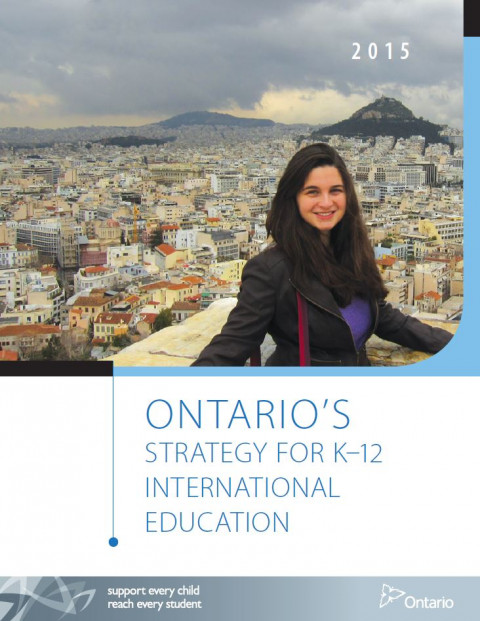 Ontario’s Strategy for K–12 International Education Year of publication: 2015 Corporate author: Ontario (Canada). Ministry of Education Ontario’s strategy for international education will provide an integrated, coordinated approach that will link the continuum of learning from K–12 schooling to postsecondary education and training, to living and working in Ontario.The Ministry of Education will lead with phase one of the provincial strategy, focusing on K–12 learning opportunities. Ontario’s international education strategy will provide: enhanced course offerings and opportunities with an international context, to help Ontario K–12 students and educators build the global competencies, knowledge, and experiences needed to succeed in the worldwide economy;high-quality programs and services and a safe, welcoming environment for international students, to promote achievement and well-being and stimulate intercultural learning;opportunities to develop and share expertise among Ontario and international educators; andpathways for international students studying in Ontario, from elementary/secondary school to postsecondary education and beyond. Stratégie ontarienne en matière d’éducation internationale de la maternelle à la 12e année Year of publication: 2015 Corporate author: Ontario (Canada). Ministry of Education Une stratégie ontarienne en matière d’éducation internationale procurera une approche intégrée et coordonnée qui s’appliquera à l’ensemble du continuum d’apprentissage, allant de la maternelle à la 12e année en passant par les études postsecondaires et la formation, et jusqu’à travailler et résider en Ontario.Le ministère de l’Éducation mènera la première phase de la stratégie provinciale, mettant l’accent sur les possibilités d’apprentissage. La Stratégie ontarienne en matière d’éducation internationale de la maternelle à la 12e année (la « Stratégie ») offrira : un éventail enrichi de cours et d’autres activités d’apprentissage à contexte international en vue d’aider les élèves et le personnel enseignant de la maternelle à la 12e année à développer les connaissances, les compétences et les expériences globales indispensables à la réussite dans le cadre d’une économie mondialisée;des programmes et services de qualité supérieure, et un environnement accueillant et sécuritaire pour les élèves étrangers, destinés à promouvoir le rendement scolaire et le bien-être, de même qu’à stimuler l’apprentissage interculturel;des possibilités accrues d’enrichissement et de partage des connaissances pour les membres du personnel enseignant de l’Ontario et d’ailleurs;un choix de parcours continus pour les élèves étrangers séjournant en Ontario, depuis l’école élémentaire ou secondaire aux études postsecondaires, et jusqu’aux possibilités de vivre et de travailler en Ontario.
  [Video] Global Citizenship Education - The Key to a Just, Peaceful and Inclusive World Year of publication: 2015 Corporate author: Global Education First Initiative Global Citizenship Education gives students the knowledge and skills they need to answer the big questions of the day, and to help forge more tolerant, peaceful and inclusive societies.
  Global Education for Ontario Learners: Practical Strategies - A Summary of Research Year of publication: 2018 Author: Caroline Manion | Nadya Weber Corporate author: Ontario (Canada). Ministry of Education This summary report flows from the policy outlined in Ontario’s Strategy for K–12 International Education (OME, 2015). The report highlights current knowledge about good and/or promising practices in global education1 in order to suggest practical strategies for improved teaching, learning, and achievement. The intended audience for this piece includes all education stakeholders – community members, parents, learners, system leaders, school leaders, and educators – as active agents of change in support of an education strategy designed to integrate global perspectives, cultures, and experiences in the curriculum and learning environment. The purpose is to enable students to develop the competencies they will need to thrive as citizens in an increasingly globalized world.The discussion is organized by theme. To underline why global education is critically important for Ontario learners, we begin by outlining the significant contributions global education can make to the well-being of individuals and society as a whole. We then provide an overview synthesizing different conceptualizations of “global education” and “global citizenship education”, as well as a broad range of their overlapping sub-concepts. Next, through a review of the international literature on the subject, we present a series of challenges and opportunities for implementing global education, and list pertinent examples of good practices associated with delivering global education. A further section focuses on good practice in building system capacity and leadership for effective global education. We conclude by identifying key messages and lessons learned.
 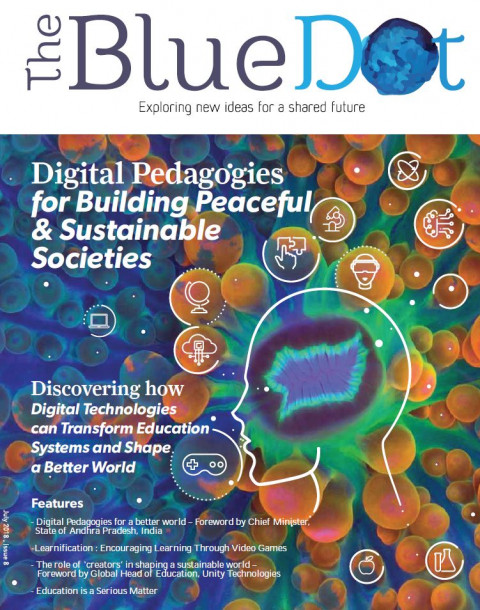 Digital Pedagogies for Building Peaceful & Sustainable Societies (The Blue Dot Issue 8, 2018) Year of publication: 2018 Corporate author: Mahatma Gandhi Institute of Education for Peace and Sustainable Development (MGIEP) In this issue of The Blue Dot (Digital Pedagogies for Building Peaceful and Sustainable Societies), some of the most prominent experts in the field of digital pedagogies share with us their views and perspectives in the growing field for education. Foreword by the visionary Chief Minister, Honourable Nara Shri Chandrababu Naidu of the State of Andhra Pradesh, India, pretty much lays the ground for the future of EdTech and the way he sees its role in his state as well as for the global community. The second foreword by the Global Head of Education, Unity Technologies, one of the world’s largest provider of game engines, demonstrates the willingness of the private sector to engage with educators to provide the platform to develop learners as creative explorers.
 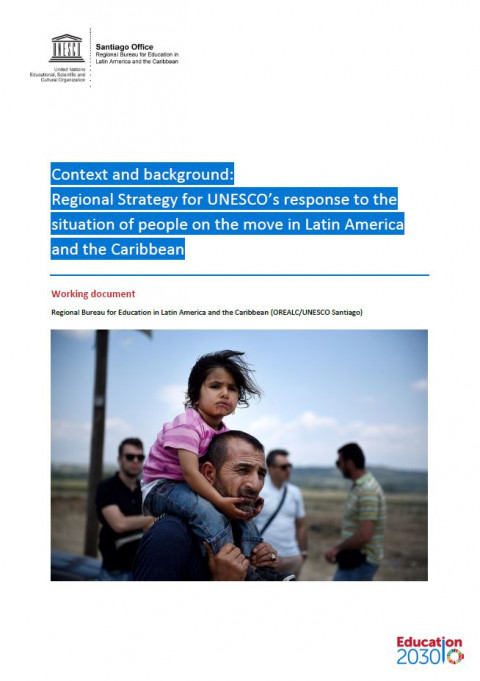 Context and Background: Regional Strategy for UNESCO’s Response to the Situation of People on the Move in Latin America and the Caribbean Year of publication: 2019 Corporate author: UNESCO Santiago The UNESCO offices in Latin America and the Caribbean, under the coordination of the Regional Bureau for Education in Latin America and the Caribbean OREALC/UNESCO Santiago, have proposed the development of a regional strategy that provides a response from UNESCO based on the needs of the region’s countries for guaranteeing the right to education of migrants, refugees, asylum seekers and returnees. The purpose of this document is to present key information for the development of the regional strategy. It reviews a set of information that contextualizes human mobility in Latin America and the Caribbean, recognizing contemporary trends, identifying their driving factors and describing the main demographic qualities that characterize them.The authors then address the needs for protection of individuals in the context of mobility in the region, particularly those associated with the exercise of their fundamental rights and processes of inclusion in social protection systems in the destination society. They then present the right to education as a multiplier right in contexts of human mobility, reviewing the main obstacles faced by migrants, refugees, asylum seekers and returnees. Finally, the text presents a discussion of UNESCO’s role in this context based on the review of international regulatory instruments and frameworks, institutional frameworks, the work agenda at the regional level and the migratory institutional structure in Latin America and the Caribbean. Antecedentes para una estrategia regional de respuesta de la UNESCO a la situación de personas en contexto de movilidad en América Latina y el Caribe: documento de trabajo Year of publication: 2019 Corporate author: UNESCO Santiago Las oficinas de la UNESCO en América Latina y el Caribe, bajo la coordinación de la Oficina Regional de Educación OREALC/UNESCO Santiago, se han propuesto el desarrollo de una estrategia regional que estructure una respuesta de la UNESCO en función de las necesidades de los países de la región para garantizar el derecho a la educación de personas migrantes, refugiados, solicitantes de asilo y retornados. El presente documento tiene como objetivo presentar antecedentes relevantes para la elaboración de la estrategia regional. En él, se revisa un conjunto de antecedentes que contextualizan la movilidad humana en América Latina y el Caribe, reconociendo tendencias contemporáneas, identificando los factores que la impulsan y revisando las principales cualidades demográficas que la caracterizan. Posteriormente, se abordan las necesidades de protección de las personas en contexto de movilidad en la región, especialmente aquellas asociadas al ejercicio de sus derechos fundamentales y a los procesos de inclusión a los sistemas de protección social en la sociedad receptora. Luego, se presenta el derecho a la educación como derecho multiplicador en los contextos de movilidad humana, revisando los principales obstáculos para su realización que deben enfrentar las personas migrantes, refugiadas, solicitantes de asilo y retornadas. Finalmente, se discute el rol de la UNESCO en este escenario a partir de la revisión de los instrumentos y marcos normativos a nivel internacional, marcos institucionales, la agenda de trabajo a nivel regional y la institucionalidad migratoria de América Latina y el Caribe.
 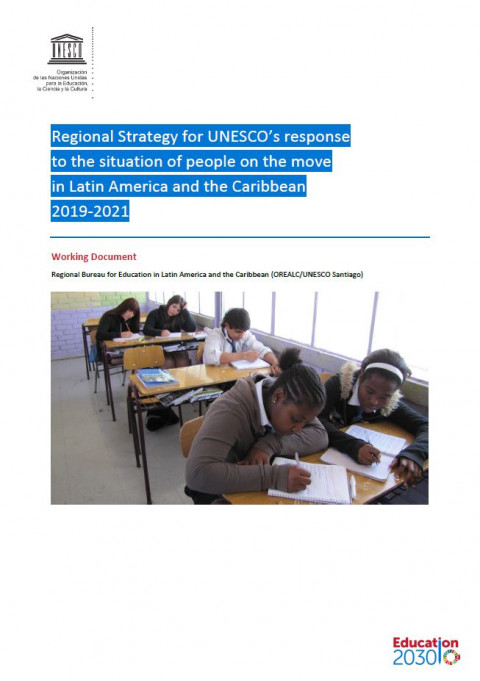 Regional Strategy for UNESCO’s Response to the Situation of People on the Move in Latin America and the Caribbean 2019-2021: Working Document Year of publication: 2019 Corporate author: UNESCO Santiago This document introduces the three priority strategic areas, defined in coherence with those analyzed in the document Background for a Regional Strategy of UNESCO, as well as the components and initiatives of each of them. In addition, the following strategic dimensions are established: coordination and implementation mechanisms, advocacy and communications, planning and financing, and finally, the consolidation of resources, tools and existing publications of UNESCO, a product of the aforementioned intersectoral consultation process.