
Resources
Explore a wide range of valuable resources on GCED to deepen your understanding and enhance your research, advocacy, teaching, and learning.
1,448 Results found
 Rapport annuel 2021 Year of publication: 2021 Author: Groupe de Coopération Internationale de l'Université de Sherbrooke Corporate author: Université de Sherbrooke. Groupe de Coopération Internationale Nos grandes orientations en 2021: Accroître les capacités de gestion de projet du GCIUS, à travers le développement d'outils de gestion standardisés ; Accroître le rayonnement du GCIUS auprès de la communauté étudiante de l'UdeS, ainsi qu'auprès de la communauté de pratique ; Favoriser la mobilisation, le recrutement et la mise en oeuvre de stratégies en matière d'équité, de diversité et d'inclusion au GCIUS.
  Annual Report 2020 Year of publication: 2020 Corporate author: University of Sherbrooke. International Cooperation Group The GCIUS has set itself the task of encouraging the emergence of sustainable development of local communities in the countries of intervention and UdeS students, through supportive, inclusive, and dynamic networks. The GCIUS supports students and local communities in the co-construction of multidisciplinary sustainable development projects aimed at improving living conditions for communities in need. Rapport annuel 2020 Year of publication: 2020 Corporate author: Université de Sherbrooke. Groupe de Coopération Internationale Le GCIUS s'est donné pour mission de favoriser l'émergence d'initiatives de développement durable des communautés locales dans les pays d'intervention et des étudiant.e.s de l'UdeS, via des réseaux solidaires, inclusifs et dynamiques. Le GCIUS appuie les étudiant.e.s et les communautés locales dans la coconstruction de projets multidisciplinaires de développement durable visant l'amélioration des conditions d'existence auprès des communautés dans le besoin.
  Security, Food and Nutrition in the World Year of publication: 2022 Corporate author: Food and Agriculture Organization of the United Nations (FAO) This report repeatedly highlights the intensification of the main factors of food insecurity and malnutrition: conflicts, climatic phenomena extremes, and economic shocks, the effects of which combine with those of the increase in some inequalities. The issue is not whether more trials are to come or not; it's about rather taking matters into their own hands with more courage and building resilience in the face of future shocks.
  être citoyen numérique, ça te dit ? Year of publication: 2022 Corporate author: TRALALERE Vinz est très excité, il a été sélectionné pour participer au concours du meilleur citoyen numérique ! En effet, dans les vidéos qu’il a déjà réalisées, il respecte, sans le savoir, la Charte pour l’éducation à la culture et à la citoyenneté numériques. Une belle occasion pour Vinz de nous expliquer les notions de charte et de citoyenneté numérique. Vinz is very excited - he's been selected to take part in the best digital citizen competition! In fact, in the videos he's already made, he unknowingly respects the Charter for Education in Digital Culture and Citizenship. This is a great opportunity for Vinz to explain the concepts of the Charter and of digital citizenship.
 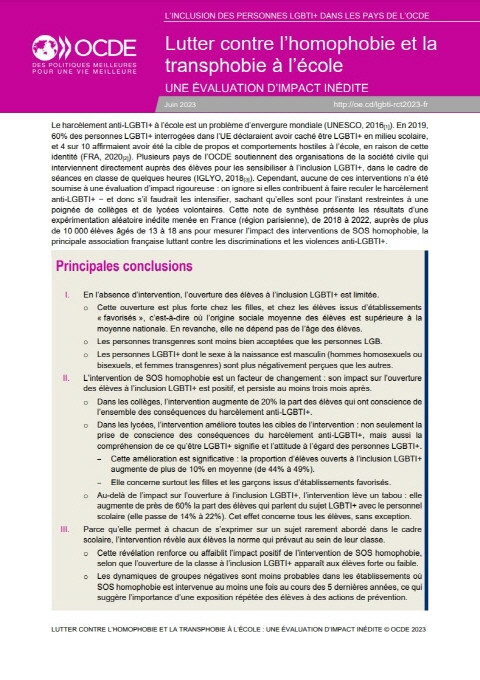 Lutter contre l’homophobie et la transphobie à l’école Year of publication: 2023 Corporate author: Organisation de coopération et de développement économiques (OCDE) Cette note de synthèse présente les résultats d’une expérimentation inédite que l’OCDE a menée en France (région parisienne), de 2018 à 2022, auprès de plus de 10 000 élèves âgés de 13 à 18 ans pour mesurer l’impact des interventions de SOS homophobie, la principale association française luttant contre les discriminations et les violences anti-LGBTI+. This briefing note presents the results of an unprecedented experiment that the OECD conducted in France (Paris region), from 2018 to 2022, with more than 10,000 pupils aged 13 to 18, to measure the impact of interventions by SOS homophobie, the leading French association fighting anti-LGBTI+ discrimination and violence.
 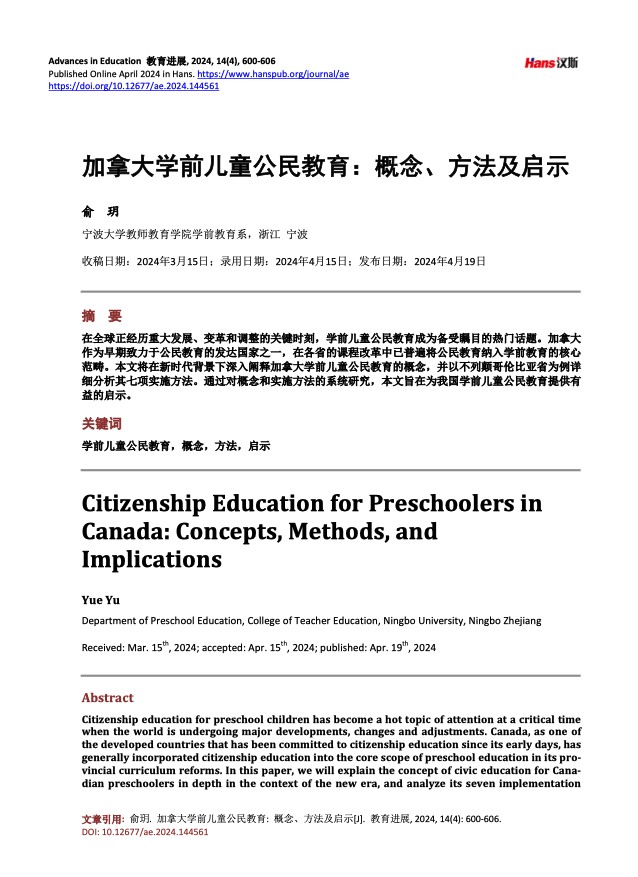 加拿大学前儿童公民教育:概念、方法及启示 (教育进展 第14卷 第4期) Year of publication: 2024 Author: 俞玥 在全球正经历重大发展、变革和调整的关键时刻,学前儿童公民教育成为备受瞩目的热门话题。加拿大作为早期致力于公民教育的发达国家之一,在各省的课程改革中已普遍将公民教育纳入学前教育的核心范畴。本文将在新时代背景下深入阐释加拿大学前儿童公民教育的概念,并以不列颠哥伦比亚省为例详细分析其七项实施方法。通过对概念和实施方法的系统研究,本文旨在为我国学前儿童公民教育提供有益的启示。
 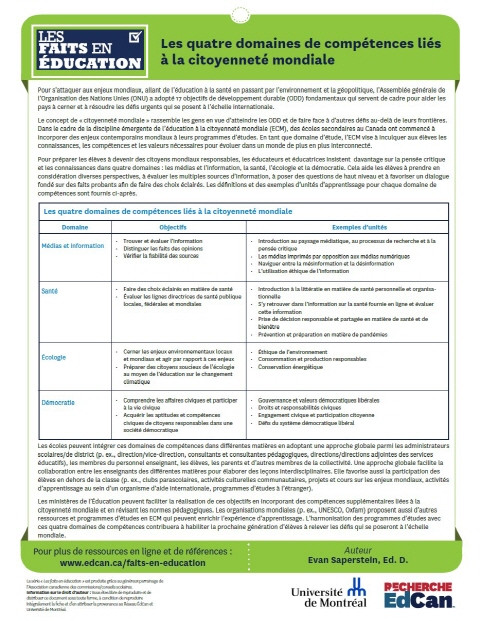 The Four Areas of Competence Linked to Global Citizenship Year of publication: 2023 Author: Evan Saperstein Corporate author: Université de Montréal | Association Canadienne d'Education Ce document présente les quatre domaines de compétences liées à la citoyenneté, et comment les intégrer à l'éducation des élèves. Pour préparer les élèves à devenir des citoyens mondiaux responsables, les éducateurs et éducatrices insistent davantage sur la pensée critique et les connaissances dans quatre domaines : les médias et l’information, la santé, l’écologie et la démocratie. This document presents the four areas of competency linked to citizenship, and how to integrate them into pupils' education. To prepare students to become responsible global citizens, educators are placing greater emphasis on critical thinking and knowledge in four areas: media and information, health, ecology and democracy. Les quatre domaines de compétences liés à la citoyenneté mondiale Year of publication: 2023 Author: Evan Saperstein Corporate author: Université de Montréal | Association Canadienne d'Education Ce document présente les quatre domaines de compétences liées à la citoyenneté, et comment les intégrer à l'éducation des élèves. Pour préparer les élèves à devenir des citoyens mondiaux responsables, les éducateurs et éducatrices insistent davantage sur la pensée critique et les connaissances dans quatre domaines : les médias et l’information, la santé, l’écologie et la démocratie. This document presents the four areas of competency linked to citizenship, and how to integrate them into pupils' education. To prepare students to become responsible global citizens, educators are placing greater emphasis on critical thinking and knowledge in four areas: media and information, health, ecology and democracy.
 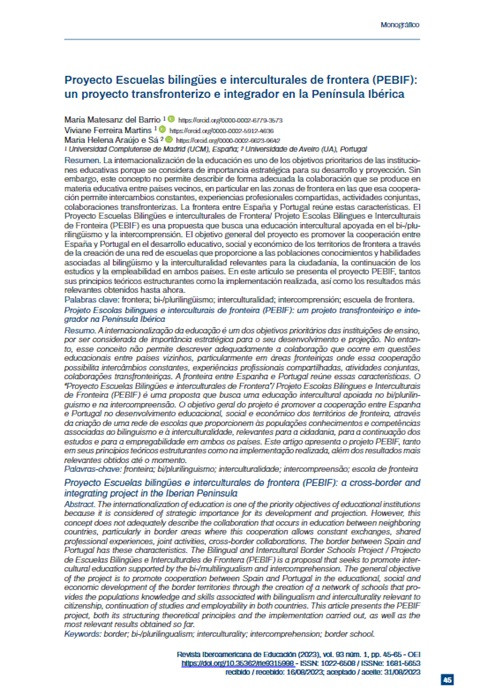 Bilingual and Intercultural Border Schools Project: A Cross-Border and Integrative Project in the Iberian Peninsula(Revista iberoamericana de educación; vol. 93, no. 1) Year of publication: 2023 Author: María Matesanz del Barrio | Maria Helena Araújo e Sá | Vivianne Ferreira Martins Corporate author: Revista Iberoamericana de Educación The Bilingual and Intercultural Border Schools Project / Projecto de Escuelas Bilingües e Interculturales de Frontera (PEBIF) is a proposal that seeks to promote inter-cultural education supported by the bi-/multilingualism and intercomprehension. The general objective of the project is to promote cooperation between Spain and Portugal in the educational, social and economic development of the border territories through the creation of a network of schools that pro-vides the populations knowledge and skills associated with bilingualism and interculturality relevant to citizenship, continuation of studies and employability in both countries. This article presents the PEBIF project, both its structuring theoretical principles and the implementation carried out, as well as the most relevant results obtained so far.