
Resources
Explore a wide range of valuable resources on GCED to deepen your understanding and enhance your research, advocacy, teaching, and learning.
1,180 Results found
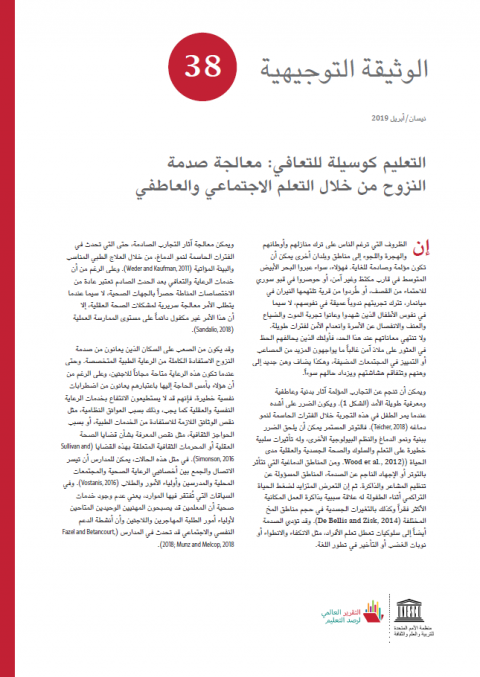 التعليم كوسيلة للتعافي: معالجة صدمة النزوح من خلال التعلم الاجتماعي والعاطفي Year of publication: 2019 وتتناول هذه الوثيقة أنشطة التعليم النظامي وغير النظامي، ولا سيما الأنشطة التي تركز على التعلم الاجتماعي والعاطفي، كنهج واعد لتوفير الدعم النفسي والاجتماعي للمهاجرين واللاجئين في مواجهة الآثار السلبية للصدمات التي تعرضوا لها. وتغطي الوثيقة سياقات الطوارئ والأوضاع المجتمعية التي تقود فينهاية المطاف إلى استقرار أطفال المهاجرين واللاجئين. كما تغطي الدراسة مسألة توفير التعليم وبيئة التعلم؛ ومحتوى التعليم والتعلم لكل من الأطفال وأولياء أمورهم؛ والدور الذي يمكن أن يقوم به المعلمون وغيرهم من المهنيين . Education as healing: addressing the trauma of displacement through social and emotional learning Year of publication: 2019 The conditions under which migrants and refugees have to leave their homes and homelands can be traumatic in the extreme. Whether they have crossed the Mediterranean in an overcrowded and unsafe boat, been barricaded in a Syrian basement for protection from shelling, or been chased away from a burning village in Myanmar, the events of their departures and their journeys can leave scars on those affected – and none more than on children who have witnessed and experienced death, loss, violence, separation from family and prolonged insecurity. Even those fortunate enough to find a sanctuary often face further hardship or discrimination in their host communities that can exacerbate their vulnerability.
 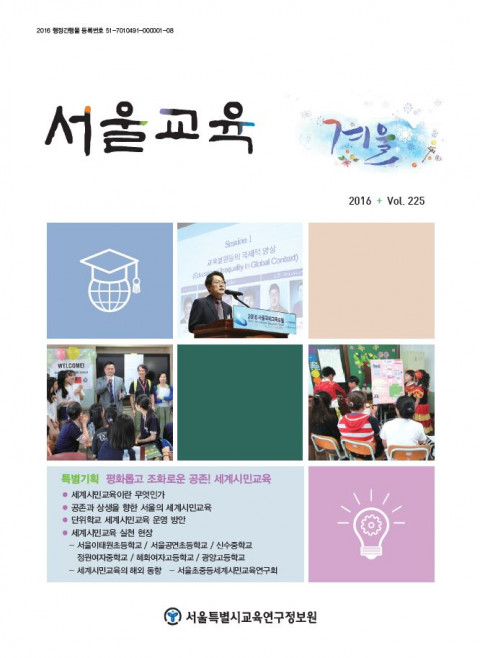 서울교육 2016년 겨울호 (제58권 통권 225호) Year of publication: 2016 Corporate author: 서울특별시교육청 교육연구정보원 권두칼럼:혁신미래교육으로서의 세계시민교육특별기획: 평화롭고 조화로운 공존! 세계시민교육세계시민교육이란 무엇인가공존과 상생을 향한 서울의 세계시민교육단위학교 세계시민교육 운영 방안세계시민교육 실천 현장 해외교육:세계시민교육의 해외 동향 출처 URL:http://www.serii.re.kr/photo/viw.do?method=getView&mcode=S029a&seq=921
  서울교육 2018년 겨울호 (제60권 통권 233호) Year of publication: 2018 Corporate author: 서울특별시교육청 교육연구정보원 권두칼럼:통일교육 패러다임 전환 키워드: #평화특별기획:평화시대를 여는 새로운 통일교육 – 평화와 민주시민교육을 담는 통일교육으로 –화해로 나아가는 평화와 공존의 통일교육한반도 대변혁기의 학교 평화·통일교육 방향 – 통일교육연구학교 운영사례를 중심으로 –해외교육:독일 통일교육이 한국 통일교육에 주는 시사점통일독일의 동독청소년 사회통합을 통해 보는 21세기 통일한국의 청소년 사회통합 정책연구:평화에 대한 비판적 공부: 평화학 출처 URL:http://www.serii.re.kr/photo/viw.do?method=getView&mcode=S029a&seq=1081
  Review of best practices in education for sustainable Development in Central Asia in the light of the implementation of the UN Decade of ESD and the UNECE Strategy on ESD Year of publication: 2009 Corporate author: Regional Environmental Centre for Central Asia (CAREC) “A review of the best practices in education for sustainable development in Central Asia in the light of the implementation of the UN Decade on ESD and the UNECE Strategy on ESD” was prepared by CAREC in 2008-2009 in the framework of the “Subregional Education for Sustainable Development Network” project, in collaboration with experts from Central Asian countries. Обзор лучших практик по образованию для устойчивого развития в Центральной Азии в свете реализации Декады ООН по ОУР и Стратегии ЕЭК ООН по ОУР Year of publication: 2009 Corporate author: Regional Environmental Centre for Central Asia (CAREC) «Обзор лучших практик по образованию для устойчивого развития в Центральной Азии в свете реализации Декады ООН по ОУР и Стратегии ЕЭК ООН по ОУР» подготовлен РЭЦЦА в 2008-2009 гг. в рамках проекта «Субрегиональная сеть по образованию для устойчивого развития», в сотрудничестве с экспертами стран Центральной Азии
  Out-of-School Children and Adolescents: Left Behind on the Road to Learning Opportunities for All Year of publication: 2017 Corporate author: UNESCO Institute for Statistics (UIS) | UNESCO Bangkok This document shows the most recent data from UIS (2017) on the rates and numbers of out-of-school children and adolescents since 2000, first globally and then within this region, examining common characteristics these young people share to provide insights into which groups are more likely to find themselves excluded from national education systems. The focus then turns to a closer examination of the obstacles out-of-school children and adolescents face in this regard and introduces educational programmes that can help them overcome these challenges. URL:http://www.flexlearnstrategies.net/out-of-school-children-and-adolescents-left-behind-on-the-road-to-learning-opportunities-for-all-2/
  Understanding the Impact of Global Citizenship Education - Using a Theory of Change Approach: An IDEAS Report Year of publication: 2017 Corporate author: International Development Education Association Scotland (IDEAS) This report provides an overview of the range of impacts IDEAS members are working towards and discusses how best to approach their assessment. It focuses, in particular, on how global citizenship education affects teachers and pupils and how this relates to attainment. The Theory of Change that it is based around offers a forward-looking framework that will over time enable us to make the evidence for global citizenship education more accessible, approachable and coherent.
  Edutech Industry Trends and Implications Year of publication: 2020 Author: Youngil Gong Corporate author: Software Policy & Research Institute Edutech, combining education with such technologies as artificial intelligence(AI), augmented reality(AR), virtual reality(VR) and blockchains, has been gaining attention. Edutech is considered a market with huge potential as its digitalization is slow in progress. The recent Covid-19 crisis has led our society to make an inevitable choice of contactless education by reopening schools online. It can be an opportunity for the country to take the lead in transforming education into a digitalized one, if we find common ground in society toward digitalization of education, make various edutech to tackle problems in education, and improve institutions to make those changes happen. 에듀테크 산업 동향 및 시사점 Year of publication: 2020 Author: 공영일 Corporate author: 소프트웨어정책연구소 AI, AR/VR, 블록체인 등의 기술을 기존 교육에 접목한 에듀테크가 주목을 받고 있다. 에듀테크는 디지털전환이 더뎌 잠재력이 큰 시장으로 평가되고 있다. 최근 코로나19 사태로 우리 사회는 온라인 개학 등 비대면 교육이라는 피할 수 없는 선택과 마주하게 되었다. 교육부문의 디지털전환에 대한 강력한 사회적 공감대 형성, 교육현장의 문제해결을 위한 에듀테크의 다양한 시도, 그리고 이를 수용할 수 있는 제도의 개선이 뒷받침된다면 우리는 코로나19 사태로 인한 교육의 위기를 교육 분야의 디지털전환을 선도할 수 있는 기회가 될 것이다.