
Resources
Explore a wide range of valuable resources on GCED to deepen your understanding and enhance your research, advocacy, teaching, and learning.
3,376 Results found
 La situación de los derechos humanos en el mundo: abril de 2024 Year of publication: 2024 Corporate author: Amnesty International Le Rapport d’Amnesty International décrit la situation des droits humains dans le monde en 2023 dans 155 pays différents. Les équipes de journalistes et d’enquêteurs de l'ONG peignent un portrait plutôt sombre, avec notamment un recul du droit des femmes, les conséquences dramatiques du réchauffement climatique sur les populations les plus vulnérables, le recul du droit de manifester, ou encore la prolifération de la haine en ligne dans le monde. La multiplication des conflits armés et le choc du 7 octobre ont également eu des conséquences dramatiques. Cependant, quelques bonnes nouvelles sont aussi à noter, avec des avancées pour les droits des personnes LGBTI par exemple. Amnesty International Report describes the human rights situation worldwide in 2023 in 155 different countries. TheNGO's teams of journalists and investigators paint a rather gloomy picture, with, in particular, a decline in women's rights, the dramatic consequences of global warming on the most vulnerable populations, a decline in the right to protest, and the proliferation of online hate around the world. The multiplication of armed conflicts and the shock of October 7 have also had dramatic consequences. However, there is some good news too, with advances in LGBTI rights for example.
 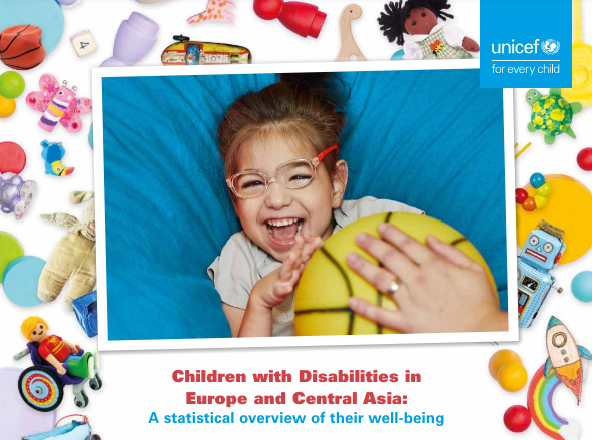 Children with Disabilities in Europe and Central Asia: A Statistical Overview of Their Well-Being Year of publication: 2023 Corporate author: United Nations (UN) This regional report provides critical evidence for decision-makers across countries to use in both policy and programming. In the context of the Global Disability Inclusion Strategy and Policy, UNICEF in Europe and Central Asia will use this valuable resource to embark on the next level of engagement to give all children with disabilities the opportunity to realize their rights on an equal basis with their peers. Дети с инвалидностью в Европе и Центральной Азии: статистический обзор их благополучия Year of publication: 2023 Corporate author: United Nations (UN) Данный региональный доклад содержит важные фактические данные, которые лица, принимающие решения в разных странах, могут использовать при разработке политических документов и программ. ЮНИСЕФ в Европе и Центральной Азии в контексте Глобальной стратегии и политики по вовлечению людей с инвалидностью будет использовать этот ценный ресурс, чтобы перейти на следующий уровень взаимодействия, дающий всем детям с инвалидностью перспективы реализации своих прав наравне со сверстниками.
  Thematic Alternative Report on the Implementation by the Republic of Tajikistan of the Convention on the Elimination of All Forms of Discrimination Against Women (CEDAW) in Relation to the Rights of Women Released from Places of Deprivation of Liberty Year of publication: 2024 Corporate author: European Union (EU) | DVV International | Bureau of Human Rights and Rule of Law (BHR) This alternative report focuses on the implementation by the Republic of Tajikistan of the UN Convention on the Elimination of All Forms of Discrimination against Women (CEDAW) in relation to the rights of women released from places of deprivation of liberty. The report contains information for the period from 2019 to 2023. Тематический альтернативный доклад о выполнении Республикой Таджикистан Конвенции о ликвидации всех форм дискриминации в отношении женщин. Применительно к правам женщин, освободившихся из мест лишения свободы Year of publication: 2024 Corporate author: EU | DVV International | Bureau of Human Rights and Rule of Law (BHR) Данный альтернативный доклад посвящен выполнению Республикой Таджикистан Конвенции ООН о ликвидации всех форм дискриминации в отношении женщин (КЛДЖ) в аспекте соблюдения прав женщин, освободившихся из мест лишения свободы. Доклад содержит информацию за период с 2019 по 2023 годы.
  2021 교육(누리)과정 연계 다문화교육 수업 도움자료: 다문화감수성 제고를 위한 세계시민교육 교수·학습 자료; 유치원 (만 3~5세) Year of publication: 2021 Author: 유준호 Corporate author: 국가평생교육진흥원 | 중앙다문화교육센터 「교육(누리)과정 연계 다문화교육 수업 도움자료」는 다문화교육 연구학교의 연차별 연구과제 수행의 결과로 마련된 수업모델을 토대로 개발되었으며, 만3세~5세 대상 유치원 교육과정과 연계한 세계시민교육 주제의 교수ᆞ학습과정안으로 구성되어 있다.
 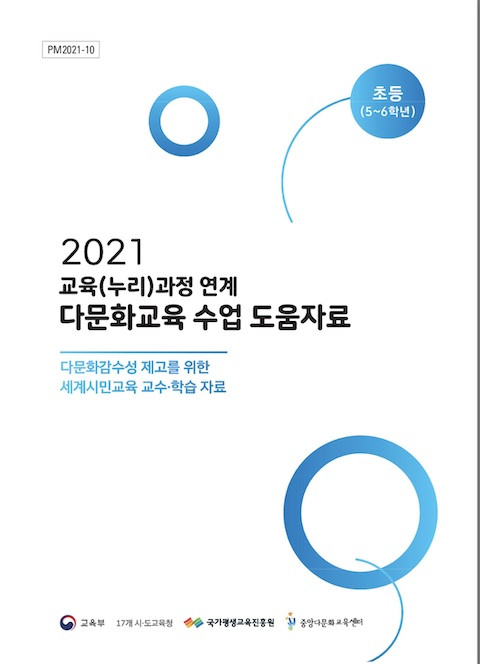 2021 교육(누리)과정 연계 다문화교육 수업 도움자료: 다문화감수성 제고를 위한 세계시민교육 교수·학습 자료; 초등 (5~6학년) Year of publication: 2021 Author: 구정화 Corporate author: 국가평생교육진흥원 | 중앙다문화교육센터 본 도움자료는 다문화감수성 제고를 위한 세계시민교육을 교과 수업에서 실시하기 위해 초등학교 5~6학년 대상의 다양한 교수·학습과정안을 담고 있다.
 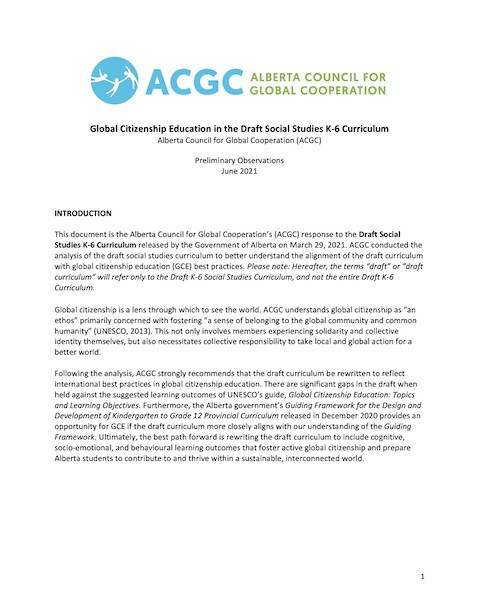 Global Citizenship Education in the Draft Social Studies K-6 Curriculum Year of publication: 2021 Corporate author: Alberta Council for Global Cooperation (ACGC) This document is the Alberta Council for Global Cooperation’s (ACGC) response to the Draft Social Studies K-6 Curriculum released by the Government of Alberta on March 29, 2021. ACGC conducted the analysis of the draft social studies curriculum to better understand the alignment of the draft with global citizenship education (GCE) best practices.Global citizenship is a lens through which to see the world. ACGC understands global citizenship as “an ethos” primarily concerned with fostering “a sense of belonging to the global community and common humanity” (UNESCO, 2013). This not only involves members experiencing solidarity and collective identity themselves, but also necessitates collective responsibility to take local and global action for a better world.Following the analysis, ACGC strongly recommends that the draft curriculum be rewritten to reflect international best practices in global citizenship education. There are significant gaps in the draft when held against the suggested learning outcomes of UNESCO’s guide, Global Citizenship Education: Topics and Learning Objectives. Furthermore, the Alberta government’s Guiding Framework for the Design and Development of Kindergarten to Grade 12 Provincial Curriculum released in December 2020 provides an opportunity for GCE if the draft curriculum more closely aligns with our understanding of the Guiding Framework. Ultimately, the best path forward is rewriting the draft curriculum to include cognitive, socio-emotional, and behavioural learning outcomes that foster active global citizenship and prepare Alberta students to contribute to and thrive within a sustainable, interconnected world.
 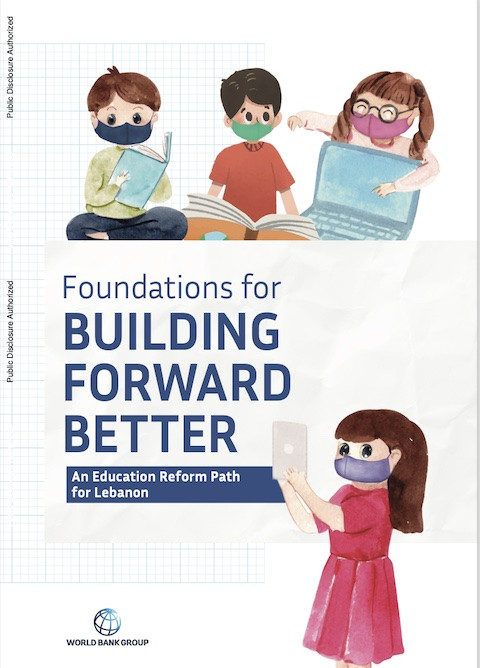 Foundations for Building Forward Better: An Education Reform Path for Lebanon Year of publication: 2021 Corporate author: World Bank Human capital development is a critical determinant of economic growth, equity, and prosperity, but outcomes in this domain are worryingly low inLebanon, risking the future of generations of children. Lebanese children lag behind their peers in human capital development—measured accordingto the World Bank (2020c) Human Capital Index—suggesting that the future productivity of the labor force and the country’s trajectory for equitablegrowth is at risk (World Bank 2020b). The Human Capital Index indicates that children born in Lebanon today will reach, on average, only 52 percentof their potential productivity when they grow up. This is lower than the average estimates for the Middle East and North Africa (MENA) region(57 percent) and upper-middle-income countries (56 percent). Lebanon’s poor performance on the Human Capital Index is largely attributed to theeducation outcomes calculated for the index. If actual years of schooling, which average approximately 10.2 years in Lebanon, are adjusted for actual learning, effective years of schooling are 40 percent less—on average, only 6.3 years of actual learning (World Bank 2020b). The most recent school closures were due to the COVID-19 pandemic, with schools being closed over 75 percent of the school year between January 2020 and February 2021.1 This will likely lead to a further and significant decrease in learning: effectively, students are facing a lost year of learning (Azevedo et al. 2021).
  Education Sector Analysis: Methodological Guidelines (Vol. 3) Year of publication: 2021 Corporate author: UNESCO International Institute for Educational Planning (IIEP) | United Nations Children's Fund (UNICEF) | Global Partnership for Education (GPE) | Foreign, Commonwealth & Development Office (UK) This present volume is the third in a series of education sector analysis (ESA) guidelines following two volumes published in 2014. The series provides methodologies and applied examples for diagnosing education systems and informing national education policies and plans. This volume proposes guidelines to strengthen national capacities in analyzing education systems in four areas: inclusive education system for children with disabilities, risk analysis for resilient education systems, functioning and effectiveness of the educational administration, and stakeholder mapping and problem-driven analysis (governance and political economy).