
Resources
Explore a wide range of valuable resources on GCED to deepen your understanding and enhance your research, advocacy, teaching, and learning.
2,772 Results found
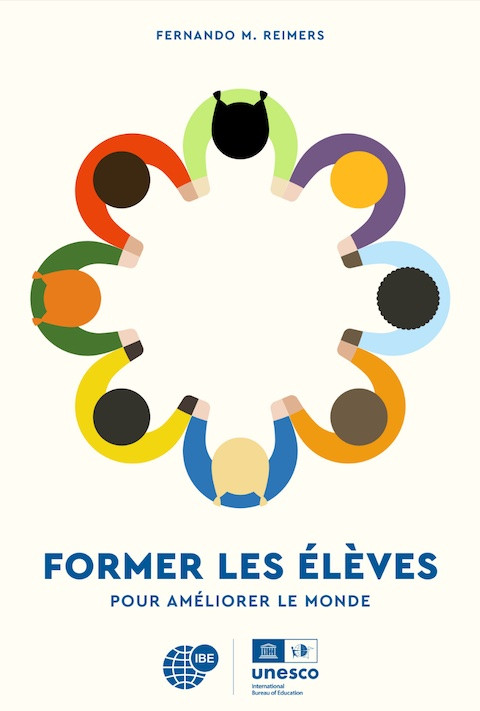 Former les élèves pour améliorer le monde Year of publication: 2021 Author: Fernando Reimers Corporate author: UNESCO International Bureau of Education (IBE) Ce livre porte sur la manière d’aider les élèves à trouver un sens à leur vie dans un monde un mutation rapide. Par une analyse approfondie et visionnaire du domaine de l’éducation à la citoyenneté mondiale, Fernando Reimers explique comment conduire la transformation des écoles et des systèmes scolaires afin de préparer plus efficacement les élèves à relever les défis actuels les plus urgents et à inventer un avenir meilleur.
 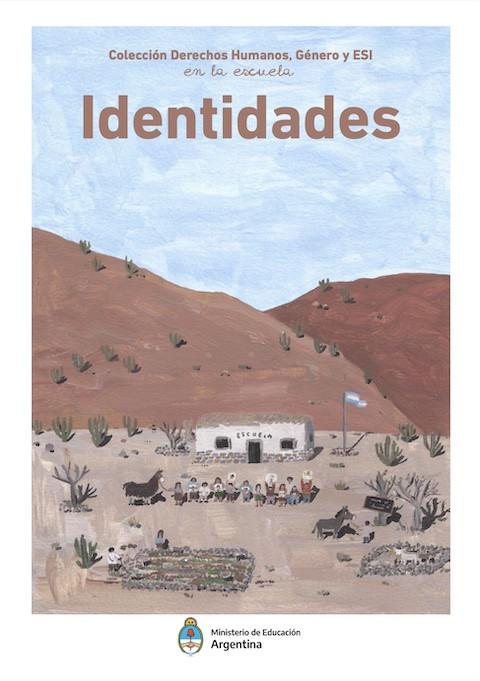 Identities Year of publication: 2021 Corporate author: Argentina. Ministry of Education In these pages, it is invited to rethink the construction of identity and identities within the framework of the school, from a transversal perspective. This concept is traversed by multiple dimensions, genealogies and debates that give shape to a privileged and nodal notion for the formation of a new democratic citizenship in schools. The idea is that both students of different educational levels, as well as teachers and families feel challenged and challenged by the reflections that this concept raises. Identidades Year of publication: 2021 Corporate author: Argentina. Ministry of Education En estas páginas, se invita a (re)pensar la construcción de la identidad y de las identidades en el marco de la escuela, desde una perspectiva transversal. Este concepto se encuentra atravesado por múltiples dimensiones, genealogías y debates que le dan forma a una noción privilegiada y nodal para la formación de una nueva ciudadanía democrática en las escuelas. La idea es que tanto estudiantes de los distintos niveles educativos, como las y los docentes y las familias se sientan interpeladas e interpelados por las reflexiones que suscita este concepto.
  Exploring the Development of Special Education Professional Knowledge of Teachers in Ordinary Schools from the Perspective of the Inclusive Education (Advances in Educatio; vol. 10, no. 3) Year of publication: 2020 Author: Chi-Man Tong | Kim-Cho Ng This paper discusses problems related to the acculturation of dislocated Chinese ethnic minority students and provides suggestions for future improvement. 从融合教育角度探讨普通学校教师的特教专业知能发展 (教育进展; vol. 10; no. 3) Year of publication: 2020 Author: 董志文 | 伍剑佐 文章探讨中国异地就读的少数民族学生的文化适应问题,并对如何改变和提升这些学生的文化适应提出相关建议。
  Race, Culture and Institution: The Construction of National Identity in Singapore’s Bilingual Policy (Advances in Social Sciences; vol. 10, no. 4) Year of publication: 2021 Author: Zhang Lifang This paper introduces the bilingual education policy in Singapore, and discusses how the policy has contributed to the construction of national identity in Singapore. 种族·文化·制度: 新加坡双语政策中的国家认同构建 (社会科学前沿; vol. 10, no. 4) Year of publication: 2021 Author: Zhang Lifang 本文介绍了新加坡的双语教育政策,并探讨了相关政策与国家认同建构的关系。
  معايير جودة الدمج التعليمي Year of publication: 2020 Author: Abdalbasit Huaidi | Eman Durki Corporate author: Child Evaluation and Education Center الفيديو عبارة عن شرح لمعايير الدمج التعليمي في مركز تعليم وتقويم الطفل. ويشرح المحاضر وثيقة جودة معايير الدمج بجميع مجالاتها وأهدافها. الفيديو مناسب للمؤسسات التربوية المهتمة بالدمج التعليمي. Quality Standards for Educational Inclusion Year of publication: 2020 Author: Abdalbasit Huaidi | Eman Durki Corporate author: Child Evaluation and Education Center The video is an explanation of the educational inclusion standards in the Child Education and Assessment Center. The lecturer explains the quality document of the integration standards in all its fields and objectives. The video is suitable for educational institutions interested in educational integration.
 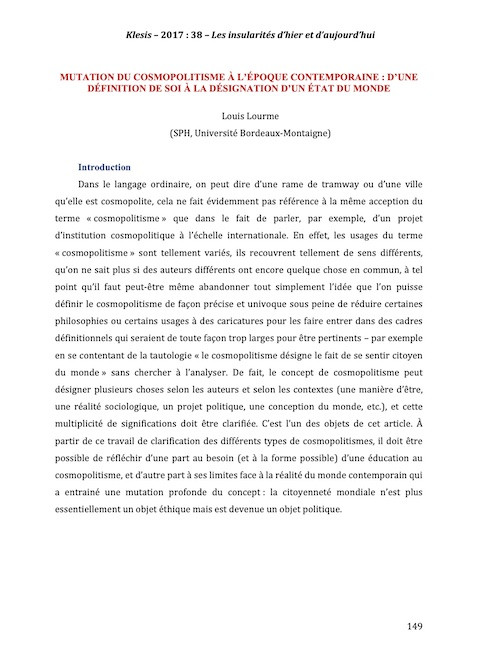 Mutation du cosmopolitisme à l’époque contemporaine : d’une définition de soi à la désignation d’un état du monde (Klesis Revue Philosophique; no. 38) Year of publication: 2017 Author: Louis Lourme Corporate author: Université Paul-Valéry Dans le langage ordinaire, on peut dire d’une rame de tramway ou d’une ville qu’elle est cosmopolite, cela ne fait évidemment pas référence à la même acception du terme « cosmopolitisme » que dans le fait de parler, par exemple, d’un projet d’institution cosmopolitique à l’échelle internationale. En effet, les usages du terme « cosmopolitisme » sont tellement variés, ils recouvrent tellement de sens différents, qu’on ne sait plus si des auteurs différents ont encore quelque chose en commun, à tel point qu’il faut peut-être même abandonner tout simplement l’idée que l’on puisse définir le cosmopolitisme de façon précise et univoque sous peine de réduire certaines philosophies ou certains usages à des caricatures pour les faire entrer dans des cadres définitionnels qui seraient de toute façon trop larges pour être pertinents – par exemple en se contentant de la tautologie « le cosmopolitisme désigne le fait de se sentir citoyen du monde » sans chercher à l’analyser. De fait, le concept de cosmopolitisme peut désigner plusieurs choses selon les auteurs et selon les contextes (une manière d’être, une réalité sociologique, un projet politique, une conception du monde, etc.), et cette multiplicité de significations doit être clarifiée. C’est l’un des objets de cet article. À partir de ce travail de clarification des différents types de cosmopolitismes, il doit être possible de réfléchir d’une part au besoin (et à la forme possible) d’une éducation au cosmopolitisme, et d’autre part à ses limites face à la réalité du monde contemporain qui a entrainé une mutation profonde du concept : la citoyenneté mondiale n’est plus essentiellement un objet éthique mais est devenue un objet politique.