
Resources
Explore a wide range of valuable resources on GCED to deepen your understanding and enhance your research, advocacy, teaching, and learning.
3,224 Results found
 Inequidad de género en los logros de aprendizaje en educación primaria ¿Qué nos puede decir TERCE?; resumen ejecutivo Year of publication: 2016 Author: Denisse Gelber, Ernesto Treviño, Pamela Inostroza Corporate author: UNESCO Santiago This premise of work clearly establishes that promoting learning opportunities for all will be one of the priorities in the Education 2030. Within this framework, UNESCO Santiago has its own instrument that allows delivering diagnosis and analysis in depth about the learning inequality within the region; the Thrid Regional Comparative and Explanatory Study, TERCE - carried out by the Latin American Laboratory for Assessment of the Quality of Education, LLECE, body bringing together 15 countries and coordinated by our Office.
  Global Monitoring of Target 4.7: Themes in National Curriculum Frameworks; Background Paper Prepared for the 2016 Global Education Monitoring Report Year of publication: 2016 Corporate author: UNESCO International Bureau of Education (IBE) This study is an initial attempt to monitor ESD and GCED content in curricula globally. The goal here is to analyse national curriculum documents to reveal if, how, and to what extent ESD and GCED content is present across the globe. For this purpose, the research team developed a coding scheme based on key ESD and GCED knowledge, skills, behaviours and pedagogies that was used in evaluating the various national curriculum documents for evidence of ESD and GCED content. In this paper, we present the study in the following order. Further explanation of ESD and GCED, and a discussion of issues relating to their implementation and monitoring will come first. Then we will review similar studies that have also attempted to monitor GCED and ESD through content analysis. The study’s methods and findings will then be presented, followed by a discussion of the challenges addressed in developing a coding system to monitor curricula effectively. Finally, we share a series of recommendations that will focus on ways for moving forward in monitoring GCED and ESD effectively, both at a curricular level and beyond.
 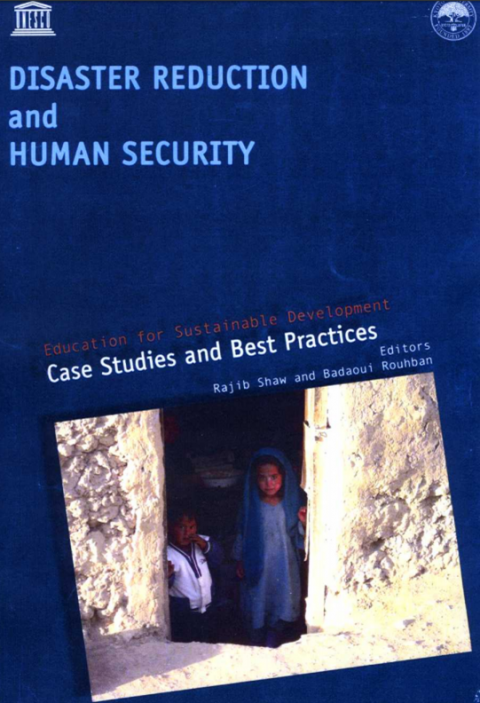 Disaster reduction and human security: education for sustainable development; case studies and best practices Year of publication: 2005 Corporate author: Kyoto University. Graduate School of Global Environmental Studies Disaster reduction, human security, education and sustainable development are the four key issues, which are considered in the current compilation. A quick glance of the case studies will tell us the varieties of focus areas. WCD R Thematic Cluster 3 (Knowledge, Innovation and Education: To Build a Culture of Safety and Resilience) identifies four themes under the cluster: Education, Research, Public Awareness and Community Empowerment. A majority of case studies focus on community activities, especially on ho w the communities were able to cope with different types of disasters in different socio-economic context. These are all learning processes for the community, especially to enhance the resilience among its members. A number of these studies include public awareness, training and capacity building programmes. Quite a number of case studies focus on professional expertise, like microzonation, mapping, planning, hazard assessment, and development of risk reduction tools. These are all related to education and research. There are some case studies, which focus on formal education at school and colleges, but are linked to practical learning exercise. Distance learning has appeared as one of the possible media to reach the global mass, and to reach the farthest and the most needy group. The link between on-site testing and on-line learning has been emphasized by several case studies. La prévention des catastrophes et de la sécurité humaine: l'éducation pour le développement durable; études de cas et les meilleures pratiques Year of publication: 2005 Corporate author: Kyoto University. Graduate School of Global Environmental Studies La prévention des catastrophes, la sécurité humaine, l'éducation et le développement durable sont les quatre questions clés, qui sont pris en compte dans la compilation actuelle. Un rapide coup d'œil des études de cas va nous dire les variétés de domaines d'intervention. WCD R thématique Cluster 3 (Connaissance, innovation et éducation: construire une culture de la sécurité et la résilience) identifie quatre thèmes du groupe: l'éducation, la recherche, la sensibilisation du public et l'autonomisation des communautés. La majorité des études de cas se concentrent sur les activités communautaires, en particulier sur ho w les communautés ont pu faire face à différents types de catastrophes dans le contexte socio-économique différent. Ce sont tous les processus d'apprentissage pour la communauté, en particulier pour améliorer la résilience parmi ses membres. Un certain nombre de ces études comprennent des programmes de sensibilisation du public, la formation et le renforcement des capacités. Un certain nombre d'études de cas se concentrer sur l'expertise professionnelle, comme microzonage, la cartographie, la planification, l'évaluation des risques, et le développement d'outils de réduction des risques. Ceux-ci sont tous liés à l'éducation et à la recherche. Il y a quelques études de cas, qui mettent l'aCECnt sur l'éducation formelle à l'école et les collèges, mais sont liés à la pratique d'exercice d'apprentissage. L'enseignement à distance est apparu comme l'un des médias possibles pour atteindre la masse globale, et d'atteindre le plus loin et le groupe le plus nécessiteux. Le lien entre les tests sur site et l'apprentissage en ligne a été soulignée par plusieurs études de cas.
 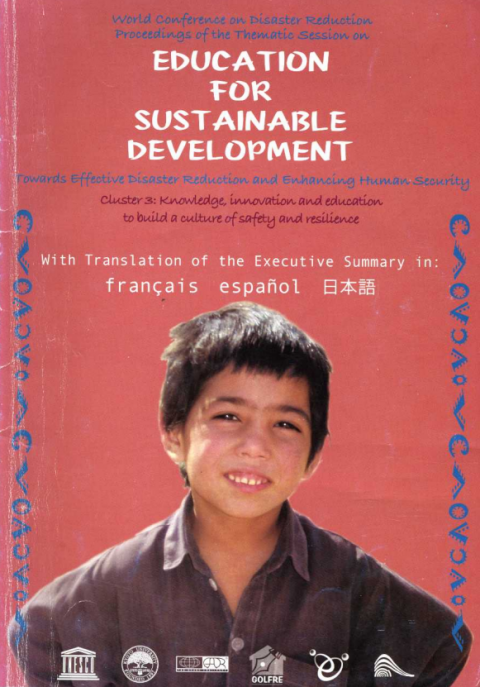 Proceedings of the thematic session on education for sustainable development: towards effective disaster reduction and enhancing human security; cluster 3: knowledge, innovation and education to build a culture of safety and resilience Year of publication: 2005 Author: Rajib Shaw | Badaoui Rouhban Corporate author: Kyoto University. Graduate School of Global Environmental Studies | Global Alliance for Disaster Reduction | Global Open Learning Forum on Risk Education | Disaster Reduction Alliance | International Institute of Earthquake Engineering and Seismology Ten years ago, the city of Kobe and its adjoining areas in Hyogo prefecture of Japan were hit by a strong earthquake, leaving behind a trail of death and destruction. This earthquake was a turning point in disaster reduction initiatives in Japan, resulting in two prominent changes: 1) a blending of technological and social issues in the field of research and application, and 2) an enhanced participation of civil society in disaster reduction Initiatives. Since Japan had long been one of the most developed countries in the field of earthquake engineering, the tragedy in Kobe posed a daunting question: 'how to fill the gap between knowledge and practice?' This question is not only for Japan, but is pertinent to many other countries. With the advancement of technology, the knowledge base is growing, and it is now time to tackle this question in order to save lives and properties from natural disasters. The World Conference on Disaster Reduction (WCDR), at the 10th anniversary of the Kobe earthquake, is therefore of special significance, providing an excellent platform to share experiences, expertise, and lessons from different parts of the world. The year 2005 is also the beginning of the United Nations Decade of Education for Sustainable Development (DESD: 2005-2014) which is led by UNESCO. Compte rendu de la session thématique sur l'éducation pour le développement durable: vers une réduction efficace des catastrophes et le renforcement de la sécurité humaine; groupe 3: la connaissance, l'innovation et l'éducation pour instaurer une culture de la sécurité et de résilience Year of publication: 2005 Author: Rajib Shaw | Badaoui Rouhban Corporate author: Kyoto University. Graduate School of Global Environmental Studies | Global Alliance for Disaster Reduction | Global Open Learning Forum on Risk Education | Disaster Reduction Alliance | International Institute of Earthquake Engineering and Seismology Il y a dix ans, la ville de Kobe et ses zones adjacentes dans la préfecture de Hyogo du Japon ont été touchés par un fort tremblement de terre, laissant derrière lui une traînée de mort et de destruction. Ce tremblement de terre a été un point tournant dans les initiatives de prévention des catastrophes au Japon, ce qui entraîne deux changements importants: 1) un mélange de questions technologiques et sociales dans le domaine de la recherche et de l'application, et 2) une participation accrue de la société civile dans les initiatives de prévention des catastrophes. Depuis que le Japon a longtemps été l'un des pays les plus développés dans le domaine de l'ingénierie des tremblements de terre, la tragédie de Kobe a posé une question de taille:? Comment combler le fossé entre les connaissances et la pratique ' Cette question est non seulement pour le Japon, mais est pertinent pour de nombreux autres pays. Avec l'avancement de la technologie, la base de connaissances est en croissance, et il est maintenant temps d'aborder cette question dans le but de sauver des vies et des propriétés des catastrophes naturelles. La Conférence mondiale sur la prévention des catastrophes (CMPC), au 10e anniversaire du tremblement de terre de Kobe, est donc d'une importance particulière, en fournissant une excellente plateforme pour partager des expériences, des compétences et des leçons de différentes parties du monde. L'année 2005 est aussi le début de la Décennie des Nations Unies pour l'éducation pour le développement durable (DEDD: 2005-2014) qui est dirigé par l'UNESCO.
  A Geographical - Political Analysis of the Determinants of women's empowerment in Iraq Year of publication: 2020 Author: Zainab Ali Mazloum, Lateef Kamel Kelaiwy Empowering women is one of the modern topics that geopolitics is concerned with, especially after the United Nations adopted in the eighties of the twentieth century the strategy of empowering women against the background of discrimination against them on the basis of gender and depriving them of equal opportunities compared to males in the fields of learning and work as well as drawing state policy, that empowerment The political status of women is based on two main variables: the first is the removal of legislative, administrative, and social determinants that hinder women's political participation, and the second is the creation of political measures and measures that support women's participation and increase their effectiveness by developing their capabilities, nah As for employing those capabilities in the institutional framework of political units, so states at various levels and orientations, including Iraq, are keen to eliminate gender differences and women's empowerment through achieving comprehensive development in general and political development in particular because they mimic political empowerment, however Iraq has said a lot in this field by doing The many political transformations and wars that affected the state, as well as the great challenges that faced and still face the Iraqi political decision-maker with its various political, security, economic and social dimensions.
 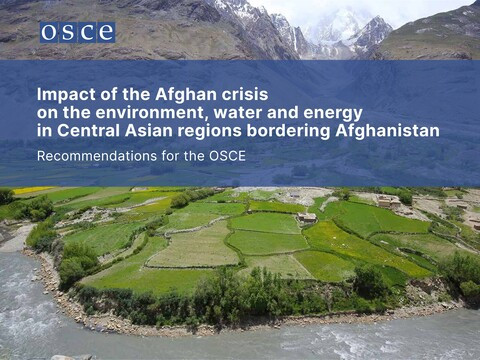 Impact of the Afghan Crisis on the Environment, Water and Energy in Central Asian Regions Bordering Afghanistan Year of publication: 2023 Corporate author: Organization for Security and Co-operation in Europe (OSCE) Development projects in Central Asia are diverse. In 2021, the Interstate Commission on Sustainable Development of Central Asia adopted the Central Asian Sustainable Development Program till 2030, while a regional climate adaptation strategy is being developed. Afghanistan is not involved in regional environmental and water processes. The results and lessons from the development projects could be useful in tackling the effects of the Afghan crisis. Исследование влияния кризиса в Афганистане на экологическую, водную и энергетическую ситуацию в приграничных областях Центральной Азии Year of publication: 2023 Corporate author: Organization for Security and Co-operation in Europe (OSCE) В странах Центральной Азии также реализуются проекты развития в различных сферах. Для целей охраны природы на региональном уровне в 2021 г. МКУР принята центрально-азиатская программа устойчивого развития до 2030 г., и разрабатывается региональная стратегия адаптации к изменению климата, но Афганистан в региональных экологических и водных процессах не участвует. Результаты и наработки проектов могут оказаться полезными для обмена опытом и масштабирования, в том числе для смягчения кризиса в Афганистане.
  Statistics of the Sustainable Development Goals in Kazakhstan Year of publication: 2023 Corporate author: ООН-женщины | Бюро национальной статистики Агентства по стратегическому планированию и реформам Республики Казахстан The publication reflects data on the current state and progress in the field of sustainable development based on available official data and statistics on the SDGs, taking into account gender aspects. The collection was presented at the national seminar on the dissemination of official statistics organized by the Bureau of National Statistics of Kazakhstan and the United Nations Economic Commission for Europe (UNECE) on October 19-21, 2022.