
Resources
Explore a wide range of valuable resources on GCED to deepen your understanding and enhance your research, advocacy, teaching, and learning.
950 Results found
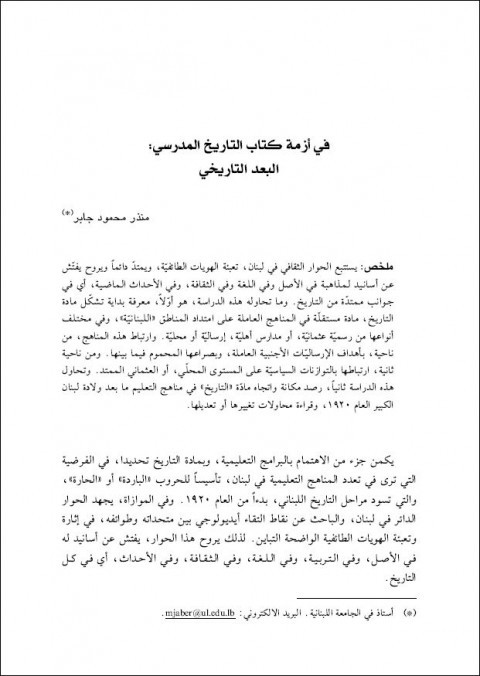 في أزمة كتاب التاريخ المدرسي: البعد التاريخي Year of publication: 2012 Author: جابر، منذر محمود Corporate author: Lebanese Association for Educational Studies (LAES) يستتبع الحوار الثقافي في لبنان، تعبئة الهويات الطائفيّة، ويمتدّ دائماً ويروح يفتّش عن أسانيد لمذاهبة في الأصل وفي اللغة وفي الثقافة، وفي الأحداث الماضية، أي في جوانب ممتدّة من التاريخ. وما تحاوله هذه الدراسة، هو أوّلاً، معرفة بداية تشكّل مادة التاريخ، مادة مستقلّة في المناهج العاملة على امتداد المناطق "اللبنانيّة"، وفي مختلف أنواعها من رسميّة عثمانيّة، أو مدارس أهليّة، إرساليّة أو محليّة. وارتباط هذه المناهج، من ناحية، بأهداف الإرساليّات الأجنبية العاملة، وبصراعها المحموم فيما بينها. ومن ناحية ثانية، ارتباطها بالتوازنات السياسيّة على المستوى المحلّي، أو العثماني الممتد. وتحاول هذه الدراسة ثانياً، رصد مكانة واتجاه مادّة "التاريخ" في مناهج التعليم ما بعد ولادة لبنان الكبير العام 1920، وقراءة محاولات تغييرها أو تعديلها. The History Textbook Crisis: A Historical Background Year of publication: 2012 Author: جابر، منذر محمود Corporate author: Lebanese Association for Educational Studies (LAES) The cultural dialogue in Lebanon brings into play attempts to build up sectarian identities, by seeking arguments in support of the claims of each sect whether in terms of origin, language, culture or past events that stretch back in history. This study tries to: 1) Explore the beginnings of the development of history as an independent subject in the curricula of schools throughout the regions of “Lebanon”, whether Ottoman state schools or private schools, missionary or local. It also looks into the connections between these curricula and the aims of the foreign missions working in the field, and the fierce inter-fighting among them on one hand, and the connections with the local political power balance at both the local and the extended Ottoman level, on the other. 2) Take stock of the importance and development of the history subject in the school curricula after the creation of Greater Lebanon in 1920, and analyze the attempts made to change or revise it.
 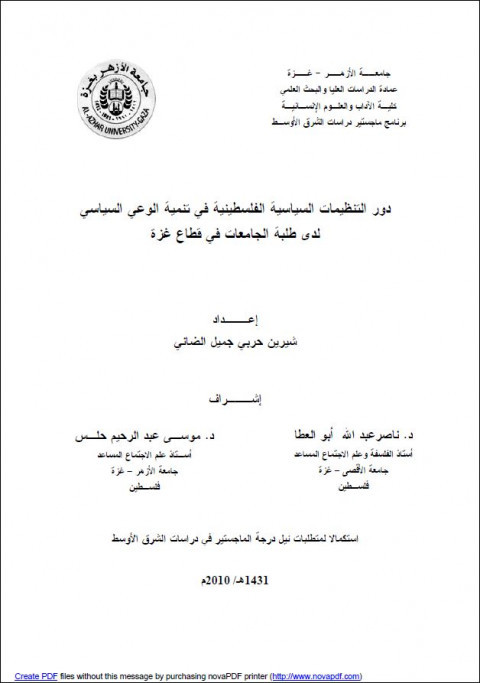 دور التنظيمات السياسية الفلسطينية في تنمية الوعي السياسي لدى طلبة الجامعات في قطاع غزة Year of publication: 2010 Author: الضاني، شيرين حربي جميل Corporate author: Al-Azhar University (Gaza) تهدف هذه الدراسة إلى التعرف على دور التنظيمات السياسية الفلسطينية في تنمية الوعي السياسي لدى طلبة الجامعات في قطاع غزة، وذلك من خلال إجراء دراسة ميدانية على عينة من طلبة جامعات قطاع غزة، حيث أجابوا على بعض التساؤلات التي تضمنت الكشف عن مستوى الوعي السياسي لديهم نحو المعرفة السياسية العامة تجاه بعض القضايا والأحداث والشخصيات السياسية، والانتماء للهوية الوطنية، والتنظيمات السياسية ومفاهيم الديمقراطية والتسامح والتعددية، والمشاركة السياسية، ودور الأنشطة التنظيمية الممارسة داخل الجامعات في تعزيز الوعي السياسي لأبنائها الطلبة. وتعتمد الدراسة على منهجين في البحث والتحليل: المنهج التاريخي... والمنهج الوصفي التحليل.... وقد استخدمت الباحثة استبانة... واعتمدت على بعض الأساليب الإحصائية... يتكون مجتمع الدراسة من طلبة البكالوريوس في الجامعات الرئيسية في قطاع غزة وهي جامعة الأزهر، والجامعة الإسلامية، وجامعة القدس المفتوحة، وجامعة الأقصى والبالغ عددهم 60 طالبا و112 طالبة تقريبا. وأجريت الدراسة على عينة تتكون من 600 مفردة من مجتمع الدراسة... توصلت الدراسة إلى العديد من النتائج، أهمها: 1) انخفاض مستوى الوعي السياسي العام لدى طلبة الجامعات الفلسطينية في قطاع غزة. 2) ارتفاع مستوى الوعي السياسي لدى الطلبة الذكور مقارنة بالإناث. 3) ارتفاع نسبة الوعي السياسي العام لدى الطلبة الذين تتراوح أعمارهم بين 28 و32 عام مقارنة بباقي الفئات العمرية. 4) سجل الطلبة في جامعتي الإسلامية والقدس المفتوحة مستوى أعلى في الوعي السياسي من الطلبة في جامعتي الأزهر والأقصى. 5) سجل طلبة كلية الآداب أعلى درجة في مستوى الوعي السياسي مقارنة بباقي الكليات، بينما سجل طلبة كلية التربية أقل درجات في مستوى الوعي السياسي العام....(الخ)... 12) إنخفاض مستوى الانتماء الوطني لدى الطلبة في جامعات قطاع غزة، وتراجع قيام التنظيمات السياسية بوظائفها التوعوية في تعزيز الانتماء، وبلورة الهوية الوطنية ونشر الوعي السياسي. The Role of the Palestinian Political Organizations in Developing the Political Awareness of University Students in Gaza Strip Year of publication: 2010 Author: الضاني، شيرين حربي جميل Corporate author: Al-Azhar University (Gaza) The purpose of this study is to investigate the role of the Palestinian political organizations in developing the political awareness of university students in the Gaza Strip using a field study on a sample of university students (Al-Azhar University, The Islamic University, Al- Aqsa University, and Al-Quds Open University). The students answered some questions that explored their political awareness and knowledge of some public issues, events and political figures, as well their relation to the national identity, political organizations, the concepts of democracy, tolerance, pluralism, political participation and the role of regulatory activities at universities in promoting political awareness of their students. The study used two methods of research and analysis: 1) historical research method.. and 2) a descriptive analytical method... A questionnaire was used... (plus) statistical methods to discuss and analyze the results... The population of study (60 male, 112 female) were bachelor students at the main universities in the Gaza Strip. The study sample was 600 of the study population... Main findings of the study: 1) Low level of public political awareness. 2) High level of political awareness by female students compared to male students. 3) High percentage of public political knowledge by students between 28-32 years compared to other age groups. 4) Students at in The Islamic and Al-Quds Open Universities have a higher level of public political knowledge... 5) Students at arts colleges have higher public political knowledge... but education college students showed lower public political knowledge... 12) National affiliation showed a low level and the political organizations showed a decline in promoting political awareness and national affiliation and in developing the national identity.
  منهاج التربية المدنية الفلسطيني ودوره في التنشئة الديمقراطية لدى طلاب المرحلة الأساسية في فلسطين : دراسة حالة محافظة نابلس 1994-2006 Year of publication: 2007 Author: حسين، نذير أحمد مصطفى Corporate author: An-Najah National University هدفت هذه الدراسة إلى استقصاء دور التربية المدنية الفلسطينية في التنشئة الديمقراطية في صفوف مرحلة التعليم الأساسي التي يدرس فيها منهاج التربية المدنية الفلسطيني والكشف عن الإشكاليات التي يعاني منها منهاج التربية المدنية كمقرر مستقل في المدارس الفلسطينية. تتمثل الإشكالية الأولى في عدم وضوح الإطار المفاهيمي والفلسفي الذي استند إليه المنهاج، ينجم عن ذلك وجود حالة من عدم الانسجام بين المدرس والمادة الدراسية والذي ينعكس أثره على الطالب. أما الإشكالية الثانية فقد فرضها المناخ الاجتماعي الفلسطيني السائد في المجتمع الفلسطيني المتأثر بتداعيات الاحتلال الإسرائيلي، والوضع السياسي الفلسطيني. إن أهم ما خلصت إليه الدراسة أن أهم ما يجب أن يراعيه منهاج التربية المدنية الفلسطيني في مجال التنشئة الديمقراطية، هو أن الديمقراطية ليست أنموذجا جاهزا يمكن تطبيقه بمفهومه الغربي في المجتمع الفلسطيني. لذلك فإن التنشئة الديمقراطية الفلسطينية يجب أن تراعي أن النموذج الديمقراطي المستهدف تطبيقه يجب أن يناسب في نظرياته وتطبيقاته قيم المجتمع الفلسطيني وعقيدته وتقاليده وتراثه وظروفه الخاصة. Palestinian Civic Education Curriculum and its Role in Democratic Upbringing of Basic Stage Students in Palestine: Case Study, Nablus Governorate 1994-2006 Year of publication: 2007 Author: حسين، نذير أحمد مصطفى Corporate author: An-Najah National University This study aims to investigate the role of Civic Education in the democratic upbringing of students in the basic education classes, in Palestine. Civic Education can play a major role if its topics are in line with the relevant ongoing comprehensive development plans of which political developments occupies the front seat. Civic Education is seen as a Palestinian societal necessity towards democratic transition in the unique Palestinian situation...and within the framewoork of an effective educational system that is comprehensive, systematic, and modern, where it takes into consideration the structure and nature of the Palestinian society and its Arab-Islamic roots in the aspired state of Palestine. Since its launch as an independent course in Palestinian schools, Civic Education has been suffering from two obstacles vague philosophical and conceptual framework (which leads to lack of harmony between the educator and the teaching material thus reflecting itself on the students),and the dominant social climate (which is affected by the Israeli occupation and the political situation in Palestine). those are obstacle to the democratic upbringing which might otherwise satisfy the needs of the nation. Democracy in civic education here is offered from the standpoint that it is a quest to catch up with the contemporary needs. The democratic concepts in the curriculum are parallel to those in the West, without identifying the Arab-Islamic thought in the Palestinian society. this is expected to generate conflict due to the differences between two totally different societies (religion, culture, civilization, history, ideology, regime, and others). This study concludes that Palestinian civic education should take into consideration the fact that democracy is not a ready-made model that can be applied blindly in Palestine. In other words, democratic upbringing in Palestine should adopt only what rhymes with Palestinian values, laws, history and the peculiar circumstances.
 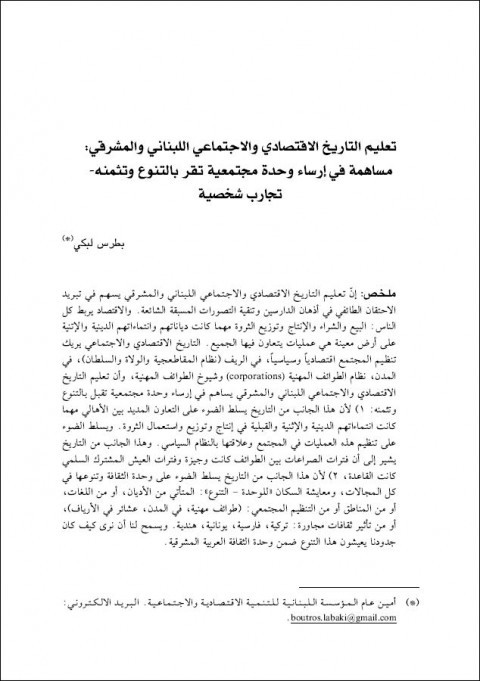 تعليم التاريخ الاقتصادي والاجتماعي اللبناني والمشرقي : مساهمة في إرساء وحدة مجتمعية تقر بالتنوع وتثمنه: تجارب شخصية Year of publication: 2012 Author: لبكي، بطرس Corporate author: Lebanese Association for Educational Studies (LAES) إنّ تعليم التاريخ الاقتصادي والاجتماعي اللبناني والمشرقي يسهم في تبريد الاحتقان الطائفي في أذهان الدارسين وتنقية التصورات المسبقة الشائعة. والاقتصاد يربط كل الناس: البيع والشراء والإنتاج وتوزيع الثروة مهما كانت دياناتهم وانتماءاتهم الدينية والإتنية على ارض معينة هي عمليات يتعاون فيها الجميع. التاريخ الاقتصادي والاجتماعي: يريك تنظيم المجتمع اقتصادياً وسياسياً، في الريف (نظام المقاطعجية والولاة والسلطان)، في المدن: نظام الطوائف المهنية (corporations) وشيوخ الطوائف المهنية وأن تعليم التاريخ الاقتصادي والاجتماعي اللبناني والمشرقي يساهم في إرساء وحدة مجتمعية تقبل بالتنوع وتثمنه: 1) لأن هذا الجانب من التاريخ يسلط الضوء على التعاون المديد بين الأهالي مهما كانت انتماءاتهم الدينية والإثنية والقبلية في إنتاج وتوزيع واستعمال الثروة. ويسلط الضوء على تنظيم هذه العمليات في المجتمع وعلاقتها بالنظام السياسي. وهذا الجانب من التاريخ يشير إلى أن فترات الصراعات بين الطوائف كانت وجيزة وفترات العيش المشترك السلمي كانت القاعدة، 2) لأن هذا الجانب من التاريخ يسلط الضوء على وحدة الثقافة وتنوعها في كل المجالات، ومعايشة السكان "للوحدة - التنوع": المتأتي من الأديان، أو من اللغات، أو من المناطق أو من التنظيم المجتمعي: (طوائف مهنية، في المدن، عشائر في الأرياف)، أو من تأثير ثقافات مجاورة: تركية، فارسية، يونانية، هندية. ويسمح لنا أن نرى كيف كان جدودنا يعيشون هذا التنوع ضمن وحدة الثقافة العربية المشرقية. Teaching Lebanese-Oriental Economic and Social History: Promoting a Societal Unity Which Acknowledges and Values Diversity Year of publication: 2012 Author: لبكي، بطرس Corporate author: Lebanese Association for Educational Studies (LAES) Teaching the economic and social history of the Lebanon and the Orient contributes towards the cooling down of sectarian tensions in the minds of learners and clears up common prejudices. Economic transactions connect everyone within a given area: Buying and selling, production and distribution of resources are operations in which everyone cooperates, regardless what their religious, confessional or ethnic affiliation might be. Economic and social history informs about the economic and political organization of society: in rural areas taxed farmers, governors and the Sultan; in the cities guilds (corporations) and the sheikhs of the guilds/corporations. Indeed, teaching the economic and social history of Lebanon and the Orient contributes to a societal unity which acknowledges and values diversity because this aspect of history highlights the longstanding cooperation among the people in the production, distribution or use of resources, no matter what their religious, ethnic or tribal affiliation might be. It also highlights the organization of these activities in society and their relation to the political system. This aspect of history also points to the fact that the intervals of conflict between the sectarian communities were short, whereas the intervals of peacefully living together were the rule. Besides, this aspect of history highlights the cultural unity and its diversity in all domains and the fact that all are shaped in their lives by this same experience of unity in diversity which comes from: religions, languages, regions, societal organization (guilds/corporations in the cities, clans in rural areas) or adjacent cultures: Turkish, Persian, Greek and Indian. It allows us to see how our ancestors lived this diversity within the unity of the Arab-Oriental culture.
  صورة الآخر في الخطاب التربوي المغربي بين طموح الأهداف ومحدودية التأثير Year of publication: 2014 Author: حميد، عبد الإله Corporate author: International Group for Consulting and Training (IGCT) تعالج الدراسة صورة الآخر في الكتب والبرامج المدرسية المغربية الخاصة بالمرحلة الثانوية الإعدادية، وتمثلات عينة من أساتذة هذه المرحلة التعليمية. وتحاول هذه الدراسة تشخيص طبيعة على تقنية تحليل صورة الآخر في برامج كتب التاريخ اعتمادا على المضمون، والذي يقوم على استخراج الإشارات والعبارات التي تخص الموضوع، وتبويبها في فئات موضوعاتية بقصد رسم صورة عامة للآخر. وقد تم الاعتماد أيضا على الإستبانة لرصد تمثلات عينة من مدرسي مادة التاريخ حول الآخر. وبناء على نتائج التحليل أشارت أهم التوصيات المتوصل إليها إلى ضرورة تصحيح الاختلالات والمشاكل التي تميز مقاربة البرامج الحالية لموضوع تمثل الآخر مع الدعوة إلى بناء مقاربة جديدة تقوم على مبادئ التربية على التنوع الثقافي، باعتبارها إطارا ناظما للقيم والإجراءات المعتمدة للتربية في مجتمع متعدد الثقافات كالمجتمع المغربي. The Image of the Other in Moroccan Educational Programs between Ambitious Objectives and Limited Efficiency Year of publication: 2014 Author: حميد، عبد الإله Corporate author: International Group for Consulting and Training (IGCT) This study aims to shed light on the image of ‘the Other’ in Moroccan schools’ curricula, at the secondary and preparatory levels, including teachers. The study addresses the image of the Other in of history books and school programs. It attempts to diagnose the nature of the image of the Other in history books using content analysis techniques that is based on the extraction of relevant signs and phrases and classifying them into thematic categories in order to draw a general picture of the Other.The study used a questionnaire to monitor a sample of among history teachers regarding their representations of the Other. The study tried to provide a set of recommendations and practical suggestions that aim to correct distortions and problems that characterize the current programs. The study advocates a new approach to teaching history that is based on the principles of education on cultural diversity and “tolerance” which should be the regulating framework for values and measures of the educational system in a multicultural society such as the Moroccan society.