
Resources
Explore a wide range of valuable resources on GCED to deepen your understanding and enhance your research, advocacy, teaching, and learning.
3,438 Results found
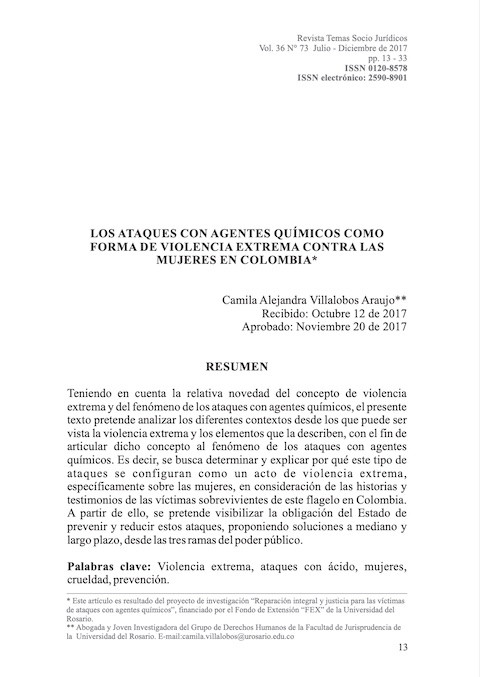 Los ataques con agentes químicos como forma de violencia extrema contra las mujeres en Colombia (Revista Temas Socio Jurídicos; Vol. 36 No. 73) Year of publication: 2017 Author: Camila Alejandra Villalobos Araujo Corporate author: Universidad Autónoma de Bucaramanga (UNAB) Este texto pretende analizar los diferentes contextos desde los que puede ser vista la violencia extrema y los elementos que la describen, con el fin de articular dicho concepto al fenómeno de los ataques con agentes químicos. Es decir, se busca determinar y explicar por qué este tipo de ataques se configuran como un acto de violencia extrema, específicamente sobre las mujeres, en consideración de las historias y testimonios de las víctimas sobrevivientes de este flagelo en Colombia. A partir de ello, se pretende visibilizar la obligación del Estado de prevenir y reducir estos ataques, proponiendo soluciones a mediano y largo plazo, desde las tres ramas del poder público.
 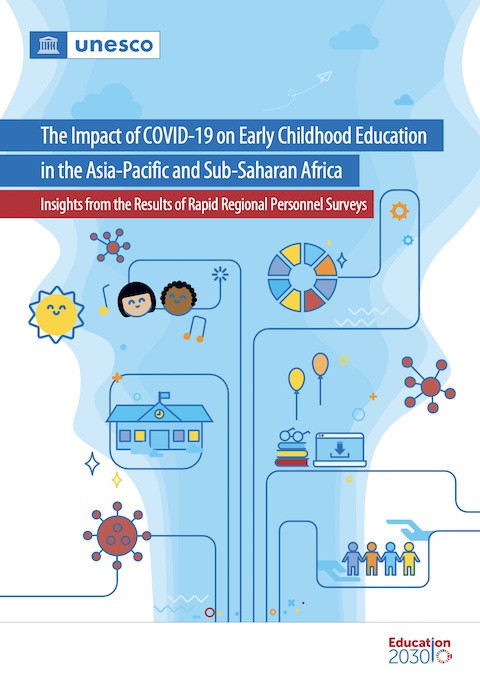 The Impact of COVID-19 on Early Childhood Education in the Asia-Pacific and Sub-Saharan Africa: Insights From the Results of Rapid Regional Personnel Survey Year of publication: 2021 Author: Yoshie Kaga | Kyungah Bang Corporate author: UNESCO Bangkok Declared a global pandemic on 11 March 2020 by the World Health Organization (WHO), COVID-19 has had far-reaching impacts on every facet of life around the world, exacerbating pre-existing inequalities and negatively impacting on vulnerable and disadvantaged populations the most. Learning continuity has been disrupted by school closures, generating an unprecedented situation worldwide. According to UNESCO Institute for Statistics (UIS) data collated in July 2020, over 18.6 million children in pre-primary education in forty-eight Sub-Saharan African countries and 4.4 million pre-primary teachers – eighty- five per cent of whom were women – in twenty-four countries in the Asia-Pacific region were affected by school or centre closures. Recognizing the possible severe and detrimental impact that COVID-19 might have on ECE personnel and their practices, UNESCO Bangkok and Dakar teamed up with several partners to undertake regional surveys in the Asia-Pacific and Sub-Saharan Africa from April to July 2020. Based on the regional surveys, this report features eight key findings and three key messages to better understand ECE personnel’s needs and to identify possible responses to support them.
 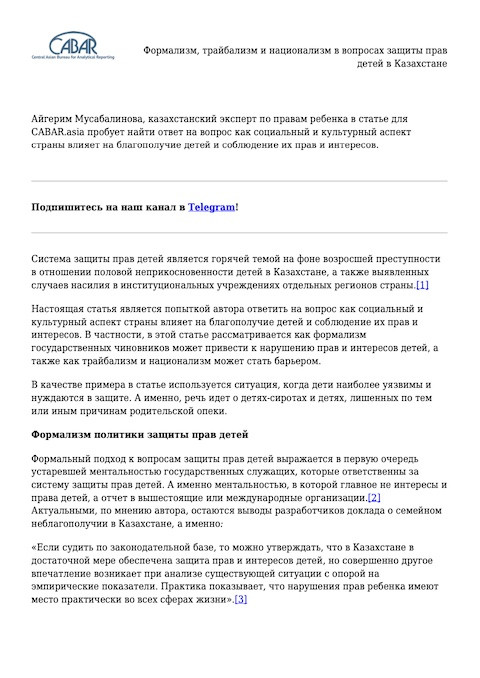 Formalism, Tribalism, and Nationalism in the Protection of Children’s Rights in Kazakhstan Year of publication: 2020 Author: Aigerim Musabalinova Corporate author: Central Asian Bureau for Analytical Reporting (CABAR) | Institute for War and Peace Reporting (IWPR) Aigerim Musabalinova, an expert on children’s rights tries to find an answer to the question of how the social and cultural aspect of the country affects the well-being of children and the observance of their rights and interests, in an article for CABAR.asia. Формализм, трайбализм и национализм в вопросах защиты прав детей в Казахстане Year of publication: 2020 Author: Aigerim Musabalinova Corporate author: Central Asian Bureau for Analytical Reporting (CABAR) | Institute for War and Peace Reporting (IWPR) Айгерим Мусабалинова, казахстанский эксперт по правам ребенка в статье для CABAR.asia пробует найти ответ на вопрос как социальный и культурный аспект страны влияет на благополучие детей и соблюдение их прав и интересов.
 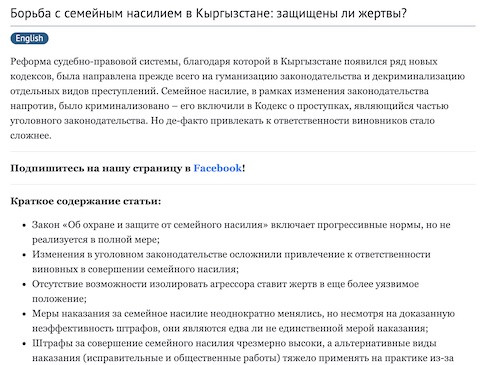 Борьба с семейным насилием в Кыргызстане: Защищены ли Жертвы? Year of publication: 2020 Author: Anna Zubenko Corporate author: Central Asian Bureau for Analytical Reporting (CABAR) | Institute for War and Peace Reporting (IWPR) В данной статье автор анализирует некоторые результаты реформ судебно-правовой системы, благодаря которым в Кыргызстане появился ряд новых кодексов, была направлена прежде всего на гуманизацию законодательства и декриминализацию отдельных видов преступлений. Семейное насилие, в рамках изменения законодательства напротив, было криминализовано – его включили в Кодекс о проступках, являющийся частью уголовного законодательства. Однако по мнению автора де-факто привлекать к ответственности виновников стало сложнее.
 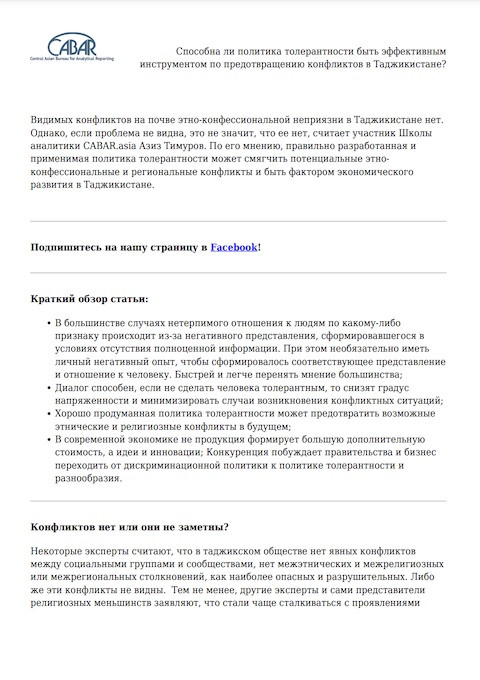 Can Tolerance Policy Be an Effective Tool for Conflict Prevention in Tajikistan? Year of publication: 2020 Author: Aziz Timurov Corporate author: Central Asian Bureau for Analytical Reporting (CABAR) | Institute for War and Peace Reporting (IWPR) There are no visible conflicts on the basis of ethnic-religious hostility in Tajikistan. However, if the problem is not visible, this does not mean that it does not exist, said Aziz Timurov, participant of the CABAR.asia School of Analytics. In his opinion, a well-developed and applicable tolerance policy can mitigate potential ethnic-religious and regional conflicts and be a factor in economic development in Tajikistan. Способна ли политика толерантности быть эффективным инструментом по предотвращению конфликтов в Таджикистане? Year of publication: 2020 Author: Aziz Timurov Corporate author: Central Asian Bureau for Analytical Reporting (CABAR) | Institute for War and Peace Reporting (IWPR) Видимых конфликтов на почве этно-конфессиональной неприязни в Таджикистане нет. Однако, если проблема не видна, это не значит, что ее нет, считает участник Школы аналитики CABAR.asia Азиз Тимуров. По его мнению, правильно разработанная и применимая политика толерантности может смягчить потенциальные этно-конфессиональные и региональные конфликты и быть фактором экономического развития в Таджикистане.
 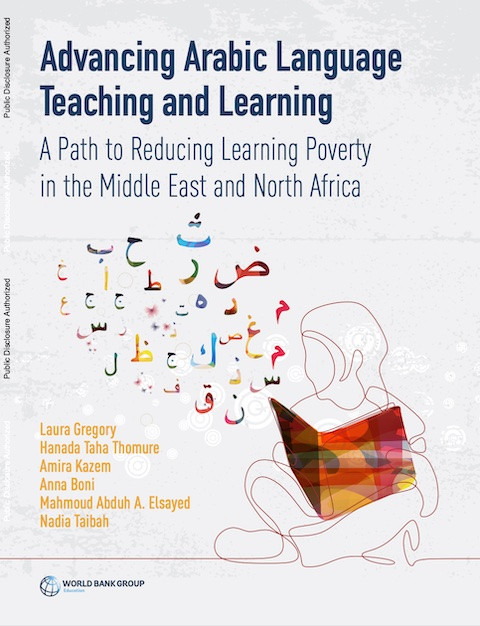 Advancing Arabic Language Teaching and Learning: A Path to Reducing Learning Poverty in the Middle East and North Africa Year of publication: 2021 Author: Laura Gregory | Hanada Taha Thomure | Amira Kazem | Anna Boni | Mahmoud Abduh A. Elsayed | Nadia Taibah Corporate author: World Bank The purpose of the present report is to identify and explore the evidence on factors that are leading to high rates of learning poverty in MENA countries. In addition, the report proposes a path for countries of the region to make the teaching and learning of the Arabic language—which are critical foundations for children in Arabic-speaking countries—more effective. The intended audience of the report is education stakeholders in the MENA region, including officials in ministries of education across the region, those responsible for education decision-making, teachers, academics, education administrators, parents, and nongovernmental organizations, as well as World Bank and partner organization staff tasked with supporting countries in their efforts to raise learning and human capital.The intention of the report is not to provide an Arabic literacy strategy for each country since countries of the region differ and each would need to have their own national dialogue. Instead, the report collates the relevant literature from the region and beyond, as well as local and regional initiatives, and offers guidance to countries to advance the teaching and learning of MSA. As such, the report does not focus on the broader issues of language use within each country. As part of the process of developing the report, a summary of the emerging evidence and recommendations was shared with a small group of teachers from two countries across the region in advance of a focus group discussion to explore local views. Unanimous agreement on the key findings and recommendations were expressed by these teachers. Further discussions on the topics raised in this report are expected to take place during the dissemination of this report and in the months and years to come, leading to greater consensus across stakeholders on the best ways to advance Arabic language teaching and learning.The report is structured in a way that first explores the incidence of learning poverty in the MENA region, followed by international evidence on the science of learning to read, and factors that are influencing Arabic language learning outcomes. The report then looks at some of the national strategies, policies, and initiatives already in place for Arabic language education, and proposes a path for advancing Arabic language teaching and learning, along with suggestions for regional collaboration efforts that could further support MENA countries.
  التنمر الإلكتروني بين المراهقين: دراسة مطبَّقة على عينة من طلبة المرحلة المتوسطة المستخدمين للعبة الفورتنايت Year of publication: 2019 Author: Moudi Al-Anzi Corporate author: Qassim University استهدفت الدراسة التعرف على الأسباب الشخصية للتنمر الالكتروني ومعرفة دور المناخ الأسري والمدرسي في التنمر الالكتروني. استخدمت لعبة الفورتنايت كمثال للتعرف على التنمر الذي يحصل من خلال الألعاب الالكترونية. استخدمت الاستبانة لجمع البيانات. Cyberbullying among Adolescents: A Study Applied to a Sample of Middle School Students Who Used the Game of Fortnite Year of publication: 2019 Author: Moudi Al-Anzi Corporate author: Qassim University The study aimed to identify the personal causes of cyberbullying and the role of the family and school climate in cyberbullying. The study used the game Fortnite as an example to recognize bullying that occurs through electronic games. A questionnaire was used to collect data.