
Resources
Explore a wide range of valuable resources on GCED to deepen your understanding and enhance your research, advocacy, teaching, and learning.
3,790 Results found
 المواطنة Year of publication: 2020 Author: Zeyad Alawana Corporate author: Ministry of Political and Parliamentary Affairs يهدف الكتيب إلى تعميق ثقافة المواطنة الصالحة والفعّالة لدى الشباب، وتعريفهم بحقوقهم وواجباتهم الواردة في الدستور الاردني، وتعريفهم أيضاً بقيم المواطنة الصالحة الي تقوم على أساس سيادة القانون، واحرام المساواة، والتسامح وتقبّل الآخر، وتقبل التعددية والتنوع في المجتمع. وبشكل أكثر تفصيلاً، يحتوي الكتيب على موضوعات ومعارف وأسئلة وخبرات تهدف إلى ما يلي:•أولاً، التعريف بمفهوم المواطنة والحقوق والواجبات والتمييز بين المواطن الصالح وغير الصالح.•ثانياً، التعريف بمبادئ المواطنة الصالحة ، كالحرية والمشاركة الفاعلة والمساواةوتكافؤ الفرص والتضامن والمحافظة على الممتلكات العامة.•ثالثاً، التعريف بأهداف المواطنة، كالالتزام بمبادئ الديمقراطية، والتحرر من التعصب والتميز، والايمان بالأخوّة الإنسانية والمنهج العلمي في التفك وسيادة القانون، والالزام بالدستور، والمشاركة السياسية الفاعلة، واحرام كرامة الانسان، واكتساب قيم المواطنة الحقة.
  Fifteen Analytical Keys to Strengthen the Education 2030 Agenda Year of publication: 2017 Author: Renato Opertti Corporate author: UNESCO International Bureau of Education (IBE) The joint review of the goals of the Education 2030 agenda and global change accentuated by the emergence of a fourth industrial revolution highlights the need to rethink the concepts that have influenced education over the past forty years. This necessity is accompanied by a major challenge: that of giving a new meaning to these concepts, in the same way education systems, in a transformational and united perspective. The present document proposes a global reflection based on fifteen keys of analysis, in order to help define a vision of education and learning that is in line with the Education 2030 agenda examines the following aspects: 1) education as a reflection of the type of society targeted; 2) the state as guarantor of the right to education; 3) education as a cultural, social and economic ; 4) the characteristics and roles of education systems; 5) learning throughout life long; 6) education according to age groups; 7) inclusion as a basis for education systems; 8) education for global and local citizenship; 9) education for sustainable development ; 10) STEM training to build sustainable societies; 11) the relevance of the gender issue at a time of the democratization of society and education; 12) computer programming as a new challenge in the teaching of ICT; 13) the evolution of the relationship between training and work; 14) the trio formed by curricula, educational establishments and pedagogy; and 15) teachers as decision-makers. Quinze clés d’analyse pour renforcer l’agenda Éducation 2030 Year of publication: 2017 Author: Renato Opertti Corporate author: UNESCO International Bureau of Education (IBE) L’examen conjoint des objectifs de l’agenda Éducation 2030 et des changements planétaires accentués par l’émergence d’une quatrième révolution industrielle met en évidence la nécessité de repenser les concepts qui ont influencé l’éducation au cours des quarante dernières années. Cette nécessité s’accompagne d’un défi de taille : celui de donner un sens nouveau à ces concepts, de même qu’aux systèmes éducatifs, dans une perspective transformationnelle et unie. Le présent document propose une réflexion globale reposant sur quinze clés d’analyse, en vue de contribuer à définir une vision de l’éducation et de l’apprentissage qui soit en adéquation avec l’agenda Éducation 2030. Il se penche ainsi sur les aspects suivants : 1) l’éducation en tant que reflet du type de société visé ; 2) l’État en tant que garant du droit à l’éducation ; 3) l’éducation en tant que politique culturelle, sociale et économique ; 4) les caractéristiques et les rôles des systèmes éducatifs ; 5) l’apprentissage tout au long de la vie ; 6) l’éducation en fonction de groupes d’âge ; 7) l’inclusion en tant que fondement des systèmes éducatifs ; 8) l’éducation à la citoyenneté mondiale et locale ; 9) l’éducation pour le développement durable ; 10) la formation aux STEM en vue de bâtir des sociétés durables ; 11) la pertinence de la problématique hommes-femmes à l’heure de la démocratisation de la société et de l’éducation ; 12) la programmation informatique en tant que nouveau défi dans l’enseignement des TIC ; 13) l’évolution de la relation entre la formation et le travail ; 14) le trio formé par les curricula, les établissements éducatifs et la pédagogie ; et 15) les enseignants en tant que décideurs.
 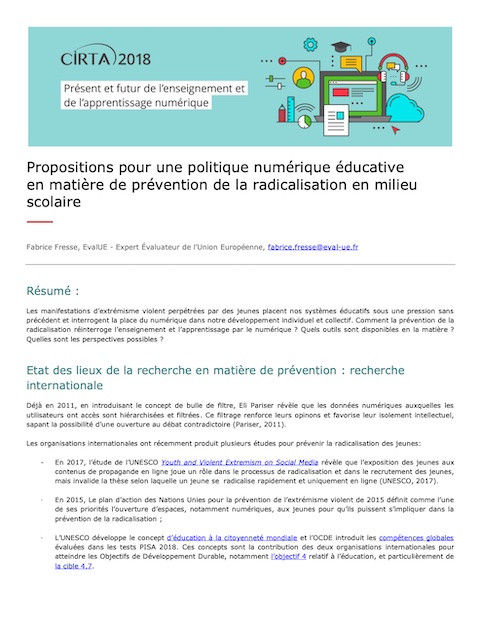 Propositions pour une politique numérique éducative en matière de prévention de la radicalisation en milieu scolaire Year of publication: 2018 Author: Fabrice Fresse Corporate author: Communauté pour l’innovation et la recherche sur les technologies dans l’enseignement/apprentissage (CIRTA) Les manifestations d’extrémisme violent perpétrées par des jeunes placent nos systèmes éducatifs sous une pression sans précédent et interrogent la place du numérique dans notre développement individuel et collectif. Comment la prévention de la radicalisation réinterroge l’enseignement et l’apprentissage par le numérique ? Quels outils sont disponibles en la matière ? Quelles sont les perspectives possibles ?
  L'éducation au service du développement: La vision de la Banque mondiale, de l'OCDE et de l'UNESCO (L’Education en débats: analyse comparée; no. 8) Year of publication: 2016 Author: Thibaut Lauwerier Corporate author: Université de Genève Dans ce présent article, nous nous intéressons aux liens entre éducation et développement du point de vue de la Banque mondiale, l’OCDE et l’UNESCO, organisations internationales majeures dans le secteur éducatif au niveau mondial. Après avoir présenté le contexte de la recherche, à savoir les caractéristiques majeures des trois organisations étudiées et la méthodologie utilisée, nous montrons comment le concept du développement est perçu par ces institutions. Ensuite, nous traitons des implications de ces visions du développement pour l’éducation. En conclusion, tout en analysant les récentes évolutions des discours des organisations internationales, nous discutons de la nécessité d’aller au-delà d’une vision étriquée du développement et donc de l’éducation.
 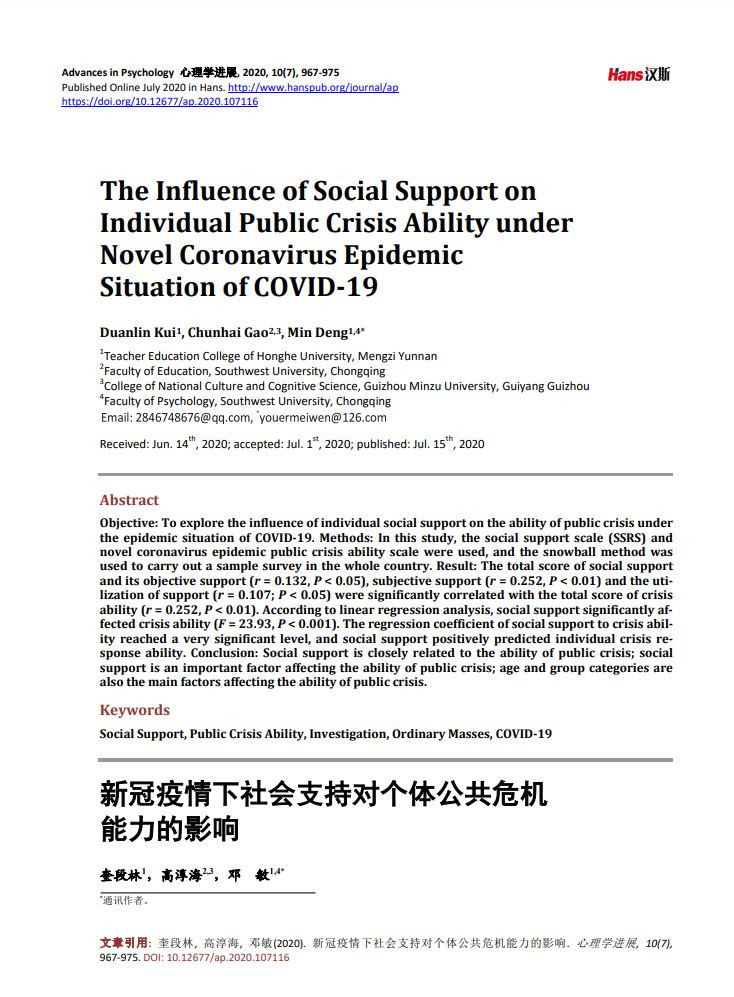 The Influence of Social Support on Individual Public Crisis Ability under Novel Coronavirus Epidemic Situation of COVID-19 Year of publication: 2020 Author: Kui Duanlin | Gao Chunhai | Deng Min This paper discusses the relationship between social support citizens have received during the Covid-19 pandemic and their ability to respond to public crisis. The paper finds that the former has a potive influence on the latter. 新冠疫情下社会支持对个体公共危机能力的影响 Year of publication: 2020 Author: Kui Duanlin | Gao Chunhai | Deng Min 本文探讨新冠疫情背景下民众受到的社会支持与他们应对公共危机的能力的关系,研究发现社会支持对公众应对公共危机起正相关关系。 Citizenship Year of publication: 2020 Author: Zeyad Alawana Corporate author: Ministry of Political and Parliamentary Affairs The booklet aims to deepen the culture of good and effective citizenship among young people, inform them of their rights and duties contained in the Jordanian constitution, and also introduce them to the values of good citizenship that are based on the rule of law, respect for equality, tolerance and acceptance of others, and acceptance of pluralism and diversity in society. In more detail, the booklet contains topics, knowledge, questions and experiences aimed at:First, the definition of the concept of citizenship, rights and duties, and the distinction between a good and a good citizen.Second, introducing the principles of good citizenship, such as freedom, active participation, and equalityEquality of opportunity, solidarity and preservation of public property.Third, the definition of the goals of citizenship, such as commitment to the principles of democracy, freedom from fanaticism and distinction, belief in human brotherhood and the scientific method in disunity and the rule of law, commitment to the constitution, active political participation, respect for human dignity, and the acquisition of true citizenship values.
 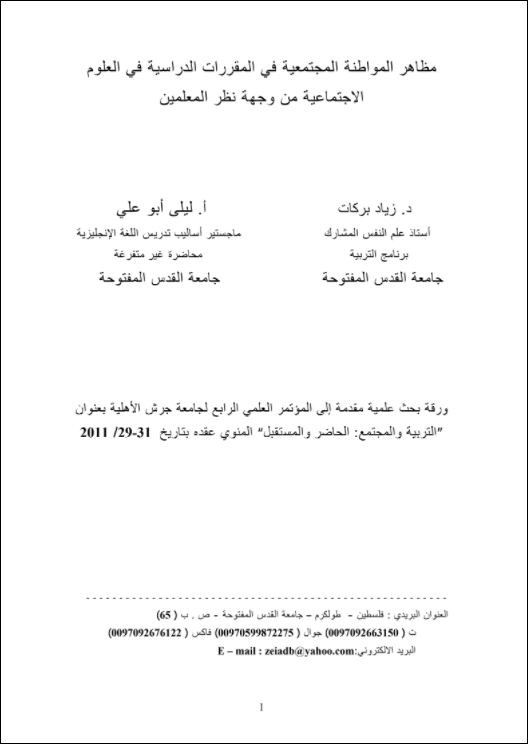 مظاهر المواطنة المجتمعية في المقررات الدراسية في العلوم الاجتماعية من وجهة نظر المعلمين Year of publication: 2011 Author: Zeiad Barakat | Laila Abu Ali Corporate author: Jerash Universtiy هدفت هذه الدراسة التعرف إلى مظاهر المواطنة المجتمعية في المجالات الاجتماعية والقانونية والاقتصادية والسياسية في المقررات الدراسية الفلسطينية المتعلقة بالعلوم الاجتماعية (التاريخ والجغرافية والتربية المدنية والتربية الوطنية ) من وجهة نظر المعلمين لهذ ه المقررات، لهذا الغرض طبقت استبانة مكونة من ( 40 ) فقرة لقياس مظاهر المواطنة المجتمعية في المظاهر المختلفة على عينة من المعلمين في المدارس الحكومية في محافظة طولكرم يدرسون هذه المقررات قو امها ( 134 ) معلمًا ومعلمة. Manifestations of Community Citizenship in the Curriculums in Social Sciences from the Viewpoint of the Teachers Year of publication: 2011 Author: Zeiad Barakat | Laila Abu Ali Corporate author: Jerash Universtiy The purpose of this study was to investigate the manifestations of community citizenship in domains of social, legal, economic and political in the Palestinian social science curriculum (history, geography, civic education and national education) from the viewpoint of the teachers of these courses, for this purpose applied a questionnaire consisting of (40) items to measure aspects of community citizenship, in the various manifestations on a sample of teachers in government schools in the province of Tulkarem who teach these courses consisted of (134) teachers.