
Resources
Explore a wide range of valuable resources on GCED to deepen your understanding and enhance your research, advocacy, teaching, and learning.
1,473 Results found
 Информационные потоки и радикализация, ведущая к насильственному экстремизму в Центральной Азии Year of publication: 2019 Corporate author: Search for Common Ground Данное исследование проведено в рамках регионального проекта «Содействие стабильности и миру в Центральной Азии посредством медиаграмотности, эффективного освещения и регионального сотрудничества», реализуемого офисом Интерньюс и финансируемого Европейским союзом. Проект нацелен на поддержку национальных и региональных инициатив, способствующих предотвращению радикализации в Центральной Азии через повышение потенциала журналистов, гражданских активистов и медиаспециалистов в вопросах производства качественного медиаконтента и уровня критического медиапотребления представителей гражданского общества, лиц, принимающих решения, и активных граждан.
 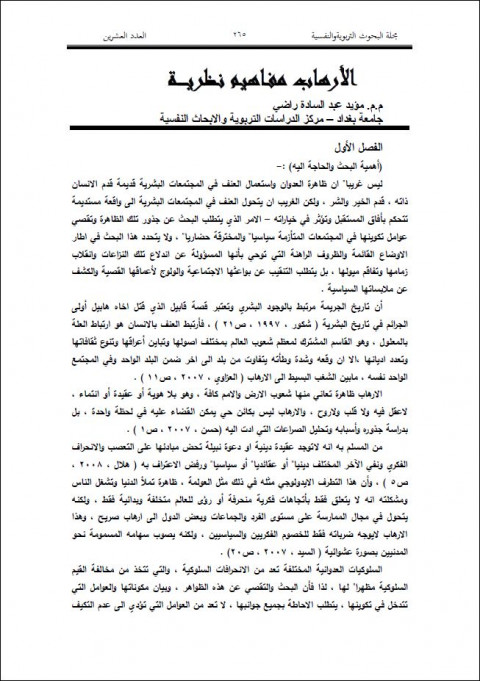 الأرهاب مفاهيم نظريـــــة Year of publication: 2009 Author: Moayad Abdel | Sadi Radi Corporate author: Educational and Psychological Research Center ليس غريبا" ان ظاهرة العدوان واستعمال العنف في المجتمعات البشرية قديمة قدم الانسان ذاته ، قدم الخير والشر ، ولكن الغريب ان يتحول العنف في المجتمعات البشرية الى واقعة مستديمة تتحكم بأفاق المستقبل وتؤثر في خياراته – الامر الذي يتطلب البحث عن جذور تلك الظاهرة وتقصي عوامل تكوينها في المجتمعات المتأزمة سياسيا" والمخترقة حضاريا" ، ولا يتحدد هذا البحث في اطار الاوضاع القائمة والظروف الراهنة التي توحي بأنها المسؤولة عن اندلاع تلك النزاعات وانقلاب زمامها وتفاقم ميولها ، بل يتطلب التنقيب عن بواعثها الاجتماعية والولوج لأعماقها القصية والكشف عن ملابساتها السياسية . Terrorism: Theoretical Concepts Year of publication: 2009 Author: Moayad Abdel | Sadi Radi Corporate author: Educational and Psychological Research Center Not surprisingly, the phenomenon of aggression and the use of violence in human societies is as old as man itself, good and evil, but it is strange that violence in human societies turns into a permanent reality that controls the future prospects and influences its choices - which requires searching for the roots of this phenomenon and investigating the factors of its formation in This research is not determined in the context of the current circumstances and circumstances that suggest that they are responsible for the outbreak of these conflicts and the reversal of their leadership and aggravation of their tendencies, but requires exploration of their social motives and access to the depths of the remote and disclose the circumstances A political.
  The Ontario Curriculum, Grades 11 and 12 : Canadian and World Studies Year of publication: 2015 Corporate author: Ontario (Canada). Ministry of Education In Canadian and world studies, students develop skills, knowledge and understanding, and attitudes that will serve them both inside and outside the classroom, including in the world of work and as responsible citizens in the various communities to which they belong.The focus of teaching and learning in the Canadian and world studies curriculum is the development of ways of thinking and of transferable skills that students need in order to acquire and apply knowledge and understanding. Students apply these ways of thinking and skills in a variety of contexts to examine information critically; to assess the significance of events, developments, and processes; to develop an understanding of and respect for different points of view; to reach supportable conclusions; and to propose solutions to, and courses of action to address, real problems.Citizenship education is an important facet of students’ overall education. In every grade and course in the Grade 11 and 12 Canadian and world studies curriculum, students are given opportunities to learn about what it means to be a responsible, active citizen in the community of the classroom and the diverse communities to which they belong within and outside the school. It is important for students to understand that they belong to many communities and that, ultimately, they are all citizens of the global community. Le curriculum de l'Ontario, 11e et 12e année : Études canadiennes et mondiales Year of publication: 2015 Corporate author: Ontario (Canada). Ministry of Education Le présent document Le curriculum de l’Ontario, 11e et 12e année – Études canadiennes et mondiales, édition révisée, 2015 est destiné aux écoles de langue française; il remplace Le curriculum de l’Ontario, 11e et 12e année – Études canadiennes et mondiales, 2005 et Le supplément du curriculum de l’Ontario de la 9e à la 12e année – Études canadiennes et mondiales, 2008.À compter de septembre 2015, tous les cours d’études canadiennes et mondiales de 11e et 12e année seront fondés sur les attentes et les contenus d’apprentissage énoncés dans cette édition révisée du programme-cadre.LES ÉCOLES SECONDAIRES AU XXIe SIÈCLE Les écoles secondaires de l’Ontario offrent à chaque élève un programme d’études varié et planifié de grande qualité. Ce programme vise la réussite de tous les élèves dans la destination de leur choix. La mise à jour du curriculum de l’Ontario, de pair avec un élargissement des options d’apprentissage offertes à l’extérieur de la salle de classe traditionnelle, intègre l’apprentissage des compétences essentielles pour réussir au XXIe siècle et respecte les champs d’intérêt, les points forts ainsi que les besoins de chaque élève.Le programme-cadre révisé prend en compte le fait qu’aujourd’hui comme demain, la littératie critique sera fondamentale afin de synthétiser l’information, de prendre des décisions réfléchies, de communiquer de manière efficace et d’évoluer dans une communauté mondiale en continuel mouvement. Il est important que les élèves se sentent concernés par le curriculum établi, qu’ils se reconnaissent dans ce qui est enseigné et dans la méthode d’enseignement, et qu’ils réalisent comment leur apprentissage s’applique au monde qui les entoure. Le programme tient compte des besoins variés des élèves; il les aide à enrichir leurs connaissances et à développer leurs habiletés, et leur offre les perspectives dont elles ou ils ont besoin pour devenir des citoyennes et citoyens informés, productifs, bienveillants, responsables, en bonne santé et actifs au sein de leurs communautés et dans le monde.
 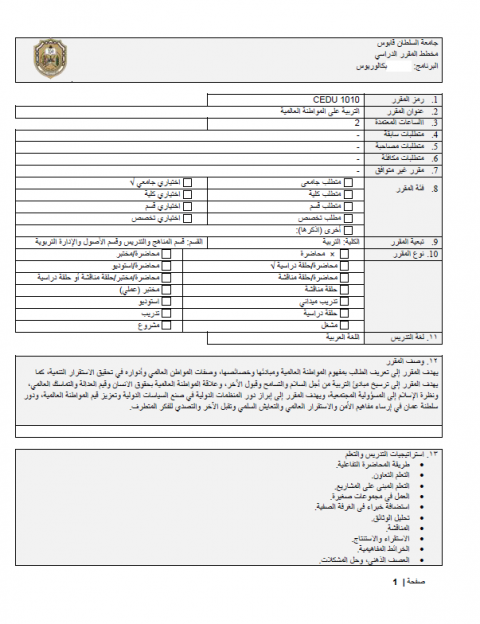 مقرر التربية على المواطنة العالمية Year of publication: 2019 هذا المقرر قام بوضعه مجموعة من الاساتذة بكلية التربية في جامعة السلطان قابوس، وقد جاء هذا المقرر كفكرة بالتعاون بين الجامعة ومكتب اليونسكو ببيروت وأيضا مركز أسيا والمحيط الهادي للتربية من أجل التعاون الدولي. ويهدف المقرر إلى تعريف الطالب بمفهوم المواطنة العالمية ومبادئها وخصائصها، وصفات المواطن العالمي وأدواره في تحقيق الاستقرار التنمية، كما يهدف المقرر إلى ترسيخ مبادئ التربية من أجل السلام والتسامح وقبول ألآخر وعلاقة المواطنة العالمية بحقوق الانسان وقيم العدالة والتماسك العالمي، ونظرة الإسلام إلى المسؤولية المجتمعية، ويهدف المقرر إلى إبراز دور المنظمات الدولية في صنع السياسات الدولية وتعزيز قيم المواطنة العالمية، ودور سلطنة عمان في إرساء مفاهيم الأمن والاستقرار العالمي والتعايش السلمي وتقبل الآخر والتصدي للفكر المتطرف. Global Citizenship Education Course Year of publication: 2019 This course was developed by a number of academicians at the College of Education at Sultan Qaboos University. The idea of offering the course came as a collaboration between Sultan Qaboos University and UNESCO Beirut as well as the Asia-Pacific Center of Education for International Understanding. The aim of the course is to introduce global citizenship concept, its focuses, basics, aims, and characteristics to students. The attributes of the global citizens and their roles in the sustainable development are also defined framed in the course. Moreover, the course is an attempt to reinforce the values of global citizenship, peace education and the acceptance of others. In more deep focus, the course outline the relationship between global citizenship and some other concepts such as justice, human rights, international understanding and peace. The course also shed light on the Islamic view of the social responsibility and the role of Islam in that. With regards to international organizations, the course focuses on the role played by international organizations in promoting global citizenship. Finally, the role of Oman as a model of tolerance, accepting others and peacefully living together will be discussed.
  Rethinking schooling: annual report 2018 Year of publication: 2019 Corporate author: Mahatma Gandhi Institute of Education for Peace and Sustainable Development (MGIEP) Calls to gear up schools for the 21st century are ubiquitous today. Some Asian education systems are held up as models for an innovation-led utopian future. Across much of Asia, however, neither the reality of schooling nor the patterns of development with which it is associated give cause for blithe optimism. This study is informed by UNESCO’s commitment to realizing the Sustainable Development Goals (SDGs) through educational reform worldwide. Since its inception, UNESCO has championed a humanistic vision of education (UNESCO, 2015)—a vision today encapsulated in SDG 4.7. These ideals need to be strongly restated and defended in an era when educational debate has come to be framed by a narrowly economistic and instrumentalist agenda. Deriving urgent significance from this broader context, the Rethinking Schooling report analyses how far the ideals of SDG 4.7 are embodied in policies and curricula across 22 Asian countries (UNESCO MGIEP, 2017a). The report seeks to develop benchmarks against which future progress can be assessed. It also argues forcefully that the fundamental purposes of schooling need to be reconfigured, if the ideals to which the global community has subscribed are actually to be realized.
  Violent extremism in Central Asia 2018: A preliminary survey of groups, digital dimensions and state responses Year of publication: 2018 Corporate author: Civil Initiative on Internet Policy | SecDev This research has been produced within the framework of the “Contributing to stability and peace in Central Asia through media literacy, improved reporting and regional cooperation” Project implemented by Internews and funded by the European Union. The contents of this research are the sole responsibility of The SecDev Group, and Public Foundation Civil Initiative on Internet Policy and can not be regarded as reflecting the position of the European Union and Internews under any circumstances. Насильственный экстремизм в Центральной Азии, 2018: обзор террористических групп, законодательства стран ЦА и правоприменительной практики по противодействию насильственному экстремизму онлайн Year of publication: 2018 Corporate author: Civil Initiative on Internet Policy | SecDev Исследование проведено совместно с общественным фондом «Гражданская инициатива интернет - политики» и организацией The SecDev Group в рамках проекта «Содействие стабильности и миру в Центральной Азии посредством повышения медиа-грамотности, эффективного освещения и регионального сотрудничества», финансируемого Европейским союзом и реализуемого Интерньюс. Содержание этого исследования является исключительной ответственностью организации The SecDev Group и общественного фонда «Гражданская инициатива интернет-политики» и ни при каких обстоятельствах не отражает позицию Европейского Союза и Интерньюс.