
Resources
Explore a wide range of valuable resources on GCED to deepen your understanding and enhance your research, advocacy, teaching, and learning.
661 Results found
 Transforming Lives through Education Year of publication: 2018 Author: Anne Müller | Cristina Stanca-Mustea Corporate author: UNESCO 1945-2018: This book invites the reader on a fascinating photographic journey that highlights UNESCO’s work in promoting education across the world for more than seven decades. Above all, it testifies to the power of education to transform lives, build self-confidence, contribute to economic and social progress, and promote intercultural understanding.Through this book, the reader will discover the history of UNESCO’s work in education from its foundation to its current role as global leader for the coordination of Goal 4 of the United Nations 2030 Agenda for Sustainable Development, dedicated to education.The publication highlights the important milestones, normative advances, innovations and outstanding projects in our history, which bear witness to our humanistic vision of education. Drawing on a rich archive of photographs, some of them little known, this book illustrates the scale and diversity of UNESCO’s education programme across the globe. Transformer la vie grâce à l'éducation Year of publication: 2018 Author: Anne Müller | Cristina Stanca-Mustea Corporate author: Organisation des Nations Unies pour l'éducation, la science et la culture (UNESCO) 1945-2018 : cet ouvrage vous invite à un passionnant voyage photographique qui témoigne de l’action de l’UNESCO pour promouvoir l’éducation à travers le monde depuis maintenant plus de sept décennies. Il témoigne avant tout du pouvoir de l’éducation pour transformer les vies, développer la confiance en soi, contribuer au progrès économique et social, favoriser la compréhension interculturelle.En parcourant cet ouvrage, le lecteur découvrira l’histoire de l’action de l’UNESCO en matière d’éducation, depuis ses débuts jusqu’à son rôle actuel de chef de file, au niveau mondial, pour la coordination de l’Objectif de développement durable 4 dédié à l’éducation, dans le cadre de l’Agenda 2030 défini par les Nations Unies.Ce livre reflète les jalons que nous avons posés, les avancées normatives et les innovations que nous avons réalisées, les projets phares que nous avons conduits et rend compte de notre vision humaniste de l’éducation. S’appuyant sur de riches archives photographiques, don't certaines sont peu connues, ce livre illustre l’ampleur et la variété du programme d’éducation de l’UNESCO à travers le monde.
  Agree to Differ Year of publication: 2015 Corporate author: UNESCO Dialogue on the basis of respect, tolerance, human rights and dignity has never been so important. This is the spirit of the International Decade for the Rapprochement of Cultures (2013-2022). The International Decade originates in the United Nations General Assembly Resolution 67/104 adopted in December 2012, co-sponsored by Kazakhstan and designating UNESCO as lead agency. This drew on a Resolution of the UNESCO General Conference and the experience of the 2010 International Year for the Rapprochement of Cultures which UNESCO led forward with activities across the world.The objective of the International Decade is to promote mutual understanding and respect for diversity, rights and equal dignity between peoples, through intercultural dialogue and concrete initiatives. This is essential for all societies today, undergoing deep transformation. The surge of conflict, acts of violence, extremism and intolerance pose a threat to peace, undermining the unity of humanity and calling on us all to redouble our efforts to advance a culture of peace, through dialogue, the safeguarding of cultural heritage, and the promotion of global citizenship education.The International Decade for the Rapprochement of Cultures embodies a commitment to explore new articulations between cultural diversity and universal values. The rapprochement of cultures calls for a commitment to the principles of human dignity and solidarity as the corner stones of living together within and between societies, making the most of all sources of diversity.This publication bears testimony to the urgency of addressing contemporary challenges through intercultural and interreligious dialogue in order to deepen understanding and cooperation for peace. Through concrete examples, including experiences at the community level from across the world, the publication showcases why cultural diversity, intercultural dialogue and responsive democratic governance are vital for the enhancement of mutual understanding, the growth of tolerance, and the building of bridges of mutual respect and dignity.
  Global Citizenship Education: Taking It Local Year of publication: 2018 Corporate author: UNESCO UNESCO is leading global efforts on Global Citizenship Education (GCED), which is at the core of Target 4.7 of Sustainable Development Goal 4 on Education. To address the perception that the concept of GCED is concerned mainly with global matters and maybe dissociated from local needs and realities, UNESCO has identified local/national/traditional precepts and concepts that are similar to the UNESCO understanding of global citizenship.As culturally relevant expressions of GCED and to contribute to building peace through the implementation of GCED, the concepts identified here can serve as entry-points to teach and learn about GCED in more locally relevant ways. Education à la citoyenneté mondiale: pour une approche locale Year of publication: 2018 Corporate author: Organisation des Nations Unies pour l'éducation, la science et la culture (UNESCO) L’UNESCO mène les efforts mondiaux portant sur l’éducation à la citoyenneté mondiale, qui est au coeur de la cible 4.7 de l’Objectif 4 de développement durable sur l’éducation. Afin de clarifier la perception selon laquelle le concept de l’éducation à la citoyenneté mondiale concerne principalement des questions mondiales et qu’il est peut-être dissocié des réalités et des besoins locaux, l’UNESCO a identifié des préceptes et des concepts locaux/nationaux/traditionnels qui sont comparables à la compréhension qu’a l’UNESCO de la citoyenneté mondiale. En tant qu’expressions culturellement pertinentes de l’éducation à la citoyenneté mondiale, et dans le but de contribuer à l’édification de la paix grâce à la mise en oeuvre de l’éducation à la citoyenneté mondiale, les concepts identifiés dans ce document peuvent servir de points d’entrée pour enseigner l’éducation à la citoyenneté mondiale et pour l’apprendre, de manière plus pertinente au niveau local.
 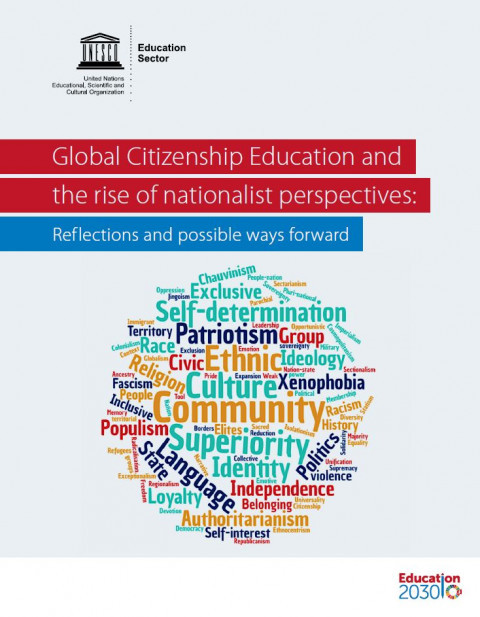 Global Citizenship Education and the Rise of Nationalist Perspectives: Reflections and Possible Ways Forward Year of publication: 2018 Corporate author: UNESCO | APCEIU Over the past few years, many have observed a rise in nationalist perspectives across the world. These trends raise questions about the role of education and, in particular, one of UNESCO’s key areas of work in the field of education, namely Global Citizenship Education (GCED), which seeks to equip learners with the skills, values and attitudes needed to contribute to the development of peaceful and just societies. This paper seeks to clarify the evidence of the rise of nationalist perspectives and its causes, and to lay out how GCED is challenged by this phenomenon. It recommends ways forward for education stakeholders in promoting GCED, in order to strengthen ‘learning to live together’ by embedding GCED meaningfully in local and country contexts. 세계시민교육과 민족주의적 관점의 부상: 성찰과 나아갈 길 Year of publication: 2018 Corporate author: 유네스코 | 유네스코 아시아태평양 국제이해교육원 지난 몇 년간 많은 이들이 전 세계에서 민족주의적 관점의 부상을 목도해왔다. 이에 관해 평론가들은 배타성과 외국인 공포증, 때로 인종주의적 주장과 공공장소 내 폭력적 행위가 증가하고 있는 것뿐만 아니라, 일부 국가에서 경제적 보호주의에 더욱 중점을 두는 현상에 대해 언급해왔다. 이러한 추세는 교육의 역할에 대해 많은 의문을 불러일으키고 있으며, 특히 평화롭고 공정한 사회의 발전에 필요한 능력·가치·태도 함양을 목적으로 하는, 유네스코 교육 분야의 핵심 사업인 세계시민교육(GCED, Global Citizenship Education)에 있어 심각한 도전이 되고 있다. 이 책에서는 민족주의적 관점이 부상하고 있다는 증거 및 그 원인을 규명하고, 이러한 현상으로부터 세계시민교육이 어떠한 도전을 받고 있는지를 보여주고자 한다. 이 책은 유네스코의 사업과 더불어 세계시민교육을 추진하는 다른 교육 종사자들에게 앞으로 나아갈 수 있는 방안을 권고하고자 한다.
  Notes techniques du secteur de l’éducation: Education en vue du Développement Durable (EDD) Year of publication: 2013 Corporate author: UNESCO The Education Sector is called to implement a significant and broad mandate, covering many challenging issues in education in a diverse and fast-changing world. More than ever, we need to better focus and ensure greater cohesion in implementing this mandate. This document is part of a series of Technical Notes that have been developed by colleagues in the Education Sector in order to facilitate programme delivery in thematic areas related to the work of the Sector. The Technical Notes are meant to serve as a quick reference tool for UNESCO staff, providing a brief overview including basic knowledge, key priorities for UNESCO and future directions as well as practical information on each topic. Prix UNESCO de l'éducation pour la paix, 2008 Year of publication: 2009 Corporate author: UNESCO The UNESCO Prize for Peace Education 2008 was awarded to the Institute for Justice and Reconciliation (South Africa) by Mr Koïchiro Matsuura, Director-General of UNESCO, on the recommendation of the International Jury of the Prize. The prize-giving ceremony, organized as part of the celebrations of the International Day of Peace (21 September), the International Decade for a Culture of Peace and Non-Violence for the Children of the World (2001- 2010) and the 60th anniversary of the Universal Declaration of Human Rights, was held at UNESCO Headquarters on 18 September 2008 in the presence of Mr Mohammed Arkoun, President of the International Jury, and H.E. Mr Javier Pérez de Cuéllar, member of the International Jury, former Prize laureates, Permanent Delegates of Member States and representatives of governmental and non-governmental organizations. The award ceremony was preceded by the screening of an excerpt from the documentary Truth, Justice, Memory: South Africa’s Truth and Reconciliation Process and by a video message from Archbishop Emeritus Desmond Tutu, winner of the 1984 Nobel Peace Prize for his role as a unifying leader in the campaign to resolve the problem of apartheid in South Africa, and former Chairperson of South Africa’s Truth and Reconciliation Commission
  UNESCO prize for peace education, 2008 Year of publication: 2009 Corporate author: UNESCO The UNESCO Prize for Peace Education 2008 was awarded to the Institute for Justice and Reconciliation (South Africa) by Mr Koïchiro Matsuura, Director-General of UNESCO, on the recommendation of the International Jury of the Prize. The prize-giving ceremony, organized as part of the celebrations of the International Day of Peace (21 September), the International Decade for a Culture of Peace and Non-Violence for the Children of the World (2001- 2010) and the 60th anniversary of the Universal Declaration of Human Rights, was held at UNESCO Headquarters on 18 September 2008 in the presence of Mr Mohammed Arkoun, President of the International Jury, and H.E. Mr Javier Pérez de Cuéllar, member of the International Jury, former Prize laureates, Permanent Delegates of Member States and representatives of governmental and non-governmental organizations. The award ceremony was preceded by the screening of an excerpt from the documentary Truth, Justice, Memory: South Africa’s Truth and Reconciliation Process and by a video message from Archbishop Emeritus Desmond Tutu, winner of the 1984 Nobel Peace Prize for his role as a unifying leader in the campaign to resolve the problem of apartheid in South Africa, and former Chairperson of South Africa’s Truth and Reconciliation Commission