
Resources
Explore a wide range of valuable resources on GCED to deepen your understanding and enhance your research, advocacy, teaching, and learning.
2,660 Results found
 How to Improve the Availability of Pre-School and Primary Education in Kazakhstan? Year of publication: 2019 Author: Meruert Seidumanova Corporate author: Central Asian Bureau for Analytical Reporting (CABAR) | Institute for War and Peace Reporting (IWPR) «Equal access for all social groups to quality pre-school and primary education is the key to sustainable development, both for the individual and society as a whole», – notes Meruert Seidumanova, independent researcher from Kazakhstan, in her special article for CABAR.asia.
  Build Forward Better: How the Global Community Must Act Now to Secure Children’s Learning in Crises Year of publication: 2021 Author: Emma Wagner Corporate author: Save the Children ‘Build back better’ has long been a rallying cry of crisis responses – and is being used frequently today. However, given the scale of the global learning crisis even before the Covid-19 pandemic – with one child in six denied their right to education – it’s vital we don’t limit our ambition to building ‘back’ to how things were. Now it’s imperative we build forward better – and differently.There’s no denying the scale of the challenge. But there’s also cause for hope. The global reach of the Covid-19 crisis has generated a shared understanding of the impact of crisis on children’s right to education. This understanding can be used to build forward better – and radically transform children’s chances.Build Forward Better presents new analysis on which countries’ school systems are most vulnerable to existing risks and future crises. And it sets out what the global community needs to do to support ministries of education in those countries to prepare now. So that, even during emergencies, education systems can provide all children with good-quality, safe and inclusive opportunities to learn.
  Introduction to Anti-Racist Curriculum Development: A Guide for Teachers in Scotland Year of publication: 2021 Corporate author: Coalition for Racial Equality and Rights (CRER) This guide outlines why anti-racist approaches are important in curriculum development, and explores the barriers that have hampered race equality in education. It then goes on to explore three key components for developing anti-racist approaches to curriculum development: Decolonising the curriculum Building intercultural competence Reducing racism, prejudice and discrimination
  Taking Stock of Progress Towards Gender Equality in the Water Domain: Where Do We Stand 25 Years After the Beijing Declaration? Year of publication: 2021 Corporate author: UNESCO World Water Assessment Programme (WWAP) Women are not only the main persons responsible for water collection in many parts of the world, but they also possess invaluable knowledge with regard to water resources and play a key role in water and sanitation management at the local and community levels. Accordingly, women must be able to enjoy equal access to water and also have an equal say in the management and governance of water resources. Twenty-five years after the Beijing Declaration and Platform for Action, progress towards gender equality through the fulfilment of the basic right to water and sanitation is clearly off track.Despite advances at the policy level in acknowledging the need to progress towards gender equality in the water sector – and the resulting benefits – large gender inequalities persist in practice. Women are generally under-represented in terms of participation at all levels: from institutional bodies that manage national or transboundary waters, to water-related institutions such as governmental water agencies and water utilities, to local water management institutions.This report provides a detailed overview of the existing and emerging challenges to gender equality in the water domain with a particular focus on: access to water, sanitation and hygiene (WASH), health, employment,climate change management, water governance, education and training, and data collection and funding. Systematic and sustained efforts to eliminate these inequalities are essential to achieve meaningful and lasting gender equality in the water sector, and to promote sustainable development in general.Governments, international organizations, professionals and policy-makers in the water sector, academia and NGOs are invited to join forces to accelerate the achievement of gender equality in water for a more just, sustainable and peaceful future.
  Achieving SDG4 Through a Human Rights Based Approach to Education: World Development Report 2018 Background Paper Year of publication: 2018 Author: Kate Moriarty Corporate author: World Bank Quality education is a critical dimension for the achievement of sustainable development. The renewed political commitment set out in sustainable development goal 4 (SDG4) is an opportunity to ensure strong coherence between education policy and the right to education first articulated more than 70 years ago. This paper presents the results of a desk-based study on a human rights-based approach to education (HRBAE) in the context of SDG4. It explores the ways in which such an approach can guide policy, planning, and the delivery of education in observance with agreed international frameworks providing for the right to education. The paper argues that the human rights conventions on the right to education are not passive instruments designed to remain only at the level of discourse but, as legal obligations, require action from the state and should be central in the development of education services, including in the context of large scale displacement and crisis. This paper outlines the legally binding commitments of the right to education. It considers how these can be applied practically through a HRBA-E to address the continuing barriers to access and completion of quality education and learning.
 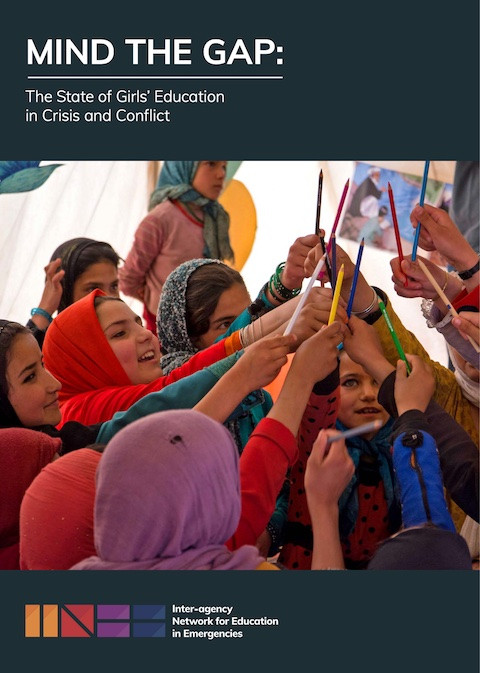 Mind the Gap: The State of Girls’ Education in Crisis and Conflict Year of publication: 2021 Corporate author: Inter-agency Network for Education in Emergencies (INEE) This report summarizes progress, gaps, challenges and opportunities in improving education and training for girls and women affected by conflict and crisis. The report aims to support the Charlevoix Declaration on Quality Education’s commitment to enhance the evidence base and monitor progress toward gender-equitable education in crises. The report draws from data on 44 crisis-affected countries, from recent research, and from a set of case studies of interventions in a range of crisis-affected contexts.
  On Education & Democracy: 25 Lessons from the Teaching Profession Year of publication: 2019 Author: Susan Hopgood | Fred van Leeuwen Corporate author: Education International (EI) On the occasion of the 25th anniversary of Education International, the authors have selected 25 lessons which educators and their organizations have learnt throughout history on education and democracy.These lessons serve as a set of recommendations to every classroom teacher working at all levels in education systems and in their education unions. These lessons are an invitation to take a stand in favour of democracy and its institutions and to consider contributions that teachers, schools, universities and representative organizations can make to solidify and progress democratic life. Sobre la educación y la democracia: 25 lecciones de la profesión docente Year of publication: 2019 Author: Susan Hopgood | Fred van Leeuwen Corporate author: Education International (EI) Con motivo del 25o aniversario de la Internacional de la Educación, que actualmente reúne a los sindicatos de la educación de 170 países, que representan a 32,5 millones de docentes y personal de apoyo educativo, hemos seleccionado 25 lecciones sobre la educación y la democracia que el personal docente y sus organizaciones han aprendido a lo largo de la historia. Nuestras lecciones ofrecen una serie de recomendaciones destinadas a todo el personal docente que trabaja en todos los niveles de nuestros sistemas educativos y en sus sindicatos de la educación. Estas lecciones son una invitación a posicionarse en favor de la democracia y sus instituciones y a analizar las contribuciones que el profesorado, las escuelas, las universi- dades y las organizaciones que los representan pueden aportar para consolidar y hacer progresar la vida democrática. Éducation & démocratie: 25 leçons de la profession enseignante Year of publication: 2019 Author: Susan Hopgood | Fred van Leeuwen Corporate author: Education International (EI) À l’occasion du 25e anniversaire de l’Internationale de l’Éducation, qui regroupe actuellement les syndicats nationaux de l’éducation de 170 pays représentant 32,5 millions d’éducateur·rice·s et de membres des personnels de soutien à l’éducation, les auteurs ont sélectionné 25 leçons que les éducateur·rice·s et leurs organisations ont tirées sur l’éducation et la démocratie au long de l’histoire. Ces leçons établissent une série de recommandations destinées à tou·te·s les enseignant·e·s travaillant à tous les niveaux de nos systèmes éducatifs et de leurs syndicats d’ensei- gnement. Les leçons sont une invitation à prendre position en faveur de la démocratie et de ses institutions et à examiner les contributions que les enseignant·e·s, les écoles, les universités et les organisations représentatives peuvent apporter pour consolider et faire avancer la vie démocratique.
 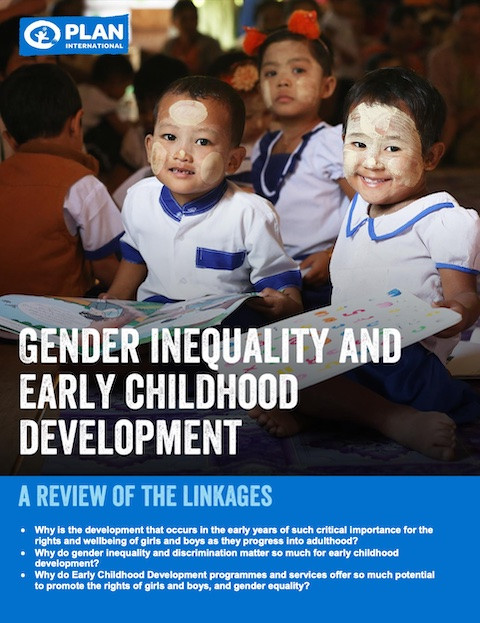 Gender Inequality and Early Childhood Development: A Review of the Linkages Year of publication: 2017 Corporate author: Plan International This paper aims to respond to the fact that Early Childhood Development initiatives and programmes, both internal and external, often appear to give limited attention to gender inequality and discrimination. Furthermore, initiatives to promote girls’ rights and gender equality often pay little attention to early childhood, instead focusing on older girls and adolescents.