
Resources
Explore a wide range of valuable resources on GCED to deepen your understanding and enhance your research, advocacy, teaching, and learning.
124 Results found
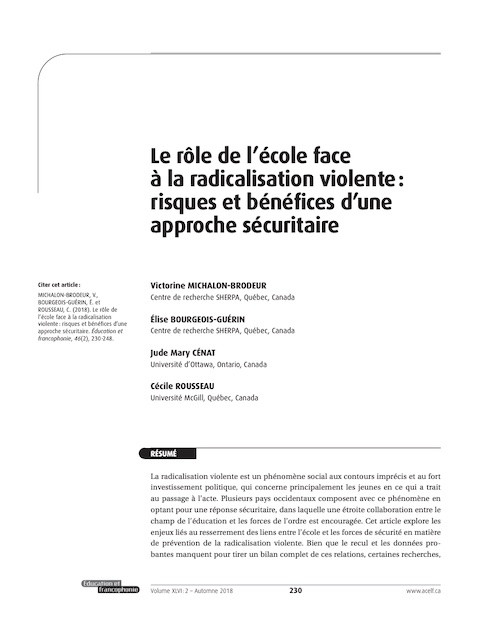 Le rôle de l’école face à la radicalisation violente: Risques et bénéfices d’une approche sécuritaire (Éducation et francophonie; vol. 46, no. 2) Year of publication: 2018 Author: Victorine Michalon-Brodeur | Élise Bourgeois-Guérin | Jude Mary Cénat | Cécile Rousseau Corporate author: Association canadienne d’éducation de langue française La radicalisation violente est un phénomène social aux contours imprécis et au fort investissement politique, qui concerne principalement les jeunes en ce qui a trait au passage à l’acte. Plusieurs pays occidentaux composent avec ce phénomène en optant pour une réponse sécuritaire, dans laquelle une étroite collaboration entre le champ de l’éducation et les forces de l’ordre est encouragée. Cet article explore les enjeux liés au resserrement des liens entre l’école et les forces de sécurité en matière de prévention de la radicalisation violente. Bien que le recul et les données probantes manquent pour tirer un bilan complet de ces relations, certaines recherches, consacrées à l’impact de la guerre au terrorisme sur les jeunes et sur la sécurisation des écoles américaines en réponse aux fusillades scolaires, appellent à la retenue. À la lumière de ces travaux, le présent article soutient qu’il est nécessaire d’établir des frontières claires entre les mandats de l’école et ceux des forces de sécurité. L’importance de ces pare-feu doit être mise de l’avant dans la formation du personnel scolaire en prévention de la radicalisation violente, afin de préserver la capacité de l’école à se poser en espace qui favorise le développement d’une pensée critique et d’une conscience de l’Autre.
  International Conference on Global Citizenship Education and International Solidarity Year of publication: 2022 Corporate author: Quebec Association of International Cooperation Organizations (AQOCI) This material aims to share practices and reflections on education for global and solidarity citizenship. The conference was initiated by the international committee of the Festival des Solidarités (Festisol) and led by AQOCI (Quebec Association of International Cooperation Organizations). Conférence internationale sur l'Éducation à la citoyenneté mondiale et la solidarité internationale Year of publication: 2022 Corporate author: Association québécoise des organismes de coopération internationale (AQOCI) Cette vidéo est pour traiter des diverses dimensions de la pauvreté ainsi que de ce qui peut être fait pour s'attaquer aux causes de la pauvreté. Partage de pratiques et de réflexions sur l'éducation à la citoyenneté mondiale et solidaire. Conférence initiée par le comité international du Festival des Solidarités (Festisol) et animée par l'AQOCI (Association québécoise des organismes de coopération internationale).
 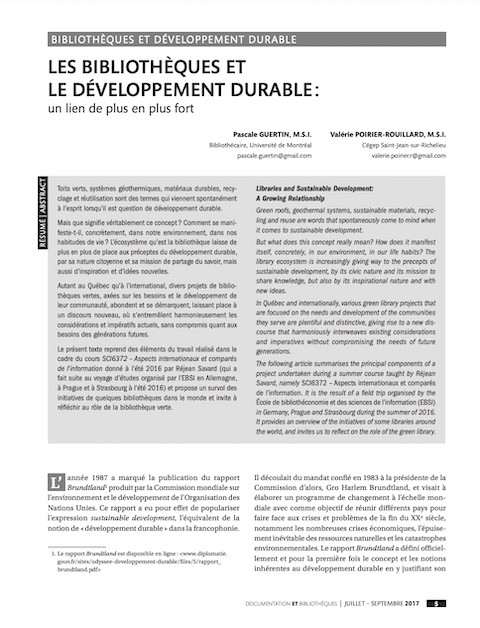 Libraries and Sustainable Development: A Growing Relationship (Documentation et bibliothèques; vol. 63, no. 3) Year of publication: 2017 Author: Pascale Guertin | Valérie Poirier-Rouillard Corporate author: Association pour l'avancement des sciences et des techniques de la documentation (ASTED) Green roofs, geothermal systems, sustainable materials, recycling and reuse are words that spontaneously come to mind when it comes to sustainable development.But what does this concept really mean? How does it manifest itself, concretely, in our environment, in our life habits? The library ecosystem is increasingly giving way to the precepts of sustainable development, by its civic nature and its mission to share knowledge, but also by its inspirational nature and with new ideas.In Québec and internationally, various green library projects that are focused on the needs and development of the communities they serve are plentiful and distinctive, giving rise to a new discourse that harmoniously interweaves existing considerations and imperatives without compromising the needs of future generations.The following article summarises the principal components of a project undertaken during a summer course taught by Réjean Savard, namely SCI6372 – Aspects internationaux et comparés de l’information. It is the result of a field trip organised by the École de bibliothéconomie et des sciences de l’information (EBSI) in Germany, Prague and Strasbourg during the summer of 2016. It provides an overview of the initiatives of some libraries around the world, and invites us to reflect on the role of the green library. Les bibliothèques et le développement durable: Un lien de plus en plus fort (Documentation et bibliothèques; vol. 63, no. 3) Year of publication: 2017 Author: Pascale Guertin | Valérie Poirier-Rouillard Corporate author: Association pour l'avancement des sciences et des techniques de la documentation (ASTED) Toits verts, systèmes géothermiques, matériaux durables, recyclage et réutilisation sont des termes qui viennent spontanément à l’esprit lorsqu’il est question de développement durable.Mais que signifie véritablement ce concept ? Comment se manifeste-t-il, concrètement, dans notre environnement, dans nos habitudes de vie ? L’écosystème qu’est la bibliothèque laisse de plus en plus de place aux préceptes du développement durable, par sa nature citoyenne et sa mission de partage du savoir, mais aussi d’inspiration et d’idées nouvelles.Autant au Québec qu’à l’international, divers projets de bibliothèques vertes, axées sur les besoins et le développement de leur communauté, abondent et se démarquent, laissant place à un discours nouveau, où s’entremêlent harmonieusement les considérations et impératifs actuels, sans compromis quant aux besoins des générations futures.Le présent texte reprend des éléments du travail réalisé dans le cadre du cours SCI6372 – Aspects internationaux et comparés de l’information donné à l’été 2016 par Réjean Savard (qui a fait suite au voyage d’études organisé par l’EBSI en Allemagne, à Prague et à Strasbourg à l’été 2016) et propose un survol des initiatives de quelques bibliothèques dans le monde et invite à réfléchir au rôle de la bibliothèque verte.
 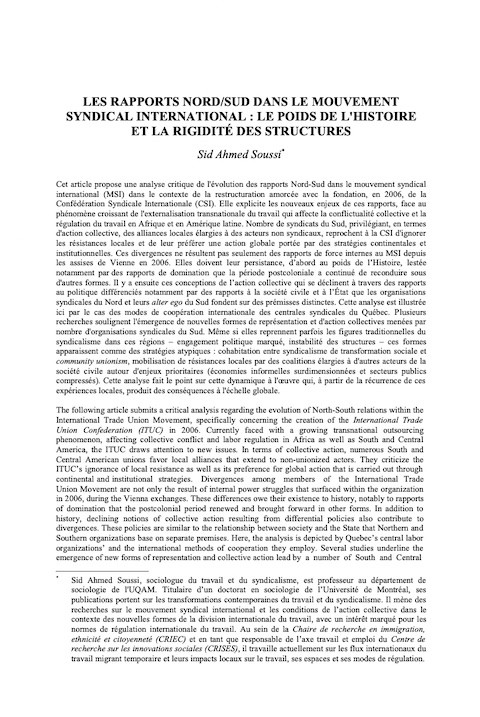 North/South Relationships in the International Trade Union Movement: The Weight of History and the Rigidity of Structures (Quebec Journal of International Law; Special Issue, Nov.) Year of publication: 2012 Author: Sid Ahmed Soussi Corporate author: Société québécoise de droit international (SQDI) The following article submits a critical analysis regarding the evolution of North-South relations within the International Trade Union Movement, specifically concerning the creation of the International Trade Union Confederation (ITUC) in 2006. Currently faced with a growing transnational outsourcing phenomenon, affecting collective conflict and labor regulation in Africa as well as South and Central America, the ITUC draws attention to new issues. In terms of collective action, numerous South and Central American unions favor local alliances that extend to non-unionized actors. They criticize the ITUC’s ignorance of local resistance as well as its preference for global action that is carried out through continental and institutional strategies. Divergences among members of the International Trade Union Movement are not only the result of internal power struggles that surfaced within the organization in 2006, during the Vienna exchanges. These differences owe their existence to history, notably to rapports of domination that the postcolonial period renewed and brought forward in other forms. In addition to history, declining notions of collective action resulting from differential policies also contribute to divergences. These policies are similar to the relationship between society and the State that Northern and Southern organizations base on separate premises. Here, the analysis is depicted by Quebec’s central labor organizations’ and the international methods of cooperation they employ. Several studies underline the emergence of new forms of representation and collective action lead by a number of South and Central American labor organizations. Even though, in some cases, these new types of representation take on traditional forms of unionism such as marked political involvement and organizational instability, they surface within atypical strategies. These unusual approaches include the coexistence of socially-generated unionism and community unionism, as well as the mobilization of local resistance movements through coalitions that extend to other community actors with prioritized issues (oversized informal economies and a compressed public sector). The analysis explores the underlying dynamic that, based on recurring local experiences, produces consequences on a global scale. Les rapports nord/sud dans le mouvement syndical international: Le poids de l’histoire et la rigidité des structures (Revue québécoise de droit international; Special Issue, Nov.) Year of publication: 2012 Author: Sid Ahmed Soussi Corporate author: Société québécoise de droit international (SQDI) Cet article propose une analyse critique de l’évolution des rapports Nord-Sud dans le mouvement syndical international (MSI) dans le contexte de la restructuration amorcée avec la fondation, en 2006, de la Confédération Syndicale Internationale (CSI). Elle explicite les nouveaux enjeux de ces rapports, face au phénomène croissant de l’externalisation transnationale du travail qui affecte la conflictualité collective et la régulation du travail en Afrique et en Amérique latine. Nombre de syndicats du Sud, privilégiant, en termes d’action collective, des alliances locales élargies à des acteurs non syndicaux, reprochent à la CSI d’ignorer les résistances locales et de leur préférer une action globale portée par des stratégies continentales et institutionnelles. Ces divergences ne résultent pas seulement des rapports de force internes au MSI depuis les assises de Vienne en 2006. Elles doivent leur persistance, d’abord au poids de l’Histoire, lestée notamment par des rapports de domination que la période postcoloniale a continué de reconduire sous d’autres formes. Il y a ensuite ces conceptions de l’action collective qui se déclinent à travers des rapports au politique différenciés notamment par des rapports à la société civile et à l’État que les organisations syndicales du Nord et leurs alter ego du Sud fondent sur des prémisses distinctes. Cette analyse est illustrée ici par le cas des modes de coopération internationale des centrales syndicales du Québec. Plusieurs recherches soulignent l’émergence de nouvelles formes de représentation et d’action collectives menées par nombre d’organisations syndicales du Sud. Même si elles reprennent parfois les figures traditionnelles du syndicalisme dans ces régions – engagement politique marqué, instabilité des structures – ces formes apparaissent comme des stratégies atypiques : cohabitation entre syndicalisme de transformation sociale et community unionism, mobilisation de résistances locales par des coalitions élargies à d’autres acteurs de la société civile autour d’enjeux prioritaires (économies informelles surdimensionnées et secteurs publics compressés). Cette analyse fait le point sur cette dynamique à l’oeuvre qui, à partir de la récurrence de ces expériences locales, produit des conséquences à l’échelle globale.
 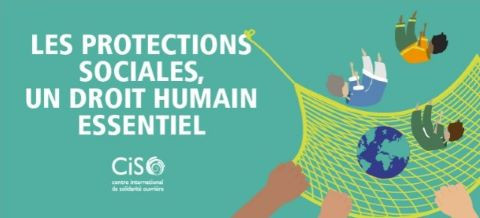 Campaign "Social Protections, an Essential Human Right!" Year of publication: 2021 Corporate author: International Labour Solidarity Centre Around the world, the COVID-19 pandemic has highlighted the inequalities in the individual and collective protection measures that societies had access to face the crisis. Unsurprisingly, we found that not everyone was equal in the face of the pandemic, quite the contrary. Countries with higher rates of social coverage and labor formalization have seen their populations much better prepared and equipped to deal with the aftermath. In contrast, places, where a large number of workers worked in precarious situations, suffered from an increase in the unemployment rate and a much higher rate of contagion.It is therefore with the current pandemic context in mind that the CISO has decided to set up the annual campaign under the theme of social protection for all, to raise awareness among the Quebec public about the precariousness of work. in the South and the North and the importance of social protection floors to protect the most vulnerable workers. Through this campaign, we want to present social protections not as a privilege but as an essential human right for all. Campagne « Les protections sociales, un droit humain essentiel! » Year of publication: 2021 Corporate author: International Labour Solidarity Centre Partout dans le monde, la pandémie de COVID-19 a mis en lumière les inégalités dans les mesures de protections individuelles et collectives auxquelles les sociétés avaient accès pour faire face à la crise. Sans surprise, nous avons constaté que toutes et tous n’étaient pas égales et égaux face à la pandémie, bien au contraire. Les pays avec de plus hauts taux de couverture sociale et de formalisation du travail ont vu leur population beaucoup mieux préparée et outillée à faire face aux contrecoups. Par opposition, les endroits où un grand nombre de travailleuses et travailleurs oeuvraient dans des situations de précarité ont souffert d’une augmentation du taux de chômage et d’un taux de contagion beaucoup plus élevé.C’est donc en gardant en tête le contexte pandémique actuel que le CISO a décidé de mettre en place la campagne annuelle sous le thème des protections sociales pour toutes et tous, et ce dans le but de sensibiliser le public québécois à la précarisation du travail au Sud et au Nord et à l’importance des socles de protection sociale pour protéger les travailleuses et travailleurs les plus vulnérables. Par cette campagne, nous souhaitons présenter les protections sociales non comme un privilège mais bien comme un droit humain essentiel pour toutes et tous.
 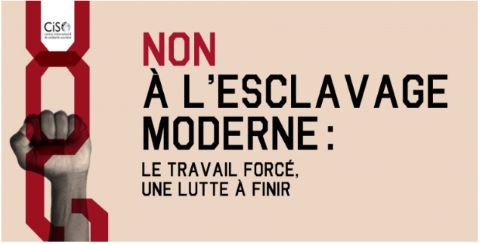 2018-2019: NO to Modern Slavery: Forced Labor, a Struggle to End Year of publication: 2019 Corporate author: International Labour Solidarity Centre The CISO has embarked with its partners on a three-year campaign against forced labour. In 2017-2018, he called for the ratification of ILO Convention 189 on the rights of domestic workers and publicized the violations of their rights here and elsewhere in the world. This year, it is tackling the task of making known the existence of forced labor in the agri-food and electronics sector in order to promote greater and effective mobilization against this scourge which offends the conscience and the rights of all workers in the world.