
Resources
Explore a wide range of valuable resources on GCED to deepen your understanding and enhance your research, advocacy, teaching, and learning.
1,402 Results found
 Pour vivre ensemble: l'élaboration de nouvelles attitudes à la paix par l'éducation Year of publication: 1997 Author: Daniel S. Halpérin Corporate author: UNESCO International Bureau of Education (IBE) L'initiative «Pour vivre ensemble» est né lors d'une réunion en Février 1996 avec le professeur Emeritus Antoine Cuendet, un chirurgien pédiatrique, ancien doyen de la Faculté de médecine de l'Université de Genève et président de la Fondation de Genève pour la protection de la santé dans la guerre (ci-après Fondation de Genève). Sa fondation était en train d'essayer de mieux définir son champ d'action au sein du grand thème de «la santé et de la guerre», et d'identifier les domaines de recherche qui mériterait un soutien prioritaire. Nous avons convenu que, à un moment où les politiciens étaient entrés dans une ère de rétablissement de la paix au Moyen-Orient, la situation pourrait être appropriée pour les Palestiniens et les Israéliens à se lancer dans des projets de recherche conjoints. En particulier, un projet potentiellement fructueux pourrait consister à examiner les effets de long terme, les conflits prolongés, tels que celui sur la santé israélo-palestinien mental et social des enfants. On ne savait pas combien de leur anxiété, troubles psychosomatiques, agressivité, troubles du comportement ou des échecs scolaires peuvent être liés avec des conséquences directes ou indirectes du conflit. Quelles ont été les interventions ou les instruments qui peuvent contrebalancer, voire corriger ces problèmes? Y avait-il tout type d'un programme d'éducation, par exemple, qui pourrait être démontré pour être efficace dans la lutte contre les effets putatifs du conflit; et qui pourrait se révéler utile pour accélérer effectivement la guérison des traumatismes, tout en renforçant simultanément la construction de la paix? Inter-agency peace education programme: skills for constructive living; overview of the programme Year of publication: 2005 Author: Antonella Verdiani Corporate author: UN. Office of the United Nations High Commissioner for Refugees (UNHCR) | Inter-agency Network for Education in Emergencies (INEE) This manual is one of the components of the “Inter-Agency Peace Education Programme”. The programme is designed for education managers of ministries dealing with both formal and non-formal education and for agencies which implement education activities on behalf of the government. The implementation structure is based on the experience acquired over the eight years the programme has been in use, from 1998 to 2005. The programme has been evaluated by external experts and the new revised materials (2005) incorporate both the suggestions made in the evaluation and the feedback from the specialists who implemented it in the field. Programme Interinstitution d'éducation pour la paix: compétences pour la vie constructive; aperçu du programme Year of publication: 2005 Author: Antonella Verdiani Corporate author: UN. Office of the United Nations High Commissioner for Refugees (UNHCR) | Inter-agency Network for Education in Emergencies (INEE) Ce manuel est l'une des composantes du «Programme Interinstitution d'éducation pour la paix». Le programme est conçu pour les gestionnaires de l'éducation des ministères chargés de l'éducation formelle et non-formelle et pour les organismes qui mettent en œuvre des activités d'éducation au nom du gouvernement. La structure de mise en œuvre est basée sur l'expérience acquise au cours des huit années, le programme a été utilisé, de 1998 à 2005. Le programme a été évalué par des experts externes et les nouveaux matériaux révisés (2005) intègrent à la fois les suggestions formulées dans l'évaluation et les réactions des spécialistes qui œuvre dans le domaine. Discours de M. Koïchiro Matsuura, Directeur général de l'UNESCO, à l'occasion de la Cérémonie de Remise du Prix UNESCO de l'Éducation pour la Paix 2008, UNESCO, 18 Septembre 2008 Year of publication: 2008 Corporate author: UNESCO. Director-General, 1999-2009 (Matsuura, K.) This is an address by Address by Mr Koïchiro Matsuura, Director-General of UNESCO, on the occasion of the Award Ceremony for the UNESCO Prize for Peace Education 2008.
  Address by Mr Koïchiro Matsuura, Director-General of UNESCO, on the occasion of the Award Ceremony for the UNESCO Prize for Peace Education 2008; UNESCO, 18 September 2008 Year of publication: 2008 Corporate author: UNESCO. Director-General, 1999-2009 (Matsuura, K.) This is an address by Address by Mr Koïchiro Matsuura, Director-General of UNESCO, on the occasion of the Award Ceremony for the UNESCO Prize for Peace Education 2008. Discours de M. Koïchiro Matsuura, Directeur Général de l'UNESCO, à l'occasion de la Cérémonie de remise du Prix UNESCO de l'éducation pour la paix 2008; UNESCO, 18 Septembre 2008 Year of publication: 2008 Corporate author: UNESCO. Director-General, 1999-2009 (Matsuura, K.) Ceci est une adresse par adresse de M. Koïchiro Matsuura, Directeur général de l'UNESCO, à l'occasion de la Cérémonie de remise du Prix UNESCO de l'Éducation pour la Paix 2008.
  Address by Irina Bokova, Director-General of UNESCO on the occasion of the the Side Even “What Works and What Doesn’t in the Prevention of Violent Extremism (PVE)” Year of publication: 2017 Corporate author: UNESCO. Director-General, 2009-2017 (Bokova, I.G.) This Address was delivered by Irina Bokova, Director-General of UNESCO on the occasion of the the Side Even “What Works and What Doesn’t in the Prevention of Violent Extremism (PVE): A Discussion on UNESCO’s Actions and Launch of UNESCO’s Latest Publications”. Couleur? Quelle couleur? Rapport sur la lutte contre la discrimination et le racisme dans le football Year of publication: 2015 Author: Albrecht Sonntag | David Ranc Football has been shown to be a mirror of society, it may also be viewed as providing a temporary suspension of reality for an interlude of high emotion and idealized hopes and dreams. Football’s public transcends differences of age, gender, culture, religion, and socioeconomic status to unite in support of their team. The broad diversity of backgrounds of football players represents tangible evidence of equal opportunity and meritocracy. The sport itself has team solidarity, fair play and mutual respect among members and for opponents ingrained within its rules and practices. Yet, the ‘beautiful game’ is one with an imbedded paradox. Football is also a game that may in many vaguely resemble war, where opponents face each other in a struggle to win over the other side, with the noisy and emphatic support of the spectators. An ‘us’ and ‘them’ mentality is an integral part of trying to help a team reach the objective, which is to win the game. This setting naturally produces a desire by supporters to intimidate the other side by encouraging their team and expressing both confidence and superiority through their words and actions. When the ‘us’ and ‘them’ mentality turns into symbolic exclusion of others, language of disparagement and insult based on racism or discrimination, or physical confrontation, the ‘beautiful game’ is debased. The existence of racism and discrimination in football is not a secret, but it is a shame on the game. Although much is already being done, both observers and experts feel too many problems persist and measures to tackle them have not been effective enough. This report was commissioned by UNESCO within the framework of UNESCO’s partnership with Juventus. It focuses on discrimination and racism in professional football and to some extent the amateur clubs that funnel into the leagues. It provides an overview of the historic and theoretical background. It reports on the state of affairs on the ground. It summarizes what has been done and is being done to mitigate racism and discrimination in domestic and international football, how the effects of these actions may be evaluated, and which new avenues for further, complementary action are promising. The report is based on a literature review, desk research, regional reports from the Unesco network and a field survey among a purposive sample of experts and actors in a number of countries. The report has a somewhat European focus, in its sources and examples. Europe has a unique position Executive Summary in the world of football, with its leading competitions, championships and clubs. It is the region where racism and discrimination in football has been most intensively researched. A number of civil society organisations from Europe have played a pioneering role in the fight against racism and discrimination in football. Moreover, the pressure that comes with the money invested in and generated by western European football, as well as its exposure in the media, has also made clubs, federations and UEFA particularly sensitive to the negative impact that discrimination can have on the game and its image, within Europe and worldwide. Europe must therefore occupy a central role in a study of the fight against discrimination in professional football and in determined policies to mitigate racism and discrimination related to football wherever they occur. The examples of incidents of discrimination and racism, as well as of existing measures to combat them have been selected to be as wide-ranging as possible. The authors do not, however, claim the report to be a comprehensive listing. Similarly, the examples of best practice have been collected through extensive reading and contacts, but must be looked at as an overview rather than as a directory. They are chosen by the authors to illustrate types of actions and institutions with the potential for greatest impact. The report also does not deal with the methods of allocation of resources to football, with issues of employment, or with womens’ football. While these are significant topics on which concerns can be expressed, the necessary focus of a report of this type means that they are alluded to without being treated in depth. ¿Color?¿Qué color? Informe sobre la lucha contra el racismo y la discriminación en el fútbol Year of publication: 2015 Author: Albrecht Sonntag | David Ranc Football has been shown to be a mirror of society, it may also be viewed as providing a temporary suspension of reality for an interlude of high emotion and idealized hopes and dreams. Football’s public transcends differences of age, gender, culture, religion, and socioeconomic status to unite in support of their team. The broad diversity of backgrounds of football players represents tangible evidence of equal opportunity and meritocracy. The sport itself has team solidarity, fair play and mutual respect among members and for opponents ingrained within its rules and practices. Yet, the ‘beautiful game’ is one with an imbedded paradox. Football is also a game that may in many vaguely resemble war, where opponents face each other in a struggle to win over the other side, with the noisy and emphatic support of the spectators. An ‘us’ and ‘them’ mentality is an integral part of trying to help a team reach the objective, which is to win the game. This setting naturally produces a desire by supporters to intimidate the other side by encouraging their team and expressing both confidence and superiority through their words and actions. When the ‘us’ and ‘them’ mentality turns into symbolic exclusion of others, language of disparagement and insult based on racism or discrimination, or physical confrontation, the ‘beautiful game’ is debased. The existence of racism and discrimination in football is not a secret, but it is a shame on the game. Although much is already being done, both observers and experts feel too many problems persist and measures to tackle them have not been effective enough. This report was commissioned by UNESCO within the framework of UNESCO’s partnership with Juventus. It focuses on discrimination and racism in professional football and to some extent the amateur clubs that funnel into the leagues. It provides an overview of the historic and theoretical background. It reports on the state of affairs on the ground. It summarizes what has been done and is being done to mitigate racism and discrimination in domestic and international football, how the effects of these actions may be evaluated, and which new avenues for further, complementary action are promising. The report is based on a literature review, desk research, regional reports from the Unesco network and a field survey among a purposive sample of experts and actors in a number of countries. The report has a somewhat European focus, in its sources and examples. Europe has a unique position Executive Summary in the world of football, with its leading competitions, championships and clubs. It is the region where racism and discrimination in football has been most intensively researched. A number of civil society organisations from Europe have played a pioneering role in the fight against racism and discrimination in football. Moreover, the pressure that comes with the money invested in and generated by western European football, as well as its exposure in the media, has also made clubs, federations and UEFA particularly sensitive to the negative impact that discrimination can have on the game and its image, within Europe and worldwide. Europe must therefore occupy a central role in a study of the fight against discrimination in professional football and in determined policies to mitigate racism and discrimination related to football wherever they occur. The examples of incidents of discrimination and racism, as well as of existing measures to combat them have been selected to be as wide-ranging as possible. The authors do not, however, claim the report to be a comprehensive listing. Similarly, the examples of best practice have been collected through extensive reading and contacts, but must be looked at as an overview rather than as a directory. They are chosen by the authors to illustrate types of actions and institutions with the potential for greatest impact. The report also does not deal with the methods of allocation of resources to football, with issues of employment, or with womens’ football. While these are significant topics on which concerns can be expressed, the necessary focus of a report of this type means that they are alluded to without being treated in depth.
 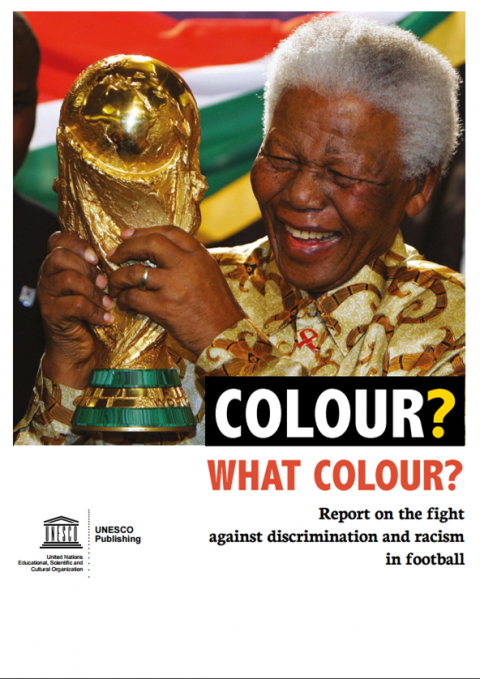 Colour? What colour? Relazione sulla lotta contro la discriminazione e il razzismo nel calcio Year of publication: 2015 Author: Albrecht Sonntag | David Ranc Football has been shown to be a mirror of society, it may also be viewed as providing a temporary suspension of reality for an interlude of high emotion and idealized hopes and dreams. Football’s public transcends differences of age, gender, culture, religion, and socioeconomic status to unite in support of their team. The broad diversity of backgrounds of football players represents tangible evidence of equal opportunity and meritocracy. The sport itself has team solidarity, fair play and mutual respect among members and for opponents ingrained within its rules and practices. Yet, the ‘beautiful game’ is one with an imbedded paradox. Football is also a game that may in many vaguely resemble war, where opponents face each other in a struggle to win over the other side, with the noisy and emphatic support of the spectators. An ‘us’ and ‘them’ mentality is an integral part of trying to help a team reach the objective, which is to win the game. This setting naturally produces a desire by supporters to intimidate the other side by encouraging their team and expressing both confidence and superiority through their words and actions. When the ‘us’ and ‘them’ mentality turns into symbolic exclusion of others, language of disparagement and insult based on racism or discrimination, or physical confrontation, the ‘beautiful game’ is debased. The existence of racism and discrimination in football is not a secret, but it is a shame on the game. Although much is already being done, both observers and experts feel too many problems persist and measures to tackle them have not been effective enough. This report was commissioned by UNESCO within the framework of UNESCO’s partnership with Juventus. It focuses on discrimination and racism in professional football and to some extent the amateur clubs that funnel into the leagues. It provides an overview of the historic and theoretical background. It reports on the state of affairs on the ground. It summarizes what has been done and is being done to mitigate racism and discrimination in domestic and international football, how the effects of these actions may be evaluated, and which new avenues for further, complementary action are promising. The report is based on a literature review, desk research, regional reports from the Unesco network and a field survey among a purposive sample of experts and actors in a number of countries. The report has a somewhat European focus, in its sources and examples. Europe has a unique position Executive Summary in the world of football, with its leading competitions, championships and clubs. It is the region where racism and discrimination in football has been most intensively researched. A number of civil society organisations from Europe have played a pioneering role in the fight against racism and discrimination in football. Moreover, the pressure that comes with the money invested in and generated by western European football, as well as its exposure in the media, has also made clubs, federations and UEFA particularly sensitive to the negative impact that discrimination can have on the game and its image, within Europe and worldwide. Europe must therefore occupy a central role in a study of the fight against discrimination in professional football and in determined policies to mitigate racism and discrimination related to football wherever they occur. The examples of incidents of discrimination and racism, as well as of existing measures to combat them have been selected to be as wide-ranging as possible. The authors do not, however, claim the report to be a comprehensive listing. Similarly, the examples of best practice have been collected through extensive reading and contacts, but must be looked at as an overview rather than as a directory. They are chosen by the authors to illustrate types of actions and institutions with the potential for greatest impact. The report also does not deal with the methods of allocation of resources to football, with issues of employment, or with womens’ football. While these are significant topics on which concerns can be expressed, the necessary focus of a report of this type means that they are alluded to without being treated in depth.