
Resources
Explore a wide range of valuable resources on GCED to deepen your understanding and enhance your research, advocacy, teaching, and learning.
328 Results found
 세계시민교육 주제선택의 촉진요인과 제약요인: 세계시민교육 선도교사의 인식을 중심으로 (한국교원교육연구; Vol.35, No.4) Year of publication: 2018 Author: 박근아 | 오순영 | 황재운 Corporate author: 한국교원교육학회 이 연구는 교사의 세계시민교육 주제선택에 대한 영향요인을 분석하는데 데 그 목적이 있 다. 구체적으로 이 연구를 통해 교사의 세계시민교육 주제선택을 촉진하고, 제약하는 요인에 는 어떤 것이 있는지를 세분해서 탐색하고자 하였다. 이를 위해 연구진은 세계시민교육 선도 교사로 참여하고 있는 13명의 연구참여자를 선정하여 심층면담을 실시하였다. 이 연구의 주요한 결과는 다음과 같다. 첫째, 교사의 세계시민교육 주제선택 촉진요인으로 는 ‘교사의 경험’, ‘학생’, ‘시사성’, ‘지역’, ‘교수ㆍ학습자료’ 등이 있는 것으로 드러났다. 둘째, 교사의 세계시민교육 주제선택 제약요인에는 ‘제도’, ‘학부모’, ‘지역’ 등이 존재하는 것으로 나 타났다. 이 연구의 결과를 토대로, 세계시민교육과 관련한 현장친화형 교수ㆍ학습자료 개발의 필요성, 세계시민교육에 대한 교육주체의 인식 제고가 가지는 중요성 등에 대해 논하였다.
  Development of Global Citizenship Education Competence Scale for Early Childhood Teacher (The Journal of Korean Teacher Education; Vol.35, No.4) Year of publication: 2018 Author: Jeoungsook Kim | Kyeonghwa Lee Corporate author: Korean Society for the Study of Teacher Education The study aims to develop a scale to identify and measure the early childhood teacher’s competence for global citizenship education. In order to construct the factors of the teacher’s competence for global citizenship education, conceptualization of the competence was made based on the review of literatures, and then the preliminary scale was constructed through 3 time-Delphi survey of 34 expert panels. The content analysis and statistical analysis (content validity, consensus, and convergence) of the data collected through the Delphi survey revealed that the final version of the scale with 2 domains, 5 factors and 33 items was derived. Then, in order to validate the final version of the scale, the tests with early childhood teachers were carried out. The data collected through the final test of 294 early childhood teachers were statistically analyzed through the ratio of content reliability, validity, and reliability. The analysis was confirmed that the scale was a valid and reliable instrument for measuring the early childhood teacher’s competence for global citizenship education. In conclusion, the scale developed in this study consisted of two domains: the competence as a global citizen and the competence as a early childhood teacher to carry out global citizen education for young children. The global citizenship competence consists of 3 factors and 20 items, and the global citizenship education competence for young children consists of 2 factors and 13 items. Lastly, the possibility of using the scale for early childhood teacher education was discussed. 유아교사의 세계시민교육 역량 척도 개발 (한국교원교육연구; Vol.35, No.3) Year of publication: 2018 Author: 김정숙 | 이경화 Corporate author: 한국교원교육학회 본 연구는 유아교사가 갖추어야 할 세계시민교육 역량을 측정할 수 있는 도구를 개발하는 데 목적을 두었다. 문헌 고찰을 바탕으로 유아교사의 세계시민교육 역량 요인을 구성한 후, 3 회에 걸친 34명 전문가 패널의 델파이 조사를 통해 척도 시안을 구성하였다. 1차 개방형 조 사와 2차 및 3차의 5점 척도형 조사를 통해 수집된 자료를 분석한 결과, 2개 영역, 5요인, 33 개 요소 및 문항으로 구성된 척도의 최종시안이 도출되었다. 척도의 최종시안을 타당화하기 위하여, 유치원 및 어린이집 재직 중인 유아교사를 대상으로 예비조사 및 본조사를 실시하였 다. 60명의 유아교사를 대상으로 실시한 예비조사와 294명의 유아교사로부터 얻은 본조사 자 료를 바탕으로 문항양호도, 구인타당도, 신뢰도 등 통계적 분석을 실시한 결과, 유아교사의 세계시민교육 역량을 측정하는 도구로서 양호한 척도임을 확인하였다. 본 연구에서 개발한 척도는 유아교사가 세계시민으로서 갖추어야 할 개인적 역량(세계시민 역량)과 유아에게 세계 시민교육을 실행할 수 있는 교사로서의 역량(유아세계시민교육 역량)의 2개 영역으로 구성되 었으며, 세계시민 역량은 지식 및 이해, 기술, 태도 및 실천의 3요인, 20개 문항으로 그리고 유아세계시민교육 역량은 유아세계시민교육과정 구성 및 운영, 유아세계시민교육 실천의 2요인, 13개 문항으로 구성되었다. 이러한 척도의 구성 요인의 의미와 척도의 교사교육적 활용 가능성에 관해 논의하였다.
  The Status and Issues of Peace Education: Focussing on Its Interactions with Unification Education Year of publication: 2019 Author: Jeongah Cho | Ellie Kim | Ahyoung Moon | Boyoung Yoon Corporate author: Korea Institute for National Unification To lay the groundwork to explore the accessibility of peace education and unification education in an era of peace cooperation on the Korean Peninsula, this study takes a look at the history of peace education and the current situation and issues of both peace education and unification education. Against the backdrop of the division on the Korean Peninsula, unification education and peace education have been established as educational sectors of conflict resolution between the North and the South and of means of mediation for violence caused by the division. The two sectors have developed commonalities along the way. The origin of peace education and unification education is rooted on the division of the Korean Peninsula and the subsequent unification issues. In the current educational practices, there are different characteristics and emphasis in terms of the direction, contents, and subject of education between peace education and unification education. Efforts of creating “peace·unification education” are recently being made which focuses more on issues of peace than existing unification education. Peace education and unification education exhibit differences when it comes to the relationship between peace and unification in realizing a peaceful Korean Peninsula, whether unification is justified as an ultimate goal, how issues of ‘positive peace’ and security are handled, and how much initiatives the learners have. This study asserts that the issues between peace education and unification education should be clarified and that the two sectors should expand the overlapping areas under the principal of dealing with unification issues on the basis of value of peace. 평화교육의 실태와 쟁점: 통일교육과의 접점을 중심으로 Year of publication: 2019 Author: 조정아 | 김엘리 | 문아영 | 윤보영 Corporate author: 통일연구원 이 연구는 한반도 평화협력의 시대에 평화교육과 통일교육의 접근 가능성을 모색하기 위한 기초작업이다. 평화교육의 역사를 고찰하고 평화 교육과 통일교육 실태와 쟁점을 살펴보았으며, 이에 기초하여 평화교육과 통일교육의 과제를 도출하였다. 통일교육과 평화교육은 분단의 역사 속에서 분단과 남북 간의 대립, 분단으로 인한 폭력과 비평화를 해소하기 위한 교육으로 자리매김하였고, 그 과정에서 접점을 형성하고 공동의 영역을 만들어왔다. 평화교육의 역사 고찰에서 나타난 바와 같이, 한국의 평화교육은 그 태생에서부터 분단의 극복과 민족화해라는 문제를 중심에 놓았다. 한국에서 평화교육은 우리 사회의 폭력의 주요한 원인 중 하나인 분단문제를 고민하지 않고 이루어질 수는 없는 것이었다. 그 점에서 평화교육과 통일교육은 태생에서부터 한반도의 분단과 통일이라는 출발점을 공유하고 있다. 그럼에도 불구하고, 평화교육이라는 이름으로 불리는 교육실천과 통일교육이라는 이름으로 불리는 교육실천의 현재 모습 속에는 교육의 방향성, 내용, 주체 등의 측면에서 서로 다른 특성과 강조점이 나타난다. 특히 통일교육 영역에서 최근 평화‧ 통일교육이라는 명칭으로 기존 통일교육과의 차별화를 시도하고 있지만, 한반도 평화에서 통일의 위상, 통일의 당위성 문제, 적극적 평화와 안보문제, 학습자의 주도성 등을 다루는 관점에서 평화교육과의 차이가 존재한다. 이에, 이 연구에서는 평화교육과 통일교육 중 어느 하나가 다른 쪽을 대체하거나 양자를 통합해야 한다고 주장하기보다는, 평화교육과 통일 교육이 양자의 문제의식을 공유하면서 한반도 분단과 통일문제를 평화의 관점과 가치에 입각해서 다루어야 한다고 보았다. 이를 위한 정책과 평화교육의 실태와 쟁점: 통일교육과의 접점을 중심으로 제로 ① 교육 방향성 정립과 이를 위한 사회적 논의, ② 역량중심으로 평화교육 및 통일교육 내용체계 개편, ③ 민간 영역의 자율성 확대와 거버넌스 구축, ④ 시대적 과제와 평화지향성을 반영한 통일교육 관계 법령 정비를 제시하였다.
  한국사회와 지속가능발전목표 4: 지속가능한 사회를 꿈꾸는 교육 Year of publication: 2018 Author: 임현묵 | 박환보 Corporate author: 유네스코한국위원회 지속가능발전목표에 대한 시민의 이해를 돕고자 유네스코한국위원회가 발간하는 ‘한국사회와 지속가능발전목표’ 시리즈 중 4번째로, 세계시민교육과 지속가능발전교육을 포함한 지속가능발전목표 4번을 집중적으로 다루고 있다. 유네스코한국위원회는 2017년 <<한국사회와 지속가능발전목표 7: 우리의 지속가능한 에너지>>와 <<한국사회와 지속가능발전목표 11: 우리의 지속가능한 도시>>를 펴낸 데 이어, 2018년에는 <<한국사회와 지속가능발전목표 15: 우리의 지속가능한 생물다양성>>과 이 책을 발간했다.
  평화를 향한 유네스코의 역할 Year of publication: 2019 Author: 강인욱 | 김성해 | 김지현 | 성지은 | 유성상 | 조동준 | 최동주 | 한경구 Corporate author: 유네스코한국위원회 평화를 위한 유네스코의 국제적인 지적 협력 활동은 교육과 문화 분야에서는 상당한 가시적 성과를 거두었다. 이 과정에서 문제점도 발견되고 한계도 드러나고 정치화되었다는 비판도 받았지만, 교육과 문화의 영역에서 유네스코는 국제적 협력과 활동의 방향을 설정하거나 논의를 주도하고 이끌어가는 모습을 보이고 있다.유네스코가 평화를 위한 기구이면서도 평화와 관련하여 폭넓고 다양하며 깊이 있는 새로운 연구와 실천을 적극적으로 주도하지 못한 것은, 냉전이라는 국제정치적 요인을 감안하더라도 매우 안타까운 일이다. 유네스코는 평화를 위하여 만들어진 국제기구이면서도 전후에 평화와 관련된 학술적 논의와 이론의 발전을 주도하지 못했다. ‘평화의 문화’ 개념이 처음 언급된 것은 1989년 코트디브아르에서였고, 1997년이 되어서야 유네스코가 ‘Toward a Culture of Peace Program 을 시작하였으며, 유엔총회가 2000 년을 ‘평화의 문화의 해로 선언했다.유네스코의 이러한 상황은 한국이 보다 적극적인 역할을 할 기회를 제공한다. 한국은 과거 와 같이 기회가 있을 때마다 국위를 선양하는 수준의 상황추수적(狀況追隨的) 대응에 매몰되거나, 좁은 시야로 단기적 국익을 추구하는 소극적인 입장을 탈피할 필요가 있다. 오히려 대국적 견지에서 세계 평화와 인류의 행복이라는 지구 공동체(Global Community) 전체의 이익을 중시하고, 이틀 장기적 국가이익과 동일시하며, 이에 상응하는 재정 부담을 감수함으로써 세계시민권력(Global Citizenship Power)을 추구하면서 국제적 지위의 향상과 도덕적 지도력을 증대 시킬 수 있을 것이다.
  SDG 4 Midterm Review: Monitoring Implementation of SDG 4 Target 4.1. ~ 4.c. in Rep. of Korea Year of publication: 2023 Author: Hunwoo Joo | Mikyung Kim | Mugyeong Moon | Jeongwon Hwang | Kirak Ryu | Hyeseung Cho | Yunjeong Choi | Hyosook Shin | Kyungsook Kang | Minseon Park | Eunju Lee | Nayoung Kim | Hwanbo Park | Hannah Kim | Jonghun Kim Corporate author: National Consultative Group on Education 2030 | Korean National Commission for UNESCO This report presents the compiled work from the National Consultative Group and Working Groups on Education 2030 of the Republic of Korea regarding the midterm review on the implementation of SDG 4.
 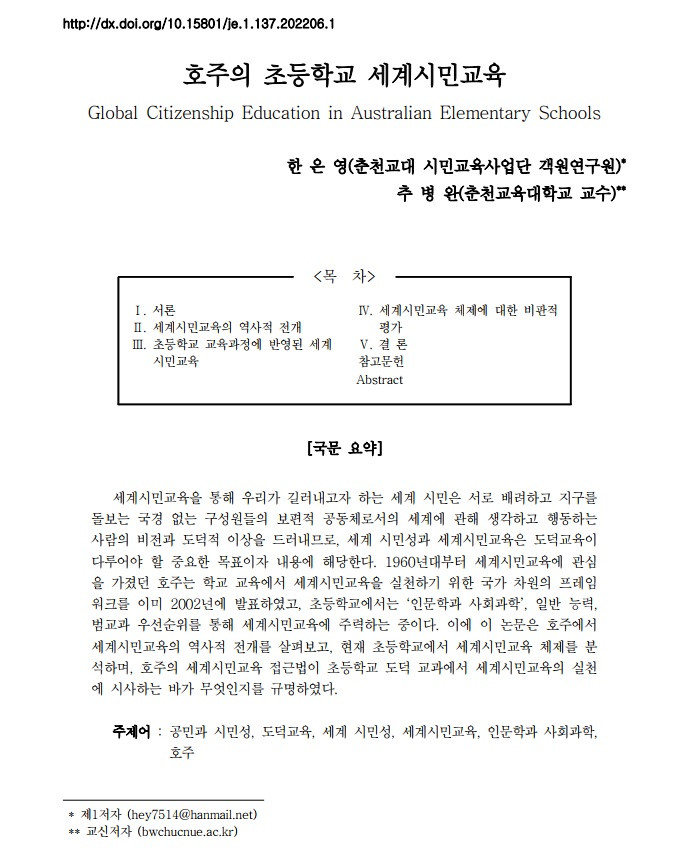 Global Citizenship Education in Australian Elementary Schools(Journal of Ethics; Vol. 137, No 1) Year of publication: 2022 Author: 한은영 | 추병완 Corporate author: 한국윤리학회 Global citizens think and act about the world as a universal community of borderless members who care for each other and are dedicated to taking care of the earth. Considering these visions and moral ideals, global citizenship education is an important goal and content of moral education. However, at present, we do not have a framework for dealing with global citizenship education in moral education. In this regard, Australia is the country we should pay attention to. Australia declared a national statement for global citizenship education in 2002. Since 2009, it has been reflected in the Australian curriculum. This article examines the historical development of global citizenship education in Australia, analyzes the current systems of global citizenship education system in primary schools, and investigates what Australia's approach to global citizenship education suggests for elementary moral education in Korea. In conclusion, we proposed three things. First, we must develop and apply a framework for the practice of global civic education in moral education. Second, we should emphasize the aspects of knowledge and understanding, skills and processing, behavior and participation as well as values and attitudes. Third, we must seek a balance between moderate global citizenship education and critical global citizenship education. 호주의 초등학교 세계시민교육(윤리연구; Vol. 137, No 1) Year of publication: 2022 Author: 한은영 | 추병완 Corporate author: 한국윤리학회 세계시민교육을 통해 우리가 길러내고자 하는 세계 시민은 서로 배려하고 지구를 돌보는 국경 없는 구성원들의 보편적 공동체로서의 세계에 관해 생각하고 행동하는 사람의 비전과 도덕적 이상을 드러내므로, 세계 시민성과 세계시민교육은 도덕교육이 다루어야 할 중요한 목표이자 내용에 해당한다. 1960년대부터 세계시민교육에 관심을 가졌던 호주는 학교 교육에서 세계시민교육을 실천하기 위한 국가 차원의 프레임워크를 이미 2002년에 발표하였고, 초등학교에서는 ‘인문학과 사회과학’, 일반 능력, 범교과 우선순위를 통해 세계시민교육에 주력하는 중이다. 이에 이 논문은 호주에서 세계시민교육의 역사적 전개를 살펴보고, 현재 초등학교에서 세계시민교육 체제를 분석하며, 호주의 세계시민교육 접근법이 초등학교 도덕 교과에서 세계시민교육의 실천에 시사하는 바가 무엇인지를 규명하였다.