
Resources
Explore a wide range of valuable resources on GCED to deepen your understanding and enhance your research, advocacy, teaching, and learning.
3,777 Results found
 SDG Talk: Mr. Martin Nesirky Year of publication: 2021 Author: Martin Nesirky Corporate author: Sloga Platforma | Bridge 47 SDG Talk with Martin Nesirky, director of UN Information Service Vienna about Sustainable Development Goals, implication od COVID-19 pandemic on education, Global Citizenship Education and more.SDG Talks was prepared in cooperation with the UN Association for Slovenia, as part of the Bridge 47 - Building Global Citizenship project. The project is funded by the European Commission and the Ministry of Foreign Affairs of the Republic of Slovenia, and is implemented by the SLOGA Platform.Content does not reflect positions of the EU or Slovene MFA.
  Strategies to Counter Antisemitism: A Handbook for Educators Year of publication: 2025 Corporate author: UNESCO Education is the first line of defence against hate and prejudice. By targeting the root causes of hate ideologies, deconstructing the stereotypes that underlie them from an early age, and promoting inclusive models, education is the keystone of a holistic approach to combating discrimination. Tackling antisemitism through education requires tailored content that addresses its complex, shifting and multilayered forms, both past and present.Acknowledging the topic’s complexity and the paucity of resources available to education stakeholders, this concise guide developed by UNESCO and funded by the European Commission aims to provide a roadmap for policymakers, curriculum developers and educators on current approaches and initiatives. It presents ten educational practices, each grounded in academic literature and illustrated by a promising educational initiative that operationalizes core pedagogical principles. The handbook is built around the three core learning domains which inform UNESCO’s approach to Global Citizenship Education: cognitive, socio-emotional, and behavioural learning.Conceived as an accessible operational guide for practitioners, this resource sets out to start a larger conversation about the needs of educators for tackling contemporary forms of antisemitism. It aims to encourage investments in high-quality empirical research that can pave the way for a better approach to combat antisemitism.
 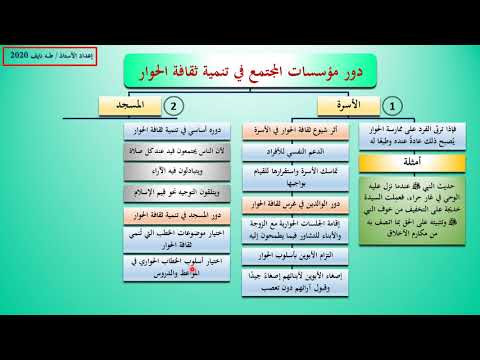 The Fifth Lesson: The Culture of Dialogue Year of publication: 2020 Author: Taha Nayef In this video, the teacher tries to explain to students the concept and etiquette of dialogue. The teacher reviews the roles of the family, educational institutions and other community institutions in the formation of the interlocutor. The lesson is filled with vivid examples of dialogue etiquette from everyday life. شرح الدرس الخامس: ثقافة الحوار Year of publication: 2020 Author: Taha Nayef يحاول المعلم في هذا الفيديو أن يشرح للطلاب مفهوم الحوار وآدابه. يقوم المعلم باستعراض أدوار الأسرة والمؤسسات التربوية وغيرها من مؤسسات المجتمع في تكوين الشخص المحاور. الدرس ملئ بالأمثلة الحية لآداب الحوار من خلال الحياة اليومية.
  Course: Dialogue and Dialogue Etiquette Year of publication: 2017 Author: Fath Omar Corporate author: Majmaah University The course includes two topics of dialogue and disagreement. It seeks to form the Muslim to be a tactful interlocutor and able to manage the conflict between him and his society and his counterparts. The course deals with one of the important pillars of global citizenship issues, which is dialogue. مقرر دراسي: الحوار وآداب الحوار Year of publication: 2017 Author: Fath Omar Corporate author: Majmaah University يتضمن المقرر موضوعي الحوار والخلاف. ويسعى لتشكيل المسلم ليكون محاوراً لبقاً، وقادراً على إدارة الخالف بينه ، وبين مجتمعه ومناظريه. المقرر يتعرض لأحد الركائز المهمة من مواضيع المواطنة العالمية وهو الحوار.
  [Video] Whole School Approach to Global Citizenship Year of publication: 2011 Corporate author: Education Scotland Global citizenship brings together education for citizenship, international education and sustainable development education and recognises the common outcomes and principles of these three areas. All curriculum areas can contribute to developing the skills, attributes and knowledge that will create active global citizens.
 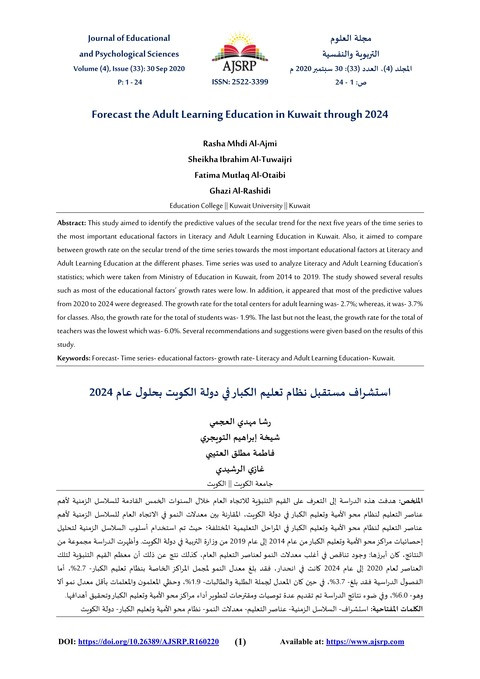 Forecast the Adult Learning Education in Kuwait Through 2024 (Journal of Educational and Psychological Sciences; vol.4, no.33) Year of publication: 2020 Author: Rasha Mhdi Al-Ajmi | Sheikha Ibrahim Al-Tuwaijri | Fatima Mutlaq Al-Otaibi | Ghazi Al-Rashidi Corporate author: Arab Institute of Science and Research Publishing (AISRP) This study aimed to identify the predictive values of the secular trend for the next five years of the time series to the most important educational factors in Literacy and Adult Learning Education in Kuwait. Also, it aimed to compare between growth rate on the secular trend of the time series towards the most important educational factors at Literacy and Adult Learning Education at the different phases. Time series was used to analyze Literacy and Adult Learning Education’s statistics; which were taken from Ministry of Education in Kuwait, from 2014 to 2019. The study showed several results such as most of the educational factors’ growth rates were low. In addition, it appeared that most of the predictive values from 2020 to 2024 were degreased. The growth rate for the total centers for adult learning was- 2.7%; whereas, it was- 3.7% for classes. Also, the growth rate for the total of students was- 1.9%. The last but not the least, the growth rate for the total of teachers was the lowest which was- 6.0%. Several recommendations and suggestions were given based on the results of this study. استشراف مستقبل نظام تعليم الكبار في دولة الكويت بحلول عام 2024 (مجلة العلوم التربوية و النفسية ;no.33, vol.4) Year of publication: 2020 Author: Rasha Mhdi Al-Ajmi | Sheikha Ibrahim Al-Tuwaijri | Fatima Mutlaq Al-Otaibi | Ghazi Al-Rashidi Corporate author: Arab Institute of Science and Research Publishing (AISRP) هدفت هذه الدراسة إلى التعرف على القيم التنبؤية للاتجاه العام خلال السنوات الخمس القادمة للسلاسل الزمنية لأهم عناصر التعليم لنظام محو الأمية وتعليم الكبار في دولة الكويت، المقارنة بين معدلات النمو في الاتجاه العام للسلاسل الزمنية لأهم عناصر التعليم لنظام محو الأمية وتعليم الكبار في المراحل التعليمية المختلفة؛ حيث تم استخدام أسلوب السلاسل الزمنية لتحليل إحصائيات مراكز محو الأمية وتعليم الكبار من عام 2014 إلى عام 2019 من وزارة التربية في دولة الكويت. وأظهرت الدراسة مجموعة من النتائج، كان أبرزها: وجود تناقص في أغلب معدلات النمو لعناصر التعليم العام، كذلك نتج عن ذلك أن معظم القيم التنبؤية لتلك العناصر لعام 2020 إلى عام 2024 كانت في انحدار، فقد بلغ معدل النمو لمجمل المراكز الخاصة بنظام تعليم الكبار- 2.7%، أما الفصول الدراسية فقد بلغ- 3.7%، في حين كان المعدل لجملة الطلبة والطالبات- 1.9%، وحظي المعلمون والمعلمات بأقل معدل نمو ألا وهو- 6.0%، وفي ضوء نتائج الدراسة تم تقديم عدة توصيات ومقترحات لتطوير أداء مراكز محو الأمية وتعليم الكبار وتحقيق أهدافها.
  Mainstreaming the General History of Africa into Education Systems: The Curriculum Pathway Year of publication: 2025 Corporate author: UNESCO Education about the history of Africa in formal, non-formal and informal learning settings continues to be dominated by Eurocentric perspectives, which has led to imbalanced representation of Africa’s history and preconceptions.This publication is a tool to support countries in challenging the skewed perspectives on how African history is taught and how Africa is perceived. It aims to bring to the foreground Africa’s history, cultures and heritage through the curriculum to strengthen knowledge, skills, values and attitudes that contribute towards addressing long-standing hegemonic, colonial thinking and connected racial bias, while forging a united, prosperous and peaceful Africa and world.Stemming from the decolonial vision and content of the volumes of the General History of Africa, the publication proposes guiding principles and approaches for designing and implementing the General History of Africa into the curriculum. It puts forth curriculum outlines for basic and secondary education to offer renewed and broader perspectives on the history of Africa and its diasporas, and their contributions to humanity.The curriculum outlines are structured around nine thematic Learning Units, arranged chronologically from the origins of humanity and civilizations to Africa’s most recent history.