
Resources
Explore a wide range of valuable resources on GCED to deepen your understanding and enhance your research, advocacy, teaching, and learning.
882 Results found
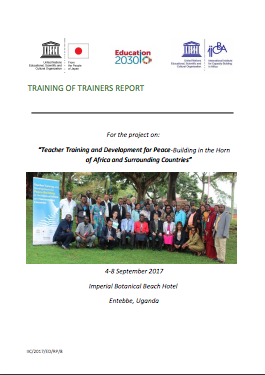 Training of Trainers Report: For the Project on: Teacher Training and Development for Peace-Building in the Horn of Africa and Surrounding Countries Year of publication: 2017 Corporate author: UNESCO International Institute for Capacity-Building in Africa (IICBA) The overall framework of this project is to create a critical mass of teachers who can implement effective teaching and learning, producing economically productive and peace-loving youth. The project has a shortterm objective of training at least 8,000 young teachers through the Training of Trainers (TOT) model. The medium-term objectives will contribute to the 2030 SDGS. The long-term objectives are in line with AU’s Agenda 2063, which promotes increased regional integration, peace and stability, and equitable economic development. Training of Trainers Report: For the Project on: Teacher Training and Development for Peace-Building in the Horn of Africa and Surrounding Countries Year of publication: 2017 Corporate author: UNESCO International Institute for Capacity-Building in Africa (IICBA) The overall framework of this project is to create a critical mass of teachers who can implement effective teaching and learning, producing economically productive and peace-loving youth. The project has a shortterm objective of training at least 8,000 young teachers through the Training of Trainers (TOT) model. The medium-term objectives will contribute to the 2030 SDGS. The long-term objectives are in line with AU’s Agenda 2063, which promotes increased regional integration, peace and stability, and equitable economic development. Training of Trainers Report: For the Project on: Teacher Training and Development for Peace-Building in the Horn of Africa and Surrounding Countries Year of publication: 2017 Corporate author: UNESCO International Institute for Capacity-Building in Africa (IICBA) The overall framework of this project is to create a critical mass of teachers who can implement effective teaching and learning, producing economically productive and peace-loving youth. The project has a shortterm objective of training at least 8,000 young teachers through the Training of Trainers (TOT) model. The medium-term objectives will contribute to the 2030 SDGS. The long-term objectives are in line with AU’s Agenda 2063, which promotes increased regional integration, peace and stability, and equitable economic development.
  Address by Irina Bokova, Director-General of UNESCO on the occasion of the the Side Even “What Works and What Doesn’t in the Prevention of Violent Extremism (PVE)” Year of publication: 2017 Corporate author: UNESCO. Director-General, 2009-2017 (Bokova, I.G.) This Address was delivered by Irina Bokova, Director-General of UNESCO on the occasion of the the Side Even “What Works and What Doesn’t in the Prevention of Violent Extremism (PVE): A Discussion on UNESCO’s Actions and Launch of UNESCO’s Latest Publications”.
 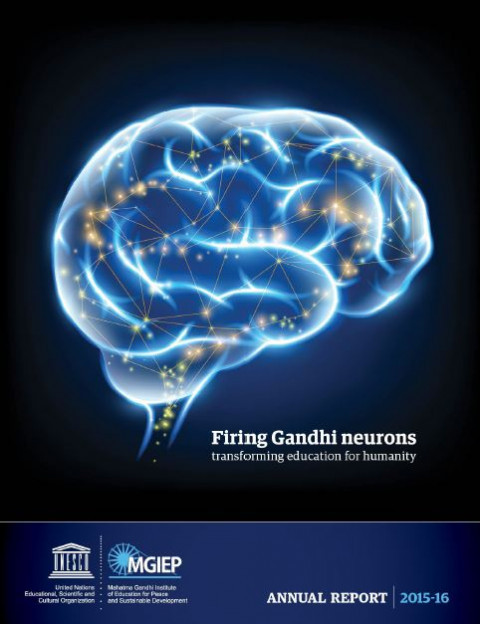 MGIEP Annual Report 2015-2016 Year of publication: 2017 Corporate author: Mahatma Gandhi Institute of Education for Peace and Sustainable Development (MGIEP) The Mahatma Gandhi Institute of Education for Peace and Sustainable Development (MGIEP) is UNESCO’s first Category I institute in the Asia-Pacific region, established with the generous support of the Government of India.UNESCO MGIEP focuses on transforming current education policies and practices by developing innovative teaching and learning methods. Their objective is to build generations of young people equipped to create peaceful and sustainable societies.This annual report describes MGIEP’s main works and various educational programmes for peace and sustainable development.
  Address by Irina Bokova, Director-General of UNESCO on the occasion of the Event on Education for Preventing Violent Extremism; Brussels, 21 March 2017 Year of publication: 2017 Corporate author: UNESCO. Director-General, 2009-2017 (Bokova, I.G.) This address was delivered by Irina Bokova, Director-General of UNESCO on the occasion of the Event on Education for Preventing Violent Extremism.
 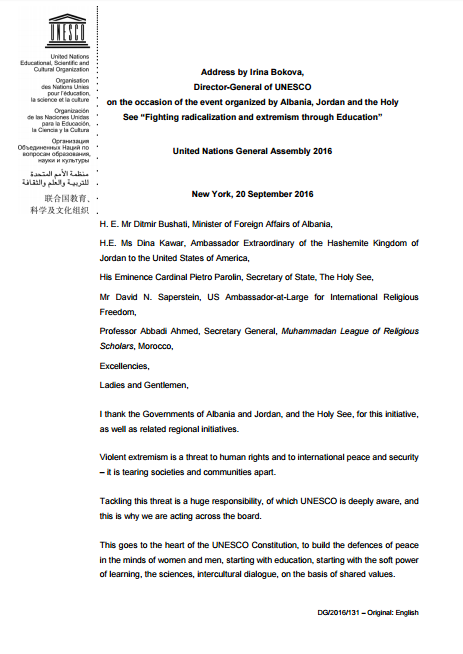 Address by Irina Bokova, Director-General of UNESCO, on the occasion of the event organized by Albania, Jordan and the Holy See: Fighting radicalization and extremism through Education; United Nations General Assembly 2016; New York, 20 September 2016 Year of publication: 2016 Corporate author: UNESCO. Director-General, 2009-2017 (Bokova, I.G.) This address was presented by Irina Bokova, Director-General of UNESCO, on the occasion of the event organized by Albania, Jordan and the Holy See.
 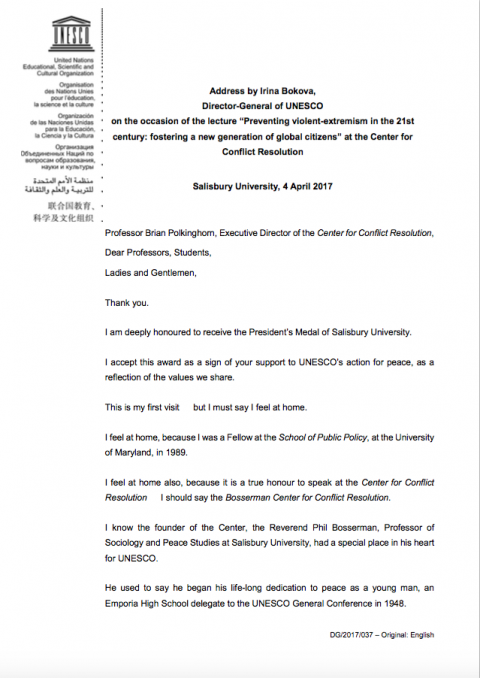 Address by Irina Bokova, Director-General of UNESCO, on the occasion of the lecture: Preventing violent-extremism in the 21st century: fostering a new generation of global citizens at the Center for Conflict Resolution; Salisbury University, 4 April 2017 Year of publication: 2017 Corporate author: UNESCO. Director-General, 2009-2017 (Bokova, I.G.) This address was given by Irina Bokova, Director-General of UNESCO on the occasion of the lecture “Preventing violent-extremism in the 21st century: fostering a new generation of global citizens” at the Center for Conflict Resolution.
  Address by Irina Bokova, Director-General of UNESCO, on the occasion of the Conference: Victims of ethnic and religious violence in the Middle East, Protecting and promoting plurality and diversity; Madrid, 24 May 2017 Year of publication: 2017 Corporate author: UNESCO. Director-General, 2009-2017 (Bokova, I.G.) This address was presented by Irina Bokova, Director-General of UNESCO, on the occasion of the Victims of Ethnic and Religious Violence conference in the Middle East for protecting and promoting plurality and diversity
  Discussing Terrorism: a pupil-inspired guide to UK counter-terrorism policy implementation in religious education classroom in England Year of publication: 2016 Author: Angela Quartermaine Corporate author: Christian Education | Taylor & Francis Religious education (RE) in England is affected by the challenging of terrorist ideologies and improving community cohesion, but many RE teachers feel ill-equipped in dealing with the issues that might arise from terrorism discussions. Therefore, I suggest that clarification could help alleviate some of the teacher’s concerns and help provide routes by which critical RE teaching and learning can take place.